
Sprinkler System Winterization in Northern Virginia: Timing, Methods, and What Goes Wrong
Sprinkler winterization in Northern Virginia means removing the water from your irrigation system before it can freeze, expand, and split the components it sits inside. In this region that work is normally scheduled from October into November, ahead of the first sustained hard freeze, and it is normally done with a compressed-air blowout rather than gravity draining alone.
The short answer: watch the forecast rather than the calendar. Book your blowout once nighttime lows begin flirting with the upper 20s and the ten-day outlook shows sustained sub-freezing nights, and book it earlier than you think you need to because contractor schedules compress into a few short weeks. Winterizing a couple of weeks early costs you almost nothing. Winterizing a week late can crack a backflow preventer, a valve manifold, or the mainline.
Lawn Theory works on irrigation across Fairfax, Loudoun, and Prince William counties, and fall shutdown is one of the few maintenance tasks where getting the date wrong has an immediate, expensive, physical consequence. Our irrigation and sprinkler system services cover shutdown, spring startup, and repairs, and shutdown timing is usually coordinated with the rest of a property’s lawn care and landscaping schedule so that seeding, leaf work, and irrigation do not fight each other.
Key Takeaways
- There is no fixed winterization date for Northern Virginia. Watch for a run of sub-freezing nights in the forecast and act before it arrives.
- The risk is lopsided: winterizing early costs a few weeks of fall watering you probably do not need. Winterizing late costs hardware.
- Compressed-air blowout is the regional standard because manual and automatic drains still leave water trapped in heads, valves, and low spots.
- Blowouts are genuinely dangerous. Eye protection is mandatory, and safe pressure limits vary by pipe material and manufacturer, so follow your equipment’s published limits rather than a number from a blog.
- The backflow preventer sits above ground, is the most freeze-exposed part of the system, and is usually the most expensive thing to replace.
- Backflow testing and certification rules are set by your local water authority, not by the state, so confirm requirements with your own provider.
- Set the controller to off or rain mode rather than unplugging it, so you keep your programming and keep the transformer protected.
- Fall seeding may still need irrigation into October, which is exactly why the shutdown date is a judgment call rather than a rule.
What Sprinkler Winterization Actually Does
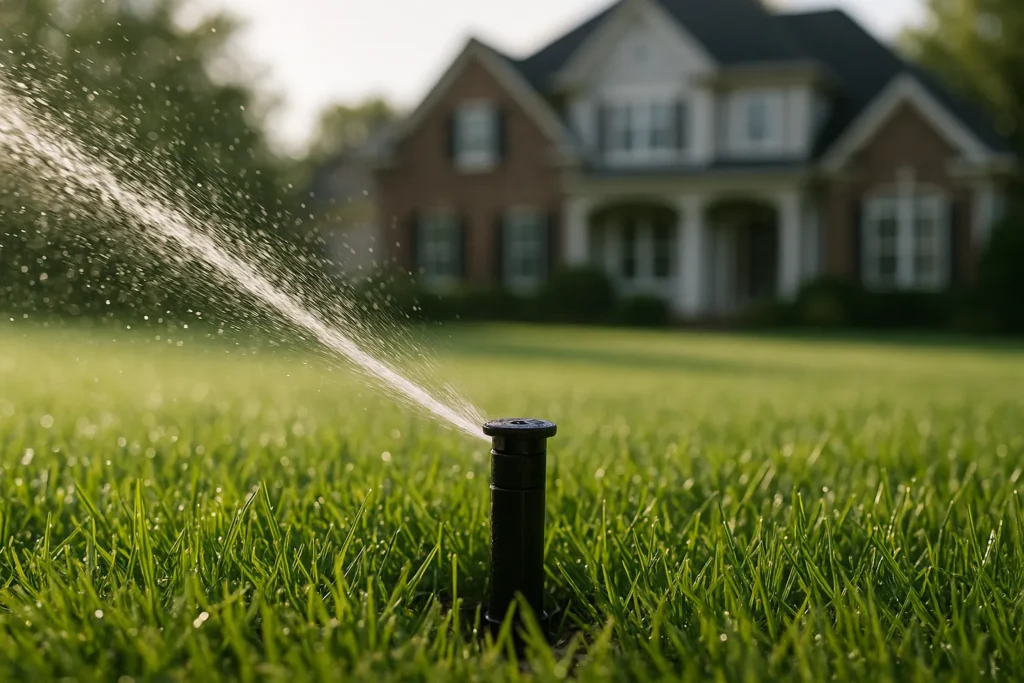
Water expands as it freezes. That single fact is the entire reason winterization exists. An irrigation system is a closed network of pipe, fittings, valves, and precision plastic components, and almost none of it is designed to survive the pressure that ice generates from the inside. When water in a lateral line freezes, it does not simply stop the system for a few months. It pushes outward until something gives, and what gives is usually a threaded fitting, a solvent-welded joint, a valve body, or the riser inside a pop-up head.
When to Winterize in Northern Virginia: The Timing Rule That Actually Works
The honest answer is that the scheduling conversation in Northern Virginia runs through October and into November, and the right date for your property depends on the weather that particular year, what your lawn is doing, and how quickly your contractor can get to you. Anyone who gives you a single guaranteed date is selling certainty that the climate does not provide.
Why a fixed calendar date does not work
What works better is a trigger condition rather than a date. Start watching the extended forecast in early October. When you see the first stretch of nights forecast to sit at or below freezing for several hours at a time, rather than a single brief dip near dawn, your system needs to be done before that stretch arrives. A light overnight touch of 31 degrees for an hour is not usually what breaks a system. A run of nights in the mid-20s is.
The risk asymmetry nobody explains
If you winterize too early, the cost is that you lose the ability to run the system for the last few weeks of fall. In most years that is close to a non-event. Fall in Northern Virginia brings shorter days, cooler soil, heavier dew, and more reliable rainfall. Established tall fescue needs far less supplemental water in late October than it did in August. If a dry spell shows up, you can drag a hose to the areas that need it. That is inconvenient, not expensive.
If you winterize too late, the cost is hardware. A split backflow assembly, a cracked valve body inside a manifold, a fractured mainline under a lawn you just renovated. Those repairs require excavation, parts, and labor, and the mainline repairs in particular can mean cutting into turf and beds. There is no version of “a bit late” that costs less than “a bit early.”
Fall seeding genuinely complicates the decision
This is the one legitimate reason to push the date later, and it is worth taking seriously. Northern Virginia is tall fescue country, and the productive seeding window here runs from the last week of August into mid-September, with acceptable results as late as mid-October according to Virginia Cooperative Extension guidance for lawns. New seedlings have shallow roots and dry out fast. If you seeded in late September, or if you did a full renovation, that young turf may still want frequent light irrigation well into October.
That creates a real tradeoff rather than a clean answer. Our guide to fall lawn renovation in Northern Virginia walks through how to sequence seeding so the irrigation demand tapers before shutdown season instead of colliding with it. In practice, seeding earlier in the window is the cleanest fix, because it lets the new stand establish while soil is still warm and gets your watering requirement down before the freeze conversation starts. If you are working with core aeration and overseeding or a full sod installation and lawn renovation, plan the shutdown date at the same time you plan the seeding date, not two months later.
If the seeding is late and the freeze is early, you shut down anyway and hand-water. Frozen pipe is not negotiable. Dry seedlings are recoverable.
Book early, because the calendar compresses
Booking in September for an October or early November appointment is not overcautious. It is how you get to choose your date instead of taking whatever is left. It also lets you bundle the visit with other fall work, which is more efficient for everyone. Many properties schedule shutdown alongside leaf removal and seasonal cleanup so the crew is on site once rather than three times.
The Three Sprinkler Winterization Methods, Compared Honestly
Manual drain
A manual-drain system has drain valves installed at the low points of each zone and at the end of each lateral. You shut off the water supply, open each valve by hand, and let gravity pull the water out. It is simple, it requires no equipment, and it is the method most accessible to a homeowner.
Automatic drain
Automatic drain valves open on their own when line pressure falls below a threshold, usually somewhere in the single digits of pressure. Shut off the supply, run a zone briefly to bleed pressure, and the drains do the rest. Nothing to find, nothing to open.
Compressed-air blowout
A blowout uses compressed air introduced downstream of the backflow assembly to physically push water out of the pipe and out through the heads, zone by zone. It is the regional standard in Northern Virginia, and there is a straightforward reason for that: it is the only method that clears water gravity cannot reach.
Gravity moves water downhill. It does not move water that is sitting in the body of a pop-up head above the lateral, in the diaphragm chamber of a solenoid valve, in a low spot where the trench dipped between two drain points, or in a run of drip tubing that meanders across a bed. Every one of those pockets holds water that will freeze. Blowout also clears the heads themselves, which gravity systems essentially never do.
Soil is the other reason blowout dominates here. Northern Virginia clay does not drain, so the trench a system sits in stays saturated, and pipe bedded in wet clay chills faster and holds cold longer. If your property already fights standing water in the yard, the ground around your valve boxes is exactly the environment that makes half-measures fail.
| Method | How it works | Suits which systems | Limitations | DIY feasibility |
|---|---|---|---|---|
| Manual drain | Supply is shut off, hand-operated drain valves at low points are opened, gravity empties the lines | Systems deliberately piped with consistent fall to documented drain points; small, simple, mostly flat layouts | Leaves water in heads, valve bodies, and any low spot between drains; requires knowing where every valve is; useless if the pipe does not actually slope | Reasonable for a confident homeowner with a system map and known drain locations |
| Automatic drain | Drain valves open by themselves once line pressure drops; a brief zone run bleeds pressure and triggers them | Systems specified with auto drains at installation, typically on gently graded lots | Same trapped-water problem as manual, plus the valves themselves clog, stick, or fail silently underground | Easy to perform, but you cannot verify it worked without digging |
| Compressed-air blowout | Air is introduced downstream of the backflow assembly and each zone is run until water stops discharging from the heads | Effectively every system design, including drip, multi-zone, sloped, and systems with no drain valves at all | Requires a compressor with adequate airflow, not just pressure; carries real injury and equipment-damage risk if done wrong | Not recommended for most homeowners; equipment and technique both matter |
Compressed-Air Blowout Safety: Read This Before You Rent a Compressor
This is the most important section in this article, and it is the section most irrigation content skips or handles carelessly. A compressed-air blowout is not a gentle procedure. It puts stored energy into a plastic pipe network and then releases it through small openings. People are injured doing this every fall, and systems are destroyed doing this every fall. Please read all of it before deciding to do your own.
Eye protection is mandatory, not optional
Wear ANSI-rated safety glasses or goggles the entire time the system is under air, including while you are walking the yard between zones. A blowout expels a violent mix of water, air, and whatever grit has accumulated in the lines over the season. Sand, sediment, and small pieces of debris exit heads at speed. Sunglasses are not eye protection. Prescription glasses are not eye protection.
Never stand over a head or an open valve box
Do not position your body above a sprinkler head while a zone is being blown out, and do not lean over an open valve box to watch. A pop-up riser under air can launch upward with force. A cap, a nozzle, a fitting, or a chunk of the head itself can become a projectile. Stay to the side, keep a distance, and keep children and pets indoors for the duration. If you need to see what a head is doing, look at it from an angle, not from directly above.
Why this article will not give you a PSI number
You will find blog posts that confidently publish a maximum blowout pressure. Do not trust them, including this one, and here is the reason: there is no single safe number.
Safe blowout pressure depends on what your pipe is made of. Flexible polyethylene and rigid PVC behave differently under air, and the accepted working limits for the two materials are not the same. It further depends on the specific components installed in your system, because sprinkler head manufacturers, valve manufacturers, and backflow manufacturers each publish their own limits for their own products, and those limits differ. It also depends on what condition your system is in, since aged fittings and previously stressed joints do not tolerate what new ones do.
Excessive pressure does not produce a gradual warning. It shatters fittings, blows nozzles out of heads, ruptures the seals inside valves, and sends the pieces outward at speed. A pipe network that has quietly worked for a decade can be destroyed in one zone cycle by someone who read a number online.
So the correct instruction is this: find the documentation for your own equipment, from your own manufacturers, and follow those published limits. If you cannot identify your components or cannot find their specifications, that is a strong signal to hire a professional rather than guess. A wrong number here is not a typo. It is broken equipment or an injury.
CFM matters more than PSI, and this is where homeowners get hurt
Here is the trap. A small pancake or hot-dog compressor from a home center is built to deliver high pressure at very low volume, which is what a nail gun wants. An irrigation zone wants the opposite: a large, sustained volume of air, measured in cubic feet per minute, to actually push a column of water through a hundred feet of pipe and out the heads.
When a homeowner connects a small compressor and sees the water barely trickle, the instinctive response is to crank the pressure up. That is precisely the wrong move, and it is the single most common path to a destroyed system. The compressor was never going to work. Compensating for inadequate airflow by increasing pressure converts a capacity problem into a safety problem.
Professional blowout rigs are towable or truck-mounted units chosen for airflow capacity, not for the pressure on the gauge. That equipment difference, more than technique, is why blowouts are usually left to contractors.
Running a zone dry destroys rotors
Gear-driven rotor heads rely on the water moving through them for lubrication and cooling of the internal gear train. Air provides neither. Once the water is out of a zone and the head is spinning on air alone, friction heat builds inside the gear case quickly, and the internals can be cooked in a surprisingly short time.
The discipline is to move on the moment a zone stops discharging water and is producing only a fine mist or dry air. Do not let it run because it looks satisfying. Do not run one long pass to be thorough. Several short cycles with the air off in between is gentler than one continuous blast, because it gives water in low spots time to migrate back toward the heads where the next pass can clear it. Leaving a zone running dry is how a homeowner turns a shutdown into a head replacement bill.
Finally, never leave a system pressurized and unattended, and always relieve air pressure before disconnecting anything. If any part of this section made you uneasy, that is the correct reaction, and talking to an irrigation professional is the sensible next step.

The Backflow Preventer: The Most Expensive Freeze Failure
If you remember one component from this article, make it this one. The backflow preventer is simultaneously the most expensive thing on your system to replace, the most exposed to freezing, and the part homeowners are least likely to think about.
What it is and why it exists
A backflow preventer is a mechanical assembly that stops water in your irrigation system from flowing backward into the drinking water supply. That reversal can happen when pressure in the public main drops, for example during a main break or heavy fire-department draw, creating suction that pulls water back through the connection.
What is sitting in your irrigation pipe is not drinking water. It has been in contact with soil, and on many properties with fertilizer, weed control products, and pet waste. Keeping that out of the potable supply is why the device is required, and it is why water authorities regulate it rather than leaving it to the homeowner’s discretion. The backflow preventer is a public health device that happens to live in your yard.
Why it is the most freeze-exposed part of the system
Most residential backflow assemblies are installed above ground, typically near the house or at the property line, in a brass or bronze body with test cocks, shutoff valves, and internal check assemblies. It has to be above ground and accessible so it can be inspected and tested.
That accessibility is exactly what makes it vulnerable. Every other component of your system has soil above it acting as insulation. The backflow assembly has air. It sits fully in the coldest ambient temperature the night produces, it is made of metal that conducts heat away efficiently, and it contains chambers that trap water in shapes that do not drain. When it freezes, the brass body can crack, the internal checks can be destroyed, and the assembly typically has to be replaced rather than repaired.
Insulation is a stopgap, not a substitute
Insulated covers, wraps, and pouches for backflow assemblies are widely sold and genuinely useful, but they are frequently misunderstood. Insulation does not generate heat. It slows the rate at which the assembly loses whatever warmth it has. That buys real protection against a brief overnight dip, which is why a cover is a smart precaution during an unexpected early cold snap while you wait for your appointment.
It does not protect a water-filled assembly through a Northern Virginia winter. Given enough hours below freezing, an insulated assembly full of water reaches the same temperature as an uninsulated one and fails the same way. Insulation is a bridge to winterization, not a replacement for it. Use it as emergency cover, then get the water out.
Testing and certification: ask your own water authority
Backflow prevention assemblies are commonly subject to periodic testing and certification requirements, and those requirements are imposed at the local water authority level. That is the part homeowners get wrong. There is no single Northern Virginia rule to look up.
Fairfax Water, Loudoun Water, Prince William County Service Authority, and the utilities serving Arlington and Alexandria each set their own policies on which assemblies must be tested, how often, who is qualified to test them, and how results must be submitted. Some properties are also served by smaller systems or by a town utility with different rules again. Do not assume your neighbor’s requirement is your requirement, and do not assume a contractor in a different county knows your provider’s process.
Contact your own water provider directly and confirm what applies to your address and your device type. That five-minute call is worth more than any general article, including this one. If you are unsure which authority serves you, your water bill will tell you, and our Fairfax County service page, Loudoun County service page, and Prince William County service page outline how we work in each jurisdiction.
Component-by-Component Freeze Risk
| Component | Freeze risk | Winterization step | What failure looks like in spring |
|---|---|---|---|
| Backflow preventer | Highest. Above ground, metal bodied, fully exposed to air temperature, with chambers that trap water | Isolate, drain through the test cocks and bleed points, leave shutoffs at a partial angle so no chamber is sealed full, and insulate as a secondary measure | Continuous leaking or spraying at startup, a visible crack in the body, or failure to hold during a certification test |
| Valve manifold | High. Solenoid valves have diaphragm chambers that hold water, and valve boxes in clay sit in saturated soil | Cleared by blowout air passing through each valve; confirm every zone was actually run, including any zone you rarely use | A zone that will not open, a zone that will not shut off, or water seeping into the valve box while the system is pressurized |
| Rotors and spray heads | Moderate. Each riser body holds a small volume of water that gravity draining cannot remove | Blow out until the head produces only mist or dry air, then stop immediately to protect the gear drive | Heads that will not retract, cracked riser bodies, wobbling or non-rotating rotors, or nozzles missing entirely |
| Drip zone | Moderate to high, and routinely forgotten. Tubing meanders with no reliable low point, and filters and pressure regulators hold water | Treat as its own zone at appropriate low pressure; drain the filter bowl and pressure regulator separately | Blown emitters, split tubing found only when a bed stays dry, or a cracked filter housing |
| Mainline | Moderate but the most costly to repair, since it stays pressurized year-round unless properly isolated | Close the irrigation supply valve fully, then relieve pressure downstream of it | Unexplained water use, a soft or persistently wet strip of lawn, or pressure that will not build at startup |
| Controller and wiring | Low freeze risk, but exposed to moisture, rodents, and power events over the winter | Set to off or rain mode rather than unplugging; photograph the programming; check that outdoor enclosures are sealed | Lost programming, a zone that never energizes, or a dead transformer with no output |
The Complete Shutdown Sequence
Order matters. Doing these steps out of sequence is how people end up blowing air against a closed valve or draining a line that is still under supply pressure.
- Shut off the irrigation supply valve. This is the dedicated valve isolating the irrigation line from the house supply, usually in a basement, crawl space, utility room, or a meter pit. Close it fully. If you have never located it, find it now, in daylight, before you need it in an emergency.
- Set the controller to off or rain mode. Do this before anything else happens to the water, so the system cannot start a scheduled cycle partway through your work.
- Relieve the pressure. With the supply closed, run one zone briefly, or open a drain or bleed point, so the system is no longer holding pressure. Everything downstream should be at atmospheric pressure before you go further.
- Drain or blow out zone by zone, nearest to farthest. Start with the zone closest to the point of connection and work outward. Working outward pushes water progressively toward the far end of the system rather than repeatedly recontaminating zones you have already cleared. Use short passes and stop each zone the moment it runs dry.
- Address the backflow assembly. Open the test cocks and any bleed points to drain the internal chambers, and leave the shutoff valves at a partial angle rather than fully open or fully closed, so no cavity is sealed with water inside it. Follow your specific assembly’s documented procedure, since designs differ.
- Insulate what remains exposed. Cover the backflow assembly and any above-ground piping. Treat this as a supplement to a proper shutdown, never as the shutdown itself.
- Document everything for spring. Photograph the controller screen for each program, note run times and start times, and write down which zone number covers which part of the property. Then take a photo of the whole controller face and the valve box locations. Spring startup is dramatically easier when you are not reconstructing settings from memory six months later.
Why “off” beats unplugging the controller
Homeowners often yank the controller’s plug in November, reasoning that a system with no water does not need a timer. There are two good reasons not to.
The first is your programming. Many controllers hold settings in nonvolatile memory indefinitely, but plenty rely on a backup battery or capacitor that will not survive five months unpowered. Come April you may find your zone run times, start times, and seasonal adjustments gone, and rebuilding them from scratch is tedious and error-prone.
The second is the transformer. Repeatedly unplugging and replugging a low-voltage transformer, especially plugging it back in during a spring storm season, is harder on it than leaving it energized in a no-output state. Leaving the controller powered but set to off keeps the electronics in a stable, known condition, and modern controllers in off or rain mode draw a trivial amount of power. Some models also continue tracking the date and running diagnostics, which is genuinely useful come startup.
Northern Virginia Conditions That Change the Math
Generic irrigation advice is written for a climate that does not exist here. Several local conditions meaningfully change how a system fails and how it should be shut down.
Freeze-thaw cycling, not one deep freeze
Northern Virginia does not deliver a single freeze that locks the ground until spring. It delivers dozens of cycles: nights in the 20s followed by afternoons in the 50s, repeated from November through March. That pattern is harder on shallow components than a steady deep freeze would be.
Every cycle expands and contracts the water and soil around a component, working joints loose, fatiguing seals, and heaving fittings out of alignment. A pipe that tolerates one freeze can fail on the fifteenth. It also means warm December and February stretches tempt homeowners into reopening a system for a hose bib or a car wash, which is a common way to reintroduce water into a line that freezes the following week.
Clay soil holds water around valve boxes
The heavy clay across much of the region does not drain, and valve boxes are effectively small basins set into it. Water collects inside the box and in the soil surrounding it, and stays there. A valve sitting in saturated clay is in far worse thermal company than a valve in well-drained soil, because wet soil conducts cold downward more readily than dry soil and stays cold longer once chilled.
This is also why properties with existing grading problems have more irrigation failures. If a valve box sits in a low spot that ponds after every storm, it is worth solving the water problem rather than replacing valves every few years. Our drainage solutions and grading work frequently ends up protecting irrigation hardware as a side benefit.
Frost heave moves your heads
Clay swells when it takes on water and moves again as it freezes and thaws. Over a winter of cycling, that movement pushes sprinkler heads up, tilts them off vertical, and shifts them relative to the lateral they are attached to. A head that was flush and plumb in October is often proud of the soil and leaning by April.
The consequences are practical. A raised head gets clipped by a mower deck, which is an avoidable expense on any property with a regular lawn mowing and maintenance schedule. A tilted head throws its arc into a bed, a driveway, or a fence instead of the turf it was aimed at, and the resulting dry wedge is a frequent hidden cause of the patchy decline described in our article on why lawns turn brown in Northern Virginia. Head realignment belongs on the spring checklist for that reason.
Sloped lots drain unevenly
Much of Loudoun and the western reaches of Fairfax sit on rolling terrain, and larger lots there often carry systems with long runs crossing significant grade. That geometry produces a specific failure pattern: the high zones drain readily and the low zones do not, because every downhill run terminates in a pocket that collects whatever the rest of the system released.
Homeowners with drain valves on sloped lots often report that shutdown “went fine” because they watched water pour out, when in fact they were watching the upper zones empty into the lower ones. The low-elevation heads on those systems are the ones that split. Blowout is close to mandatory on this terrain, and the zones at the bottom of the grade deserve extra passes. Properties in Leesburg and around Great Falls commonly fall into this category, as do the larger parcels we service throughout Ashburn.
Irrigation season overlaps seeding season
This is the scheduling conflict unique to cool-season regions. The best time to establish tall fescue and the beginning of freeze risk are only weeks apart. Extension guidance on fall lawn care in Virginia puts the productive fall management window squarely in the same months you are thinking about shutdown.
Practically, that means fall is crowded. Seeding, late-season fertilization and weed control, fall planting of trees and shrubs, leaf work, and irrigation shutdown all compete for the same eight weeks. Newly planted trees and shrubs in particular still need watering after your sprinklers are down, which is a job for a hose and a slow soak rather than a reason to delay winterization. Sequencing all of this deliberately is the difference between a smooth fall and a scramble, and the lawn calendar generator is a quick way to lay the tasks out against each other.
HOA and common-area systems
If you live in a managed community, confirm in writing who winterizes what before October. The failure mode here is not technical, it is administrative: a zone nobody believed was theirs is a zone nobody blew out. Associations should also confirm that whoever handles their common areas is coordinating with the water authority on backflow testing for shared assemblies, which are often larger devices with stricter requirements than residential ones.
Drip Zones and Low-Flow Zones Get Forgotten
Drip assemblies also carry components no spray zone has: an inline filter with a bowl that holds water, and a pressure regulator that steps supply pressure down to the low pressure emitters need. Both trap water. Both crack. And because drip zones operate at low pressure by design, they cannot be blown out the same way a rotor zone can without risking damage to emitters and tubing.
Treat every drip zone as its own task. Drain the filter bowl and the regulator separately, clear the tubing at appropriate low pressure, and confirm the zone is actually included in whatever service you booked. The same applies to any other low-flow or specialty zone: bubblers around foundation plantings, a zone serving a vegetable garden, a micro-spray zone in a shade bed, or a hose-bib-fed line someone added later. Beds served by drip are often the same beds handled under tree and shrub care, so it is worth flagging them when you book.

What Sprinkler Winterization Costs: The Real Drivers
We do not publish dollar figures in articles, because a number written in August is misleading by November and misleading across a region this varied. What is useful is understanding what actually moves the price, so you can read a quote intelligently.
- Zone count. The dominant driver. Every zone must be cycled individually, sometimes more than once, so a twelve-zone property takes materially longer than a four-zone one. Most pricing is built around this.
- System size and layout. Long runs, large turf areas, and multiple valve manifolds spread across a property add both air volume and walking time.
- Backflow assembly type. Different device types have different draining procedures, and larger or more complex assemblies take longer. If testing or certification is being handled at the same visit, that is separate work.
- Access. Buried valve boxes, an unlocatable supply shutoff, a backflow assembly behind mature plantings, or a controller in a locked garage all add time. Undocumented systems inherited with a house are the most common source of unexpected labor.
- Specialty zones. Drip, bubblers, and low-flow zones need separate handling rather than being lumped into the standard cycle.
- Whether spring startup is bundled. Many providers price shutdown and startup together as a season package, which usually compares favorably to booking each separately and guarantees you a spring slot.
- Repairs found during the visit. Broken heads and leaking valves are often discovered during shutdown. Fixing them then is usually cheaper than in spring, when everyone wants service at once.
Worth framing against the other side of the ledger: an efficient, well-maintained system uses less water every season it runs. Our sprinkler savings calculator gives you a sense of what efficiency is worth on your property, and bundled maintenance is generally handled through our service packages rather than as one-off visits.
Sprinkler Winterization: Professional vs. DIY
A capable homeowner with a small, well-documented manual-drain system can reasonably winterize it themselves. Shutting a supply valve, setting a controller to off, opening known drain valves, and draining a backflow assembly per its own instructions are all within reach if you know where the components are and what your assembly’s procedure says. Add an insulated cover and you have done real work.
Blowouts are a different proposition, and the deciding factor is equipment rather than skill. Delivering enough sustained airflow to clear a multi-zone residential system requires a compressor most homeowners will not rent correctly, and the common substitution of pressure for airflow is how systems get destroyed and people get hurt. Add a large property, a sloped lot, drip zones, or a system you inherited without documentation, and the calculus tips decisively. That is the situation on most of the properties we service in Vienna and McLean, and across Ashburn.
There is a second, quieter argument for professional service: a technician walking your system in October finds the broken head, the weeping valve, and the misaligned rotor before winter, not in May when the repair queue is six weeks deep. You can read more about how we work on our about page.

Common Sprinkler Winterization Mistakes
- Relying on auto-drains alone. They clog and stick silently underground, and even working perfectly they cannot clear heads, valve bodies, or low spots.
- Forgetting the backflow preventer. The most expensive component, sitting fully exposed to air temperature, is also the one homeowners most often skip.
- Leaving a hose connected to a hose bib. A connected hose traps water against the spigot and the pipe behind it. Disconnect and drain every hose, and shut off and drain any interior valve serving an outdoor bib.
- Blowing out at too high a pressure. Usually a compensation for a compressor that cannot supply enough air. It shatters fittings and turns parts into projectiles.
- Running zones dry for too long. Gear-driven rotors are cooled and lubricated by water. On air alone they overheat quickly.
- Missing a drip or low-flow zone. Filters and pressure regulators hold water, and drip needs its own low-pressure treatment rather than the standard cycle.
- Not recording controller programming. Photograph every program screen before shutdown. Reconstructing run times in April wastes an afternoon and usually produces worse settings than you had.
- Reopening the system during a warm winter week. Freeze-thaw cycling means the next hard night may be days away.
Spring Startup: A Short Preview
Startup deserves its own article, but knowing what is coming shapes how you shut down. The single most important habit is slow re-pressurization: open the supply valve gradually so the system fills without a pressure surge. Charging a dry system quickly produces water hammer, and water hammer breaks fittings that survived the winter untouched.
After that, walk each zone looking for winter damage, reset heads that frost heave pushed up or tilted, and run a catch-cup audit to confirm the system is applying water evenly rather than drowning one corner and starving another. Startup is also the right moment to reload the programming you photographed in the fall. Our guide to early spring lawn success covers how irrigation startup fits the wider spring sequence, and there is more seasonal reading on our blog.
Frequently Asked Questions
When should I winterize my sprinkler system in Northern Virginia?
Before the first sustained hard freeze, which in practice means scheduling through October and into November. Rather than picking a date, watch the extended forecast and act before the first stretch of nights that sit below freezing for several hours. Book the appointment weeks ahead, because contractor calendars fill as soon as cold weather appears.
What PSI should I use to blow out my sprinkler system?
There is no universally safe number, and any article that gives you one is guessing on your behalf. Safe pressure depends on your pipe material, since polyethylene and PVC differ, and on the published limits of your specific head, valve, and backflow manufacturers. Follow your equipment’s own documentation, or hire a professional.
Can I use my shop compressor for a blowout?
Almost certainly not. Pancake and hot-dog compressors are built for high pressure at very low airflow, and an irrigation zone needs the opposite. When the water barely moves, the instinct is to raise pressure, and that is the most common way homeowners destroy a system. The equipment gap is the real barrier.
Is winterizing too early a problem?
Rarely. You give up the ability to run the system for the last few weeks of fall, when cooler temperatures, shorter days, and heavier dew have already cut water demand sharply. If a dry spell arrives you can hand-water. Compare that with excavating a cracked mainline and the choice makes itself.
Do I still need a blowout if I have automatic drain valves?
In this region, usually yes. Auto drains only address water that gravity can reach, leaving the volume inside pop-up heads, inside valve diaphragm chambers, and in any low spot between drains. They also fail silently underground, and you have no way to confirm they opened without digging.
Will an insulated cover protect my backflow preventer?
Only temporarily. Insulation slows heat loss, it does not add heat, so it buys you protection through an unexpected overnight dip while you wait for your appointment. Given enough hours below freezing, a water-filled assembly under a cover reaches the same temperature as one without. Treat it as a bridge, not a solution.
Does my backflow preventer need to be tested every year?
That depends entirely on your water provider. Testing and certification requirements are set locally, and Fairfax Water, Loudoun Water, Prince William County Service Authority, and the Arlington and Alexandria utilities each publish their own rules on frequency, device type, and who may test. Contact your own provider and confirm what applies to your address.
Should I unplug my irrigation controller for the winter?
No. Set it to off or rain mode instead. Many controllers rely on a backup battery or capacitor that will not survive five months unpowered, so you risk losing your programming. Leaving it energized in a no-output state is also easier on the low-voltage transformer than repeated unplugging and replugging.
I seeded in late September and the lawn still needs water. What do I do?
Irrigate as long as the forecast safely allows, then shut down and switch to hand-watering the newly seeded areas. Frozen pipe is not negotiable; thirsty seedlings are recoverable. The better long-term fix is seeding earlier in the fall window so establishment finishes before the freeze conversation begins.
Can I water the lawn at all once the system is winterized?
Yes, with a hose during a mild spell, and occasionally that is worthwhile for new plantings or during a dry, windy winter. We cover when it helps and when it does not in can you water your lawn in winter. Always disconnect and drain the hose afterward.
Book the Blowout Before the Forecast Turns
Irrigation shutdown is one of the few pieces of fall maintenance with a hard deadline set by the weather rather than by preference. The homeowners who get it done comfortably are the ones who booked in September and treated it as part of the season’s work, alongside leaf removal and seasonal cleanup and the rest of the winter lawn care routine in Northern Virginia. The ones who scramble are the ones who waited for the cold.
If you would rather not stand over a pressurized system with a rented compressor, that is a reasonable conclusion to reach. Get in touch with Lawn Theory to schedule your shutdown, ask about bundling spring startup, or have someone walk an inherited system with you so you finally know where every zone and valve actually is.
Keep Reading: Lawn Care
 Lawn Care
 Fall Planting in Northern Virginia: Trees, Shrubs, and Mulch Done Right
Fall is the best time to plant trees and shrubs in Northern Virginia, but most failures trace to the first twenty minutes…
 Lawn Care
 The Fall Lawn Renovation Calendar for Northern Virginia: Dates, Seeding Rates, and Soil Temperature
Virginia Cooperative Extension puts the Northern Virginia seeding window at the last week of August through mid-September. Here are the exact dates,…
 Lawn Care
 Clay Soil and the $10 Soil Test Every Northern Virginia Lawn Needs
Most Northern Virginia lawns struggle from builder compaction, not clay itself. Here is how the $10 Virginia Tech soil test works, how…
Want this handled by the crew that wrote the guide?
Veteran-owned. Licensed & insured. Free walkthroughs across Northern Virginia — quotes in 24–48 hours.
Get Your Free Estimate