
Clay Soil and the $10 Soil Test Every Northern Virginia Lawn Needs
The short answer: Test before you treat. The Virginia Tech routine package costs $10.00 per sample in-state and returns pH, phosphorus, potassium, calcium, magnesium, micronutrients, estimated CEC, and specific lime and fertilizer recommendations, usually within three working days of receipt. Then fix structure with fall core aeration and compost topdressing. Soil texture you cannot change. Soil structure you can.
Lawn Theory works these soils every week across Fairfax, Loudoun, and Prince William counties, and the pattern is predictable: lawns that stall rarely have a seed problem or a fertilizer problem. They have a root zone problem. Our lawn fertilization and weed control program and our core aeration and overseeding service both start from what the soil is doing, not from a calendar template.
Key Takeaways
- Texture (the ratio of sand, silt, and clay) is fixed. Structure (how particles clump into aggregates with air space between them) is what you can actually improve.
- A well-structured clay soil drains acceptably and roots deeply. A compacted clay soil of identical texture does neither. They need different fixes.
- On most subdivisions built from the 1980s through the 2000s, topsoil was scraped for grading and equipment ran over the subsoil. Your turf roots in that subsoil.
- The Virginia Tech routine test is $10.00 per sample in-state, covering pH, P, K, Ca, Mg, Zn, Mn, Cu, Fe, B, estimated CEC, plus lime and fertilizer recommendations. Reports are emailed, usually within three working days of receipt.
- Your local Virginia Cooperative Extension office supplies free sample boxes and often loans soil probes.
- Test every three to four years, and at least a month before establishing or renovating so there is time to act on the lime recommendation.
- Core aeration relieves compaction but does not convert clay to loam. Compost topdressing on top of aeration builds structure, over several seasons.
- Never add sand to a clay lawn, and never lime without a test.
Why Northern Virginia Clay Soil Behaves the Way It Does
Every lawn company in the region opens with the same sentence: we have heavy clay soil here. Almost nobody explains what that means physically, and the explanation is the entire reason certain fixes work and others waste money.
Fine particles, small pores, slow water
Clay particles are extremely small and plate-shaped, so a handful of clay carries vastly more particle surface area than the same handful of sand. That surface is where water and nutrients cling, which is why clay soils hold a lot of both. It is a genuine advantage in a Northern Virginia July.
The trade-off is pore size. Soil drains and breathes through macropores, the larger channels between aggregates. Clay is naturally short on them, and the small pores it does have hold water tightly rather than moving it. Water enters slowly, moves down slowly, and once the profile saturates there is almost no air left. Roots need oxygen, so a root zone that stays waterlogged after every storm stops growing downward. That is why so many local lawns run a shallow, easily stressed root system. Extension’s primer on soil and soil water relationships covers the underlying mechanics.
Well-structured clay versus compacted clay
In undisturbed clay, particles bind into crumbs and blocks called aggregates. Roots, fungal threads, earthworms, decaying organic matter, and our freeze-thaw winters all build and maintain them, and the macropores between aggregates carry air and drain water. A well-aggregated clay loam is a productive soil. Dig a spade wedge in an old, never-graded corner of a Great Falls or Vienna property and you will often find exactly that: dark, crumbly soil that breaks apart in your hand.
Compaction destroys that architecture. Load from equipment, vehicles, or repeated foot traffic crushes the aggregates and collapses the macropores. The mineral texture has not changed at all, but bulk density rises and the remaining pore space is the small, water-holding kind. The result is soil that is simultaneously too wet and starved of air, resists root penetration, and sheds water instead of taking it in. Same clay content, completely different lawn. Put plainly: texture is a fact about your property; structure is a management outcome.
The builder-scraped topsoil problem
Here is the part homeowners are never told. On a typical lot developed between roughly 1980 and the mid-2000s, topsoil was stripped so the site could be graded to drainage and foundation specs. Excavators, dump trucks, and lifts then worked the exposed subsoil for months, often in wet conditions. Near the end, a thin veneer of screened topsoil went back down and sod or seed followed.
So your turf’s functional root zone is not native topsoil. It is a couple of inches of imported material over a compacted subsoil pan. That pan is why the lawn looks fine in April and collapses in July, why a screwdriver stops dead three inches down, and why fertilizer that works on a 1950s lot in Arlington does nothing on a 1998 lot in Ashburn. It is also why the Northern Virginia Soil and Water Conservation District’s guidance on wet yards names compacted soils alongside high clay content and shallow bedrock as causes of perched water sitting above the true water table.
Newer construction is not exempt. Any lot that has had an addition, a pool, a shed pad, or a hardscape install has had equipment on it. We see the same signature on recent builds in Loudoun County, where larger lots simply mean more room for a staging area that is now the worst grass on the property.
The $10 Virginia Tech Soil Test, Walked Through End to End
There is no cheaper high-value purchase in lawn care. The Virginia Tech Soil Testing Laboratory charges $10.00 per sample for the routine package for in-state residents, published on its fees and forms page. Fairfax County’s soil and water conservation district independently confirms the same fee in its fall lawn care guidance.
What the routine package measures
- Soil pH
- Phosphorus and potassium
- Calcium and magnesium
- Micronutrients: zinc, manganese, copper, iron, and boron
- Estimated cation exchange capacity (CEC)
- Fertilizer and lime recommendations for the crop you declare
Turnaround is usually within three working days of the lab receiving your sample, and the report is emailed. A sample mailed in early August can put lime on the ground well before a September renovation.
Where to get a box and a probe
Your local Virginia Cooperative Extension office supplies sample boxes free and frequently loans soil probes to residents. Find yours through the VCE office directory. Keep two publications open while you work: VCE 452-129, soil sampling for residential areas, which gives the procedure and sampling depth, and VCE 452-125, the submission form.
How to take a proper composite sample
A soil test is only as good as the sample. One core tells you about one spot. What you want is a composite: many cores from across a management area, blended into one representative sample.
- Define your sampling areas. Areas differing in history, sun exposure, or performance get sampled separately. A regraded front lawn, a shaded back lawn, and a strip that has never grown grass are three soils. Each is its own $10 fee, so two or three areas covers most properties.
- Collect a box and borrow a probe from your Extension office. A probe gives a cleaner, uniform-depth core than a spade.
- Pull 10 to 20 cores per area, walking a zigzag or W-shaped path so you cover the whole area rather than one side of it.
- Use one consistent depth, following the depth VCE 452-129 specifies for turf. Turf chemistry concentrates near the surface, and a core pulled too deep dilutes the result with subsoil your grass never touches.
- Skip contaminated spots. Stay several feet from driveways, walks, patios, and foundations, where lime leaching out of concrete skews pH upward. Avoid burn piles, brush piles, compost heaps, fertilizer or lime spill sites, and any area a dog uses consistently.
- Collect into a clean plastic bucket, never galvanized or bare metal, which can contaminate micronutrient readings such as zinc.
- Strip off thatch and turf, then break up and mix the cores thoroughly, removing stones, roots, and debris. You want a homogeneous blend, not a bucket of intact plugs.
- Fill the box to its line. If the soil is wet, air-dry it at room temperature. Never use an oven or heat gun; heating alters the chemistry you paid to measure.
- Complete VCE 452-125 carefully. The crop or use code drives the recommendations, so declare lawn or turf, not garden. Include your email so the report comes back electronically.
- Label, package, and mail. Note on your own copy which box is which area, because in three days you will not remember.
How often to test, and when
VCE 430-011 advises testing every three to four years. VCE 430-520 recommends at least every three years and notes fall as an ideal time. Extension also advises testing at least a month before establishing or renovating, and that lead time is the point. Lime is slow. Learning in mid-September that you needed lime in August costs you a year. If you want a fast read on your lawn while results are in transit, our lawn grade quiz scores the visible symptoms.
How to Actually Read the Report
Most homeowners open the PDF, look at pH, and close it. The report is far more useful than that. Extension publishes SPES-384 specifically to help interpret results. Work through it in this order.
pH and the lime recommendation
Piedmont soils commonly test acidic, a product of high rainfall leaching basic cations down out of the profile over long periods. Acidity matters because it governs nutrient availability: at low pH some nutrients lock up chemically while others become more soluble than you want. You can apply a perfectly correct fertilizer rate to an acidic soil and get a mediocre response, because availability rather than quantity is the limiting factor.
The important move is to stop chasing the pH number and read the lime recommendation instead. The lab does the interpretation for you, converting your measured pH, your soil’s buffering behavior, and your declared crop into a rate in pounds per 1,000 square feet. That rate, not the raw pH, is the actionable output. Two lawns with identical pH can carry very different lime recommendations because they resist pH change differently.
Estimated CEC, the line nobody uses
Cation exchange capacity measures how many positively charged nutrient ions, such as calcium, magnesium, potassium, and ammonium, your soil can hold on particle surfaces and release to roots. Clay particles and organic matter both carry negative charges, so both raise CEC.
A higher CEC, common on Northern Virginia clay, means a good nutrient reservoir: nutrients resist leaching, and you do not need tiny frequent doses. The same property cuts the other way with pH, because a well-buffered soil takes more lime to move and moves slowly. A lower CEC, which shows up where builders spread a thin sandy screened topsoil, means the opposite: faster leaching, more responsive pH, lighter and more frequent inputs. Once you know your CEC, both recommendations stop looking arbitrary.
Phosphorus: the line that saves you money
Plenty of established Northern Virginia lawns test sufficient or high in phosphorus after years of complete fertilizer applied without a test. If your report says phosphorus is sufficient, buying a starter fertilizer for fall overseeding is buying a nutrient you already have in surplus, for no agronomic response. It is also an environmental issue here, since excess phosphorus leaving a property in runoff ends up in the Chesapeake Bay watershed. This is why our fertilization planning starts with soil data, and it pairs with the reasoning in our guide to how often to fertilize a lawn.
Potassium, calcium, magnesium, micronutrients
Potassium supports stress tolerance, which on tall fescue in a Northern Virginia summer is not a small thing. Calcium and magnesium mostly tell you which lime to buy: dolomitic lime supplies magnesium as well as calcium, calcitic supplies calcium. If magnesium is already adequate, there is no reason to pay for dolomitic. The micronutrient panel is rarely the limiting factor in home turf, but it lets you rule those out instead of guessing.
Turning a lime recommendation into bags
- Measure the turf area you are treating in square feet. Not the lot size, the lawn.
- Divide by 1,000 to get your treatment units.
- Multiply by the recommended pounds per 1,000 square feet for your total pounds of lime.
- Divide by the bag weight of the product you are buying and round up.
- If the total needs splitting across applications, divide again and set the spreader for the per-application rate, not the annual total.
As an illustration with invented round numbers: a recommendation of 50 pounds per 1,000 square feet on a 6,000 square foot lawn is 300 pounds total, or seven and a half 40-pound bags, split into two 150-pound applications. Use your own report’s numbers, not these.
Pelletized versus pulverized, and why lime is split
Pelletized lime is finely ground limestone bound into pellets so it flows cleanly through a rotary spreader without dust. Pulverized or agricultural lime is the same chemistry in loose powder, cheaper by weight but genuinely difficult to spread evenly on a residential lawn. The pellet is a delivery format, not a faster material. Once moisture breaks it down, you have the same ground limestone doing the same work.
Large recommendations get split because heavy single applications are hard to spread accurately, and more importantly because lime is not mobile. It reacts where it lands and migrates downward through the profile over months, which is why a pH correction is measured in seasons rather than weeks. That is also why liming and core aeration pair so well: aeration holes give surface-applied lime a shortcut into the root zone.
| Report line | What it is telling you | What to do about it |
|---|---|---|
| pH below the recommended range for turf | Nutrient availability is suppressed no matter how much fertilizer you apply | Follow the printed lime rate, split it if large, apply late summer and again at fall aeration |
| pH in range, no lime recommended | Acidity is not your limiting factor | Skip lime this cycle; spend the money on aeration and compost instead |
| Estimated CEC on the higher end | Clay-rich, well-buffered soil with good holding capacity | Expect lime to work slowly; feed in fewer, well-timed applications |
| Estimated CEC on the lower end | Thin or sandy imported topsoil with limited holding capacity | Build organic matter aggressively; expect faster leaching and more responsive pH |
| Phosphorus sufficient or high | More P than the turf can use | Stop buying starter and complete fertilizers; choose nitrogen and potassium |
| Phosphorus low | A genuine deficiency, most common on stripped new-construction lots | Apply at the recommended rate, ideally at seeding or renovation |
| Potassium low | Reduced drought and heat tolerance heading into summer | Correct at the recommended rate as part of the fall feeding sequence |
| Magnesium low with lime also recommended | Two corrections available from one product | Choose dolomitic lime; if magnesium is adequate, calcitic is fine |
| Micronutrients all in range | Not your problem | Look at compaction, drainage, shade, mowing height, and disease instead |
Diagnosing Clay Soil Compaction Without Any Equipment
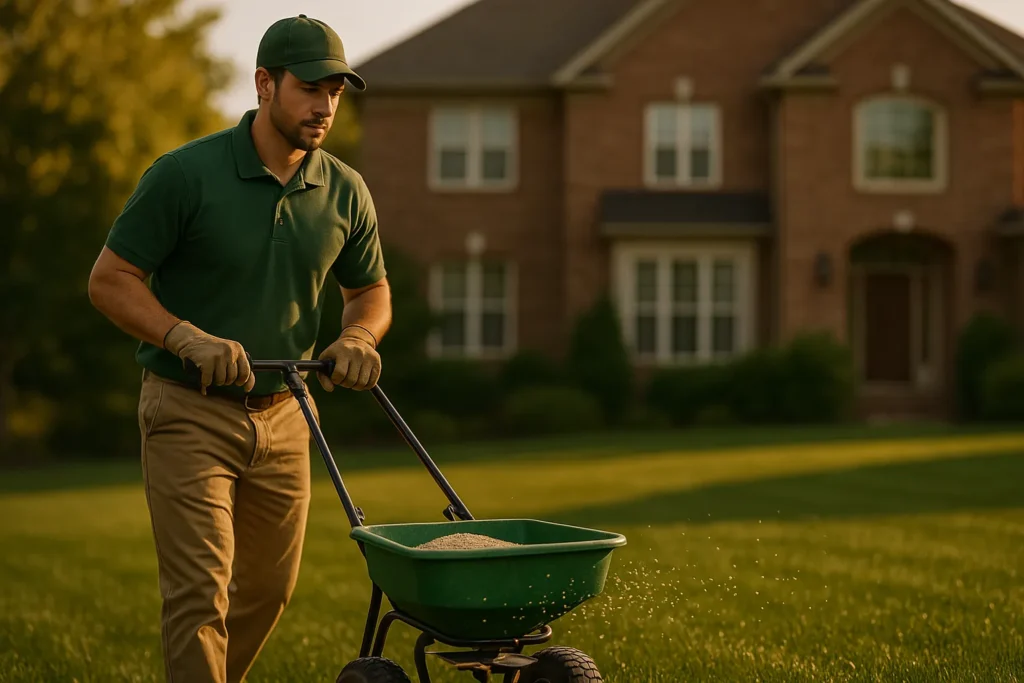
A soil test covers chemistry. It says nothing about physics. Compaction is a physical condition you can assess yourself in about fifteen minutes with things you already own.
The screwdriver test
Take a long screwdriver, ideally six inches or more of shaft, and push it straight down using hand pressure only. Do this when the soil is moist, a day after rain or irrigation, because bone-dry clay resists everything and gives a false positive. In a healthy root zone the shaft slides in most of its length with steady moderate pressure. If it stops abruptly in the first two or three inches, or you have to lean your weight on it, you have found a compacted layer, and the depth where it stopped is the depth of your problem. Repeat in eight or ten spots; the pattern matters more than any single reading.
Compare a worn path to a protected edge
This is the most useful diagnostic on a residential lot and it costs nothing. Test the middle of a well-used path, then test a strip along a fence line or the edge of a planting bed that never gets walked on. Both spots have identical soil texture, because it is the same lot. Any difference in resistance comes from traffic history, not clay content. If the protected edge takes the screwdriver easily and the open lawn does not, aeration is the right lever. If both are equally hard, you are dealing with a genuinely dense subsoil root zone, which needs the longer organic matter program below and possibly a look at drainage and grading.
Time your infiltration, and look at the roots
Cut both ends off a large can, tap it two to three inches into the soil, fill it with water, and time how long an inch takes to disappear. Run it in a suspect area and a good area the same day. You are comparing two spots on your own property, not chasing a benchmark. If water simply sits for most of an hour, that root zone is not accepting water, and no irrigation schedule will change it. Our irrigation and sprinkler work often starts with this test, because a system tuned for soil that cannot take water just makes runoff.
Then push a spade in and lift a wedge four to six inches deep. Healthy roots taper and continue downward. Compacted profiles produce a flat mat of roots that turns sideways at a hard boundary, often with a visible color and density change at that line. That abrupt horizon is the equipment pan.
Where compaction concentrates
- Under play sets, trampolines, and goal areas, where a few square yards absorb all the traffic
- Dog runs and the patrol path along a fence line, usually the first bare stripe on a property
- Mower turn-around corners and the same wheel line repeated weekly for years
- The side yard used as construction or delivery access during a deck, pool, or roofing project
- Anywhere a dumpster, storage pod, or stone pallet sat for a week
- The strip along the driveway and street edge, taking vehicle overrun plus pavement heat
- The shortcut everyone walks to the mailbox, the trash cans, or the shed
- Low areas that stay wet, since soil compacts far more severely when trafficked saturated
| Symptom | Likely cause | Correction | Best season here |
|---|---|---|---|
| Water pools or runs off instead of soaking in | Collapsed macropores; sealed, crusted surface | Core aeration followed by compost topdressing | Fall |
| Screwdriver stops within two or three inches | Equipment or traffic pan over builder subsoil | Repeated annual aeration, multiple passes, plus organic matter | Fall, repeated over several years |
| Thin bare stripe along a fence or walkway | Concentrated foot or pet traffic | Aerate, reroute traffic, or install a path rather than fight it | Fall for turf; any season for hardscape |
| Greens up in spring, collapses in July | Shallow roots trapped above a dense layer | Deepen the root zone over time; raise mowing height, water deeper | Begin in fall |
| Moss or algae in an open, unshaded area | Chronically saturated, airless surface soil | Fix drainage and grading first, then aerate | Fall, after the water problem is solved |
| Persistent low wet spot that never dries | Grading or perched water, not simple compaction | Regrade, swale, or drainage install; aeration alone will not fix it | Any dry working window |
| Turf thins under mature trees | Root competition and shade compounded by traffic | Reduce traffic, raise mowing height, consider beds instead of turf | Fall |
| Whole lawn uniformly hard, even at protected edges | Native dense subsoil exposed by topsoil stripping | Multi-year organic matter program, or renovation with imported topsoil | Late summer through fall |
What Core Aeration Does, and What It Does Not
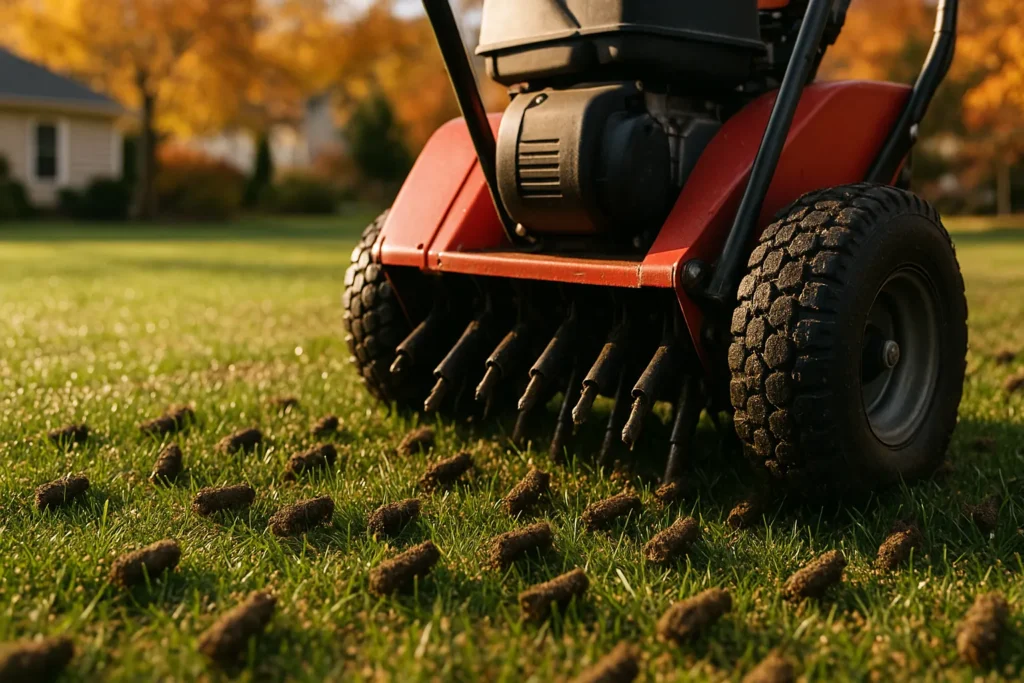
Core aeration is the most effective single intervention on a compacted Northern Virginia lawn, and also the most oversold. A core aerator removes plugs and leaves open channels behind. Those channels are new macropores: air reaches the root zone, water infiltrates instead of running off, surface-applied lime and fertilizer get below the thatch, and roots follow the path of least resistance downward. Multiple passes in different directions do meaningfully more than one, which is why Virginia Tech’s renovation guidance calls for two directions. Timing here is a fall exercise, and VCE 430-520 advises refraining from aerifying or dethatching cool-season lawns until fall. We will not re-litigate scheduling, since it is covered in our guides to when to aerate and overseed and aeration and overseeding in Northern Virginia, and in our Ashburn aeration service.
What it does not fix
- Soil texture. Clay stays clay. No aeration schedule turns a clay lot into loam.
- Grading. If water arrives from uphill with nowhere to leave, the holes fill and the spot stays wet. That is a standing water problem, not a compaction problem.
- Missing organic matter. Holes with nothing to fill them close back up.
- Chemistry. A compacted lawn with a large lime deficit needs both interventions.
- A builder pan, in one visit. One aeration on a subsoil root zone is a start, not a solution.
Topdressing is the part people skip
Organic matter builds aggregate structure. It feeds the microbial and fungal activity that glues clay particles into crumbs and raises the soil’s capacity to hold water and nutrients. Spread a thin, even layer of screened compost immediately after aeration and drag it so it falls into the holes, and that material does structural work instead of sitting on top. Be realistic about the timeline: meaningful improvement to a compacted subsoil root zone takes three to five seasons of repeated aeration and topdressing, returning clippings, and mowing high enough to support deeper roots. Anyone promising loam in one season is selling optimism. Our lawn care and landscaping program and our services are built so the soil work repeats rather than happening once.
Sand, Gypsum, and Rototillers: Three Ways to Make Clay Worse
Adding sand to a clay lawn is the region’s most persistent bad advice. In quantities a homeowner can realistically apply, sand grains sit in a clay matrix that fills every space between them, and the result behaves closer to concrete than to loam. Shifting texture would mean replacing most of the mineral fraction of the root zone, which is neither practical nor affordable on an established lawn.
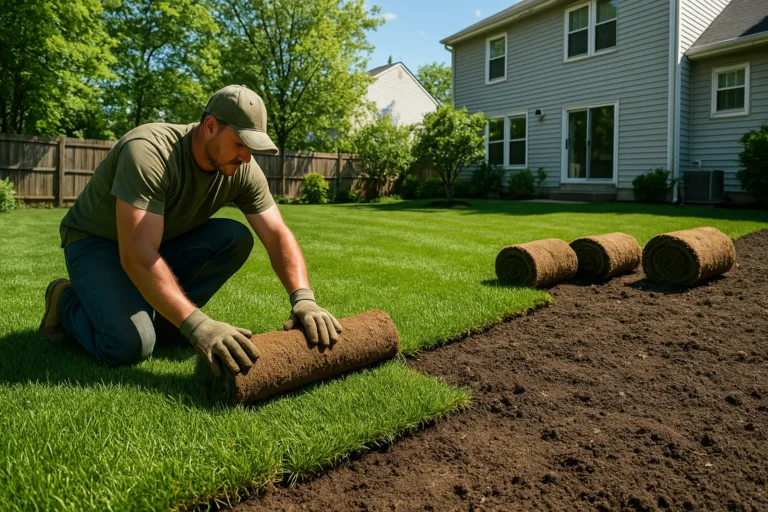
Gypsum is marketed as a clay loosener. Its legitimate role is in sodium-affected soils, which is not the situation here, and it does not correct acidity the way lime does. Buy on the basis of your report, not the bag. Rototilling an existing lawn is the third trap: it destroys what structure exists, produces a fluffy layer that settles into a bumpy surface within a year, lifts dormant weed seed into the germination zone, and often smears a tillage pan at blade depth. Where a root zone is beyond incremental repair, the honest answer is a planned renovation with imported topsoil through sod installation and lawn renovation, not a weekend rental.
Feeding a Corrected Soil: What the Nitrogen Guidance Says
Once chemistry and structure are moving, nitrogen timing decides whether the plant can capitalize. VCE 430-011 puts the optimal nitrogen window for cool-season lawns in Virginia at mid-August through early November, and all three of its programs call for zero nitrogen from June through August. Summer nitrogen on tall fescue in our humidity pushes soft growth straight into disease pressure. VCE 430-520 caps applications at a maximum of 0.7 pounds of nitrogen per 1,000 square feet in any active growing month at roughly four-week intervals, and nitrogen should never go down on frozen soil.
An honest caveat competitors gloss over: 430-011 is statewide guidance with no Northern-Virginia-specific breakdown. Local specificity has to come from local sources. Fairfax County’s soil and water conservation district offers a regional anchor, recommending fertilizing in the first two weeks of September with a second window between the last mowing and Thanksgiving. Beyond that, a west-facing slope in Leesburg and a shaded lot under mature oaks in Vienna run different microclimates on the same calendar, which is what our lawn calendar generator is for.
Virginia Tech’s Example Renovation Sequence
Virginia Tech turf specialists publish a model for how soil correction and renovation interlock in their late-summer lawn renovation guidance:
- Apply lime in August, based on a soil test, so it has time to begin reacting.
- Core aerate in two directions in mid-September.
- Apply the second lime application then, so it drops into the open holes.
- Apply the first fertilizer application.
- Seed.
Read it backwards and the case for testing early is obvious. The seeding date is fixed by the season, the aeration date by the seeding date, and the first lime application by the aeration date. A test mailed in June supports that chain; one mailed in mid-September supports next year’s. If seeding is part of the plan, our seed calculator will size the order.
When It Is Not a Soil Problem at All
Before committing to a multi-year amendment program, rule out the impostors. Water arriving from elsewhere is the big one: the local conservation district distinguishes perched water sitting above a restrictive layer from a genuinely high water table, and if a low corner is fed by roof runoff or a swale that no longer functions, amendments will not touch it. That is conveyance work, covered in our standing water guide and delivered through drainage and grading in Leesburg and nearby.
Disease and insects mimic a failing root zone. If damaged turf lifts like a loose carpet, that is root feeding, not compaction, and it belongs with lawn pest and disease control; our breakdown of why lawns turn brown here separates the causes. Thatch is another lookalike, since a spongy layer intercepts water and fertilizer before either reaches soil, so cut a wedge and measure it against our dethatching guidance. Under a mature canopy in Fairfax County, turf may simply be losing a competition for light and water, where mulching and bed maintenance or landscape design and installation beats any amendment.
Common Clay Soil Mistakes on Northern Virginia Lawns
- Liming without a test. Over-liming pushes pH the wrong way and can induce micronutrient problems harder to reverse than acidity.
- Buying starter fertilizer when phosphorus is already sufficient. Avoidable, and a water quality issue in this watershed.
- Aerating cool-season turf in spring or summer. It opens the canopy as summer annual weeds germinate.
- Adding sand to clay. Produces a denser root zone, not a looser one.
- Rototilling an established lawn. Settling, bumps, weed seed, and a tillage pan.
- Working or driving on saturated soil. Wet clay compacts far more than dry clay, and that includes your own mower.
- Sampling next to concrete. Lime leaching from drives and foundations skews pH upward and masks a real lime need.
- Expecting the fix in one season. Budget for a program, not an event. More errors are collected in our roundup of common lawn care mistakes.
DIY Versus Hiring It Out, and What Drives Cost
Soil testing is the rare piece of lawn care where do-it-yourself is right for almost everyone. Pulling a composite takes half an hour, the box is free, and the fee is $10.00. Acting on the report is where the calculus changes. Spreading lime accurately at a split rate takes a calibrated spreader and discipline about overlap. Renting an aerator means loading a heavy machine and returning it the same day, which in practice means one hurried pass rather than two. Topdressing means moving cubic yards of compost by wheelbarrow. Test yourself always; hire out multiple passes, bulk compost, renovations, and slopes. You can read about our approach and veteran-owned background on our about us page.
On cost, we will give exactly one verified number, and you already have it: $10.00 per sample. Everything downstream varies too much by property to quote here. The drivers are what matter when you read a proposal.
- Turf square footage, the largest driver on every line item
- Number of sample areas, since each is its own test and recommendation
- Size of the lime recommendation, which drives material and passes
- Whether compost topdressing is included, usually the biggest jump
- Number of aeration passes
- Access and slope, including gated back yards and narrow side yards
- Whether seeding or sod follows, since bundled work prices differently
- Whether drainage work has to come first, which is its own scope
For renovation planning, our sod cost calculator gets you to a defensible range before anyone visits.
How This Plays Out Across the Region
The geology is broadly similar area-wide, but the practical picture shifts with lot age and size. In older inner-suburban neighborhoods, lots are smaller and canopy is mature, so the limiting factors are usually shade, root competition, and concentrated traffic rather than a builder pan. Across much of Loudoun and western Prince William County, lots are larger and newer, with a far higher chance the root zone is graded subsoil under a thin veneer. Those properties respond dramatically to aeration and organic matter precisely because they start from a compacted baseline. In Fairfax you find both patterns within a few miles, which is a good argument for testing rather than assuming. One regional constant works in your favor: freeze-thaw cycling heaves and cracks clay all winter for free, which is part of why fall soil work compounds so well here.
Frequently Asked Questions
How much does a Virginia Tech soil test cost?
The routine package is $10.00 per sample for in-state residents, published on the lab’s fees and forms page and independently confirmed by Fairfax County’s soil and water conservation district. Each distinct area you sample is its own sample and its own fee, so testing a front and back lawn separately means two.
How long does it take to get results back?
Turnaround is usually within three working days of the lab receiving your sample, emailed to the address on your submission form. Mail transit is on top of that, so plan on roughly a week from the day you mail the box, and build more margin if you are working toward a specific renovation date.
Where do I get a soil test box in Northern Virginia?
From your local Virginia Cooperative Extension office. Boxes are free, and many offices also loan soil probes to residents, which makes pulling a clean composite easier. The Extension office directory lists locations for every jurisdiction in the region. Call ahead to confirm hours and probe availability.
How often should I test my lawn’s soil?
Every three to four years for an established lawn, with fall noted as an ideal time. Test more often if you are actively correcting a problem or have just bought a property with unknown history, and always at least a month before establishing or renovating so the lime recommendation can be acted on before seeding.
Can I fix clay soil by adding sand?
No, and it usually makes things worse. Sand applied in realistic quantities gets surrounded by clay filling every void between grains, producing a denser root zone rather than a looser one. Organic matter is the amendment that improves clay behavior, and core aeration creates the pore space to put it in.
Does core aeration actually fix clay soil?
It fixes compaction, which is usually the real complaint. It does not change texture, so a clay lawn stays a clay lawn. What it restores is macropore space, so water infiltrates, air reaches roots, and surface-applied materials get below the thatch. Paired with compost topdressing and repeated annually, the cumulative effect over several seasons is substantial.
Why is my soil so much harder than my neighbor’s?
Almost always construction and traffic history rather than different native soil. Two adjacent lots can differ enormously depending on where equipment staged and how thickly topsoil was replaced. Run the screwdriver test in a protected bed edge and in the open lawn on your own property; the gap shows how much of the problem is history rather than geology.
When should I apply lime, and how long until it works?
Only after a soil test gives you a rate. Virginia Tech’s example sequence puts a first application in August and a second at mid-September core aeration. Expect the pH change to unfold over months rather than weeks, because lime reacts where it lands and moves down slowly. Applying it into fresh aeration holes shortens that journey considerably.
Do I need starter fertilizer when I overseed?
Only if your soil test says phosphorus is low. Many established lawns here already test sufficient or high after years of complete fertilizers, in which case a starter product spends money on a nutrient you have in surplus and adds to a nutrient of concern in the Chesapeake Bay watershed. The report answers this in one line.
Start With the Soil, Not the Symptom
Nearly every stubborn lawn problem in Northern Virginia traces back to a root zone that is chemically limited, physically compacted, or both. Ten dollars and half an hour settles the chemistry question, and a screwdriver settles the physics question in fifteen minutes. From there you are making decisions with data instead of buying products on faith.
Pull your samples, mail them, and read the report before buying a single bag of anything. If you want a second set of eyes on the results, or you would rather have the aeration, liming, and topdressing handled on a schedule that repeats, get in touch with Lawn Theory and we will build the plan around what your soil actually reports. More seasonal guidance lives on our blog.
Keep Reading: Lawn Care
 Lawn Care
 Sprinkler System Winterization in Northern Virginia: Timing, Methods, and What Goes Wrong
Sprinkler winterization in Northern Virginia is about timing, not a fixed date. How to pick your shutdown week, how the three drainage…
 Lawn Care
 Fall Planting in Northern Virginia: Trees, Shrubs, and Mulch Done Right
Fall is the best time to plant trees and shrubs in Northern Virginia, but most failures trace to the first twenty minutes…
 Lawn Care
 The Fall Lawn Renovation Calendar for Northern Virginia: Dates, Seeding Rates, and Soil Temperature
Virginia Cooperative Extension puts the Northern Virginia seeding window at the last week of August through mid-September. Here are the exact dates,…
Want this handled by the crew that wrote the guide?
Veteran-owned. Licensed & insured. Free walkthroughs across Northern Virginia — quotes in 24–48 hours.
Get Your Free Estimate