
The Fall Lawn Renovation Calendar for Northern Virginia: Dates, Seeding Rates, and Soil Temperature
Fall lawn renovation in Northern Virginia works on a tighter schedule than most homeowners realize. Virginia Cooperative Extension puts the prime seeding window for our region at the last week of August through mid-September, with acceptable results as late as mid-October. Seed tall fescue blends at 4 to 6 pounds per 1,000 square feet, and let soil temperature, not the calendar alone, tell you when to start.
The short answer: Book or plan your renovation so that seed hits soil between roughly August 25 and September 15. Aerate in at least two directions, seed at the rate that matches your goal (overseeding, blend establishment, or bare-ground repair), fertilize on the Extension nitrogen schedule beginning in September, and keep the top half inch of soil damp for two to three weeks. Skip the fall pre-emergent entirely on any area you are seeding.
Lawn Theory works these dates every autumn across Fairfax, Loudoun, and Prince William counties, where heavy clay, mature shade trees, and a humid summer make fall the only reliable time to rebuild a cool-season lawn. If you want the work handled on schedule, our aeration and overseeding service and sod installation and lawn renovation pages explain how we sequence a full renovation from soil test through establishment.
Key Takeaways
- Northern Virginia’s Extension-recommended seeding window is the last week of August to mid-September, with acceptable results to mid-October. Statewide advice that says “September 15 to October 15” is written for Southern and Southeastern Virginia, not for us.
- Measure soil temperature at 2 to 4 inches deep instead of trusting the date. A hot, dry early September can stall germination even when the calendar says go.
- Extension sources give different seeding rates for different situations, and the honest answer is that all of them are correct in context: 4 to 6 lb per 1,000 sq ft for tall fescue blends, 3 to 4 lb for overseeding and for fescue/bluegrass mixtures, 6 to 8 lb for new lawns, and 6 to 7 lb on truly barren ground.
- Crabgrass pre-emergent and new grass seed are chemically incompatible. Applying one wastes the other, and this single mistake accounts for more failed fall seedings than bad seed ever has.
- Multiple aerator passes in different directions is the minimum acceptable seedbed prep for seed-to-soil contact. One pass is not a renovation.
- The Extension fall nitrogen window runs mid-August to early November, with zero nitrogen from June through August. Total season nitrogen lands around 2.0 to 3.5 lb per 1,000 sq ft depending on your product.
- Tall fescue germinates in roughly 7 to 14 days; Kentucky bluegrass takes closer to 14 to 21. Plan your watering, mowing, and traffic restrictions around the slower species in the bag.
- If you reach mid-October without seeding, you still have three real options: dormant seeding, sod, or waiting for a spring patch. Each has an honest tradeoff.
The Actual Seeding Window for Northern Virginia
Virginia is not one climate, and Virginia Cooperative Extension does not treat it as one. The Virginia Cooperative Extension Gardener Handbook, Chapter 11 (Lawns) breaks the state into distinct seeding regions, and Northern Virginia sits in the earliest of the three. A mirrored copy of the same chapter carries identical guidance if the primary link is slow to load.
| Region of Virginia | Recommended fall seeding window | Latest acceptable |
|---|---|---|
| Northern Virginia and lower-elevation Western Virginia | Last week of August to mid-September | Mid-October |
| Higher-elevation Western Virginia (above roughly 1,200 ft) | Mid-August to mid-September | Earlier close; shorter season |
| Southern and Southeastern Virginia | September 15 to October 15 | Later window; warmer autumn |
That regional split matters more than it sounds. If you search for a Virginia lawn calendar, the pages that rank nationally almost always publish one statewide schedule. LawnStarter’s Virginia month-by-month schedule is a good example: useful general structure, no regionalization whatsoever, and no Extension citations behind the dates. A homeowner in Ashburn who follows a September 15 to October 15 schedule written for Virginia Beach has just given up the best three weeks of the season, and in a cold October that difference shows up as thin, immature seedlings going into the first frost.
Virginia Tech’s turf program frames the same period slightly differently. In Fall Lawn Recovery Strategies, Dr. Mike Goatley describes September and October as the ideal window for renovating cool-season lawns. Both framings are compatible: seed goes down at the front edge of that period so the plants get the full run of autumn root growth. The last week of August is not “early.” It is the start.
Why the front of the window beats the back
A tall fescue seedling planted August 28 has roughly ten weeks of usable growing weather before soil temperatures drop below the point where root development effectively stops. A seedling planted October 10 has perhaps three. Both may germinate. Only one enters winter with a root system deep enough to survive the freeze-thaw cycling that Northern Virginia clay puts turf through every January and February. That heaving action is what lifts shallow-rooted seedlings out of the ground, and it is the single biggest reason late seedings look fine in November and disappear by March.
There is a second reason to move early. Fall weed pressure in our area is real, and a canopy that closes before Thanksgiving crowds out the winter annuals that would otherwise colonize thin turf. If you are already fighting weeds, our guide to controlling weeds after overseeding covers what you can and cannot spray on young grass.
Where to go deeper on aeration itself
This article is about the calendar, the rates, and the sequence. It deliberately does not re-litigate aeration, because we have already covered that ground in detail. If you need the fundamentals, start with these three:
- Aeration and overseeding in Northern Virginia is the full explainer on what core aeration does to compacted clay and how overseeding fits alongside it.
- When to aerate and overseed in Northern Virginia handles the seasonal timing question on its own terms, including why spring aeration usually backfires here.
- Liquid aeration vs. core aeration compares the two methods honestly, including where liquid products do and do not help.
Read those for the why. Stay here for the when, how much, and in what order.
Soil Temperature Beats the Calendar Every Time
Almost no consumer lawn page tells homeowners to measure soil temperature. It is the most useful thing you can do for twenty dollars, and it converts fall renovation from a guess into a decision.
Seed does not respond to dates. It responds to the temperature of the soil surrounding it, plus moisture. Air temperature is a poor proxy because soil lags behind air by days to weeks, and Northern Virginia clay lags more than sandy soils do. A stretch of cool nights in early September can feel like fall while the root zone is still holding late-August heat. The reverse also happens: a mild, wet late August can bring soil down faster than expected and open the window a week early.
How to measure soil temperature correctly
- Buy a soil thermometer with a 5- to 6-inch probe. A compost thermometer or a dial-stem soil thermometer works. A meat thermometer with a long stem works in a pinch. You do not need a data logger.
- Insert to 2 to 4 inches. That is the depth where seed will actually sit and where roots initiate. Readings at half an inch swing wildly with sun and shade and tell you almost nothing.
- Take the reading in the early morning, before the sun has loaded the surface, and again mid-afternoon. The morning number is your low, the afternoon number is your high, and the trend between them across a week is the real signal.
- Sample more than one spot. A south-facing slope in Sterling and the shaded strip under a mature oak in Vienna can differ by several degrees on the same property. Renovate the cooler areas first if you are splitting the job across weekends.
- Log it. Three data points a week for two weeks tells you whether soil is trending down steadily or bouncing. Steady decline is your green light.
The practical rule: cool-season grasses germinate fastest when soil in the seeding zone has come down off its summer peak and is on a consistent downward trend, with warm days still ahead to drive growth. That combination is exactly what the last week of August through mid-September delivers in Northern Virginia in a normal year. In an abnormal year, the thermometer is what tells you the year is abnormal.
What a hot September actually does
When soil stays warm, three things go wrong at once. Germination slows or becomes erratic, so the stand comes in patchy. Surface moisture evaporates faster than a homeowner can keep up with, and seed that swells and then dries out is dead seed. And warm, humid conditions favor the very diseases that damage tall fescue, which means the seedlings that do emerge face pressure before they have a root system. If you have watched your lawn go off-color in late summer before, our post on why lawns turn brown in Northern Virginia walks through separating heat stress from disease from grub damage.
If your soil readings in the last week of August are still holding high, the correct move is to finish your prep work, hold the seed in the bag, and re-check every two or three days. You lose nothing by waiting five days. You lose a lot by seeding into hot soil with a dry ten-day forecast.
Tall Fescue Seeding Rates, Including the Discrepancy Nobody Mentions
Search for a tall fescue seeding rate and you will find four different numbers presented as though each were the only one. They come from different Extension documents describing different situations, and rather than pick one and pretend the others do not exist, here is the whole picture with the source for each.
| Situation | Rate (lb per 1,000 sq ft) | Source |
|---|---|---|
| Tall fescue blends (all tall fescue, multiple cultivars) | 4 to 6 | VCE Gardener Handbook, Ch. 11 |
| Mixtures of 90 to 95% tall fescue with 5 to 10% Kentucky bluegrass | 3 to 4 | VCE Gardener Handbook, Ch. 11 |
| Establishing a new lawn from bare soil | 6 to 8 | Virginia Cooperative Extension |
| Overseeding existing turf | 3 to 4 | Virginia Cooperative Extension |
| Barren, damaged areas in a renovation | 6 to 7 | Virginia Tech, late-summer renovation guidance |
| Areas in better condition within the same renovation | Roughly half the barren-area rate | Virginia Tech, late-summer renovation guidance |
Why does the mixture rate drop below the blend rate? Kentucky bluegrass seed is far smaller than tall fescue seed, so a small percentage by weight represents an enormous number of seeds. Adding 5 to 10% bluegrass by weight raises the seed count per pound substantially, and the total rate comes down to compensate. This is also why you cannot substitute one bag for another and keep the same spreader setting.
Virginia Tech’s SPES-353 seeding guidance gives the check that resolves all of this on the ground: after seeding, you want roughly 10 to 15 seeds per square inch, planted at a depth of one-third to one-half inch. Kneel down with a cardboard square-inch cutout and count. If you are at 30 seeds per square inch, you over-applied and those seedlings will compete themselves into weakness. If you are at 4, you left gaps for crabgrass next June.
Converting rates into actual bags
Rates in pounds per 1,000 square feet are useless at the store. Here is the same guidance converted into total pounds for the lot sizes we see most often across Northern Virginia. Measure your actual turf area, not your lot size, and subtract the house, driveway, and beds.
| Turf area | Overseeding at 3-4 lb | TF blend at 4-6 lb | New lawn at 6-8 lb | Typical NoVA lot |
|---|---|---|---|---|
| 5,000 sq ft | 15 to 20 lb | 20 to 30 lb | 30 to 40 lb | Townhome or small Arlington / Alexandria lot |
| 8,000 sq ft | 24 to 32 lb | 32 to 48 lb | 48 to 64 lb | Standard single-family in Fairfax or Herndon |
| 12,000 sq ft | 36 to 48 lb | 48 to 72 lb | 72 to 96 lb | Larger lot in Ashburn, Brambleton, or South Riding |
| 20,000 sq ft | 60 to 80 lb | 80 to 120 lb | 120 to 160 lb | Half-acre-plus in Great Falls, Clifton, or western Loudoun |
Two things jump out of that table. First, the difference between the low and high end of a single recommendation can be 40 pounds of seed on a half-acre lot, which is why deciding which situation you are in matters before you shop. Second, most homeowners badly underestimate how much seed a real renovation takes. If you are buying one 20-pound bag for a 12,000 square foot lawn, you are applying roughly a third of the overseeding rate and you will not see a meaningful difference.
Run your own numbers with our seed calculator, which takes your measured area and your objective and returns a total. Pair it with the lawn calendar generator to get the dates alongside the quantities.
How to Read a Seed Tag Before You Buy
Every bag of grass seed sold in Virginia carries an analysis tag, usually stitched to the bag or printed on the back panel. It is the only honest information on the package, and it is the reason the cheapest bag is almost always the most expensive way to buy living grass plants.
- Pure live seed (PLS). Purity percentage multiplied by germination percentage. A bag that is 95% pure with 90% germination gives you about 85.5% PLS. A bag at 85% purity and 75% germination gives you under 64%. You are buying the PLS, not the bag weight.
- Weed seed percentage. Look for 0.00% or as close as you can find. Anything meaningfully above zero means you are paying to plant weeds into a freshly aerated seedbed, which is the most receptive surface a weed seed will ever meet.
- Other crop seed. This is other agricultural species, often including grasses you do not want in a fescue lawn. Low single-digit percentages sound trivial and are not, because crop seed counts add up fast at 200,000-plus seeds per pound.
- Noxious weeds. Should read “none found.” Do not buy a bag that lists any.
- Inert matter. Chaff, coating, filler. Coated seed can be legitimate, but coating is inert weight you are paying for by the pound, and heavily coated products need proportionally higher application rates.
- Germination test date. The single most overlooked line. Seed loses viability in storage, especially in a hot warehouse or garage. A bag tested eighteen months ago will not perform to its printed germination number. Buy the freshest test date on the shelf.
- Named cultivars vs. “variety not stated.” A tag listing specific named cultivars tells you the breeder selected for something. “VNS” or “variety not stated” means you are buying commodity seed with no performance claim behind it.
Cultivar selection is not cosmetic in our climate. Virginia Cooperative Extension’s SPES-748, Selecting Turfgrass for Virginia, identifies Rhizoctonia blight, commonly called brown patch, as a long-standing concern for tall fescue in Virginia, and names gray leaf spot as an emerging one. Both are warm, humid-weather diseases, and Northern Virginia summers deliver exactly those conditions. That is the argument for buying a named-cultivar blend from a reputable supplier rather than the discount bag, and for treating disease as a design decision made at purchase rather than a spraying problem solved in July. If disease has already taken hold, our lawn pest and disease control service covers diagnosis and treatment.
One caution on cultivar shopping: performance trial data changes year to year, and any specific cultivar recommendation you read on a blog is a snapshot. Ask your supplier what current Virginia trial data supports, or contact your local Virginia Cooperative Extension office, which can point you at the current lists.
The Week-by-Week Fall Lawn Renovation Calendar
Virginia Tech publishes an example renovation sequence in its late-summer cool-season lawn renovation guidance: lime in August, core aerate in two directions in mid-September along with a second lime application, the first fertilizer application, and seed. The table below expands that skeleton into a full Northern Virginia schedule from mid-August through November.
| Timing | Task | Why this week |
|---|---|---|
| Now through early August | Pull soil samples and submit for testing; order seed | Test at least a month before renovating so lime and fertilizer recommendations arrive in time to act on |
| Mid-August | First lime application if the soil test calls for it; start nitrogen window; begin logging soil temperature | Lime moves slowly through clay and needs lead time; the Extension nitrogen window opens mid-August |
| Third week of August | Mow existing turf short (around 2 inches), bag clippings, remove debris; verify irrigation coverage | Short turf lets seed reach soil and lets you see bare areas honestly |
| Last week of August | Core aerate in at least two directions; second lime application if recommended; first fertilizer; seed | Front edge of the Northern Virginia window; maximum remaining growing season |
| First two weeks of September | Seeding continues if not already done; light, frequent watering; no traffic | Still squarely inside the recommended window |
| Mid-September | Close of the prime window; germination visible on the earliest seeded areas | Seed after this point trades root development for convenience |
| Late September | First mow once new grass reaches roughly one-third above target height; shift watering deeper and less often | Seedlings tiller in response to mowing; deeper watering drives roots down |
| Early October | Second nitrogen application per your program; continue mowing; begin light leaf management | October nitrogen builds root carbohydrate reserves for winter |
| Mid-October | Last practical seeding date for acceptable results; overseed thin spots only if you must | Extension’s outer limit for our region |
| Late October to November | Final nitrogen if your program calls for it; keep leaves off new turf; last mow before dormancy | The Extension nitrogen window closes in early November |
Soil testing is the step homeowners skip and the one that changes the most outcomes. The Virginia Tech Soil Testing Laboratory runs a routine package for in-state samples at ten dollars per sample, covering pH, phosphorus, potassium, calcium, magnesium, micronutrients, estimated cation exchange capacity, and specific lime and fertilizer recommendations. Turnaround is usually within three working days of receipt, and reports come by email. Extension’s 452-129 sampling procedure for residential areas explains how to pull a representative sample, which matters more than most people assume on a lot with fill soil and a builder-graded yard.
Retest every three to four years. In Northern Virginia’s acidic clay, pH drift is the quiet reason a well-fertilized lawn still looks mediocre, because nutrients that are present become unavailable to the plant. Our post on managing clay soil lawns in Northern Virginia goes further into what our regional soils do to root development.
Why multiple aerator passes are the minimum, not the maximum
SPES-353 is explicit that multiple passes in different directions is what produces adequate seed-to-soil contact. That is a specification, not a suggestion. A single pass on a typical residential aerator leaves core holes spaced several inches apart, which means the overwhelming majority of your seed lands on thatch and existing turf rather than in soil. Seed sitting on top of a lawn is bird food.
Two perpendicular passes roughly doubles hole density. Three passes at varying angles, which is what we do on badly compacted Loudoun and Prince William clay, gets you to the point where broadcast seed genuinely falls into openings. This is also where DIY renovations most often fall short: a rented aerator is billed by the half-day, and the temptation to do one quick pass and return it is strong. If you are hiring the work out, ask how many passes are included before you compare quotes, because two contractors quoting the same job may be quoting fundamentally different work.
If your lawn has a genuine thatch layer rather than simple compaction, aeration alone will not solve it. See lawn dethatching in Northern Virginia for how to tell the difference and when dethatching belongs in the sequence.
The Fall Nitrogen Program, By the Numbers
Fertilizer timing is where good seeding work gets undone. Virginia Cooperative Extension publication 430-011, Lawn Fertilization in Virginia, sets the optimal cool-season nitrogen window at mid-August through early November and assigns zero nitrogen from June through August in every program. It then splits the schedule three ways depending on how much slow-release nitrogen your product contains.
| Program | Product type | September | October | November | Season total |
|---|---|---|---|---|---|
| Program 1 | Quick release (under 15% slow-release N) | 0.7 | 0.7 | 0.5 | 2.0 to 3.5 |
| Program 2 | 15 to 49% slow-release N | 0.9 | 0.9 | 0.5 | 2.0 to 3.5 |
| Program 3 | 50% or more slow-release N | 1.0 to 1.5 | 1.0 to 1.5 | 0 | 2.0 to 2.8 |
Two guardrails apply across all three programs. Extension’s 430-520 fall lawn care guidance caps applications at a maximum of 0.7 lb of nitrogen per 1,000 square feet per active growing month, spaced at roughly four-week intervals, and warns against applying to frozen soil. The higher single-application figures in Programs 2 and 3 are possible precisely because slow-release nitrogen meters itself out over weeks rather than dumping availability in a few days.
Note also that 430-011 is written statewide. There is no Northern Virginia breakdown in it. Our practical adaptation: because our seeding window opens earlier than Southern Virginia’s, the first fall application lands with the seeding operation in late August or the first days of September rather than waiting for a mid-September calendar entry. Fairfax County’s Northern Virginia Soil and Water Conservation District, in its fall lawn care guidance, recommends fertilizing in the first two weeks of September with a second window between the last mowing and Thanksgiving, which lines up with the front-loaded approach.
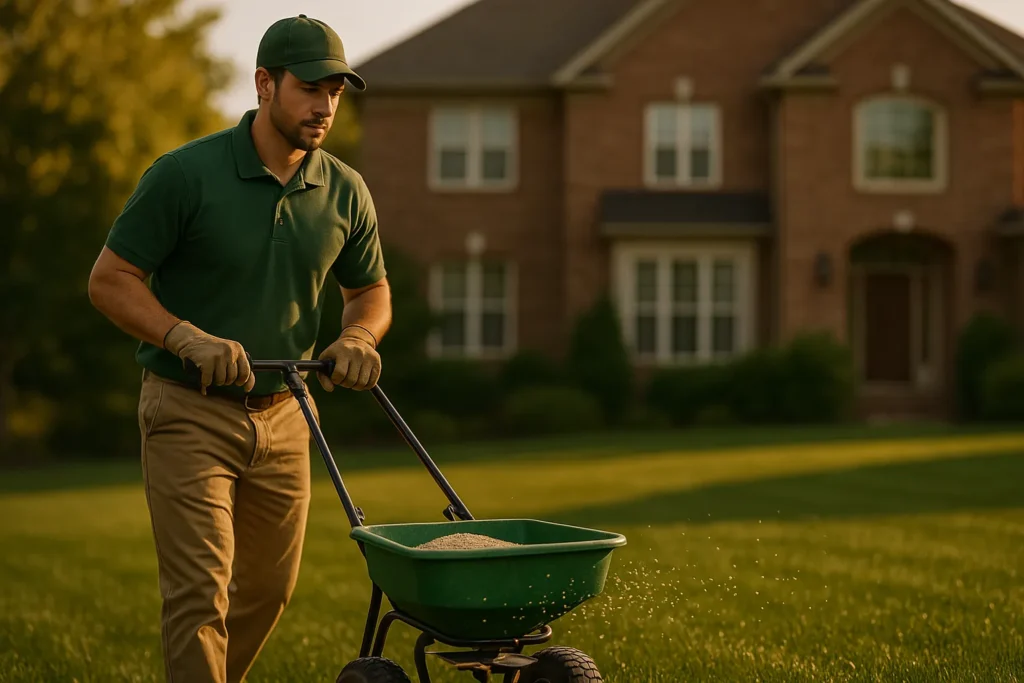
Converting pounds of nitrogen into pounds of product trips people up. A 28-0-3 fertilizer is 28% nitrogen, so 0.7 lb of N requires 2.5 lb of product per 1,000 square feet. Divide your target N rate by the first number on the bag expressed as a decimal. Calibrate the spreader on a driveway before you touch the lawn. Our lawn fertilization and weed control program handles this on a schedule, and how often to fertilize a lawn covers the annual rhythm outside the fall window.
The Pre-Emergent and Seeding Collision
This is the most expensive mistake in Northern Virginia fall lawn care, and it is entirely avoidable.
Crabgrass pre-emergent herbicides work by forming a chemical barrier in the top layer of soil that prevents germinating seedlings from establishing roots. The herbicide cannot distinguish between a crabgrass seedling and a tall fescue seedling. Applying pre-emergent and grass seed to the same area in the same season means one of the two is wasted, and usually it is the seed, because the herbicide is already in place and doing its job.
The spring version of the conflict
Homeowners who apply a spring pre-emergent and then decide in April that the lawn is thin and needs seed have already closed that door. The barrier persists for a meaningful part of the season. That is one more reason our region seeds in fall rather than spring: the fall schedule does not collide with the spring crabgrass program at all. Our posts on when to apply pre-emergent and pre-emergent weed control cover the herbicide side in full, so we will not repeat it here.
The fall version nobody warns you about
Fall is also the best time of year to control broadleaf perennials such as dandelion, clover, and ground ivy, because they are actively moving carbohydrates down to their roots and carry systemic herbicide along with it. That biology is real and the timing advice is correct in isolation. The problem is that it lands on exactly the same weeks as seeding.
You cannot spray broadleaf herbicide over young seedlings. Most product labels require waiting until new grass has been mowed a number of times before any application, and seedlings sprayed too early either die outright or stall for weeks. The practical resolutions:
- Spray first, then seed. Treat broadleaf weeds several weeks before your seeding date, following the label’s reseeding interval, then aerate and seed on schedule. This is the cleanest sequence when weed pressure is heavy.
- Seed first, spray much later. Renovate on schedule, then handle broadleaf weeds after the new stand has been mowed several times, which in practice pushes treatment to late fall or the following spring.
- Split the property. Seed the thin areas, spot-treat the weedy areas that are not being seeded, and keep a physical buffer between them.
- Never blanket-apply a weed-and-feed to a lawn you just seeded. Combination products carry herbicide, and that is the whole problem.
Read every label before it goes on the lawn, and check the reseeding interval specifically. It is printed there, and it is the number that governs your calendar.
The First 30 Days After Seeding
Everything up to this point is preparation. The month after seed goes down is where renovations succeed or fail, and the required behavior changes every week.
| Period | Watering | Mowing | Traffic |
|---|---|---|---|
| Days 1 to 14 | Light and frequent. Two to four short cycles daily in warm weather. Goal is a consistently damp top half inch, never saturated, never dry | None. Do not mow | None. Keep people, pets, and equipment off entirely |
| Days 7 to 14 | Same, tapering as germination becomes visible | Tall fescue typically germinates in this range | Still none |
| Days 14 to 21 | Reduce to once or twice daily, longer cycles | Kentucky bluegrass in a mixture germinates in this range; wait for the slower species | Minimal, only if unavoidable |
| Days 21 to 30 | Transition toward deep and infrequent, roughly two to three sessions weekly | First mow when new grass is about one-third taller than target height, on a sharp blade, bagging clippings | Light foot traffic acceptable after the first successful mow |
| Day 30 onward | Deep and infrequent, encouraging downward root growth | Regular schedule at 3 to 4 inches for tall fescue | Normal use returns gradually; heavy or repetitive traffic should wait longer |
The watering transition is the part most people get wrong. Light and frequent is correct for a seed that has no roots and lives entirely off surface moisture. It becomes actively harmful once roots exist, because shallow watering trains shallow roots, and a shallow-rooted fescue lawn on Northern Virginia clay will fail in its first real July. Make the shift deliberately around week three.
Reliable coverage is the difference between managing this and gambling on it. A hose-end sprinkler moved by hand three times a day for two weeks is a real commitment. An irrigation system with correct head spacing removes the failure mode entirely, and an audit before seeding is worth more than an audit after. Check for dry corners, blocked heads, and overspray onto hardscape before the first seed goes down, not after.

Mow the first time only when the new grass genuinely needs it, and do not scalp it. Mowing is what triggers tillering, the sideways spreading that fills a stand in, so skipping it in the name of being gentle actually produces a thinner lawn. Sharp blades matter more than usual because a dull blade tears young plants out of loose soil rather than cutting them.
Leaves are a seeding problem, not just a cleanup problem
On a wooded lot in Vienna, Great Falls, or Oakton, leaf fall begins while your seedlings are still fragile. A wet mat of leaves left for a week will smother a young stand and hold the moisture that disease wants. Clear lightly and often rather than waiting for one big cleanup, and use a blower on a low setting rather than a rake that pulls seedlings out of loose soil. Leaf removal and seasonal cleanup becomes part of the renovation, not a separate chore.
If September turns dry
A dry September is common enough here that you should plan for it rather than react to it. If you have no irrigation and the forecast shows ten dry days after your intended seeding date, the honest options are to delay seeding until rain is in the forecast, to commit to hand-watering on a genuine schedule, or to reduce the scope so you can actually keep the seeded area wet. Seeding an entire half-acre you cannot water is worse than seeding the front third properly.
A light straw or seed-blanket cover on slopes and bare areas buys you time between waterings and stops seed from washing. On the sloped lots common in western Loudoun and around Clifton, erosion control is not optional; a hard thunderstorm on freshly aerated bare ground will move seed to the bottom of the hill. If water movement across your lot is a chronic issue rather than a seeding-week issue, see standing water in your yard and our drainage and grading service, and fix the grading before you invest in seed.
Plan B: It Is Already Mid-October
Life happens. If it is the second half of October and nothing has gone down, you have three legitimate options and one bad one. The bad one is seeding anyway and hoping, which produces seedlings too immature to survive winter heaving and wastes the seed budget.
Option 1: Dormant seeding
Dormant seeding means putting seed down late enough in the season that soil is too cold for germination, then letting it sit through winter and germinate on its own as soil warms in early spring. Freeze-thaw cycling actually works in your favor here, because it opens and closes the soil surface and works seed downward into contact.
- Upside: uses time you otherwise waste, requires no watering commitment, and gets germination started earlier in spring than you could by seeding in March.
- Downside: results are less predictable than a fall seeding, seed loss to runoff and birds is higher, and it locks you out of a spring pre-emergent on those areas, which matters in a bad crabgrass year.
- Best for: moderate thinning across a large area where the alternative is doing nothing until spring.
Option 2: Sod
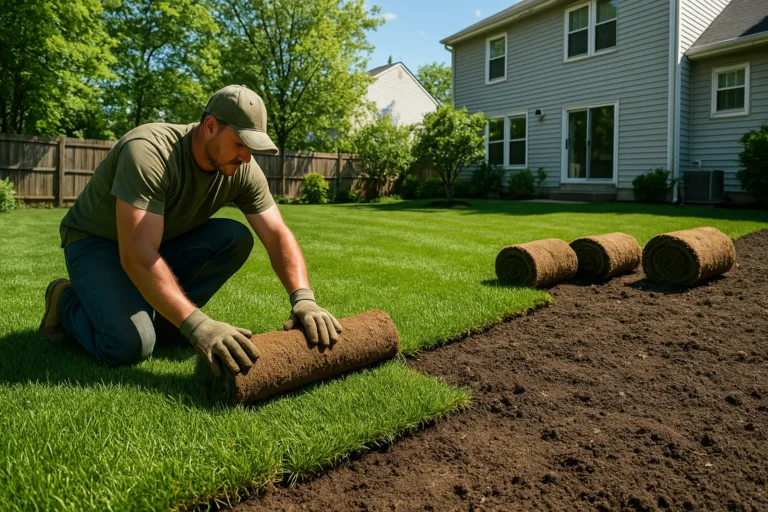
Sod is mature turf with an existing root system, which means it is not bound by the germination calendar. It can be installed later into fall than seed can be sown, as long as the ground is workable and you can water it in. It also solves erosion on slopes immediately.
- Upside: instant coverage, no germination risk, no bird or washout losses, and usable turf far sooner.
- Downside: substantially higher material and labor investment than seed, requires diligent watering to knit roots into the soil beneath, and demands the same soil preparation underneath that seeding does. Sod laid on unprepared compacted clay will not root well.
- Best for: visible front yards, slopes, and situations where the lawn cannot look bare through winter.
Weigh the two honestly with sod vs. seed for Northern Virginia and size the job with our sod cost calculator.
Option 3: Wait for spring, and do it properly
Spring seeding in mid-to-late March is the Extension-noted alternative, and it is a genuine second choice rather than a first one. Spring-seeded fescue has to establish a root system while heading into summer heat instead of away from it, and it collides directly with the crabgrass pre-emergent program. If you choose this route, plan on protecting the young stand through its first summer and accept that you will likely renovate again the following fall. Use the winter productively; our post on early spring lawn success starting in winter covers the prep that makes a spring seeding less of a gamble, and winter lawn care in Northern Virginia covers the months in between.
Common Fall Lawn Renovation Mistakes in Northern Virginia
- Following a statewide calendar. Seeding on a September 15 to October 15 schedule written for Southeastern Virginia costs you the best weeks of the Northern Virginia window.
- One aerator pass. It is the difference between a renovation and an expensive lawn decoration.
- Buying by bag price instead of pure live seed. A cheap bag with 78% purity, 80% germination, and a two-year-old test date delivers far fewer living plants per dollar than a premium bag.
- Applying seed and pre-emergent in the same season. One neutralizes the other, every time.
- Skipping the soil test. Ten dollars and three working days, versus a season of fertilizing soil that cannot deliver what you are applying because the pH is wrong.
- Watering deeply from day one. Correct for established turf, wrong for seed, and it washes seed into low spots.
- Never mowing the new stand. Mowing is what makes fescue tiller and fill in. Being gentle produces a thin lawn.
- Seeding over an unresolved drainage problem. Grass will not fix a low spot that holds water. Grade first, seed second.
- Leaving leaves down for a week. A wet leaf mat can wipe out a two-week-old stand.
- Seeding the whole property when you can only water part of it. Scope to your actual irrigation capacity.
For a broader look at the habits that undermine lawns here year-round, see our roundup of common lawn care mistakes.
DIY or Hire It Out
Fall renovation is one of the more DIY-friendly lawn projects, with real caveats. The physical work is straightforward. The failure modes are timing, equipment capability, and the two to three weeks of watering discipline afterward.
DIY makes sense when
- Your turf area is modest and relatively flat, so a rental aerator is manageable in a single day.
- You have working irrigation or you are genuinely home to water on schedule for three weeks.
- You have already soil tested and know what your lime and fertilizer needs are.
- You can commit to the specific late-August or early-September weekend rather than whichever weekend opens up.
Hire it out when
- The lot is large, sloped, or heavily compacted, where multiple passes with a consumer-grade rental becomes a full weekend of hard labor with a machine that is not really built for it.
- You need the work to happen inside a two-week window and cannot control your own schedule.
- The lawn needs grading, drainage correction, or dethatching before seed makes any sense.
- You want the fertilizer program and the seeding sequenced correctly without managing labels and rates yourself.
A middle path works well for a lot of households: hire the aeration and seeding, handle the watering and mowing yourself. That splits the work at the point where equipment and timing matter most. Our lawn care services show how the fall renovation fits alongside a full-season program, and about Lawn Theory explains how we approach the work.
What Actually Drives the Cost
We do not publish invented dollar figures, and you should be skeptical of anyone who quotes a Northern Virginia renovation price without seeing the property. What we can tell you is what moves the number, in rough order of impact.
- Turf area. The primary driver for both seed and labor. Measure it before you ask for quotes.
- Number of aerator passes. Two or three passes is more machine time than one. Quotes that look cheap often include one.
- Seed quality and quantity. The gap between commodity seed and a named-cultivar blend is significant, and the rate you choose changes total pounds by 50% or more.
- Soil amendments. Lime, compost topdressing, and starter fertilizer are line items that a soil test either justifies or eliminates.
- Site access and slope. Gates too narrow for a commercial aerator, steep grades, and terraced yards all add labor.
- Prep work. Dethatching, grading corrections, or removing dead turf are separate operations from aeration.
- Irrigation reliability. If watering is uncertain, the real cost includes the risk of repeating the whole job next year. That is the most expensive outcome on this list.
- DIY equipment rental. Aerator rental, transport, spreader, and the value of a full weekend are the honest DIY comparison, not just the seed bag.
For quantities and scope, the seed calculator gets you most of the way to an informed conversation.
Local Conditions That Change the Plan
The dates are regional. The execution is hyperlocal.
Across Fairfax County, the dominant variables are mature tree canopy and decades-old compacted lawns. Shaded turf under oaks and poplars needs a shade-tolerant blend and a realistic expectation, and leaf fall arrives while seedlings are young. Established neighborhoods also tend to have the thickest thatch and the most compaction, which pushes the number of aerator passes up.
In Loudoun County, lots run larger, which changes the arithmetic entirely. A half-acre of turf at the blend rate is 80 to 120 pounds of seed, and covering it with a residential aerator in multiple directions is a genuinely long day. Newer construction often sits on graded fill with a thin topsoil layer over compacted subsoil, so soil testing matters more here than almost anywhere. HOA standards in planned communities also mean a bare fall lawn is more visible than you might like, which pushes some homeowners toward sod on front yards.
In Prince William County, drainage and grading issues on newer subdivisions frequently surface as the real reason a lawn is thin. Seeding a low spot that collects runoff after every storm is money spent on a symptom. Fix the water first.
Everywhere in the region, the underlying constant is clay. It holds water in spring, sets hard in summer, and heaves in winter. That is why fall seeding, aggressive aeration, and honest soil testing are the three things we come back to every year.
Frequently Asked Questions
What is the exact best date to seed a lawn in Northern Virginia?
There is no single date, but the Extension-recommended window for our region is the last week of August through mid-September, with acceptable results as late as mid-October. If you want one target to plan around, aim for the first week of September and adjust forward or back based on soil temperature readings at 2 to 4 inches.
How much tall fescue seed do I need per 1,000 square feet?
It depends on the job. Tall fescue blends go down at 4 to 6 pounds per 1,000 square feet. Mixtures that are 90 to 95% tall fescue with 5 to 10% Kentucky bluegrass go at 3 to 4 pounds. Overseeding existing turf is 3 to 4 pounds, establishing a new lawn from bare soil is 6 to 8, and truly barren patches in a renovation take 6 to 7 with roughly half that rate on the better areas around them.
Why do different sources give different seeding rates?
Because they are describing different situations and different seed compositions. Bluegrass seed is much smaller than fescue seed, so a mixture containing it needs fewer pounds to reach the same seed count. Bare soil needs more seed than existing turf because there is nothing else there. Rather than pick one number, check your work on the ground: Virginia Tech’s density target is 10 to 15 seeds per square inch, at a planting depth of one-third to one-half inch.
What soil temperature should I look for before seeding?
Rather than a single threshold, watch the trend. Insert a probe thermometer to 2 to 4 inches, read it in the early morning and again mid-afternoon, and log it a few times a week. What you want is soil that has clearly come down off its summer peak and is declining steadily, with warm days still ahead. In a normal Northern Virginia year that state arrives right as the recommended window opens. In a hot year it arrives later, and the thermometer is the only thing that will tell you.
Can I put down crabgrass pre-emergent and grass seed at the same time?
No. Pre-emergent herbicides stop germinating seedlings from establishing roots and cannot distinguish desirable grass from crabgrass. Applying both to the same area wastes one of them. Choose which one that area needs this season, and check the reseeding interval printed on the herbicide label before you plan any seeding.
How long does grass seed take to germinate here?
Tall fescue typically germinates in roughly 7 to 14 days under good conditions, and Kentucky bluegrass closer to 14 to 21. If your bag is a mixture, plan your watering and traffic restrictions around the slower species. Cold or dry soil extends both ranges, sometimes considerably.
When can I mow and walk on newly seeded grass?
Mow the first time when new grass is about one-third taller than your target cutting height, which usually falls somewhere in the third or fourth week. Use a sharp blade and bag the clippings. Light foot traffic is reasonable after that first successful mow. Keep heavier or repeated traffic off longer, and keep equipment off entirely until the stand has been mowed several times.
How much fertilizer should a new fall lawn get?
Follow the Extension nitrogen program that matches your product. Quick-release products call for 0.7 pounds of nitrogen per 1,000 square feet in September and again in October, plus 0.5 in November. Products with 15 to 49% slow-release nitrogen go to 0.9 in September and October with 0.5 in November. Products with 50% or more slow-release go to 1.0 to 1.5 in September and October with nothing in November. Season totals land between 2.0 and 3.5 pounds of nitrogen. Nothing goes down from June through August.
Is it too late to seed if I have reached late October?
For a conventional seeding, yes, in the sense that seedlings will not have time to develop roots deep enough to survive winter heaving. Your realistic options at that point are dormant seeding late enough that germination waits for spring, installing sod, or preparing properly over winter for a mid-to-late March seeding. Each has a real tradeoff and none of them is as good as having seeded in early September.
Do I really need a soil test before renovating?
It is the highest-value ten dollars in the entire project. The Virginia Tech Soil Testing Laboratory’s routine in-state package returns pH, phosphorus, potassium, calcium, magnesium, micronutrients, estimated cation exchange capacity, and specific lime and fertilizer recommendations, usually within three working days of receipt. Sample at least a month before you plan to renovate so the lime recommendation has time to be useful, and retest every three to four years.
How many aerator passes should a renovation include?
At least two, in different directions, and three on badly compacted ground. Virginia Tech guidance specifies multiple passes in different directions as what produces adequate seed-to-soil contact. If you are comparing contractor quotes, ask this question directly, because it is often the hidden difference between two numbers that look similar.
Put the Dates on Your Calendar Now
The window for Northern Virginia is narrow enough that intention is not the same as execution. Pull a soil sample this week. Order seed based on measured area and a chosen rate rather than a guess. Put the aeration and seeding date on the calendar for the last week of August or the first week of September, and buy a soil thermometer so you can confirm the date rather than hope about it.
If you would rather have it handled on schedule, contact Lawn Theory to get your property on the fall renovation calendar before the window fills. We will measure the turf area, review your soil test, and sequence the aeration, seeding, and fertilizer program so the work lands inside the dates that actually matter.
Keep Reading: Lawn Care
 Lawn Care
 Sprinkler System Winterization in Northern Virginia: Timing, Methods, and What Goes Wrong
Sprinkler winterization in Northern Virginia is about timing, not a fixed date. How to pick your shutdown week, how the three drainage…
 Lawn Care
 Fall Planting in Northern Virginia: Trees, Shrubs, and Mulch Done Right
Fall is the best time to plant trees and shrubs in Northern Virginia, but most failures trace to the first twenty minutes…
 Lawn Care
 Clay Soil and the $10 Soil Test Every Northern Virginia Lawn Needs
Most Northern Virginia lawns struggle from builder compaction, not clay itself. Here is how the $10 Virginia Tech soil test works, how…
Want this handled by the crew that wrote the guide?
Veteran-owned. Licensed & insured. Free walkthroughs across Northern Virginia — quotes in 24–48 hours.
Get Your Free Estimate