
When to Aerate and Overseed in Northern Virginia (and Why Fall Wins)
In Northern Virginia, the aeration and overseeding window opens in the last week of August and runs through mid-September, with acceptable results still possible as late as mid-October. Virginia Cooperative Extension sets those dates for cool-season lawns, and Northern Virginia’s tall fescue turf follows them closely. Fall timing outperforms spring timing every year.
The short answer: aerate and overseed Northern Virginia lawns between the last week of August and mid-September. That is when soil is still warm enough for fast germination, nights have cooled, summer weed pressure is collapsing, and new seedlings get eight to ten months of growing time before the next summer. Mid-October is the honest outside edge, not the target.
Lawn Theory schedules core aeration and overseeding across Northern Virginia around that window each fall, from Fairfax County through Loudoun County and Prince William County. If you want the execution detail behind the calendar, our fall lawn renovation guide is the companion deep-dive and our service explainer covers what the work includes. This article is strictly about when. See also our lawn care and landscaping services.
Key Takeaways
- Virginia Cooperative Extension lists the last week of August to mid-September as the fall seeding window for Northern Virginia, with results still possible as late as mid-October.
- Virginia Tech’s turfgrass program frames September and October as the window for renovating cool-season lawns in Virginia.
- VCE publication 430-520 advises against aerifying or dethatching cool-season turf until fall, when the lawn can recover.
- Fall beats spring for three reasons: warm soil, collapsing weed competition, and no conflict with crabgrass pre-emergent.
- Soil temperature at 2 to 4 inches deep is the real trigger. A hot September delays germination even when the calendar says go.
- Seeding after mid-October risks seedlings that never root deeply enough to survive winter freeze-thaw on clay soil.
- Northern Virginia contractor calendars fill before the window opens, so booking in July or early August is normal.
- Miss the window and the honest options are dormant seeding, sod, or waiting for next fall.
When is the aeration and overseeding window in Northern Virginia?
The Virginia Cooperative Extension Gardener Handbook, Chapter 11, gives fall seeding dates by region. For Northern Virginia and lower-elevation Western Virginia the window is the last week of August to mid-September, and the handbook notes good results may still be possible as late as the middle of October. Read it at pressbooks.lib.vt.edu/emgtraining/chapter/11/, mirrored at bio.libretexts.org.
Virginia Tech’s turfgrass program at turf.spes.vt.edu frames the same idea more loosely as September and October, and notes that spring seedings are always touch-and-go in Virginia because carrying young plants through summer is difficult. Both agree on the shape of the year. The tighter August-to-September range is what Northern Virginia homeowners should aim for; the broader framing describes the edges, where results get less predictable.
Why statewide advice misleads Northern Virginia homeowners
Virginia’s seeding calendar shifts by several weeks across the state. A homeowner in Ashburn following a Virginia Beach lawn guide starts a month late. One in Leesburg following Blue Ridge advice starts early. Those regional differences are the reason generic “seed in fall” guidance produces inconsistent results here.
| Virginia region | VCE fall seeding window | Why the date shifts |
|---|---|---|
| Northern Virginia and lower-elevation Western Virginia | Last week of August to mid-September; possible as late as mid-October | Soil holds summer warmth into September while nights cool quickly |
| Higher-elevation Western Virginia (above roughly 1,200 feet) | Mid-August to mid-September | Cool air and first frost arrive earlier, so the window opens and closes sooner |
| Southern and Southeastern Virginia | September 15 to October 15 | Summer heat lingers, so earlier seeding cooks new seedlings |
A lawn in Fairfax County or Loudoun County is therefore on the earliest realistic schedule of any part of Virginia outside the mountains. Waiting until October because a national article said “fall” is how a lawn ends up thin the following June.

Why does fall beat spring for aeration and overseeding?
Fall wins on three independent grounds. Each alone would tip the decision.
1. Soil is still warm, but the air has cooled
Grass seed germinates on soil temperature, not air temperature. In late August and early September, Northern Virginia soil still carries the heat it absorbed all summer while nights have started dropping. Warm root zone, cooler canopy — that is what tall fescue wants. Seed moves quickly and young plants are not immediately fighting heat.
Spring inverts the problem. Soil warms slowly under our heavy clay, so seed sits before it germinates, and by the time seedlings establish, June is coming. Our guide to clay soil lawns explains why that soil behaves this way. A spring seedling gets roughly ten easy weeks before its first summer. A fall seedling gets an entire autumn, a dormant winter, and a full spring.
2. Weed pressure collapses in fall and peaks in spring
New seedlings are terrible competitors — shallow roots, little leaf area, no reserves. In fall, crabgrass and the summer annuals are finishing their life cycle, so a seedling faces an emptying field. In spring, crabgrass germinates on the same soil-temperature cue as your grass seed and grows faster. Seeding into spring weed pressure means your seedlings lose.
Fall brings cool-season broadleaf weeds, but that is a manageable follow-up rather than head-to-head competition during establishment. See controlling weeds after overseeding and broadleaf weed control in grass.
3. Fall is when the lawn can absorb the stress of aeration
Core aeration is a controlled injury: pulling plugs tears roots and opens the canopy. VCE publication 430-520, Fall Lawn Care, states that it is wise to refrain from aerifying or dethatching cool-season turfgrasses until the fall, when turf recovery can be optimized. It is published at pubs.ext.vt.edu/430/430-520/430-520.html.
That line settles the spring-versus-fall aeration argument. Aerating cool-season turf in spring stresses a lawn about to face summer and opens the soil surface exactly when crabgrass wants a seedbed. The same applies to dethatching. If your question is method rather than timing, see liquid aeration versus core aeration.
The pre-emergent collision: the timing trap most homeowners miss
Crabgrass pre-emergent forms a chemical barrier in the top layer of soil that stops germinating seeds from establishing. It cannot tell crabgrass seed from tall fescue seed. That is the entire conflict, and it runs in both directions across the year.
Spring: seeding fights the crabgrass barrier
A Northern Virginia lawn program applies pre-emergent in early spring, before soil hits the crabgrass germination threshold — our post on when to apply pre-emergent covers that trigger. Overseed in spring and you must choose: skip the pre-emergent and accept a crabgrass year, or apply it and watch most of your seed fail. There is no version where both work on the same lawn in the same spring.
Homeowners usually discover this after applying a combination weed-and-feed product and seeding a few weeks later. The seed never comes up, and bad seed or bad watering gets the blame. It was neither. Our overview of pre-emergent weed control explains how long the barrier stays active.
Fall: broadleaf herbicide timing collides with new seedlings
Fall is also the strongest season for broadleaf weed control, because perennial weeds move carbohydrates — and herbicide — down into their roots. That makes late fall the best time to treat dandelion, clover, and wild violet. It also lands on top of new seedlings, which are far too tender for a broadleaf product.
So the fall calendar has an internal sequencing problem: seed early enough that seedlings are mature before you spray, or skip the fall broadleaf application on seeded areas. Seeding in the last week of August or the first week of September leaves room for both. Seeding in mid-October does not. One more reason the early end of the window is worth more than the late end. Our fertilization and weed control service plans around that conflict.
Soil temperature is the real trigger, not the calendar
The VCE dates describe an average year, and weather does not read the handbook. In a hot, dry September, Northern Virginia soil stays warm enough that seedlings emerge into heat stress. In a cool, wet late August, the window effectively opens early. Measuring beats assuming.
How to measure soil temperature in your own yard
- Use a probe-style soil thermometer — not an air thermometer, not a weather app.
- Push the probe 2 to 4 inches deep, the zone where seed sits and roots begin.
- Read in the morning before the sun heats the surface. That is the more useful number.
- Sample more than one spot. A sunny south-facing slope and a shaded area under mature oaks can differ by several degrees on the same property.
- Track the trend over a week. A falling trend is the signal; one cool morning is not.
The decision rule: when soil temperature is trending down out of summer heat and holding, you are in the window regardless of the date. When soil is still holding hard summer heat in early September — common in Northern Virginia — waiting seven to ten days produces better establishment than seeding on schedule. If late September turns cold fast, the practical window is closing sooner than mid-October and you should stop rather than push.
Shade shifts the answer too. Lawns under mature canopy run cooler and wetter, which moves the ideal date slightly earlier so seedlings get light before leaf drop. Open, sun-baked lots in newer subdivisions run hotter and often want a few extra days. Build your own season plan with our lawn calendar generator.
How do you know your lawn needs it this year?
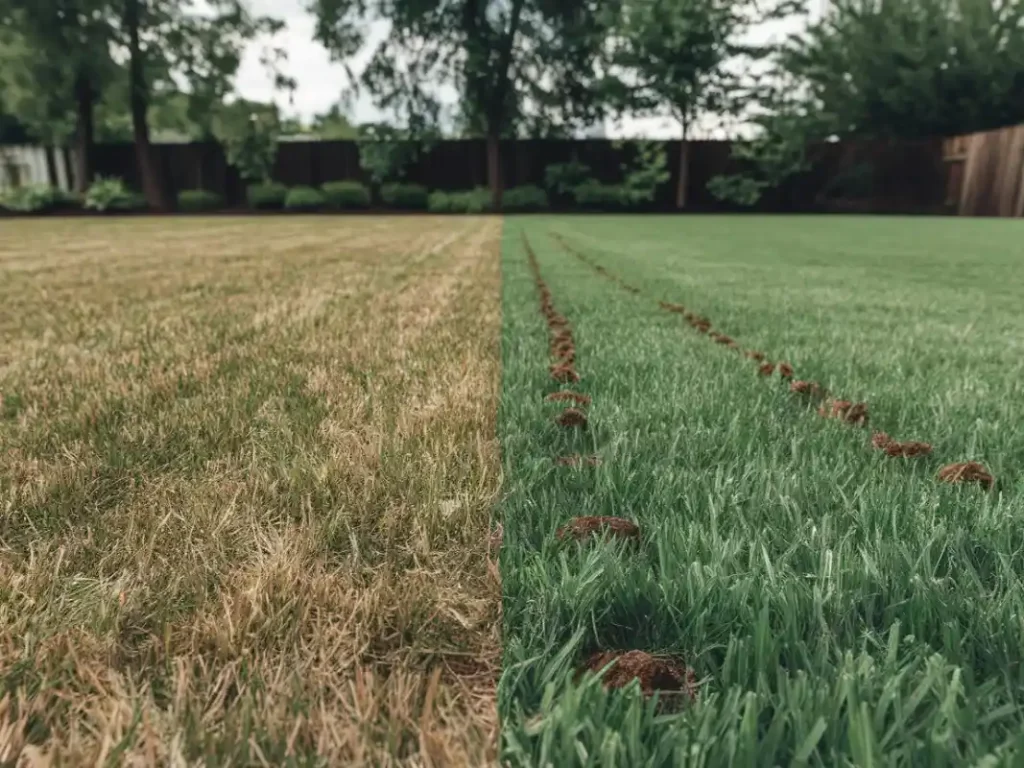
Walk the property in early August and look for these signals. Two or three together is a clear yes for the coming window.
- Thinning turf with visible soil. If you can see dirt while standing upright, density is already too low heading into winter.
- Footprints that stay visible. Healthy turf springs back within a minute.
- Water running off instead of soaking in. Runoff during irrigation is a compaction signature. Persistent wet spots are a different problem — see drainage and grading solutions.
- A screwdriver that will not push in. Push one into moist soil; if it stops in the first two or three inches, the root zone is compacted.
- The same decline every August. A lawn that browns in the same places each summer has shallow roots, not a watering deficit.
- Worn traffic paths. Dog runs, the line from driveway to front door, kids’ routes. Compaction concentrates where feet go.
- A spongy layer above the soil. Thick thatch blocks water and seed, and VCE guidance says address it in fall, not spring.
For a structured read before the window opens, our lawn grade quiz walks the same diagnostic.
Month-by-month timing for Northern Virginia
This is a timing table, not a task list. For each period: is the window open, what is the risk, and should you proceed or wait. Step-by-step execution belongs in our fall renovation manual.
| Period | Window status | Primary risk | Proceed or wait |
|---|---|---|---|
| Early to mid August | Not open | Peak summer soil heat; seedlings emerge into stress and dry out | Wait. Book service and assess the lawn |
| Last week of August to early September | Open — prime | A hot spell can push germination back a week | Proceed if soil temperature is trending down |
| Mid September | Open — ideal | Little; the reliable center of the window | Proceed. Best balance of warm soil, cool air |
| Late September to early October | Open — narrowing | Less growing time before dormancy; leaf drop starts shading seedlings | Proceed, but do not delay further |
| Mid October | Closing — outside edge | Roots may not reach depth to survive freeze-thaw heaving on clay | Proceed only if the fall is warm and watering is reliable |
| November and later | Closed | Seed germinating before a hard freeze dies | Wait. Consider dormant seeding or next fall |
Leaf drop is a timing factor, not just a cleanup chore. Seedlings need light, and a heavy oak or maple canopy can bury a young stand within days. Seed early enough to establish before the canopy comes down, and stay ahead of leaf removal and seasonal cleanup through October and November.
What happens if you miss the fall window?
Sometimes the window closes before you get to it. There is no perfect substitute for fall seeding in Northern Virginia, but there are three real options with real tradeoffs.
Dormant seeding in late fall or winter
Dormant seeding puts seed down when soil is too cold to germinate, so it waits. Freeze-thaw cycles work it into the surface and it germinates as soil warms. The tradeoff is control: you do not pick the germination date, results are uneven, and the seedlings still face their first summer young. A salvage play, not a plan. See our winter lawn care guide.
Sod
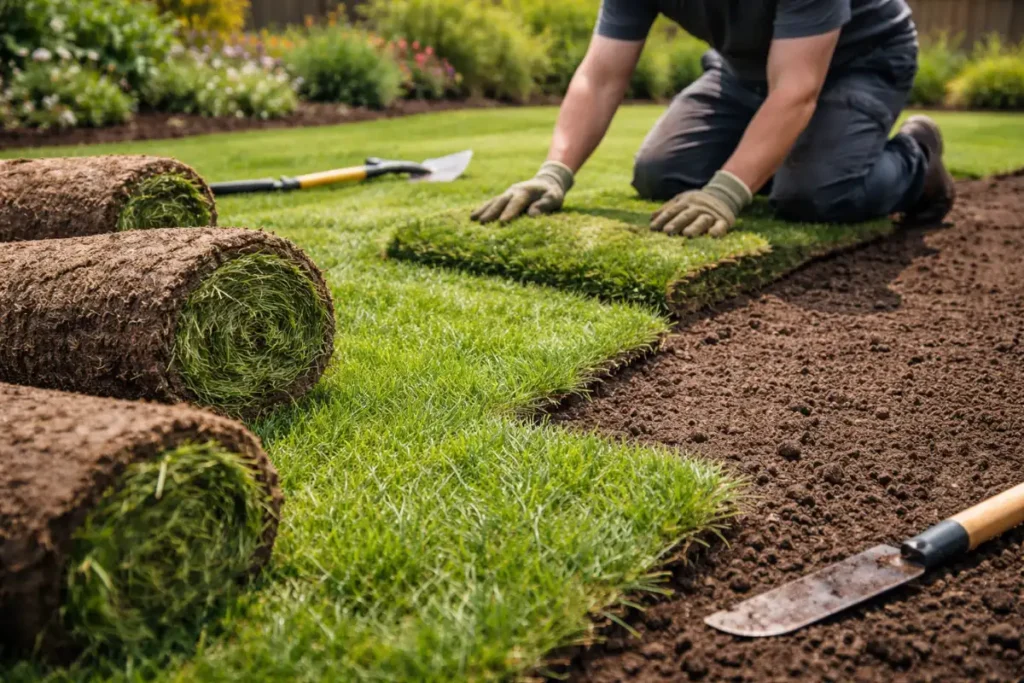
Sod sidesteps the germination window because you install mature turf rather than grow it, which widens the calendar considerably. The tradeoff is cost, plus a demanding rooting and watering period of its own. Compare the approaches in sod versus seed for Northern Virginia, or see our sod installation and lawn renovation service.
Wait for next fall
Often the smartest option. Spend the year on what makes next fall’s seeding work: consistent height through regular mowing, a sound fertility plan, and fixing drainage or irrigation problems. One well-timed fall renovation beats three rushed ones.
When should you book aeration and overseeding service?
The window is about six weeks long and every cool-season lawn in the region wants service inside it. That math is the whole scheduling story: Northern Virginia calendars fill before the window opens, so the practical booking season is July and early August, not September.
- Book early for a date inside the prime window. Calling in late September usually means being offered the tail end, if anything.
- Expect weather to move your date. Aerating saturated clay compacts more than it relieves; bone-dry clay barely lets tines penetrate. A good crew reschedules rather than forcing it.
- Confirm irrigation works first. A broken zone found on day three costs you the seeding. Have sprinkler systems checked in August.
- Coordinate with your weed control schedule so nobody applies pre-emergent near your seeding date.
- Check HOA rules early. Some Northern Virginia communities restrict equipment hours or require notice, narrowing your available dates.
Cost drivers are worth understanding qualitatively: lot size, number of aeration passes, seed selection for sun versus shade, and slopes or obstacles that slow equipment. None change the window, but they change how the job fits a booked calendar. Estimate quantities with our seed calculator, and see our lawn care services for how this fits a full-season program. Lawn Theory schedules fall work in Ashburn and Leesburg, plus Prince William County.
Common aeration and overseeding timing mistakes
- Aerating cool-season turf in spring. VCE says hold off until fall. Spring aeration stresses the lawn before summer and opens the surface for crabgrass.
- Seeding in July or early August. Soil is at peak heat; germination is poor and survival is worse.
- Seeding right before a hard freeze. Seedlings emerging in November have no root system heading into freeze-thaw.
- Applying pre-emergent and then seeding weeks later. The barrier is still active. This is the most common reason a homeowner’s overseeding fails.
- Waiting for all the leaves to drop first. By then the window has closed. Seed on schedule and manage leaves as they fall.
- Treating the date as absolute. A hot early September should push you back a week; a cold snap should stop you short of mid-October.
- Booking after the window opens. By early September most Northern Virginia crews are committed.
For what goes wrong across the rest of the year, see our roundup of common lawn care mistakes.
DIY or professional? For timing, the question is capacity
Doing it yourself has one genuine timing advantage: you can go the day conditions are right. The disadvantages are also timing-related. Rental aerators are booked solid across Northern Virginia during the same six weeks, and one person covering a large clay lot takes far longer than a crew. A job stretched across two weekends can miss the window it started inside. Professional scheduling trades that flexibility for speed: one visit, inside the window, with tines that actually penetrate compacted clay.
Frequently Asked Questions
What month is best to aerate and overseed in Northern Virginia?
September. The VCE Gardener Handbook puts the fall seeding window for Northern Virginia at the last week of August through mid-September, so that stretch is strongest. October is workable but progressively riskier.
Is it too late to overseed in October in Virginia?
Not necessarily. VCE notes good results may still be possible as late as the middle of October in Northern Virginia. After that, seedlings often lack the root depth to survive winter freeze-thaw on clay. Past mid-October, dormant seeding or waiting is usually better.
Can you aerate a lawn in spring in Northern Virginia?
You can, but VCE publication 430-520 advises refraining from aerifying or dethatching cool-season turfgrasses until fall, when the lawn can recover. Spring aeration stresses turf heading into summer and opens the soil surface as crabgrass germinates.
How long before a frost should I overseed?
Seedlings need time to root before the ground starts freezing and thawing. In Northern Virginia that means finishing by mid-October at the latest, preferably by late September. Seeding within a week or two of a hard freeze rarely survives winter.
Should I wait for cooler weather before seeding?
Wait for cooler nights, not cooler soil. The advantage of late August and September is that soil is still warm while air has cooled. Measure at 2 to 4 inches and look for a steady downward trend, not the first genuinely cold week.
Can I apply crabgrass pre-emergent and overseed the same year?
Yes, if you separate them by season: pre-emergent in early spring, overseeding in the fall window. What does not work is applying pre-emergent and seeding within the same few months, because the barrier blocks tall fescue seed too.
Does a hot September delay the overseeding window?
Yes. In a hot, dry September, Northern Virginia soil holds summer heat and seedlings emerge into stress even though the calendar says go. Delaying seven to ten days until soil temperature trends down generally produces better establishment.
Do seeding dates differ elsewhere in Virginia?
Substantially. VCE lists mid-August to mid-September for higher-elevation Western Virginia above roughly 1,200 feet, and September 15 to October 15 for Southern and Southeastern Virginia. Northern Virginia sits at the last week of August to mid-September.
How often should a Northern Virginia lawn be aerated and overseeded?
Most compacted clay-soil lawns benefit from core aeration every fall. Overseeding frequency depends on density: annually for thin or high-traffic lawns, every two to three years for lawns that are already thick.
Get your date on the calendar before the window opens
Timing is the one part of aeration and overseeding you cannot buy back later. Seed, equipment, and effort are all recoverable next year; the six-week window is not. If your lawn showed thinning, compaction, or runoff this summer, the decision is made — what remains is picking a date between the last week of August and mid-September and holding it.
Lawn Theory works across Fairfax County, Loudoun County, and Prince William County, and plans the fall schedule around the VCE window rather than around convenience. Contact Lawn Theory to reserve your aeration and overseeding date.
Keep Reading: Lawn Care
 Lawn Care
 Sprinkler System Winterization in Northern Virginia: Timing, Methods, and What Goes Wrong
Sprinkler winterization in Northern Virginia is about timing, not a fixed date. How to pick your shutdown week, how the three drainage…
 Lawn Care
 Fall Planting in Northern Virginia: Trees, Shrubs, and Mulch Done Right
Fall is the best time to plant trees and shrubs in Northern Virginia, but most failures trace to the first twenty minutes…
 Lawn Care
 The Fall Lawn Renovation Calendar for Northern Virginia: Dates, Seeding Rates, and Soil Temperature
Virginia Cooperative Extension puts the Northern Virginia seeding window at the last week of August through mid-September. Here are the exact dates,…
Want this handled by the crew that wrote the guide?
Veteran-owned. Licensed & insured. Free walkthroughs across Northern Virginia — quotes in 24–48 hours.
Get Your Free Estimate