
How Much Does Pressure Washing Cost in Northern Virginia? (2026 Homeowner Guide)
Pressure washing cost in Northern Virginia is driven by square footage, surface type, buildup severity, and access rather than a flat rate. Most single exterior cleaning services start at $199. Bundling services lowers the per-surface cost because mobilization is the expensive part.
The short answer: there is no universal price for pressure washing a home in Fairfax County, Loudoun County, or Prince William County, because no two houses present the same surface area, the same algae load, or the same access problem. What you can price accurately is the work itself — the surfaces named, the method assigned to each surface, the chemistry used, and the crew time required to protect what surrounds them.
Lawn Theory cleans exteriors across Northern Virginia and quotes every job by surface, not by guess. If you want a number before you talk to anyone, run the pressure washing calculator or the house wash instant quote tool. If you want the work explained first, start with our professional pressure washing services and the wider exterior cleaning lineup.
Key Takeaways
- Pressure washing in Northern Virginia is priced by surface area, surface material, buildup severity, and access — not by a single flat rate.
- Mobilization is the largest fixed cost in any exterior cleaning job, so adding a second or third surface to the same visit costs less per surface than booking each one separately.
- Roof cleaning in Northern Virginia should be a no-pressure soft wash. High pressure on asphalt shingles strips granules and can void the shingle manufacturer’s warranty.
- The black streaks on Northern Virginia roofs are Gloeocapsa magma, a cyanobacteria that thrives in humid, shaded, north-facing conditions.
- A legitimate quote names each surface, the method for that surface, the chemistry, and the remedy if results underperform. A single number in a text message is not a quote.
- Northern Virginia’s clay soil splashes back onto lower siding during heavy rain, which is why the bottom three feet of a house often stain differently than the rest.
- Many Northern Virginia HOAs issue appearance violation letters for algae-streaked siding, roofs, and walkways before a homeowner notices the problem.
- Most Northern Virginia homes need house washing roughly once a year; concrete and roofs run on longer cycles that depend on shade and tree canopy.
How does pressure washing pricing actually work?
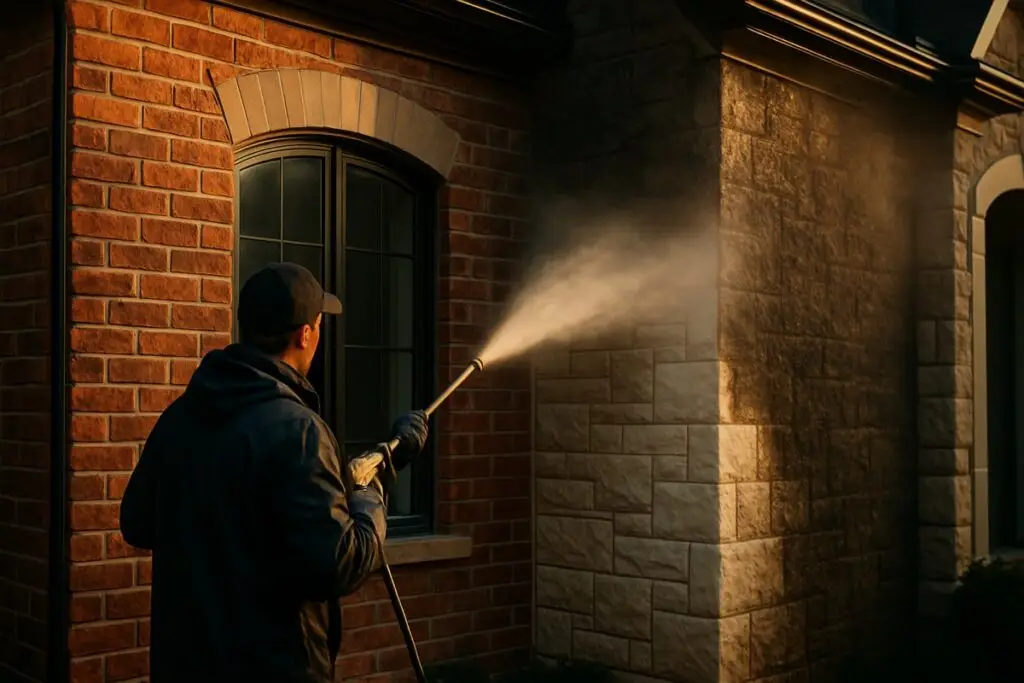
Almost every homeowner assumes exterior cleaning is priced like carpet — so many cents per square foot, multiply, done. It is not. The dominant cost in a pressure washing job is mobilization: getting a trained crew, a truck, a pressure system, tanks, hoses, ladders, chemistry, and surface cleaners to your address, staged, protected, and running.
That mobilization cost is nearly identical whether the crew cleans one surface or four. The truck still drives to Ashburn. The hoses still get run. Plantings still get pre-wetted and rinsed. Water still gets sourced and staged. Downspouts still get checked before chemistry goes anywhere near the ground. All of that happens before a single square foot of siding is touched.
This is why bundling is the single most effective way to lower your effective price per surface. Once the crew is on site and set up, the marginal cost of adding the driveway, the walkway, or the gutter exteriors is only the incremental labor and chemistry — not another full setup, another drive, another staging cycle. Three services booked as three separate visits pay the mobilization cost three times.
The classic Northern Virginia bundle is house washing plus driveway plus gutter brightening. It works because those three surfaces are visible from the street simultaneously, they age at similar rates, and cleaning one makes the other two look worse by contrast. Homeowners who clean only the siding almost always call back about the driveway within a season.
- One service, one visit — you absorb the full mobilization cost against a single surface.
- Two to three services, one visit — mobilization is spread across every surface, so each one costs less than it would alone.
- Whole-exterior package — siding, roof, concrete, deck, and gutters sequenced in a single mobilization, which is where the strongest per-surface economics live.
- Recurring maintenance — annual cleaning removes buildup before it becomes a restoration job, which keeps future visits shorter.
If you are pricing a multi-surface project, compare the bundle against the sum of the individual services rather than against a competitor’s headline number. Our exterior cleaning services are built around this math, and the calculator lets you toggle surfaces on and off to see how the sequencing changes things.
What are the real cost drivers behind a pressure washing quote?
Every honest exterior cleaning estimate is built from the same eight variables. Understanding them lets you read any quote in Northern Virginia and tell whether the contractor actually looked at your house or simply pattern-matched a number.
| Cost driver | Why it changes the price | What raises it | What lowers it |
|---|---|---|---|
| Square footage | Directly sets crew time on the surface and volume of chemistry consumed | Three-level colonial, wraparound porch, large flatwork areas, detached garage | Single-story rambler, compact footprint, townhome with shared walls |
| Surface type | Each material demands a different method, pressure, and dwell time | Mixed materials on one elevation — stone, stucco, cedar, and vinyl together | A single consistent material such as uniform vinyl siding |
| Buildup severity | Heavy organic growth needs longer dwell, a second application, or manual work | First-time clean after years of neglect, thick algae, embedded moss, tannin staining | Annual maintenance wash where growth never established |
| Access and setup | Determines staging time, ladder work, and how far hose runs must reach | Steep slopes, tight lot lines, fenced side yards, second-story overhangs, obstructed spigots | Open flat lot, wide driveway, clear perimeter, easy hose routing |
| Roof pitch and height | Steeper and taller roofs require different equipment and slower, safer work | Steep pitch, three-story elevation, complex dormers and valleys, fragile shingles | Low-slope, single-story, simple roof plane reachable from the ground |
| Water source | Insufficient flow means the crew must haul and stage water instead of drawing on site | Weak or distant spigot, well system with limited recovery, no accessible outdoor tap | Strong municipal supply with a working spigot near the work area |
| Chemistry required | Different soils need different solutions, concentrations, and neutralizing steps | Rust, tannin, battery acid, efflorescence, and organic growth on one property | Straightforward algae and mildew on a compatible surface |
| Plant and property protection | Pre-wetting, covering, and rinsing beds is real labor before and after the clean | Dense foundation plantings, mature specimen shrubs, koi pond, vegetable beds, new sod | Hardscape perimeter, mulch-only beds, minimal soft landscaping near the wall |
Notice that none of these drivers are negotiable talking points — they are physical facts about your property. A contractor who cannot tell you which of these applies to your home has not assessed your home. That is the fastest test available to a homeowner comparing bids in Fairfax County or Loudoun County.
Soft washing vs pressure washing: what is the difference?
This is the most important technical distinction in the entire exterior cleaning trade, and it is where most homeowner damage originates. Pressure washing cleans with mechanical force. Soft washing cleans with chemistry. They are not two settings on the same machine — they are two different jobs solving two different problems.
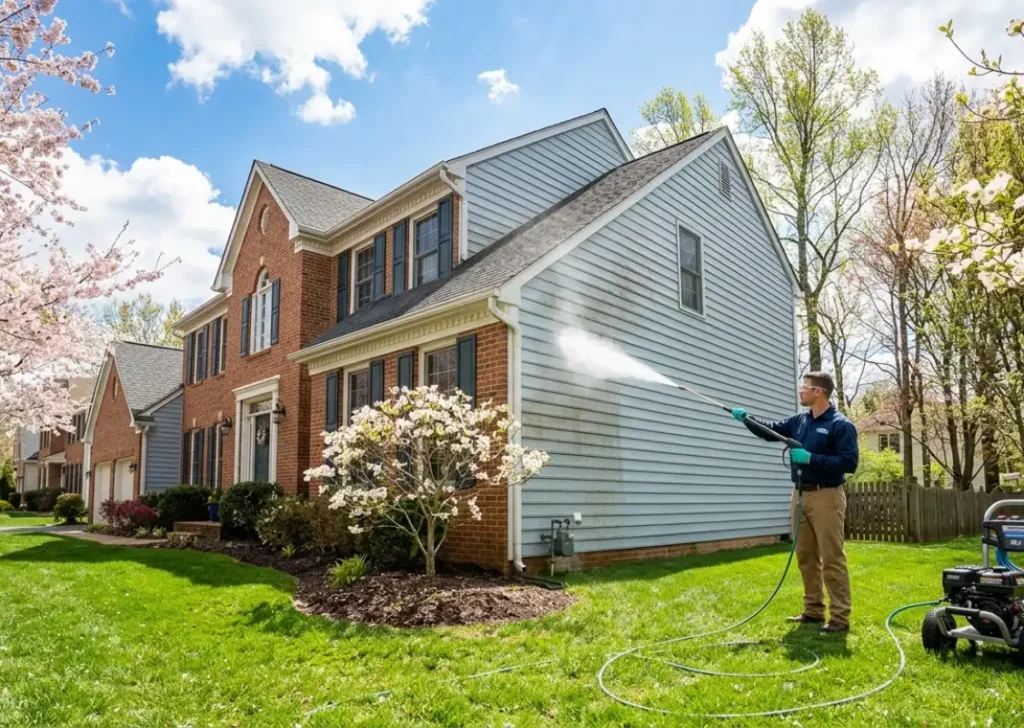
How pressure washing works
Pressure washing uses high PSI water to physically blast contamination off a hard surface. It is the correct method for durable, non-porous, non-fragile materials that can absorb mechanical force without deforming — concrete driveways, sidewalks, garage floors, and most masonry in sound condition. A surface cleaner attachment distributes that force evenly so the concrete does not stripe.
How soft washing works
Soft washing applies a cleaning solution at essentially garden-hose pressure, lets it dwell long enough to kill the organism at the root, then rinses gently. It does not scour the surface — it eliminates the biological growth causing the staining. Because it kills rather than removes, soft-washed surfaces stay clean noticeably longer than surfaces that were merely blasted.
Which surfaces demand which method?
- Soft wash only: asphalt shingle roofs, vinyl siding, painted wood, stucco, EIFS, cedar shake, screens, and most composite decking.
- Pressure wash appropriate: concrete driveways, sidewalks, garage floors, sound brick, and most paver hardscape.
- Judgment call: older mortar, aging pavers with failing joint sand, and any surface where a previous repair is visible. These get evaluated on site.
What happens when the wrong method is used?
The damage from misapplied pressure is expensive, visible, and frequently permanent. These are the failure modes we are actually called to look at in Northern Virginia:
- Oxidized siding streaking — pressure on chalky, sun-aged vinyl or painted surfaces pulls the oxidized layer unevenly, leaving permanent light and dark banding that no subsequent cleaning corrects.
- Blown mortar joints — older brick and stone have softer mortar than the masonry itself. High pressure erodes the joint, and once the mortar is gone the wall takes on water.
- Striped concrete — a wand held too close leaves parallel etch lines in the concrete surface. The stripes are cut into the material and are visible in raking light forever.
- Voided roof warranties — asphalt shingle manufacturers specify low-pressure cleaning. Pressure washing dislodges the protective granule layer, shortens shingle life, and gives the manufacturer grounds to deny a claim.
- Water forced behind siding — siding sheds water downward. Aiming pressure upward under a lap drives water into the wall cavity, where it feeds mold and rots sheathing out of sight.
- Furred and gouged wood — cedar, pine, and softwood decking raise their grain under pressure, leaving a rough splinter-prone surface that then needs sanding before it can be stained.
This is the practical reason method selection belongs in your written quote. A contractor who writes “pressure wash house and roof” is telling you they intend to point high pressure at two surfaces that should never receive it. For the full damage inventory, read our breakdown of the hidden dangers of DIY pressure washing.
How much does house washing cost, and what does it include?
House washing typically starts in the mid-$300s and scales with the elevation count, the total wall area, and how much organic growth has established on the shaded sides. It is a soft wash job on virtually every Northern Virginia home — vinyl, HardiePlank, stucco, and painted trim all fall on the chemistry side of the line.
A complete professional house washing service covers siding, soffits, fascia, gutters’ exterior faces, trim, shutters, and the areas around light fixtures and vents. It does not mean a rinse. The solution has to dwell, kill the growth, and then be rinsed with the plantings protected on both ends of the process. Timing matters too — see our guide to spring house washing in Northern Virginia for the seasonal window.
Why does roof cleaning cost in Virginia run higher than siding?
Roof cleaning costs more than house washing for three structural reasons: the work happens at height, it requires a genuinely no-pressure application system, and the chemistry has to be dosed correctly to kill Gloeocapsa magma without harming the shingles or the landscaping the runoff reaches.
Roof pitch is the biggest single modifier. A low-slope roof reachable from a ladder is a fundamentally different job from a steep three-story elevation with dormers and valleys. Add the fact that roof runoff lands directly on foundation beds, and the plant-protection burden is heavier than on any other surface.
Our professional roof cleaning services use a no-pressure soft wash exclusively. If you are seeing dark vertical streaking, read what causes black streaks on Northern Virginia roofs and check the signs your roof needs professional cleaning. The roof cleaning quiz will tell you whether your roof is a candidate.
What affects driveway and concrete cleaning cost?
Concrete flatwork is priced almost entirely on area and staining type. Plain organic darkening cleans quickly with a surface cleaner. Oil, rust, tannin from oak and maple leaf litter, and tire scuff each require targeted pretreatment before the general clean, and each adds time.
Professional driveway cleaning and sidewalk and walkway cleaning are usually quoted together because the equipment and setup are identical. The same is true of garage floor and concrete cleaning when the door is right there. Our guide to concrete cleaning in Northern Virginia covers the seasonal timing, and preventing winter driveway damage explains why de-icing residue matters.
How is patio and pool deck cleaning priced?
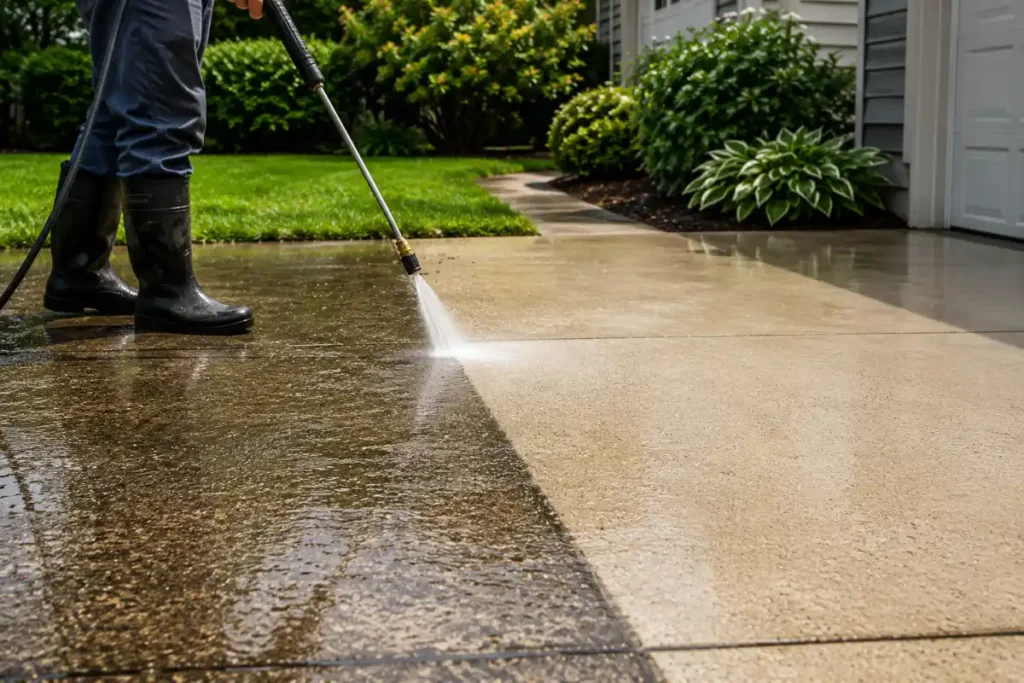
Patios and pool decks introduce variables that driveways do not: joint sand that can be displaced, coping and stone that may be softer than it looks, and a swimming pool that runoff must be kept out of. Textured pool decking also holds algae in its surface profile, which lengthens dwell time.
Patio and pool deck cleaning is often bundled with the driveway because the crew, the water, and the surface cleaner are already staged. Slick, algae-covered walking surfaces are also a liability issue — see slippery sidewalks and HOA violations in Virginia.
What does deck and fence cleaning cost depend on?
Deck and fence cleaning is priced on material, condition, and linear footage. Pressure-treated pine, cedar, and composite each need a different approach, and any board that is already failing has to be identified before cleaning rather than discovered during it.
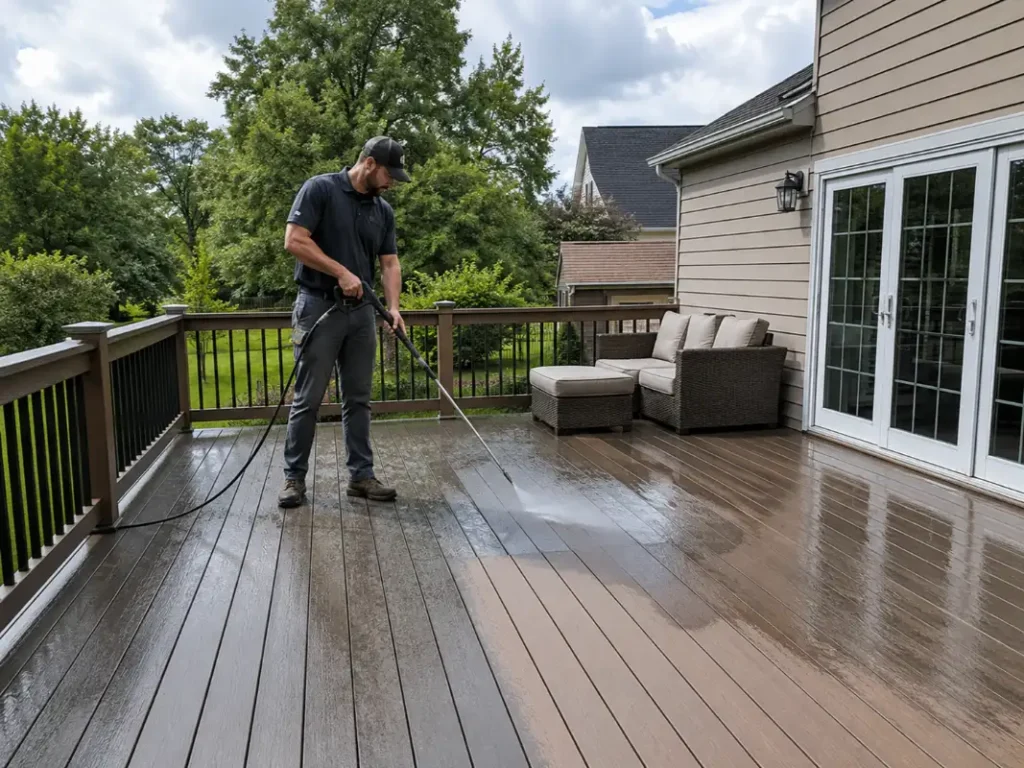
Composite is the most commonly mishandled surface in Northern Virginia. Homeowners assume composite is indestructible and hit it with pressure, which permanently mars the embossed grain. Our guide to Trex and composite deck cleaning explains the correct method, and our deck and fence cleaning services page covers scope. If the deck is being cleaned ahead of a stain or seal, the timing matters — see preparing your deck for summer.
Is gutter cleaning the same as gutter brightening?
No, and this confusion costs Northern Virginia homeowners more disappointment than any other line item. Gutter cleaning is interior debris removal. Gutter brightening is exterior stain removal. They are separate jobs with separate labor and separate chemistry, and one does not include the other.
Those vertical black stripes on the face of your gutters are called tiger striping. They come from oxidized aluminum bonding with airborne carbon and road film, and a house wash rinse will not touch them. They need a dedicated brightening product applied by hand. Gutter cleaning and brightening covers both halves, and the gutter cleaning calculator gives you a starting figure. Seasonal timing is covered in our fall gutter cleaning guide.
Should window cleaning be part of the same visit?
Usually yes, and always after the house wash rather than before. Soft washing the siding puts solution and rinse water across the glass, so windows cleaned first get dirty again immediately. Sequencing it correctly in one mobilization saves a second visit.
Northern Virginia adds a specific complication: irrigation overspray leaves mineral deposits etched into the glass that ordinary washing will not remove. Our exterior window cleaning service handles the routine work, and removing hard water stains from windows covers the restoration case.
Why is rust and stain removal quoted separately?
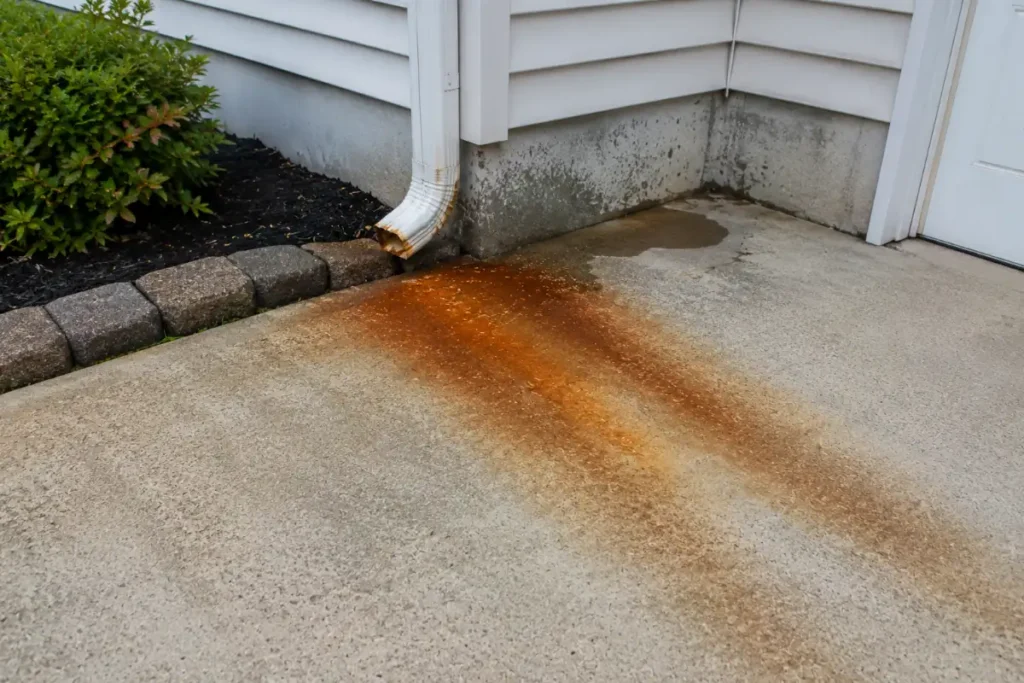
Rust, battery acid, fertilizer burn, and irrigation staining are chemical problems, not dirt. They do not respond to pressure at all, and attacking them with a wand simply etches the surrounding concrete while the stain stays put. They require a specific acid or reducing agent, controlled dwell, and neutralization afterward.
Because the chemistry is different and the risk of collateral damage is real, rust and stain removal is always a separate line. Sprinkler-fed orange staining is especially common here — see rust stain removal from concrete, brick, and stone for what is realistically achievable.
What makes Northern Virginia different from a national cost average?
National cost pages average Phoenix and Seattle together and produce a number that describes neither. Northern Virginia has a specific combination of climate, soil, tree cover, and governance that changes both how fast surfaces dirty and how often they need attention.
Humidity and tree canopy
Northern Virginia summers are humid and the region has heavy mature canopy — oak, maple, and poplar over most established neighborhoods. Shade plus moisture is exactly what algae and Gloeocapsa magma require. North-facing elevations and north-facing roof planes dry slowest and consistently show growth years before the sunny sides do.
Spring pollen load
The regional spring pollen load coats every horizontal and vertical exterior surface in a yellow-green film that then feeds surface growth once the rains start. Pollen is why so many Northern Virginia homeowners schedule house washing for late spring rather than early spring — washing before the heaviest fall means washing twice.
Clay soil splash-back
Northern Virginia sits on heavy red clay. Clay does not absorb heavy rainfall quickly, so water sheets, pools, and splashes soil upward against the bottom courses of siding. That is why the lower three feet of a house here often carry a reddish cast that is entirely distinct from the algae growth above it — two different stains needing two different treatments on the same wall.
HOA appearance standards
Much of Ashburn, Brambleton, South Riding, Stone Ridge, and Kingstowne sits under active HOA covenants with written appearance standards. Streaked siding, a stained roof, and green walkways all generate violation letters, usually with a compliance deadline attached. Our guide to why HOAs require regular pressure washing covers what those letters typically demand.
Freeze-thaw and sealing timing
Northern Virginia winters cycle repeatedly above and below freezing. Water that soaks into concrete expands as it freezes and spalls the surface. This makes sealing valuable — but only if the slab is genuinely dry first. Sealing damp concrete traps moisture under the sealer, and the next freeze-thaw cycle lifts it off in sheets. Read the best time to pressure wash your home’s exterior before scheduling.
These conditions apply across Prince William County and the rest of our service areas, with tree canopy and HOA density varying by neighborhood. Homes in Ashburn and Vienna illustrate both ends of that range.
What does a legitimate pressure washing quote contain?
A real quote names the surfaces, the method per surface, the chemistry, and what happens if results underperform. Everything else is decoration. Use this table to sort a professional estimate from a number someone guessed at from the curb.
| Element | Legitimate quote | Red-flag quote |
|---|---|---|
| Surfaces | Each surface listed individually with its approximate area — siding, soffits, driveway, walkway, gutter faces | “Wash the house” as a single undefined line |
| Method per surface | Soft wash or pressure wash specified for each surface, with the reason stated | “Pressure wash” applied to everything including the roof and siding |
| Chemistry | Solution type disclosed and matched to the soil being removed | Refuses to say, or claims “just water” while visibly removing organic growth |
| Plant protection | Pre-wetting, covering, and post-rinse of landscaping written into the scope | Not mentioned anywhere |
| Water source | Confirms whose water is used and whether the crew brings its own supply | Assumes access without asking, then discovers a problem on the day |
| Exclusions | States plainly what will not fully come out — deep rust, permanent etching, oxidation | Promises everything will look brand new |
| Remedy | Names what happens if a surface underperforms, and who returns to address it | Silent on outcomes; disappears after payment |
| Insurance | Provides a current certificate of liability insurance on request | Deflects, delays, or offers a screenshot of an expired document |
| Format | Written, itemized, dated, on company letterhead or a real estimate platform | One number in a text message |
| Payment | Reasonable terms with payment on completion or a standard deposit | Full cash payment demanded up front before any work |
How do you compare three pressure washing quotes?
Three quotes only tell you something if they describe the same work. Most homeowners collect three numbers for three different scopes, then pick the lowest and wonder why the results differ. Work through this in order.
- Normalize the scope first. Write down every surface you want cleaned, then check each quote against that list. A quote that omits the walkway is not cheaper — it is smaller.
- Compare method line by line. If one contractor soft washes the roof and another pressure washes it, you are not comparing prices. You are comparing a cleaning to a shingle-damage event.
- Ask what chemistry each will use and why. A contractor who can explain why a given solution suits your siding has done this before. One who will not answer is either guessing or hiding something.
- Confirm plant and property protection in writing. Foundation beds, new sod, and specimen shrubs are the most common collateral damage in exterior cleaning.
- Verify insurance and confirm it is current. Ladder and roof work is the exposure. Ask for the certificate rather than a verbal assurance.
- Ask what will not come out. Honest contractors set expectations before the visit. Anyone promising a perfect result on rust, oxidation, or etched concrete is selling a callback.
- Ask about the bundle, not just the item. Given how mobilization works, adding the second and third surface is where the value is. Compare bundles against bundles.
- Check local work, not national reviews. Ask for addresses or photos in your county. Northern Virginia surfaces behave differently than the ones in a stock portfolio.
Once your scope is normalized, the curb appeal score tool helps you decide which surfaces actually move the needle on how your home reads from the street.
What are the most common pressure washing mistakes?
- Pressure washing a roof. The single most expensive mistake in exterior cleaning. High pressure strips shingle granules, shortens roof life by years, and hands the manufacturer a warranty denial. Roofs get a no-pressure soft wash or nothing.
- Washing siding in direct sun. Cleaning solution has to dwell to work. On a hot sunlit wall it evaporates before it kills anything, leaving streaks and a wall that greens back up in weeks. Shaded elevations and cooler parts of the day exist for a reason.
- Assuming gutter whitening is included. Tiger striping on gutter faces is separate work with separate chemistry. Homeowners who assume it comes with the house wash are consistently disappointed at the reveal.
- DIY ladder work. Falls from ladders are the leading injury in homeowner exterior maintenance. A wet ladder, a running hose, and pressure-driven recoil at the nozzle is a genuinely dangerous combination two stories up.
- Sealing concrete before it fully dries. Freshly cleaned concrete holds moisture deep in the slab long after the surface looks dry. Sealing early traps that water, clouds the sealer, and causes it to peel at the first freeze-thaw cycle.
- Holding the wand too close. Distance is the actual pressure control. Closing the gap by a few inches turns a cleaning tool into a cutting tool on concrete, wood, and mortar alike.
- Skipping plant protection. Cleaning solutions that kill roof algae also kill foundation plantings that were not pre-wetted and rinsed. Replacing mature shrubs erases any savings instantly.
- Cleaning only what is visible from the street. The north side is where growth starts. Skipping it means paying to clean the same house again sooner.
Is DIY pressure washing worth it in Northern Virginia?
Honestly, sometimes. A homeowner with a consumer-grade machine, a surface cleaner attachment, and a ground-level concrete walkway can do a respectable job on a Saturday. Flat, durable, reachable-from-standing surfaces are a legitimate DIY target and always have been.
What does not transfer to DIY is everything requiring chemistry, height, or judgment about material tolerance. Soft washing needs a proper application system and correctly mixed solution — a garden sprayer and hardware-store cleaner will not reach the second story or dwell correctly. Roof work needs fall protection and experience reading shingle condition. Siding needs someone who can recognize oxidation before applying pressure to it.
The economics are also less favorable than they look. Rental fees, chemistry, a surface cleaner, and a full weekend of your time close much of the gap on a single service — and close none of it on a bundle, where the professional mobilization advantage is largest. Our full assessment is in the hidden dangers of DIY pressure washing.
- Reasonable to DIY: ground-level walkway, patio slab, garage floor, small fence run, outdoor furniture.
- Hire out: any roof, any second-story elevation, oxidized or painted siding, stucco and EIFS, composite decking, and any surface where rust or a chemical stain is present.
How often does each surface need cleaning in Northern Virginia?
Frequency here is set by shade and moisture more than by anything else. A house under mature oaks on a north-facing lot needs attention roughly twice as often as an identical house on an open sunny lot two streets over.
- House siding — about once a year for most Northern Virginia homes; heavily shaded or north-facing elevations may want a touch-up between full washes.
- Roof — a long cycle measured in years, driven entirely by how quickly Gloeocapsa magma re-establishes. Overhanging limbs shorten it considerably.
- Driveways and walkways — annually in shaded areas where algae makes the surface slick; less often on open sunlit slabs.
- Decks — annually, and always before any stain or seal is applied.
- Gutter interiors — at least twice a year in Northern Virginia given the leaf load, with the heavier clean after leaf drop finishes.
- Gutter faces — brightened as needed once tiger striping becomes visible from the street.
- Windows — typically twice a year, and always sequenced after a house wash rather than before it.
Deferring these cycles is where cost actually accumulates. Growth that has been on a surface for years takes longer to remove, sometimes needs a second application, and in the case of organic staining on siding can become a documented problem — see how mold and mildew affect home value in Virginia. Our spring pressure washing checklist is a practical way to plan the year.
Frequently Asked Questions
How much does pressure washing cost in Northern Virginia?
Most single Northern Virginia exterior cleaning services start at $199 and full-exterior bundles start at $649, depending on square footage, surface type, buildup, and access. Because those four variables differ on every property, the only accurate figure comes from an itemized quote. The pressure washing calculator gives you a starting point.
Does bundling services really lower the cost?
Yes, and the reason is structural. Mobilization — the crew, truck, equipment, water staging, and property protection — is the largest fixed cost in any exterior cleaning job, and it is paid once per visit regardless of how many surfaces are cleaned. Spreading it across two or three services lowers the effective cost of each one.
Will pressure washing damage my vinyl siding?
It can. Sun-aged vinyl develops a chalky oxidized layer, and pressure removes that layer unevenly, leaving permanent light and dark banding. Pressure aimed upward under a lap also forces water behind the siding into the wall cavity. Vinyl siding should be soft washed with chemistry at low pressure.
Can you pressure wash a roof?
You should not. High pressure dislodges the protective granules on asphalt shingles, shortens the roof’s service life, and gives the shingle manufacturer grounds to deny a warranty claim. Roof cleaning in Virginia should always be a no-pressure soft wash that kills the algae rather than blasting it off.
What causes the black streaks on Northern Virginia roofs?
The streaks are Gloeocapsa magma, a cyanobacteria that feeds on the limestone filler in asphalt shingles. It thrives in humid, shaded conditions and appears first on north-facing roof planes, which dry slowest. Northern Virginia’s humidity and mature tree canopy make it common on almost every neighborhood street.
Why is the bottom of my siding a different color than the rest?
That is clay splash-back. Northern Virginia’s heavy red clay sheds rather than absorbs heavy rain, so water sheets along the foundation and throws soil upward onto the lower courses of siding. It is a mineral stain, distinct from the organic algae growth higher on the wall, and the two need different treatment on the same visit.
When is the best time of year to pressure wash in Northern Virginia?
Late spring through fall covers most work, with late spring preferred for house washing because it falls after the heaviest pollen. Avoid washing siding in direct sun, since the cleaning solution evaporates before it can dwell. Concrete sealing should wait until the slab has fully dried after cleaning.
Does my HOA require exterior cleaning?
Many Northern Virginia HOAs enforce written appearance standards that cover siding, roofs, fences, and walkways, and they issue violation letters with compliance deadlines. Requirements vary by association, so check your covenants. Our guide on HOA pressure washing requirements explains what those letters usually ask for.
How long does exterior cleaning results last?
Soft-washed surfaces stay clean noticeably longer than pressure-blasted ones, because the chemistry kills the organism at the root instead of only removing what is visible. Longevity then depends on shade, tree canopy, and drainage — a north-facing wall under mature oaks will regrow faster than an open sunlit elevation.
Do I need to be home during the service?
Not usually, provided the crew has access to the areas being cleaned, gates are unlocked, and an outdoor water source is available if one is being used. Vehicles should be moved off the driveway and windows closed. Anything fragile in the work zone should be pointed out beforehand.
Will the cleaning solution harm my landscaping?
Not when the crew pre-wets, covers, and rinses the beds properly — that protection is standard scope on a professional job. It absolutely can when those steps are skipped, which is the most common form of collateral damage in exterior cleaning and one of the clearest reasons to require plant protection in writing.
What can’t be cleaned off?
Etched concrete, deep rust that has penetrated the slab, oxidation already stripped from siding, and permanent staining under a failed sealer are conditions rather than dirt. A professional will tell you what will improve and what will not before starting. Any contractor promising a brand-new appearance on all of it is overselling.
Get an itemized pressure washing quote for your Northern Virginia home
The most useful thing a homeowner can do is stop shopping for a single number and start comparing scopes. Once you know which surfaces you want cleaned, which method each one requires, and how mobilization is being spread across the job, the pricing becomes readable and the comparison becomes fair.
Lawn Theory quotes exterior cleaning in Northern Virginia surface by surface, with the method and chemistry named for each. Start with the house wash instant quote for a fast figure, browse the full exterior cleaning services lineup, read more in our blog, or contact us for a written, itemized estimate on your address.
Keep Reading: Pressure Washing
 Pressure Washing
 Trex Composite Deck Cleaning in Northern Virginia: Why the Method Totally Changes Compared to Wood
Picture this: your neighbor hires a pressure washing company to clean their beautiful new Trex Transcend deck in Brambleton. The crew shows…
 Pressure Washing
 Sprinkler Rust Stains on Your Northern Virginia Property: Why They Happen and How to Actually Fix Them
You designed your irrigation system to keep your lawn green and your landscaping thriving. Nobody told you it would also paint your…
 Pressure Washing
 The Complete Guide to Concrete Cleaning in Northern Virginia: Driveways, Sidewalks, Garage Floors, and More
Concrete surfaces dominate most Northern Virginia properties: driveways, sidewalks, patios, and garage floors are essential elements of home exteriors and important property…
Want this handled by the crew that wrote the guide?
Veteran-owned. Licensed & insured. Free walkthroughs across Northern Virginia — quotes in 24–48 hours.
Get Your Free Estimate