
Trex Composite Deck Cleaning in Northern Virginia: Why the Method Totally Changes Compared to Wood
Picture this: your neighbor hires a pressure washing company to clean their beautiful new Trex Transcend deck in Brambleton. The crew shows up with a standard pressure washer set at 3,500 PSI and goes to town. By the time they leave, the deck is technically clean. It is also permanently damaged. Surface striping. Fuzzing along the board edges. Warranty: voided.
Your neighbor now owns a very expensive outdoor mistake.
Trex composite deck cleaning in Northern Virginia is one of those topics where doing the wrong thing with total confidence is remarkably easy, and doing the right thing requires knowing a few specific technical details that most pressure washing companies either do not know or do not bother to communicate. If you have a composite deck in Ashburn, Aldie, Brambleton, Loudoun County, or anywhere else in Northern Virginia, this guide is the most important thing you will read before letting anyone touch it with a pressure washer.
At Lawn Theory, a veteran-owned exterior cleaning and outdoor living company serving Aldie, Ashburn, Brambleton, Loudoun County, Fairfax, Arlington, Chantilly, Herndon, Stone Ridge, Sterling, and Falls Church, our deck and fence cleaning service handles both composite and wood decks throughout the region every season. We follow manufacturer cleaning guidelines precisely because a single cleaning session done incorrectly is the difference between a pristine deck and a warranty claim your manufacturer will deny.
Here is the complete breakdown of how wood and composite deck cleaning differ, why PSI and technique matter so much more than most people realize, and what Northern Virginia’s specific climate throws at your deck that makes proper professional cleaning genuinely important.
Why Trex Composite Deck Cleaning in Northern Virginia Requires a Completely Different Approach
The core reason composite and wood deck cleaning require different methods comes down to what each material is actually made of and how it responds to pressure, chemistry, and temperature.
Wood decks are made of natural cellulose fibers, which are inherently porous, absorb water readily, and can withstand moderate to high pressure because the fibers have a natural grain structure that tolerates mechanical force. Wood also benefits from chemical treatments, brighteners, and sealants that penetrate into the fiber structure. The cleaning goal with wood is to open the surface, remove contamination and gray oxidation, and prepare the wood to receive protective finishes.
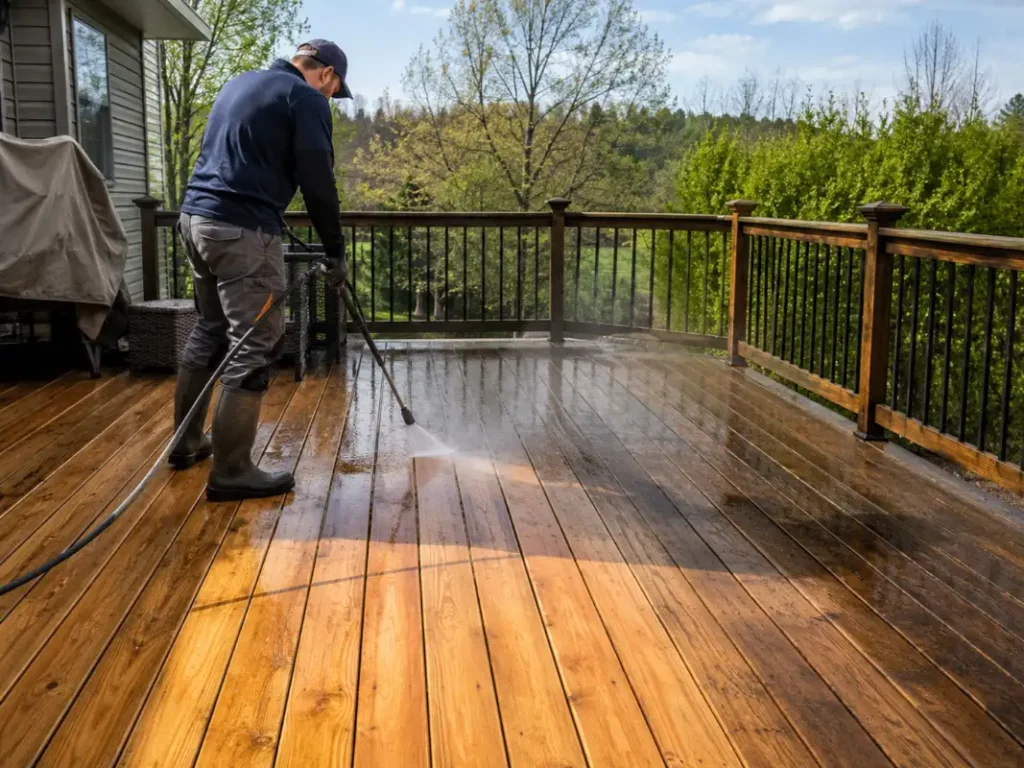
Composite decks are a manufactured product made from a blend of recycled wood fibers and polyethylene plastic, with a protective polymer cap layer fused to the surface. That cap layer is what gives composite its stain and fade resistance, its smooth appearance, and its low-maintenance characteristics. It is also the element that is permanently damaged by excessive pressure, wrong nozzle angles, or incorrect chemistry.
Think of the composite cap layer as a thin protective coating on your car’s paint. You can wash it carefully. You can clean it thoroughly. You absolutely cannot blast it with 3,500 PSI because you are in a hurry and want to get it done.
This distinction becomes especially critical in Northern Virginia because of what our climate puts on your deck over a single season:
Spring pollen loads. Oak, maple, and cedar pollen from Loudoun County’s mature tree canopy coats every horizontal surface from February through May. On a composite deck, pollen is primarily a surface contamination that responds well to low-pressure rinsing with the right composite-safe cleaner. On a wood deck, pollen can penetrate the surface layer and embed into the grain, requiring higher pressure and deck brightener chemistry to fully lift.
Summer mold and mildew. Northern Virginia’s 70 to 90 percent summer humidity creates ideal conditions for mold and mildew on shaded deck sections. On composite, mold sits on the surface cap and can be treated with composite-safe cleaners at controlled pressure. On wood, mold can penetrate into the fiber structure and requires oxalic acid-based deck cleaners and higher pressure to extract.
Oak tannin staining. Tannins from oak leaf accumulation are one of the most common staining sources on Northern Virginia decks throughout fall. On composite, tannin staining responds to specific stain-removal products recommended by manufacturers. On pressure-treated pine or cedar wood, tannins can be lifted with appropriate deck cleaner chemistry and the correct PSI range.
Understanding which material you are cleaning and what has contaminated it determines the entire cleaning protocol.
The PSI Numbers That Determine Whether You Protect or Destroy Your Deck
This is the technical core of the article and the section most homeowners never read anywhere else. The specific PSI ranges for composite and wood deck cleaning are not suggestions. They are the boundary between a successful clean and permanent material damage.
PSI for Trex and Composite Deck Cleaning
Trex’s official cleaning guidelines, published on the Trex manufacturer website and applicable to their Transcend, Enhance, and Select composite decking lines, specify that a pressure washer with no greater than 3,100 PSI may be used with a fan attachment, maintaining at least 8 inches from the decking surface.
However, this number requires important context:
The generation distinction matters enormously. Trex’s recommendation to stay under 3,100 PSI applies to their newer generation composite products with updated cap formulations. Older generation Trex products (roughly pre-2010) have a different cap layer that is more sensitive to pressure, and Trex does not recommend power washing on early-generation decking at all. If you are not certain which generation of Trex you own, treat the deck as early-generation and stay well below 1,500 PSI with a fan tip and maximum distance from the surface.
The practical safe range for professional cleaning of modern composite decking is 1,500 to 2,100 PSI with a 40-to-60-degree fan nozzle, maintained at 8 to 12 inches from the surface. This range delivers effective cleaning without approaching the threshold where cap layer damage occurs.
Fan nozzle is non-negotiable. A zero-degree or 15-degree nozzle on a composite deck, even at moderate pressure, concentrates enough force to permanently stripe the cap layer surface. Always a 40-degree fan tip minimum. Always a sweeping motion following the direction of the board grain.
Bleach is not the solution to composite mold. This point directly addresses one of the most common DIY mistakes in Northern Virginia: applying bleach to a composite deck with mold growth. Trex explicitly states that bleach does not penetrate deep enough to eliminate mold at its roots on composite surfaces, and as bleach evaporates it leaves behind moisture that can further promote mold growth. Beyond ineffectiveness, use of products containing bleach or acid will lighten the surface of Trex, potentially creating discoloration you cannot reverse. The correct chemistry for composite mold treatment is composite-specific enzymatic cleaners or the Trex-approved soap-and-water approach with appropriate dwell time.
PSI for Wood Deck Cleaning in Northern Virginia
Wood deck cleaning operates in a fundamentally different pressure range, but it is still not a situation where maximum pressure equals maximum cleaning.
For soft woods including cedar and pressure-treated pine, the safe pressure washing range is 500 to 1,200 PSI, depending on the wood condition and contamination level. Exceeding 1,200 PSI on cedar risks fuzzing the grain and raising wood fibers permanently. On pressure-treated pine that has been weathered or has any surface checking, even moderate pressure at close distance can splinter or damage the surface.
For hardwood decks including Ipe and similar tropical species, the range extends to approximately 1,500 to 2,000 PSI because the denser fiber structure tolerates more mechanical force. Even so, the 25-degree fan nozzle at a consistent 8 to 12 inch distance remains the correct technique.
The critical rule for wood deck cleaning direction: always work with the grain of the wood, moving the spray wand in the same direction as the board runs. Cross-grain pressure washing drives water and contamination laterally into the wood fiber and can create raised grain patterns that alter the surface texture permanently.
The complete PSI comparison:
| Surface Type | Safe PSI Range | Recommended Nozzle | Min Distance |
|---|---|---|---|
| Early-generation Trex or composite | 500 to 1000 | 40 to 60 degree fan | 12 inches |
| Modern Trex and composite (post-2015) | 1500 to 2100 | 40 to 60 degree fan | 8 to 12 inches |
| Cedar and pressure-treated pine | 500 to 1200 | 25 to 40 degree fan | 8 to 12 inches |
| Tropical hardwood (Ipe, Mahogany) | 1500 to 2000 | 25 degree fan | 8 to 12 inches |
| Any deck with zero-degree or turbo nozzle | Never safe | Do not use | N/A |
The Chemistry Difference: What Cleaners Work on Composite vs Wood
PSI is only half of the cleaning equation. The chemistry applied to the surface before and during pressure washing determines whether you are cleaning effectively or setting up the next problem.
Composite Deck Cleaning Chemistry
For routine composite deck cleaning of pollen, general grime, and light organic film, Trex’s approved options include mild dish soap and warm water (the gentlest and most broadly safe option), Formula 409 or similar mild household cleaners, and composite-specific deck cleaning products approved by the manufacturer.
For mold, mildew, and biological growth on composite surfaces, the correct approach is composite-safe enzymatic or oxygen-based cleaners, not chlorine bleach. Products formulated specifically for composite deck cleaning lift mold from the surface without damaging the cap layer or leaving moisture that promotes regrowth.
For tannin staining from oak leaves on composite, specific stain treatment products formulated for composite are available from Trex and third-party manufacturers. These products address the iron-tannin compounds that create the characteristic dark staining without the acid content that would etch or lighten the composite surface.
What never goes on composite: chlorine bleach, acid-based cleaners, oil-based soaps, abrasive scrubbing pads, power tools with wire brush attachments, or any product that would void the manufacturer’s warranty. Always verify any product against the current Trex care guidelines before application.
Wood Deck Cleaning Chemistry
Wood deck cleaning chemistry is more aggressive and more varied because wood can be opened, treated, and sealed in ways that composite cannot.
For general cleaning and gray oxidation removal on pressure-treated pine, a sodium percarbonate deck cleaner (oxygen bleach) applied with a stiff bristle brush and allowed to dwell before rinsing effectively lifts embedded dirt, mold, and weathering without damaging the wood fiber.
For mold and mildew on wood, diluted sodium hypochlorite (chlorine bleach) in appropriate concentrations is effective and appropriate for wood surfaces. The same bleach that is problematic on composite is the standard treatment for wood mold.
For gray, weathered wood that needs restoration before sealing, an oxalic acid-based deck brightener applied after cleaning neutralizes the alkaline compounds that cause graying and restores the wood’s natural color before stain or sealer application. This step has no equivalent in composite care.
After cleaning and brightening, wood decks require drying to below 15 percent moisture content before any stain or sealer is applied. This typically means 24 to 72 hours of dry weather after cleaning, depending on the humidity and temperature conditions. Applying deck sealer over wood with elevated moisture content is the primary cause of sealer failure, peeling, and premature finish deterioration. This post-clean drying requirement is one of the key reasons wood deck maintenance is more time-dependent and weather-sensitive than composite cleaning.
What Northern Virginia Does to Both Deck Types Between Cleanings
Northern Virginia’s specific seasonal cycle creates predictable contamination patterns on both composite and wood decks throughout the year. Understanding this cycle helps you schedule cleaning at the optimal moments.
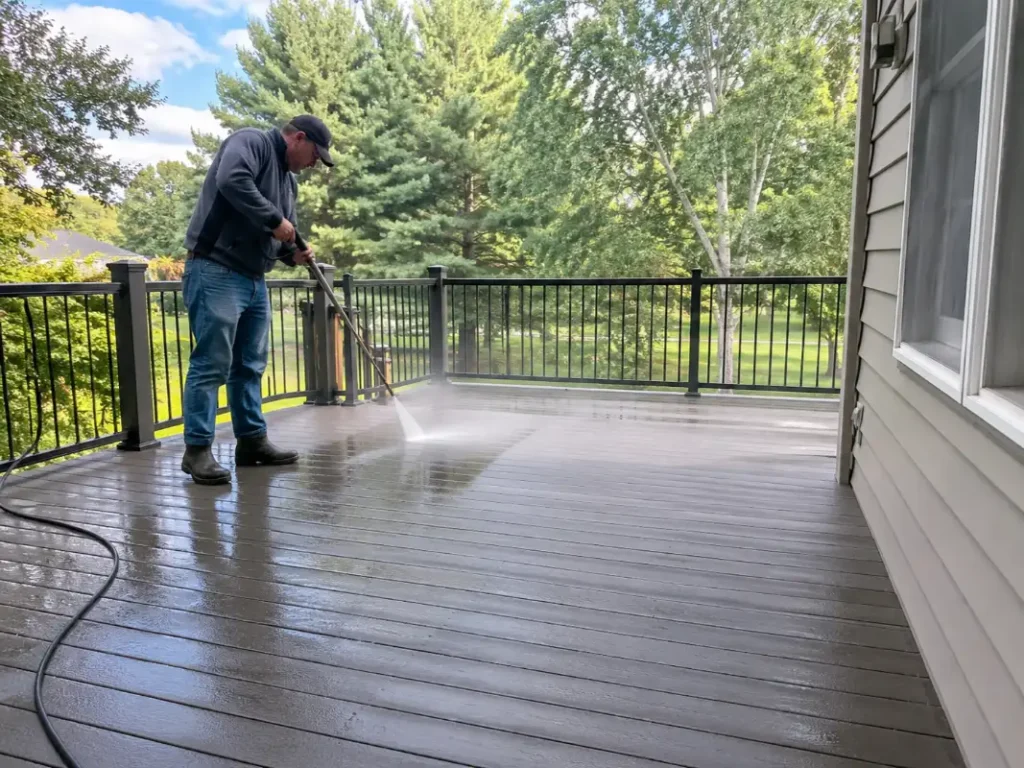
Spring (March through May): Pollen season. This is the most visible contamination event of the year. The massive pollen load from Loudoun County’s oak, maple, and cedar canopy coats deck surfaces in a yellow-green film that, if left to bake through summer, can permanently discolor composite surfaces and deeply embed in wood grain. Spring cleaning ideally happens in late April to mid-May after the primary pollen drop completes but before summer heat bakes the deposit into the surface.
Summer (June through August): Mold, mildew, and algae. Northern Virginia’s summer humidity creates the perfect incubation environment for biological growth, especially on shaded deck sections. Composite decks in Aldie, Brambleton, and Stone Ridge neighborhoods with tree canopy above the deck are especially prone to mid-summer mold development. Summer spot treatment of biological growth as it appears prevents the establishment of deeply embedded colonies that require more intensive fall cleaning.
Fall (September through November): Oak tannin and leaf debris. Decomposing oak leaves are rich in tannins that stain both composite and wood surfaces with dark brown or black discoloration. Leaves left sitting on a deck surface for more than a few days in wet fall conditions begin depositing these tannins directly into the surface. Our leaf removal and seasonal cleanup service keeps decks and outdoor surfaces clear of leaf accumulation through the fall season, preventing tannin staining before it occurs.
Winter (December through February): Freeze-thaw stress. Northern Virginia’s freeze-thaw cycles do not damage composite decking structurally, but any water pooling in board gaps that freezes can expand and gradually shift composite boards if drainage is inadequate. On wood decks, freeze-thaw cycles accelerate checking, cracking, and splitting of boards that were not properly sealed before winter. A pre-winter inspection and sealing of wood decks in October is the single most effective action for extending wood deck life.
The Cleaning Schedule That Makes Sense for Each Material in Northern Virginia
The correct cleaning frequency differs significantly between composite and wood in our climate.
Composite Deck Cleaning Schedule
Routine maintenance: Hose rinse after heavy pollen events and after fall leaf accumulation. This can be done by the homeowner with a garden hose and takes 10 to 15 minutes.
Professional cleaning: Once per year, ideally in late spring (May to June) after pollen season completes. A professional cleaning at this timing removes the full season’s biological and organic buildup before summer heat fully bonds it to the surface. Our deck and fence cleaning service handles composite decks throughout Loudoun County and Fairfax with appropriate equipment and composite-safe chemistry.
Deep clean: Every 2 to 3 years for composite decks with significant shade coverage or those adjacent to heavy organic sources (oak trees directly above the deck). Deep cleaning addresses the cumulative buildup that annual maintenance does not fully lift.
Wood Deck Cleaning and Maintenance Schedule
Wood decks in Northern Virginia require a more involved maintenance cycle because of the sealing requirement.
Annual cleaning: Once per year in spring, using appropriate wood deck cleaner and pressure-washing at the correct PSI for the wood type. The cleaning removes winter weathering, spring pollen, and surface oxidation.
Deck brightening: Apply oxalic acid brightener after cleaning to neutralize graying and prepare the surface for sealer.
Sealing every 1 to 2 years: After the deck fully dries (below 15 percent moisture), apply an appropriate penetrating sealer or stain. This is the step that protects wood from Northern Virginia’s humidity, UV exposure, and freeze-thaw stress through the next season. Skipping sealing for two or three consecutive years results in the gray, cracked, splintered surface that makes homeowners wonder if they should have bought composite.
How Deck Cleaning Fits Into the Complete Lawn Theory Outdoor Property Program
At Lawn Theory, deck and fence cleaning does not exist as an isolated service. It is one element of a complete outdoor property maintenance program that covers every surface and every need from the lawn to the roofline.
Many Northern Virginia homeowners combine our deck and fence cleaning service with:
Professional house washing to clean siding and trim at the same appointment, patio and pool deck cleaning for hardscape surfaces connected to the deck, gutter cleaning and brightening to clear the leaf and debris sources that stain decks directly below them, exterior window cleaning for windows adjacent to the deck area, sidewalk and walkway cleaning for approach and perimeter surfaces, and driveway cleaning for a complete exterior refresh in a single coordinated appointment.
If your deck or fence needs more than cleaning, our build and outdoor living team handles board replacement, structural repairs, and the complete design and construction of new decks and porches, pergolas and pavilions, outdoor kitchens, fire pits and fireplaces, patios and hardscapes, and outdoor lighting installation that transforms what surrounds your cleaned deck into a complete outdoor living environment.
The lawn and landscape surrounding your deck are part of the same property presentation. Our lawn care and landscaping services including mulching and bed maintenance, tree and shrub care, and landscape design and installation ensure that the outdoor environment surrounding your freshly cleaned deck looks as intentional and well-maintained as the deck itself.
Frequently Asked Questions: Composite and Wood Deck Cleaning in Northern Virginia
Q1: What PSI should be used to clean a Trex composite deck in Northern Virginia?
For modern Trex composite decking including Transcend, Enhance, and Select lines, the manufacturer recommends a maximum of 3,100 PSI with a fan attachment maintained at a minimum 8 inches from the surface. In practice, professional cleaning at 1,500 to 2,100 PSI with a 40-to-60-degree fan nozzle delivers effective results while staying well within the safe zone. For early-generation Trex products (pre-2010), Trex does not recommend pressure washing at all. When in doubt about which generation you own, treat the deck as early-generation and use the lowest effective pressure.
Q2: Can I use bleach on a composite deck in Northern Virginia?
Trex explicitly advises against bleach on composite decking. Bleach does not penetrate deep enough to eliminate mold at its roots, and as it evaporates it leaves behind moisture that can promote further mold growth. Bleach and acid-based cleaners can also lighten the surface of Trex composite boards, creating discoloration that cannot be reversed. Use composite-specific enzymatic cleaners or Trex-approved mild soap solutions for mold and biological growth on composite surfaces.
Q3: What is the difference between cleaning a wood deck and cleaning a composite deck?
Wood and composite decks require fundamentally different pressure ranges, chemistry, and technique. Wood decks support pressures of 500 to 1,500 PSI depending on wood type, respond well to oxygenated and chlorine bleach cleaners, benefit from oxalic acid brighteners, and require sealing every 1 to 2 years after cleaning. Composite decks require a fan nozzle under 3,100 PSI with specific composite-safe chemistry, no bleach or acid products, no sealing required, and no brightening step. The cleaning goal with wood is opening the surface for new finish. The goal with composite is protecting the factory cap layer.
Q4: How often should composite decks be professionally cleaned in Northern Virginia?
Most Northern Virginia composite decks benefit from professional cleaning once per year, ideally in late spring after pollen season completes. Composite decks with heavy shade coverage or significant organic input from overhead oak trees may benefit from a mid-season treatment of biological growth in summer and a fall rinse after leaf drop. Routine homeowner maintenance between professional cleanings includes hose rinsing after heavy pollen events and prompt removal of leaf accumulation to prevent tannin staining.
Q5: How often should wood decks be cleaned and sealed in Northern Virginia?
Wood decks in Northern Virginia should be cleaned annually in spring, brightened with oxalic acid after cleaning, and sealed every 1 to 2 years. The sealing schedule depends on the specific sealer used, the exposure level of the deck, and the condition of the existing finish. A simple test: sprinkle water on the deck surface. If it beads, the sealer is still effective. If it absorbs immediately, it is time to re-seal. Sealing in fall (October) before winter freeze-thaw cycles provides the maximum protective benefit for the most damaging season.
Q6: Will power washing void my Trex warranty?
Power washing that exceeds 3,100 PSI on modern Trex decking voids the manufacturer warranty. Any use of power washing on early-generation Trex products (Trex Accents or Trex Brasilia lines from before approximately 2010) also voids warranty. Additionally, use of zero-degree or 15-degree nozzles at any pressure on composite decking creates warranty-voiding surface damage. Professional cleaning that follows Trex’s published care and cleaning guidelines preserves the warranty. Always request confirmation that your cleaning company follows manufacturer guidelines before allowing any work on your composite deck.
Q7: What causes the dark staining on composite decks in Northern Virginia?
The most common sources of dark staining on Northern Virginia composite decks are oak tannins from fallen leaves sitting on the surface in wet conditions, iron deposits from nearby metal furniture, planters, or irrigation water with elevated iron content, and mold or mildew establishing in shaded, humid board areas. Tannin staining requires specific composite stain treatment products. Iron staining requires oxalic acid-based iron removers applied cautiously and in accordance with manufacturer guidance. Biological growth responds to composite-safe enzymatic cleaners at appropriate pressure.
Q8: Can Lawn Theory clean both wood and composite decks in Northern Virginia?
Yes. Lawn Theory’s deck and fence cleaning service handles both wood and composite decking with the correct equipment, PSI settings, and chemistry for each material. We assess the specific deck material, its generation where applicable, contamination type, and condition before selecting any equipment or products. We follow all Trex and composite manufacturer care guidelines to protect warranties, and we maintain the separate protocols required for wood deck cleaning and sealing preparation.
Q9: How does Northern Virginia’s pollen season specifically affect composite decks?
Northern Virginia’s spring pollen load from oak, maple, and cedar canopy is one of the heaviest in the Mid-Atlantic region, and composite decks accumulate a thick pollen film from February through May. On composite, pollen is primarily a surface contamination that responds well to appropriate composite cleaner and low-to-moderate pressure, but pollen that is left to bake through summer heat bonds more aggressively to the cap layer surface and requires more effort to fully remove in fall. Cleaning in late April to mid-May, after the primary pollen drop but before sustained summer heat, is the optimal timing for Northern Virginia composite decks.
Q10: What is the best way to prevent mold on a composite deck in Northern Virginia?
The most effective mold prevention strategies for composite decks in Northern Virginia are keeping the deck surface clear of organic debris (leaves, pollen accumulation, and dirt) that provides mold spores with nutrients, trimming any overhead branches that create deep shade and persistent dampness on deck sections, and ensuring adequate gap spacing between boards for drainage and airflow. Annual professional cleaning that treats existing biological growth before it establishes deeply, combined with prompt spot treatment of mold as it appears in summer, prevents the heavy infestations that require intensive restoration cleaning.
Ready to Get Your Deck Cleaned Correctly in Northern Virginia?
Your Trex composite deck is worth protecting. Your wood deck is worth maintaining properly. Both deserve a cleaning crew that knows the difference between the two and applies the right equipment, the right PSI, and the right chemistry to each one.
Lawn Theory’s deck and fence cleaning service follows manufacturer guidelines for every composite product we touch. No warranty-voiding PSI. No bleach on composite. No cross-grain pressure washing on wood. Just the correct method applied by a veteran-owned team that takes precision seriously. See us on Instagram & Linkedin.
We serve homeowners across: Aldie, Ashburn, Brambleton, Loudoun County, Fairfax, Arlington, Chantilly, Herndon, Stone Ridge, Sterling, Falls Church, and all of Northern Virginia.
Here is how to get started:
- Explore our deck and fence cleaning service
- See our full exterior cleaning program
- Add house washing or gutter cleaning to your appointment
- Request your free quote today
Call Lawn Theory: (703) 650-5655
Your deck deserves the right method. Let us deliver it.
Keep Reading: Pressure Washing
 Pressure Washing
 How Much Does Pressure Washing Cost in Northern Virginia? (2026 Homeowner Guide)
Pressure washing cost in Northern Virginia is set by square footage, surface type, buildup and access, not a flat rate. Here is…
 Pressure Washing
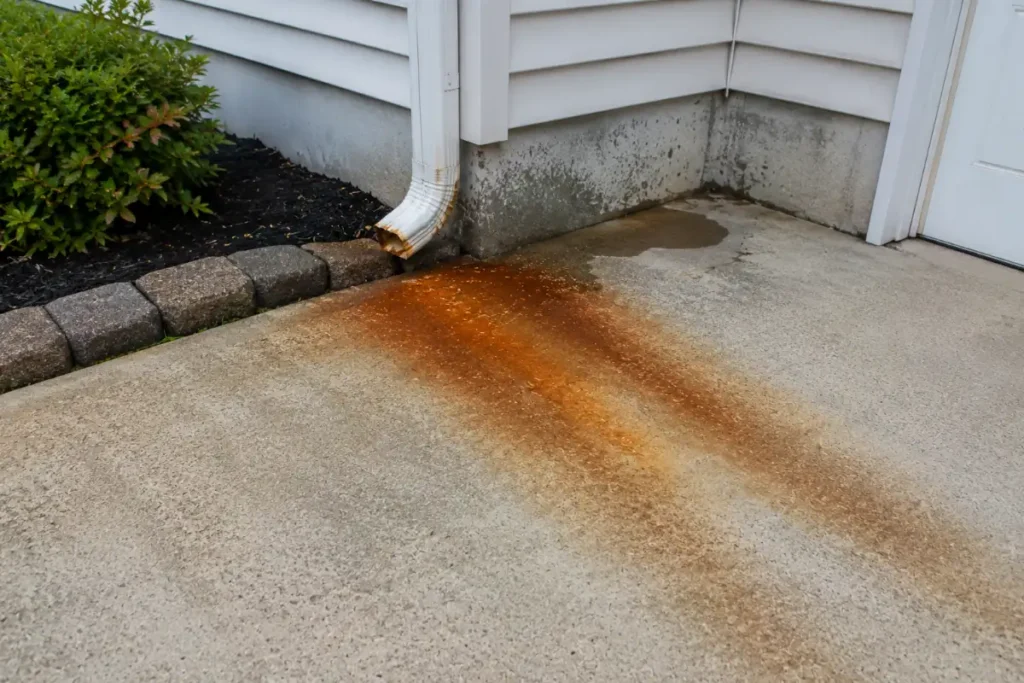
 Sprinkler Rust Stains on Your Northern Virginia Property: Why They Happen and How to Actually Fix Them
You designed your irrigation system to keep your lawn green and your landscaping thriving. Nobody told you it would also paint your…
 Pressure Washing
 The Complete Guide to Concrete Cleaning in Northern Virginia: Driveways, Sidewalks, Garage Floors, and More
Concrete surfaces dominate most Northern Virginia properties: driveways, sidewalks, patios, and garage floors are essential elements of home exteriors and important property…
Want this handled by the crew that wrote the guide?
Veteran-owned. Licensed & insured. Free walkthroughs across Northern Virginia — quotes in 24–48 hours.
Get Your Free Estimate