
Sprinkler Rust Stains on Your Northern Virginia Property: Why They Happen and How to Actually Fix Them
You designed your irrigation system to keep your lawn green and your landscaping thriving. Nobody told you it would also paint your driveway orange.
If you are staring at rust-colored streaks on your siding, orange halos on your concrete driveway, reddish-brown stains bleeding across your paver patio, or crusty discoloration around your walkways, you are dealing with one of Northern Virginia’s most frustrating and most misunderstood exterior maintenance problems. And the reason it keeps coming back, no matter how many times you scrub it, is because most homeowners are treating the symptom without understanding the source.
At Lawn Theory, a veteran-owned exterior cleaning and outdoor living company serving Aldie, Ashburn, Brambleton, Loudoun County, Fairfax, Arlington, Chantilly, Herndon, Stone Ridge, Sterling, and Falls Church, our teams remove sprinkler rust stains from Northern Virginia properties across the region every season. This guide gives you the complete picture: the chemistry behind why it happens, why Northern Virginia’s specific water supply and geology make this problem uniquely intense here, every surface type affected, and the removal and prevention strategies that actually work.
Call Lawn Theory: (703) 650-5655 or request your free on-site estimate today.
What Are Sprinkler Rust Stains and Why Do They Keep Coming Back?
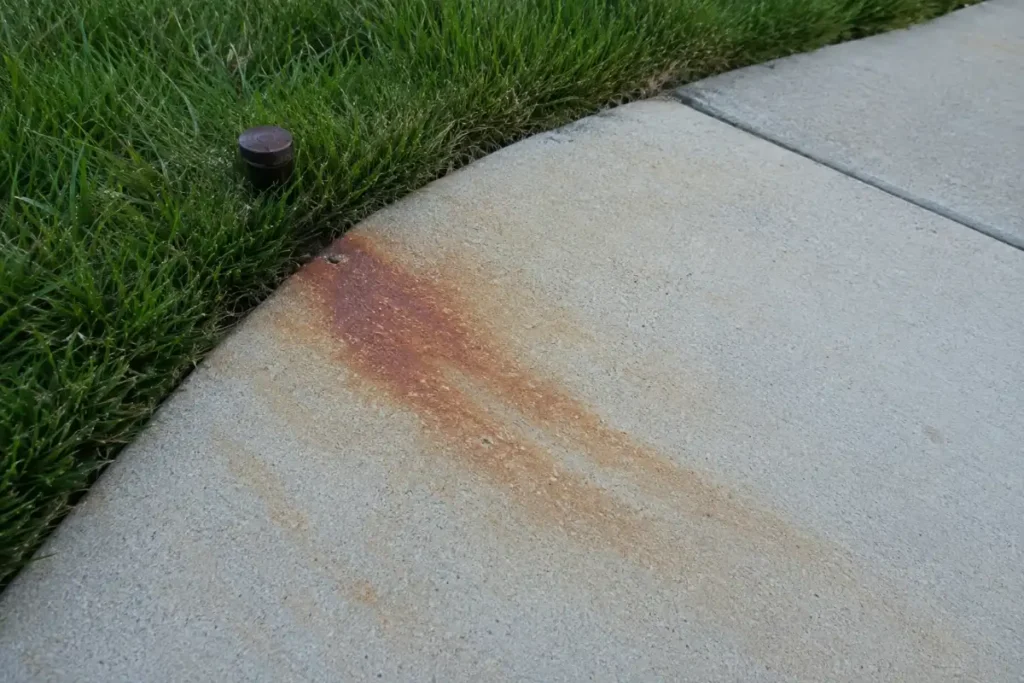
Sprinkler rust stains are iron oxide deposits left behind when water containing dissolved iron contacts an outdoor surface and then evaporates or dries. The process is exactly what happens when a nail left in the rain turns orange. Water and iron combine with oxygen to form iron oxide, which bonds to porous and semi-porous surfaces as a reddish-brown or orange stain.
Here is the short answer to why they keep coming back: you are cleaning the stain but the water producing it keeps running. Every irrigation cycle deposits a fresh layer of dissolved iron on your driveway, siding, pavers, and walkways. Each deposit bakes in the sun, bonds to the surface, and builds on top of the previous layers. Clean it once and another cycle starts the process again within days.
The key to permanently solving this problem requires understanding two things: where the iron is actually coming from in your specific Northern Virginia water supply, and which surfaces on your property are accumulating it fastest.
Why Northern Virginia Is Uniquely Vulnerable to Irrigation Rust Staining
This is the section most national cleaning guides skip entirely, and it is the most important context for understanding why this problem is more intense here than in many other regions.
The Northern Virginia Geology Factor
Northern Virginia sits at the intersection of three distinct geological provinces, each with its own groundwater chemistry. The Piedmont Province, which covers eastern Loudoun County and most of Fairfax County where the majority of the population lives, produces wells with hard water, iron, and manganese as common characteristics. The Triassic Lowland running through central Loudoun County produces very hard water with significant calcium and magnesium. The Blue Ridge Province in western Loudoun produces acidic water with iron and elevated mineral content from older rock formations.
In practical terms: a significant portion of Northern Virginia homeowners, particularly those in rural Loudoun County, western Aldie, western Ashburn, and the unincorporated areas of Fairfax County, rely on private well water for their irrigation systems. Wells in the Piedmont and Blue Ridge formations that underlie these areas routinely produce water with elevated iron content.
Iron concentrations above 0.3 parts per million are considered problematic, and well water in iron-rich areas commonly ranges from 0.5 to 10 parts per million. At the lower end of that range, you will see occasional light staining. At the higher end, a single week of irrigation can leave visible orange deposits on every surface the sprinkler touches.
The Municipal Water Hardness Factor
Even homeowners connected to Loudoun Water or Fairfax Water, the two primary municipal suppliers for the region, are not immune. Homes in Fairfax County and Loudoun County often measure higher hardness than properties closer to central DC, with mineral content varying significantly by neighborhood and county. Municipal water is treated and safe to drink, but it still contains dissolved minerals that exit the irrigation system and deposit on surfaces as the water evaporates. The result is not always the deep orange of iron-rich well water, but the cumulative mineral deposits from municipal water can produce yellow-brown staining on concrete, pavers, and siding over an irrigation season.
The Fertilizer Iron Factor
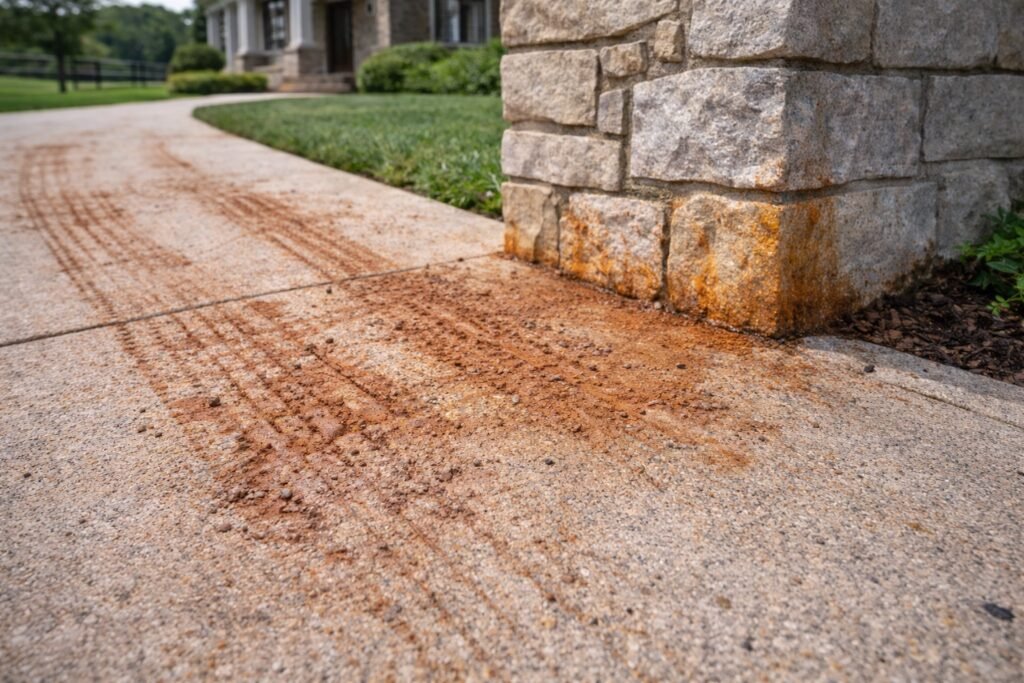
Here is a third source of orange staining that almost nobody mentions: granular lawn fertilizers containing iron sulfate or chelated iron. Many Northern Virginia lawn care programs include iron-containing fertilizer products applied to boost turf color and density. When granular fertilizer pellets land on driveways, sidewalks, or patio surfaces and get wet before being swept off, the iron oxidizes directly on the concrete and creates small orange spot patterns that look exactly like irrigation staining. Immediately using a leaf blower to clear hardscapes after granular fertilizer application prevents this type of iron staining entirely.
For many Northern Virginia homeowners dealing with orange stains, the actual source is a combination of all three: iron-rich irrigation water, mineral-laden municipal water, and fertilizer pellet contact on hardscape surfaces.
Every Surface Sprinkler Rust Stains Attack on a Northern Virginia Property
Understanding which surfaces are most vulnerable helps you prioritize cleaning and protection. Here is what Lawn Theory’s exterior cleaning teams encounter across Loudoun County and Fairfax properties:
Concrete Driveways and Walkways
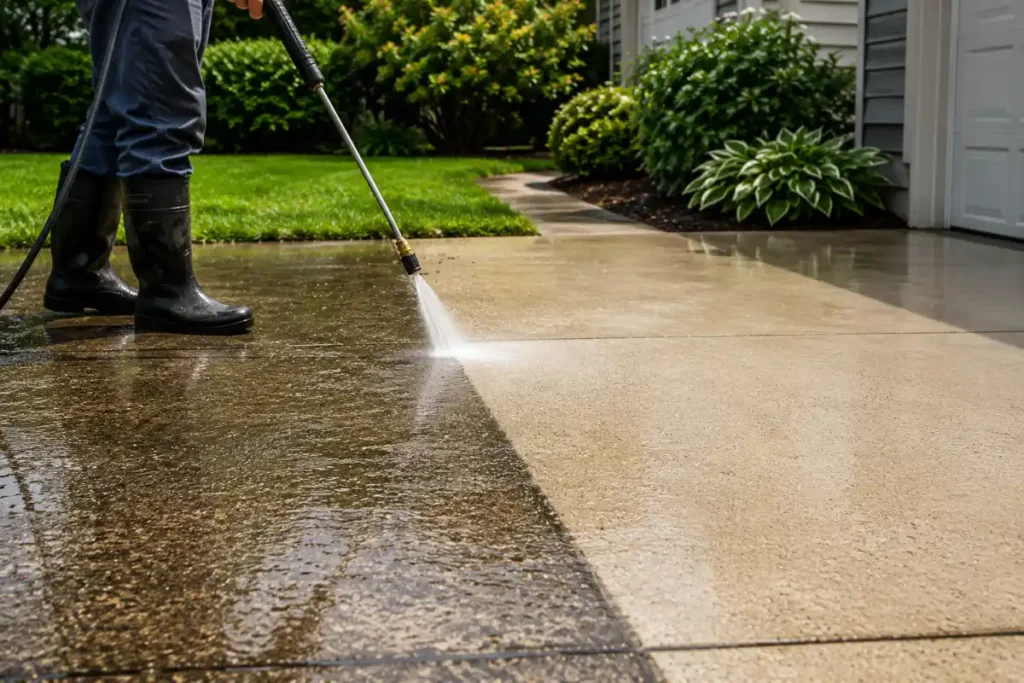
Concrete is the most severely affected surface because it is highly porous and absorbs dissolved iron directly into its surface layer. Concrete is extremely porous and absorbs the iron particles that cause rust stains, unlike vinyl siding which is not porous but still shows surface staining from contaminated water. Iron that has been absorbed into concrete cannot be removed with standard pressure washing. Standard pressure washing moves surface deposits but does not chemically dissolve the iron oxide that has bonded inside the concrete’s pore structure. Our professional driveway cleaning service uses professional-grade oxalic acid or phosphoric acid formulations specifically designed to dissolve iron oxide from concrete surfaces without etching or damaging the concrete itself.
Paver Patios and Pool Decks
Pavers present a more complex rust stain situation than poured concrete because the staining concentrates in paver joints as well as on surface faces. Iron-rich water wicks into joint sand and creates discoloration between pavers that is often mistaken for organic growth. Our patio and pool deck cleaning service addresses both surface staining and joint discoloration with chemistry calibrated for the specific paver material, whether concrete pavers, natural travertine, or clay brick.
Vinyl and Fiber Cement Siding
Siding staining from sprinkler overspray is one of the most visible and reputation-damaging forms of rust staining because it affects the primary visual impression of the home. Orange streaks running vertically down light-colored vinyl siding or creating halos around windows on fiber cement board are immediately noticeable and often mistaken for paint failure or structural damage by visitors and potential buyers. Metal sprinkler heads that come into prolonged contact with moisture can oxidize and leak rust onto nearby siding surfaces, appearing as orange or reddish streaks on vinyl. Our professional house washing service uses specific rust-treatment chemistry for siding surfaces before the soft wash rinse, lifting iron deposits without damaging the siding material.
Windows and Glass Surfaces
Windows in the spray zone of irrigation systems accumulate the same hard water mineral deposits and iron staining that cause the frustrating recurring cloudiness described in detail on our hard water window stain guide. Iron staining on glass bonds to the silica surface and, if left untreated, can progress to permanent etching. Our exterior window cleaning service uses de-ionized water throughout and professional mineral removal compounds for iron deposits on glass, addressing both the current staining and dramatically slowing redeposition after cleaning.
Fences and Outdoor Structures
Wooden fences, vinyl privacy fences, and aluminum or steel fence sections in the irrigation spray zone all accumulate rust staining. Wood fencing absorbs iron into the grain, creating deep orange discoloration that standard cleaning cannot reach. Our deck and fence cleaning service includes pre-treatment for iron and mineral deposits before the main pressure cleaning step, lifting iron that has penetrated into wood or vinyl surfaces.
Outdoor Living Surfaces and Hardscape
If your property includes an investment in patios and hardscapes, walkways and pathways, or any outdoor living design and build features, irrigation rust staining is an active threat to the aesthetic and material integrity of those investments. Natural stone is especially vulnerable because iron oxide bonds aggressively to the calcium carbonate matrix in limestone, travertine, and marble-based stone products. Treating these surfaces requires pH-controlled chemistry that removes iron without attacking the stone itself.
Roof Shingles and Gutters
Sprinkler systems that catch roofline overhangs or gutters create iron deposits on fascia boards and gutter exteriors. Our gutter cleaning and brightening service removes iron and mineral staining from gutter surfaces, and our professional roof cleaning service addresses any overspray staining on shingle surfaces near the roofline.
The Chemistry of Rust Stain Removal: Why Regular Cleaners Fail
This is the explanation that saves Northern Virginia homeowners from wasting money on products that will not work.
Iron oxide stains are alkaline-resistant and pressure-resistant. The two most common DIY approaches, bleach-based cleaners and high-pressure washing, do not touch iron staining because:
Bleach does not dissolve iron oxide. Sodium hypochlorite (bleach) is highly effective against organic growth like mold, algae, and mildew. It has essentially zero chemical action against iron oxide, which is a mineral compound, not an organic organism. Applying bleach to rust stains is like using shampoo to remove a grease stain. Wrong chemistry for the problem.
Pressure washing does not remove bonded iron. High-pressure water physically dislodges surface contaminants. Iron oxide that has been absorbed into concrete’s pore structure or bonded to siding over multiple irrigation seasons cannot be dislodged by hydraulic force alone. Pressure washing iron-stained concrete moves surface dust but leaves the bonded iron completely untouched.
What actually works is acid-based chemistry. Iron oxide dissolves in mild acid. The active ingredients in professional rust removal products are oxalic acid, phosphoric acid, or hydrochloric acid, each calibrated for specific surface types. These acids convert solid iron oxide (rust) back into soluble iron compounds that can be rinsed away.
The professional approach used by Lawn Theory’s exterior cleaning team:
Step 1: Pre-wet the affected surface and protect surrounding landscape beds and plants before any chemistry is applied.
Step 2: Apply a surface-appropriate iron removal compound. Oxalic acid formulations for natural stone and pavers. Phosphoric acid formulations for concrete driveways. F9 BARC (Battery Acid Rust and Calcium) for severe concrete staining. Each product is selected based on the surface material and the severity of the iron bonding.
Step 3: Allow dwell time. The acid compound must contact the iron oxide for a minimum of 5 to 15 minutes, depending on the product and stain severity, to complete the chemical conversion from insoluble iron oxide to soluble iron compounds.
Step 4: Agitate if needed. On porous surfaces with deep iron penetration, light agitation with a stiff brush during the dwell period improves chemical penetration.
Step 5: Rinse completely. A thorough rinse removes the dissolved iron compounds and any remaining acid. For surfaces adjacent to plantings, the rinse water pH is verified before completing the service.
Step 6: Post-treatment protection. After cleaning, applying a penetrating sealer to concrete and paver surfaces fills the pore structure and dramatically slows future iron deposition, extending the interval between needed cleanings.
The 4 Strategies That Actually Stop Sprinkler Rust Stains From Coming Back
Cleaning existing rust stains without addressing the source is an infinite loop. Here are the four strategies that break the cycle permanently.
Strategy 1: Sprinkler Head Audit and Adjustment
Misdirected spray is a leading cause of recurring rust, and adjusting sprinkler heads to water lawn and garden areas rather than siding, driveways, or walkways is the highest-impact single preventive measure. Walk your property during an active watering cycle and identify every head that catches any hardscape or structural surface. Adjust arc and radius settings to pull spray away from surfaces. Where heads cannot be adjusted adequately, consider converting perimeter zones to drip irrigation that applies water directly to soil without any surface overspray.
Our irrigation and sprinkler systems service includes seasonal head-by-head audits that identify every misaligned head on the property and adjusts them to eliminate hardscape and structural overspray before it causes another season of staining.
Strategy 2: Iron Filtration for Well Water Systems
For Northern Virginia homeowners using private well water for irrigation, chemical injection systems that add rust-preventative solutions directly into the sprinkler system’s water supply neutralize iron before it reaches the sprinkler heads, preventing stains from forming on any surface. An iron filter installed on the irrigation supply line removes dissolved iron before the water exits the sprinkler heads, eliminating the staining source at the point of entry. Given that well water iron content in Loudoun County’s Piedmont and Blue Ridge geology commonly reaches 1 to 5 ppm, a whole-system iron filter is often the most cost-effective long-term solution for affected properties in Aldie, western Ashburn, and Stone Ridge areas.
Strategy 3: Iron Chelation Treatment for Municipal Water Systems
For homeowners on municipal Loudoun Water or Fairfax Water supply, whole-system iron filtration is typically not necessary, but irrigation-specific iron chelation products added to the irrigation system can sequester dissolved iron and prevent it from oxidizing on contact with air and surfaces. Products like Rid-O-Rust or NoRust work by keeping iron in soluble form through the spray cycle, allowing it to water into the soil rather than depositing on hardscapes.
Strategy 4: Concrete and Paver Sealing After Professional Cleaning
After professional rust stain removal, applying a quality penetrating sealer to concrete driveways, paver patios, and walkways fills the pore structure of the material and reduces the surface area available for iron to bond. A sealed surface accumulates iron deposits on top of the sealer rather than within the concrete itself, making future cleaning significantly easier and extending the interval between needed cleanings from every season to every two to three years.
How Rust Stain Removal Fits Into a Complete Lawn Theory Exterior Service
Rust stain removal does not exist in isolation. It is one component of a complete exterior property maintenance program that Lawn Theory delivers as a coordinated service rather than individual one-off appointments.
Many Northern Virginia homeowners who call about irrigation rust stains on their driveway discover during the service visit that the same iron-rich water has also stained their siding, affected their window glass, created deposits on their patio pavers, and left discoloration on fence panels. Addressing the full exterior in a single coordinated appointment is more cost-efficient and produces a more cohesive result than treating one surface at a time.
A complete spring exterior refresh from Lawn Theory might combine:
Professional house washing for siding rust stains and pollen buildup, professional driveway cleaning with iron removal treatment, patio and pool deck cleaning for paver rust and organic growth, exterior window cleaning with de-ionized water for glass mineral deposits, deck and fence cleaning for wood and vinyl iron staining, gutter cleaning and brightening for fascia and gutter rust deposits, and sidewalk and walkway cleaning for entry area hardscape staining.
And once the exterior is fully restored, our irrigation and sprinkler systems service addresses the head adjustments and system audits that prevent the same staining from returning next season.
The full picture does not stop at cleaning. Our lawn care and landscaping team manages fertilization and weed control, aeration and overseeding, and mulching and bed maintenance as part of a complete outdoor property program. And if you are planning to build or expand your outdoor living space, our Build and Outdoor Living team covers patios and hardscapes, retaining walls and seating walls, outdoor kitchens, pergolas and pavilions, fire pits and fireplaces, and outdoor lighting installation for the complete outdoor transformation.
A clean exterior and a professionally maintained outdoor living space are both expressions of the same investment in your Northern Virginia property. Lawn Theory delivers both.
Frequently Asked Questions: Sprinkler Rust Stains in Northern Virginia
Q1: What causes orange stains from sprinkler systems in Northern Virginia?
Orange stains from sprinkler systems are caused by iron oxide, commonly called rust, depositing on exterior surfaces as irrigation water evaporates. Water containing dissolved iron exits the sprinkler head, contacts air, oxidizes, and deposits iron oxide wherever it lands and dries. In Northern Virginia, this problem is intensified by the iron-rich groundwater common in Piedmont and Blue Ridge geology throughout Loudoun County and western Fairfax County, as well as the moderately hard municipal water supplied by Loudoun Water and Fairfax Water. Granular fertilizers containing iron sulfate landing on hardscapes is a third common source of orange staining.
Q2: Can I remove orange sprinkler rust stains with bleach?
No. Bleach is highly effective against organic stains like mold, mildew, and algae but has no chemical action against iron oxide, which is a mineral compound. Applying bleach to rust stains will not remove them and may actually intensify the visual appearance by removing surrounding organic material while leaving the rust deposit unchanged. Effective rust stain removal requires acid-based chemistry, specifically oxalic acid, phosphoric acid, or similar iron-dissolving formulations appropriate to the specific surface material.
Q3: Why does pressure washing not remove rust stains from my driveway?
Iron oxide that has been absorbed into concrete’s porous structure bonds chemically to the surface and cannot be removed by hydraulic force alone. Pressure washing removes loose surface deposits and organic matter effectively, but bonded iron oxide requires acid chemistry to chemically convert the iron compound back into a soluble form that can be rinsed away. Professional rust stain removal combines acid pre-treatment with pressure rinsing for complete removal.
Q4: How much does professional rust stain removal cost in Northern Virginia?
Professional rust stain removal from driveways and exterior surfaces in Northern Virginia starts at $199 for a standard residential property, depending on the total stained surface area, the number of affected surface types, and the severity of iron bonding. Bundling rust stain removal with house washing, window cleaning, or a full exterior cleaning service reduces the per-service cost compared to scheduling individually. Properties with severe, multi-season staining buildup may require additional treatment passes.
Q5: How do I stop rust stains from coming back after cleaning?
The two most effective prevention strategies are adjusting sprinkler heads to eliminate overspray onto hardscape and structural surfaces, and installing iron filtration at the irrigation water source if using well water. For municipal water, iron chelation additives injected into the irrigation system keep dissolved iron in soluble form through the spray cycle. Sealing concrete and paver surfaces after professional cleaning also dramatically slows future iron bonding by filling the porous surface structure.
Q6: Does well water in Loudoun County really cause more rust staining than city water?
Yes, significantly so for properties using private wells in Loudoun County’s western and rural areas. Wells drawing from the Piedmont and Blue Ridge rock formations underlying much of Loudoun County routinely produce water with iron concentrations well above the 0.3 parts per million threshold that causes staining. Properties using Loudoun Water or Fairfax Water municipal supply still experience some mineral staining from moderately hard water, but the staining intensity is typically lower than properties using well water with elevated iron content.
Q7: Are rust stains from sprinklers damaging my siding permanently?
Early-stage rust staining on vinyl and fiber cement siding is surface staining that professional cleaning can remove completely. If rust deposits are left on siding for multiple seasons and are combined with high UV exposure, they can begin to penetrate micro-scratches and surface irregularities in the siding material more deeply, making removal more difficult. On natural wood siding or trim, iron can penetrate into the wood grain and create staining that is very difficult to fully remove without light sanding. Annual exterior cleaning prevents this progression.
Q8: Can rust stains affect my new patio or outdoor living space?
Yes. Natural stone patios using travertine, bluestone, or limestone are particularly vulnerable because iron oxide bonds aggressively to calcium carbonate, the mineral matrix in these stones. Concrete paver surfaces also absorb iron into their surface layer over time. Both materials require pH-controlled acid chemistry for rust removal that dissolves iron without attacking the stone or concrete. Sealing natural stone and paver surfaces after professional cleaning provides meaningful protection against future iron bonding.
Q9: Is the rust staining on my windows related to my sprinkler system?
Very likely, if your windows are in the spray zone of irrigation heads. Sprinkler overspray deposits dissolved iron and hard water minerals on glass surfaces. As the water evaporates in the sun, iron and calcium deposits bond to the glass surface. Over time, mineral bonding progresses toward glass etching, which is permanent surface damage. Annual professional window cleaning with de-ionized water rinse and targeted mineral removal treatment prevents this progression and keeps glass surfaces clear.
Q10: Can Lawn Theory handle both the rust stain removal and the irrigation system adjustment?
Yes, and this combination is exactly what breaks the cycle permanently for most Northern Virginia homeowners. Our exterior cleaning team removes existing rust staining from all affected surfaces, and our irrigation and sprinkler systems team audits every head on the property, adjusts arcs and radius settings to eliminate hardscape overspray, and identifies any drainage or coverage issues that contribute to staining patterns. One company. One coordinated appointment. No more orange driveways.
Ready to Get Rid of Those Orange Rust Stains for Good?
Your sprinkler system was designed to keep your property looking great, not to paint it orange. If irrigation rust staining has been building up on your driveway, siding, pavers, or walkways across one or more seasons, Lawn Theory’s exterior cleaning team has the chemistry, equipment, and Northern Virginia-specific expertise to remove it completely and keep it from coming back.
We serve homeowners across Aldie, Ashburn, Brambleton, Loudoun County, Fairfax, Arlington, Chantilly, Herndon, Stone Ridge, Sterling, Falls Church, and all of Northern Virginia. Veteran-owned. Precision-focused. Zero shortcuts. See us on Instagram & Linkedin.
Here is how to get started:
- Explore our professional driveway cleaning service
- See our complete exterior cleaning services
- Check our irrigation and sprinkler systems service
- Request your free quote today
Call Lawn Theory: (703) 650-5655
Clean surfaces. Adjusted sprinklers. No more rust. Let us handle it.
Keep Reading: Pressure Washing
 Pressure Washing
 How Much Does Pressure Washing Cost in Northern Virginia? (2026 Homeowner Guide)
Pressure washing cost in Northern Virginia is set by square footage, surface type, buildup and access, not a flat rate. Here is…
 Pressure Washing
 Trex Composite Deck Cleaning in Northern Virginia: Why the Method Totally Changes Compared to Wood
Picture this: your neighbor hires a pressure washing company to clean their beautiful new Trex Transcend deck in Brambleton. The crew shows…
 Pressure Washing
 The Complete Guide to Concrete Cleaning in Northern Virginia: Driveways, Sidewalks, Garage Floors, and More
Concrete surfaces dominate most Northern Virginia properties: driveways, sidewalks, patios, and garage floors are essential elements of home exteriors and important property…
Want this handled by the crew that wrote the guide?
Veteran-owned. Licensed & insured. Free walkthroughs across Northern Virginia — quotes in 24–48 hours.
Get Your Free Estimate