
How to Remove Hard Water Stains from Windows in Northern Virginia (And Why They Keep Coming Back)
You cleaned your windows last spring. Spent a Saturday afternoon with Windex and elbow grease. Maybe even hired someone. They looked great for about six weeks and then the hazy, chalky white film crept right back. You’re not imagining it. You’re not doing it wrong. And your windows aren’t broken.
You just live in Northern Virginia and your water is working against you.
How to remove hard water stains from windows in Northern Virginia is a question we hear constantly from homeowners across Aldie, Ashburn, Brambleton, Loudoun County, Fairfax, Arlington, Chantilly, Herndon, Stone Ridge, Sterling, and Falls Church. And the frustrating part isn’t the stains themselves. It’s that they come back, season after season, no matter what you spray at them.
At Lawn Theory, Northern Virginia’s veteran-owned exterior cleaning company, our exterior window cleaning service handles mineral deposits, calcium scale, and chronic hard water staining across the region every year. This guide gives you the complete picture what causes the stains, how to actually remove them (from mild to severe), why they keep coming back, and what permanently breaks the cycle.
Call (703) 650-5655 now or request a free window cleaning estimate today.
What Are Hard Water Stains on Windows — and What Actually Causes Them?
Hard water stains on windows are mineral deposits primarily calcium carbonate and magnesium left behind when water evaporates from the glass surface. When water lands on your window (from sprinklers, rain runoff, hose splash, or irrigation overspray) and then dries in the sun, the H₂O evaporates but the dissolved minerals don’t. They stay behind as a chalky, white, hazy residue bonded to the glass.
The reason this problem is so persistent in Northern Virginia comes down to one very specific fact about our local water supply that most cleaning guides never mention:
Northern Virginia has moderately hard to hard water.
According to data from Loudoun Water and Fairfax Water — the two primary municipal suppliers for Loudoun County and Fairfax County — tap water hardness in our region ranges from 80 to 170 parts per million (ppm) of dissolved calcium carbonate. The U.S. Geological Survey classifies water above 120 ppm as “hard” and above 180 ppm as “very hard.” Northern Virginia sits squarely in the hard range — and homes using well water in rural Loudoun County and western Aldie areas often test even harder, as groundwater drawn through Virginia’s limestone-rich geology concentrates additional calcium and magnesium.
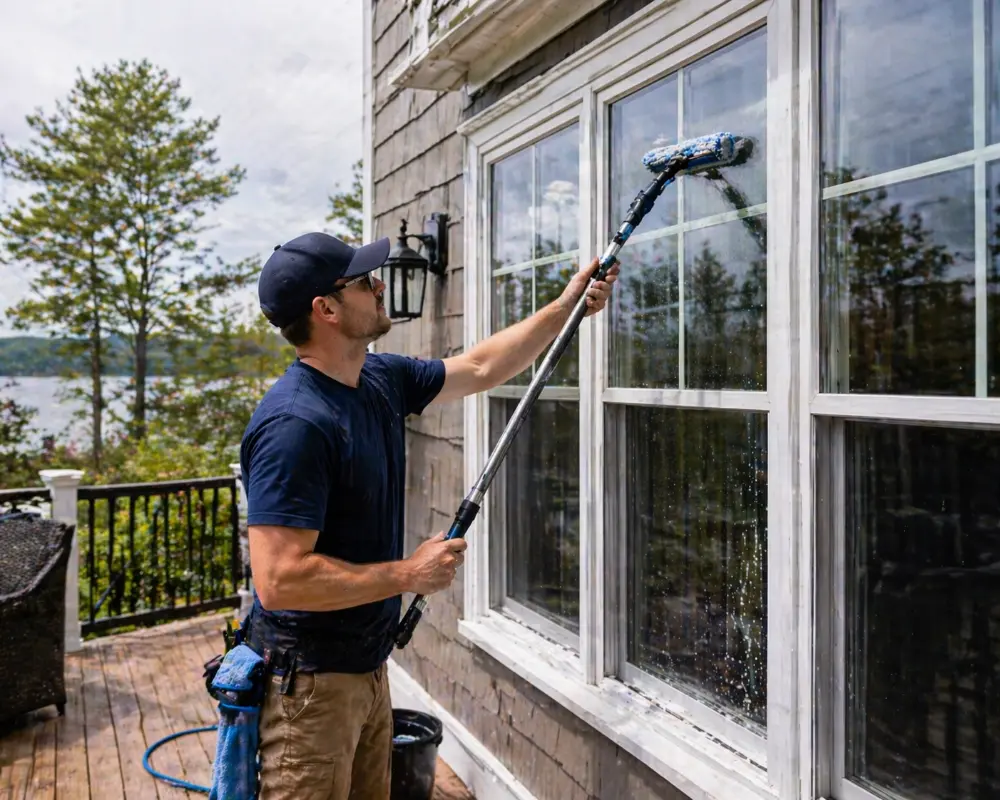
In practical terms: every time your irrigation system hits your windows, every time rain bounces off your foundation and splashes up, every time a garden hose gets near your siding — you’re depositing a fresh layer of mineral residue onto your glass. And in a climate where we cycle through wet springs, humid summers, and active irrigation seasons, that mineral layer builds faster here than in most other Mid-Atlantic regions.
Why Hard Water Stains Keep Coming Back: The Northern Virginia Cycle
Here’s what most cleaning guides never explain — the actual mechanism behind why those stains return month after month even after cleaning. Understanding this is the key to actually solving the problem.
The irrigation loop. The single most common cause of recurring hard water staining on Northern Virginia windows is a misaligned irrigation system. In neighborhoods across Ashburn, Brambleton, Stone Ridge, and Herndon — where mature landscaping and professionally installed irrigation and sprinkler systems are standard — sprinkler heads that spray across foundation plantings frequently catch the lower 18–24 inches of windows on their arc. Every watering cycle deposits a fresh layer of calcium. Every sunny day bakes it on. Clean it one week, the sprinkler re-deposits it the next.
The mineral-bonding progression. Early-stage hard water deposits sit on the glass surface and can be removed with mild acids. But when deposits are repeatedly baked by direct sun without removal, the calcium carbonate begins a slow chemical interaction with the silica in the glass itself — a process called etching. Etched glass isn’t just stained — it’s microscopically damaged. The mineral has fused to the glass surface and can no longer be dissolved with household cleaners. This is why stains that seemed manageable last year feel impossible this year.
The screen trap. Window screens sit directly in front of glass and catch mineral-rich water, holding it against the screen mesh and the adjacent glass edge. Over a full irrigation season, this creates concentrated mineral deposits at the screen perimeter the thick, crusty white border you often see around the edges of windows rather than in the center.
Northern Virginia’s UV intensity. Our region’s summer sun routinely exceeds UV index 8–10 during peak months. High UV exposure accelerates the baking-on of mineral deposits exponentially. A calcium deposit that might take several weeks to bond in a cloudier climate can permanently fuse in under a week of direct July sun in Loudoun County.
Hard Water Stain Severity: How Bad Are Yours, Really?
Before you choose a removal method, it’s worth assessing which stage of mineral bonding you’re dealing with:
| Stage | What you see | What it feels like | DIY removable? |
|---|---|---|---|
| Stage 1 — Surface deposits | Light haze, white spots | Slightly rough | Yes — vinegar/citric acid |
| Stage 2 — Moderate bonding | Cloudy film, visible scale rings | Rough, gritty | Sometimes — requires commercial-grade acid |
| Stage 3 — Deep bonding | Dense white crust, hazing that persists when wet | Very rough, textured | Rarely — professional polishing required |
| Stage 4 — Glass etching | Permanent cloudiness, pitting visible | Cannot be felt, damage is in the glass | No — glass restoration or replacement |
Most Northern Virginia homeowners presenting with “stubborn” hard water stains are dealing with Stage 2 or early Stage 3 — fully treatable professionally, partially treatable with strong DIY methods if caught early enough.
How to Remove Hard Water Stains from Windows: From Mild to Severe
Method 1: White Vinegar Solution (Stage 1 — Fresh or Mild Deposits)
This is your starting point for windows that haven’t been neglected for more than one or two seasons. The acetic acid in white vinegar dissolves calcium carbonate by neutralizing the alkaline mineral bond.
What you need: Distilled white vinegar, distilled water (not tap — tap redeposits minerals), spray bottle, non-scratch scrubbing pad, squeegee, microfiber cloth.
The process:
- Mix equal parts white vinegar and distilled water in your spray bottle
- Spray generously on the affected area — don’t let it dry; work in the shade or on overcast days
- Let the solution dwell for 3–5 minutes — this is the step most people skip; the acid needs time to work
- Scrub gently in circular motions with a non-scratch pad
- Rinse with distilled water (not tap water — this is critical; tap water re-deposits fresh minerals)
- Dry immediately with a squeegee and follow with a dry microfiber cloth
Honest reality check: Vinegar works reliably on Stage 1 deposits that haven’t been baked on by multiple sun cycles. If you’ve tried it twice with no improvement, you’re dealing with Stage 2 or higher.
Important warning: Vinegar is acidic. Never let it sit on window frames made of natural stone sills, anodized aluminum, or painted wood without pre-protecting those surfaces — it can discolor or etch frame materials.
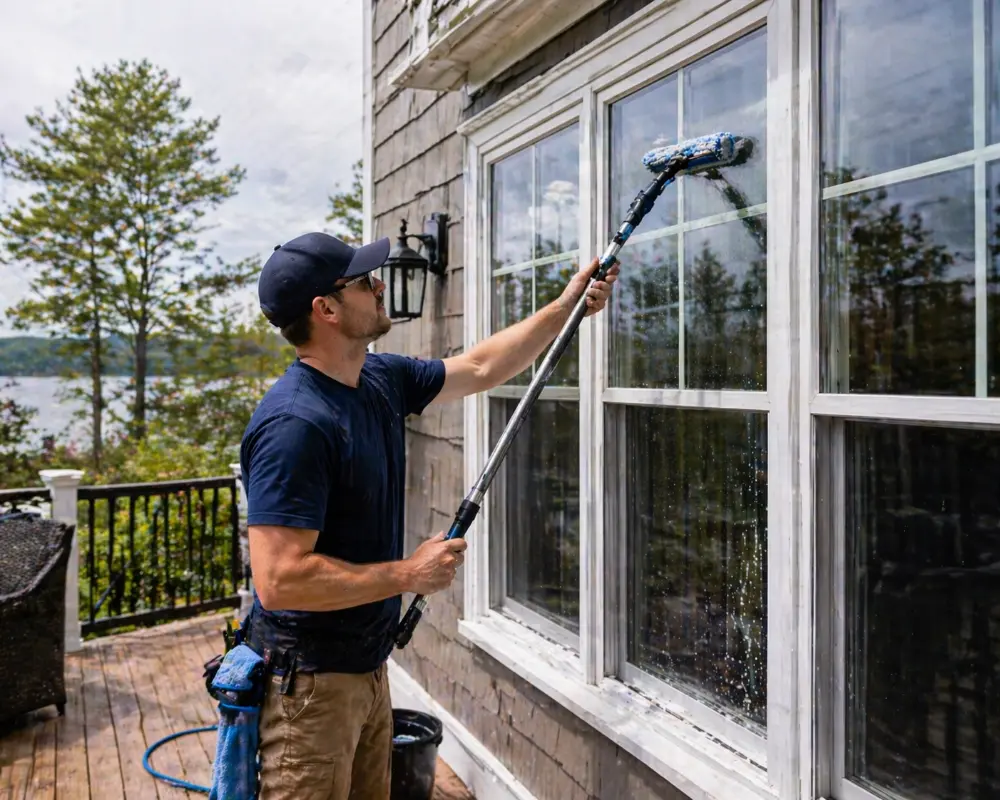
Method 2: Citric Acid or Oxalic Acid Solution (Stage 2 — Moderate Buildup)
For deposits that have cycled through more than one or two full irrigation seasons, stronger food-grade citric acid or commercial oxalic acid products (like Bar Keepers Friend) provide more effective mineral dissolution.
The process:
- Make a paste with citric acid powder and distilled water, or use Bar Keepers Friend as directed
- Apply to the stained area and allow a 5–10 minute dwell with the product kept wet (spray with distilled water to prevent drying)
- Scrub with a non-scratch nylon pad — never steel wool or abrasive pads, which scratch glass permanently
- Rinse with distilled water, squeegee immediately, microfiber dry
- Inspect from multiple angles in good light — hard water stains are often invisible when glass is wet but reappear when dry
Method 3: Commercial Hard Water Removers (Stage 2–3 — Stubborn Deposits)
CLR (Calcium, Lime, and Rust Remover), Lime-A-Way, and similar products contain industrial-grade phosphoric or hydrochloric acid formulations that dissolve significantly more bonded calcium than household acids.
Critical warnings before using:
- Always pre-wet the area around the glass and protect any metal frames, painted surfaces, or stone sills before application
- Never apply to windows with Low-E (low-emissivity) coatings — most energy-efficient windows installed in Loudoun County and Fairfax after 2010 have Low-E glass, and aggressive acid cleaners can permanently damage the coating
- Wear gloves and eye protection — these are genuinely strong chemicals
- Do not allow the product to dry on the glass; work in small sections and rinse thoroughly
How to tell if your windows have Low-E coating: Hold a colored lighter or flame 1–2 inches from the glass. Low-E glass shows one of the four flame reflections in a different color (typically blue or green). If you’re not sure, call the window manufacturer — damaging a Low-E coating typically requires full window replacement.
When DIY Stops Working: Calling in Professional Grade
If you’ve worked through Methods 1 and 2 without success, or if you’re looking at Stage 3 deposits or suspected etching, you’ve crossed the threshold where professional tools and techniques are the appropriate solution — not because you’re doing it wrong, but because the mineral bond has surpassed what household chemistry can dissolve safely.
Professional window cleaning services use:
- Commercial-grade mineral removal compounds formulated with controlled acid concentrations and buffered to protect glass coatings
- Water-fed pole systems with de-ionized (DI) water — purified water with zero mineral content that leaves no residue and dramatically slows re-deposition after cleaning
- Glass polishing compounds and polishing pads for Stage 3 deposits where the mineral crust has to be physically abraded away under professional technique — abrasion that restores rather than damages because it’s controlled and calibrated
Lawn Theory’s exterior window cleaning service uses de-ionized water throughout — the same reason our results last meaningfully longer than standard window cleaning. When you rinse glass with de-ionized water instead of tap water, there are no dissolved minerals left behind to re-bond and start a new deposit cycle.
Why Your Hard Water Stains Keep Coming Back — And the Fixes That Actually Break the Cycle
Treating the stains without addressing the source is the definition of an infinite loop. Here are the four actionable fixes that break it:
Fix 1: Audit and Adjust Your Irrigation System
This is the highest-impact single action for most Northern Virginia homeowners. Walk your property during an active watering cycle and identify every sprinkler head that catches any window surface. Adjust head direction, reduce arc, or install deflector guards. Our irrigation and sprinkler systems service includes sprinkler head adjustment as part of seasonal system audits — this is one of those quiet maintenance details that pays dividends in window cleaning costs and avoided glass damage for years.
Fix 2: Apply a Hydrophobic Glass Sealant After Professional Cleaning
Once your windows are professionally cleaned and mineral-free, applying a quality hydrophobic glass coating — similar to Rain-X but formulated for residential windows — creates a surface that causes water to bead and roll off rather than spread and dry. This doesn’t eliminate mineral deposition entirely, but it dramatically slows re-accumulation and keeps deposits from bonding as aggressively between cleaning cycles.
Fix 3: Clean Window Screens Separately and Regularly
Dirty, mineral-laden screens are one of the most overlooked contributors to recurring window staining. Rain and irrigation water passes through screen mesh, concentrating minerals in the mesh itself and depositing them on the adjacent glass with every rain event. Cleaning screens with a citric acid wash and rinsing with de-ionized water twice per season removes this concentrated source.
Fix 4: Schedule Annual Professional Window Cleaning Before Deposit Bonding Occurs
The most cost-effective long-term strategy is scheduled professional cleaning once or twice per year — before deposits have time to progress from Stage 1 to Stage 3. A Stage 1 deposit cleaned professionally takes 20 minutes. A Stage 3 deposit that’s been baking through three irrigation seasons takes considerably more time and more specialized product — and the glass underneath has already sustained some structural wear.
Spring (April–May) and fall (September–October) are the ideal windows in Northern Virginia. Spring cleaning removes the pollen-season mineral accumulation before summer UV bakes it on. Fall cleaning removes summer irrigation deposits before winter freeze-thaw cycles press them deeper into the glass surface.
The Bigger Picture: What Hard Water Does to Your Entire Home Exterior
If your windows are showing hard water staining, there’s a reliable probability that your home’s other exterior surfaces are dealing with the same municipal water supply — and showing it.
The same calcium-rich water that stains your windows is also:
- Scaling your gutter downspout outlets, creating the white crusty buildup at ground level — addressed by our gutter cleaning and brightening service
- Building up on your driveway and concrete surfaces where irrigation runoff pools — removed by our professional driveway cleaning
- Leaving mineral scale on your patio pavers, pool deck coping, and hardscape surfaces — treated by our patio and pool deck cleaning service
- Depositing on your home’s siding every time irrigation overspray catches the exterior — cleaned by our professional house washing service
- Staining your deck surfaces where irrigation spray reaches — managed by our deck and fence cleaning service
- Scaling your walkways and pathways around the home perimeter — handled by our sidewalk and walkway cleaning
Many Northern Virginia homeowners book a whole-home exterior cleaning appointment in spring — combining window cleaning, house washing, driveway cleaning, and gutter service in a single visit. It’s more cost-efficient than scheduling each service separately, and addressing the entire exterior at once means every surface gets the fresh start it needs before the summer irrigation season begins again.
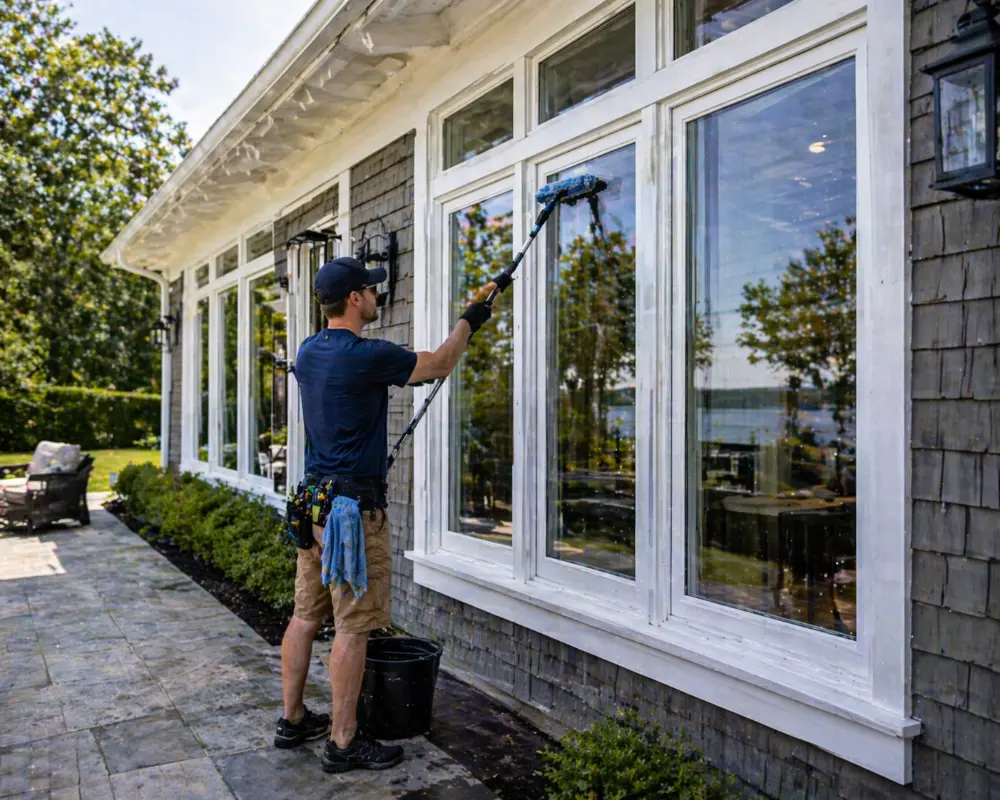
While we’re restoring the exterior of your home, don’t overlook what surrounds it. A beautifully cleaned home exterior deserves an equally sharp lawn and landscape. Our full lawn care and landscaping services — including lawn fertilization and weed control, aeration and overseeding, mulching and bed maintenance, and landscape design and installation — keep the green spaces around your clean home looking equally intentional. And when you’re ready to build out your outdoor living space — a patio, pergola, outdoor kitchen, or fire pit — our build team is your complete outdoor transformation partner.
For the full exterior cleaning picture — from windows and roof to driveway and deck — our exterior cleaning hub covers every surface on your property.
Frequently Asked Questions: Hard Water Stains on Windows in Northern Virginia
Q1: What causes hard water stains on windows in Northern Virginia specifically?
Northern Virginia tap water from Loudoun Water and Fairfax Water measures 80–170 ppm of dissolved calcium carbonate — officially classified as “moderately hard to hard.” When this water lands on windows from sprinklers, rain splash, or irrigation overspray and then evaporates in the sun, the dissolved calcium and magnesium remain bonded to the glass as a chalky, white mineral deposit. The combination of hard municipal water, active irrigation seasons, and Northern Virginia’s intense summer UV exposure makes mineral deposit buildup here faster and more stubborn than in many other regions.
Q2: Can I remove hard water stains from windows myself?
Yes — if the stains are Stage 1 (fresh, light deposits). A 50/50 white vinegar and distilled water solution applied with a 3–5 minute dwell time removes surface-level calcium deposits reliably. For Stage 2 deposits that don’t respond to vinegar, food-grade citric acid or Bar Keepers Friend applied as a paste provides stronger mineral dissolution. If neither works after 2–3 attempts, the deposits have bonded beyond what household chemistry can safely resolve, and professional tools are the appropriate next step.
Q3: Why do my hard water stains keep coming back after cleaning?
The most common cause is an unresolved water source — typically an irrigation system with sprinkler heads that hit the window surface during every watering cycle. Cleaning the stains without addressing the source simply restarts the deposition cycle. The second most common cause is using tap water to rinse after cleaning — tap water contains dissolved minerals that immediately begin a new deposit layer as they dry. Always rinse with distilled or de-ionized water after treating hard water stains.
Q4: Will vinegar damage my windows?
Properly diluted white vinegar (50/50 with distilled water) applied to glass for 3–10 minutes is safe for most standard residential windows. The important exceptions are: window frames made of natural stone sills (which vinegar can etch), anodized aluminum frames (which can discolor), and windows with Low-E glass coatings (which require pH-neutral or specifically approved cleaners). If you’re unsure whether your windows have Low-E coatings, call the manufacturer before applying any acid-based cleaner.
Q5: What is glass etching and can it be fixed?
Glass etching occurs when calcium and magnesium deposits from hard water chemically react with the silica in the glass surface over time, creating permanent microscopic pitting or cloudiness. Unlike surface deposits, etching is in the glass itself — not on top of it. Mild etching can sometimes be partially addressed with professional glass polishing compounds, but severe etching typically requires glass panel replacement. This is why early intervention matters — Stage 1 and 2 deposits are completely treatable; Stage 4 etching is permanent damage.
Q6: How much does professional exterior window cleaning cost in Northern Virginia?
Professional exterior window cleaning in Northern Virginia starts at $250 for an average single-family home, depending on the number of windows, stories, and whether mineral deposit treatment is required in addition to standard cleaning. Homes with significant hard water buildup requiring mineral removal products and de-ionized water rinsing run toward the higher end. Bundling with house washing, gutter cleaning, or driveway cleaning reduces the overall per-service cost compared to scheduling separately.
Q7: What is de-ionized water and why does it matter for window cleaning?
De-ionized (DI) water has had all dissolved mineral ions removed through a filtration process. When windows are rinsed with de-ionized water instead of standard tap water, the rinse water evaporates without leaving any mineral residue — because there are no minerals in it to leave behind. This results in spotless windows immediately after cleaning and significantly slows re-accumulation of mineral deposits between service visits. It’s one of the key reasons professional window cleaning results last longer than DIY cleaning with tap water.
Q8: How often should Northern Virginia homeowners have their exterior windows professionally cleaned?
Most Northern Virginia homes benefit from professional exterior window cleaning one to two times per year. The highest-impact timing is spring (April–May) before summer UV bakes on the irrigation season’s mineral accumulation, and fall (September–October) to clear the summer’s buildup before winter. Homes on active irrigation systems with heads that reach window surfaces — common in newer construction throughout Loudoun County and Fairfax — may benefit from three appointments per year: early spring, midsummer, and fall.
Q9: Can hard water stains affect energy-efficient (Low-E) windows?
Yes — and the treatment protocol is critically different. Low-E windows have a microscopic metallic coating (typically silver-based) applied to the glass that reduces heat transfer. Heavy mineral buildup on Low-E glass reduces the coating’s effectiveness and increases energy costs. However, many standard hard water removal products — especially strong commercial cleaners like CLR — can permanently damage or strip Low-E coatings. Only pH-neutral or specifically Low-E-approved cleaners should be used. Professional window cleaners who work regularly in Northern Virginia’s newer construction know which products are safe for which glass types.
Q10: Does cleaning my sprinkler system help prevent window staining?
Yes — it’s one of the highest-impact preventive measures available. An irrigation audit that identifies and adjusts sprinkler heads spraying onto window surfaces eliminates the primary recurring source for most Northern Virginia homeowners. Even reducing the spray radius by 6–12 inches to clear window glass eliminates hundreds of mineral deposits per irrigation season. Combined with professional window cleaning and a hydrophobic glass sealant applied post-clean, a corrected sprinkler setup can extend the interval between needed cleanings from 6 weeks to 6 months or more.
Ready to End the Hard Water Cycle for Good?
Northern Virginia’s moderately hard water isn’t going anywhere. But the cloudy, chalky windows and the frustration of watching them come right back — absolutely can stop.
Lawn Theory’s exterior window cleaning service uses de-ionized water throughout and professional mineral removal compounds for stubborn calcium deposits. We address the whole picture — not just the glass, but the surfaces around it, the irrigation overspray contributing to it, and the seasonal maintenance plan that keeps it from coming back. See us on Instagram & TikTok.
We serve: Aldie · Ashburn · Brambleton · Loudoun County · Fairfax · Arlington · Chantilly · Herndon · Stone Ridge · Sterling · Falls Church — and all of Northern Virginia
Here’s how to get started:
Explore our exterior window cleaning service → See all exterior cleaning services → Request your free quote
📞 Call us: (703) 650-5655 or request a free window cleaning estimate today.
Clear windows. Clean exterior. One veteran-owned team that gets it done right.
Keep Reading: Exterior Cleaning
 Exterior Cleaning
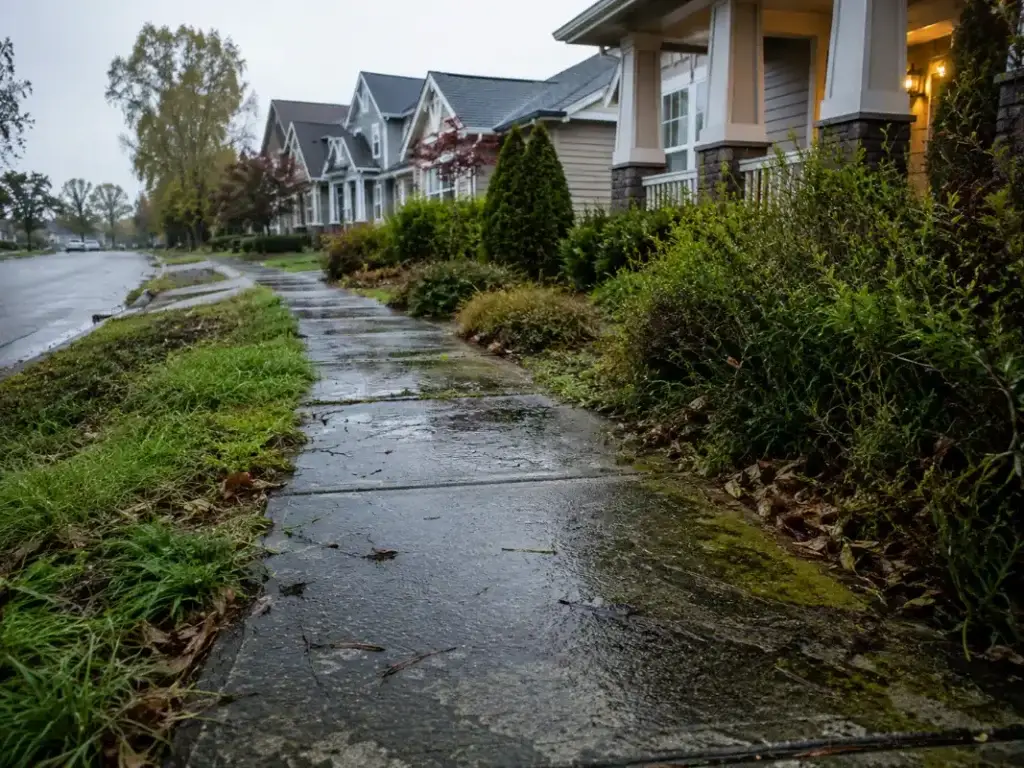
 Slippery Sidewalks and HOA Violations in Northern Virginia: How Algae Becomes a Legal Liability Problem
There are two ways to learn this lesson. The easy way: read this article, schedule a sidewalk cleaning appointment, and spend your…
 Exterior Cleaning
 Spring House Washing in Northern Virginia: Why Pollen Season Makes It Urgent
You wake up one Saturday morning in April, walk outside with your coffee, glance up at your house and stop dead in…
 Exterior Cleaning
 The Hidden Dangers of DIY Pressure Washing and When to Call a Professional
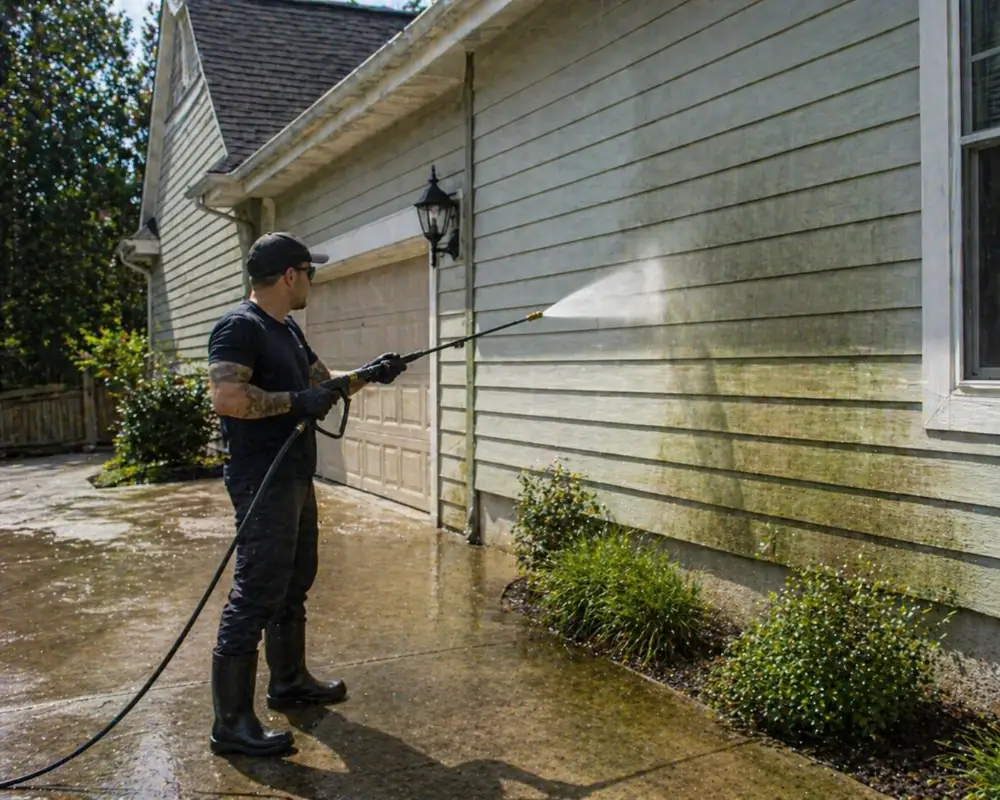
Many homeowners view Hidden Dangers of DIY Pressure Washing as a money-saving opportunity. Rent a machine for $60-$100/day, spend a Saturday morning…
Want this handled by the crew that wrote the guide?
Veteran-owned. Licensed & insured. Free walkthroughs across Northern Virginia — quotes in 24–48 hours.
Get Your Free Estimate