
Rust Stain Removal from Concrete, Brick, and Stone: The Northern Virginia Homeowner’s Guide
Rust Stain Removal is a persistent problem in Northern Virginia that frustrates homeowners across Loudoun County, Fairfax County, Prince William County, Arlington, and Alexandria. Unlike surface dirt that rinses away with water, rust stains are chemical reactions that permanently discolor concrete, brick, stone, and masonry until treated with specialized chemistry. A single episode of iron-rich water overspray from an irrigation system or a wet spell with well water can leave orange-brown stains that grow darker and more difficult to remove with each passing season. These stains are not cosmetic problems that can be ignored — they represent ongoing damage to your home’s exterior surfaces and chemical processes that accelerate material deterioration over time.
This comprehensive guide walks you through understanding how rust stains form, identifying their sources in Northern Virginia’s unique hydrogeology and landscape, the specific surfaces vulnerable to staining, the chemistry behind professional removal, prevention strategies that eliminate future stains, cost expectations, and why DIY removal often fails. Whether you’re dealing with a sudden rust discoloration from a new irrigation system or years of accumulated iron staining from well water in western Loudoun County, this guide provides the knowledge and options you need. Understanding rust chemistry and Northern Virginia’s specific environmental conditions helps you make informed decisions about treatment approaches and prevention strategies tailored to your property’s unique situation.
Call (703) 650-5655 now or request a free estimate today.
Understanding Rust and Iron Stains on Exterior Surfaces
Rust staining is an electrochemical process that occurs when iron-bearing water or iron-containing solutions contact porous surfaces like concrete, brick, and stone. Iron exists in two primary forms: ferrous iron (soluble, appears colorless or slightly yellow in water) and ferric iron (insoluble, appears reddish-brown). When ferrous iron-bearing water contacts a surface and oxidizes (exposed to oxygen), it converts to ferric iron, which is insoluble and permanently deposits as a reddish-brown stain on the surface. This oxidation process is irreversible without chemical intervention — simple rinsing cannot reverse the chemical transformation.
The stain is not merely on the surface — the iron has chemically bonded with the mineral matrix of the concrete, brick, or stone. This is why rust stains don’t wash away with water or simple pressure washing. The iron molecules have migrated into the porous structure, bonding at the molecular level with calcium compounds in concrete or mortar in brick. Standard cleaning cannot remove them because the iron has become part of the surface structure. This is also why rust stains grow darker over time — continued iron-bearing water exposure adds more iron to the affected area, deepening the discoloration with each water event.
Northern Virginia’s geology creates ideal conditions for rust staining. The region’s groundwater — particularly in western Loudoun County (Purcellville, Hamilton, Lovettsville), western Prince William County (Nokesville, Bristow), and western Fairfax County (Great Falls) — contains naturally elevated iron concentrations. Wells drilled into certain aquifers access water with 5-10+ mg/L of dissolved iron, far exceeding EPA recommendations of less than 0.3 mg/L for aesthetic acceptability. The geological formations underlying Northern Virginia contain significant iron-bearing mineral layers. When groundwater percolates through these layers, it dissolves iron oxides, becoming highly concentrated in iron compounds. When this water is used in irrigation systems or emerges from well water outlets onto concrete and stone surfaces, iron staining is inevitable unless actively prevented.
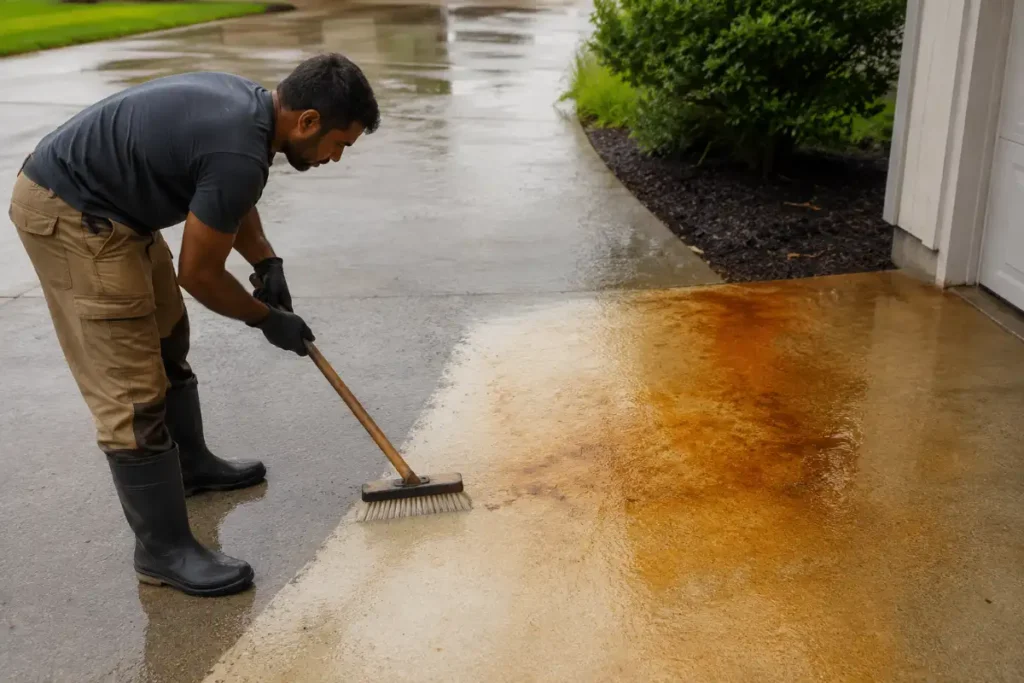
Common Causes of Rust Staining in Northern Virginia
Well water systems are the primary culprit in Northern Virginia’s western communities. Properties in Purcellville, Hamilton, Lovettsville, Great Falls, Bristow, Nokesville, and rural areas throughout Loudoun, Fairfax, and Prince William counties rely on private wells. Many of these wells contain naturally occurring iron that isn’t usually a problem for household use but becomes visible when iron-bearing water is used on exterior surfaces. A single irrigation system activation can deposit iron stains on driveways and walkways that remain visible for years unless professionally treated. Homeowners often are shocked to discover that a new well installation immediately creates rust staining problems they didn’t have before — the iron content in new wells is often higher than expected.
Irrigation systems are the second major cause of rust staining across Northern Virginia. Both well water and municipal water systems can carry dissolved iron, but iron stains are particularly prevalent where irrigation systems use well water. Even municipal water systems sometimes carry temporary iron content during maintenance cycles or water main breaks. An irrigation system malfunction — like a broken sprinkler head spraying directly on concrete — can deposit concentrated iron solution that creates dramatic staining visible within days. In Loudoun County’s master-planned communities like Brambleton, Broadlands, and Ashburn Village, irrigation system malfunctions in HOA common areas occasionally cause rust staining on homeowner properties nearby. Shared irrigation systems with iron-bearing water can affect multiple properties, creating neighborhood-wide staining problems.
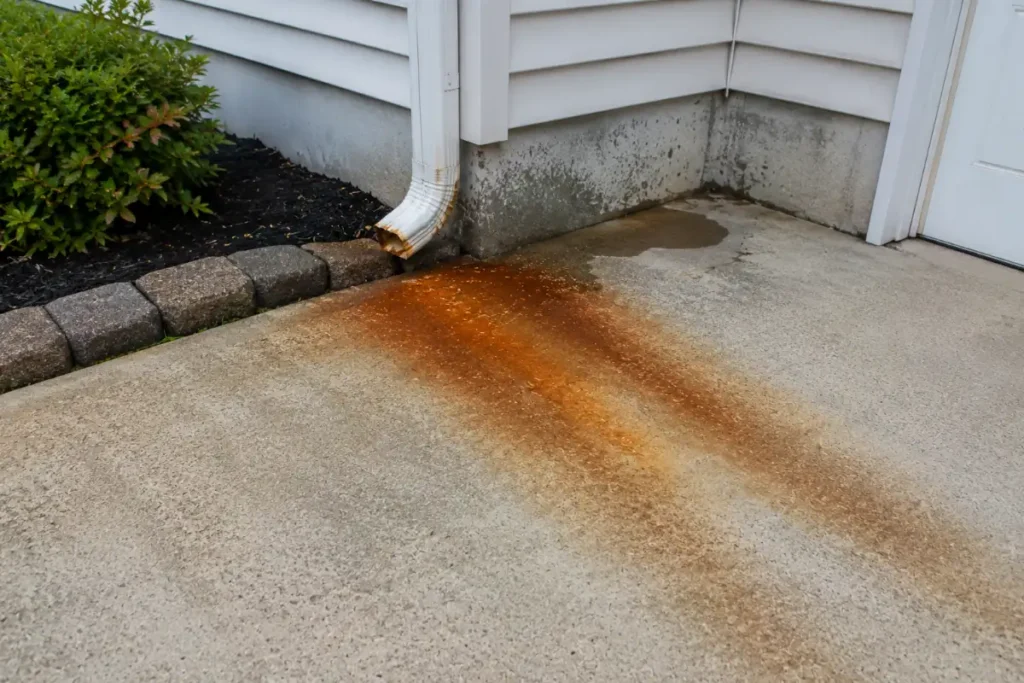
Metal fixtures and metal-containing materials are the third source. Iron railings, metal downspouts, fasteners, and hardware that rust can weep rust-stained water onto concrete and stone below. Metal-containing mortar (some older brick mortar contains iron oxide for color) can stain adjacent concrete. Fertilizer treatments containing iron compounds applied to lawns can wash onto hardscape surfaces during rain. In Prince William County’s red clay regions, the clay itself contains iron that splashes onto concrete during heavy rain, though this clay is typically brown rather than the orange-red of soluble iron staining. Rust-prone fixtures become increasingly problematic over time as rust develops and deeper iron compounds begin leaching.
Battery acid spills, though less common, create dramatic rust-like staining on concrete garage floors and driveways. Industrial accidents and chemical spills occasionally leave iron-based staining. Fertilizers containing iron compounds designed to address lawn iron deficiency (which causes yellowing in certain plant species) can wash onto hardscape during rain. Understanding the source of your specific stain is important because prevention strategy depends on identifying and addressing the root cause. Some stains originate from external sources (neighbor’s irrigation, road runoff) while others originate from property-specific sources (your own well water, your own irrigation system, your own metal fixtures).
Types of Surfaces Affected by Rust Staining
Concrete is the most vulnerable surface to rust staining because of its porous structure and widespread use on Northern Virginia properties. Concrete driveways, patios, walkways, garage floors, and pool decks in every county and neighborhood can develop rust staining. Concrete’s high pH (typically 12-13) actually protects against some staining, but dissolved iron can still penetrate the surface and stain the aggregate. Stamped concrete, which is increasingly popular in Loudoun County and Prince William County developments, shows rust staining more dramatically because the stain contrasts with the decorative coloring. Exposed aggregate concrete (where gravel is visible on the surface) is particularly vulnerable because iron can stain both the cement matrix and the exposed aggregate stones.
Brick is also vulnerable, particularly when iron-bearing water runs down brick walls or splashes onto brick surfaces. Mortar joints are especially vulnerable because they are softer and more porous than brick units. A property with a brick exterior in Vienna, McLean, or Burke may show rust staining in mortar joints from years of iron-bearing water exposure. Historic brick in Arlington’s Lyon Village and Alexandria’s Old Town can be dramatically affected by iron staining. Brick used in property construction varies in composition — some brick formulations are more porous and absorb iron more readily than others.
Stone surfaces — including flagstone, bluestone, limestone, travertine, and other natural stone patios and walkways — stain readily from iron exposure. Travertine, common in upscale patios throughout Northern Virginia, is particularly vulnerable because of its porous structure and light coloring that makes staining obvious. Travertine’s high porosity actually makes it especially susceptible to iron penetration. Stone hardscape surfaces can show orange or rust-colored stains that become darker and more entrenched over months and years. Different stone types have different vulnerability — limestone and sandstone are more susceptible than granite or slate.
Grout between pavers, tiles, and stone is highly susceptible because grout is essentially a porous cement product with even less protection than concrete. Paver patios in Dominion Valley, Piedmont, and other Prince William County communities with irrigation systems frequently show rust staining in joint grout. Vinyl siding and painted surfaces can also show rust staining where metal fasteners rust and weep stain-carrying moisture downward, though this is less common than staining on hardscape surfaces. Composite decking and Trex (engineered wood-plastic composite) can absorb iron stains through their plastic-wood matrix.
Professional Rust Removal: Chemistry and Process
Professional rust stain removal employs specialized chemistry that converts insoluble ferric iron back into a soluble state so it can be extracted from the surface. The most common professional treatments use one of two main chemical approaches: oxalic acid-based treatments or phosphoric acid-based treatments, sometimes combined with other agents depending on the specific stain type and surface material. The choice of chemical depends on stain severity, surface material sensitivity, environmental factors, and desired outcome.
Oxalic acid (also found in rhubarb, spinach, and wood) is a weak organic acid that specifically targets iron stains by chelating ferric iron — binding to iron molecules and converting them into a soluble form. When oxalic acid contacts a ferric iron stain on concrete or stone, a chemical reaction occurs that dissolves the stain chemistry. The dissolved iron is then rinsed away with water. Oxalic acid is particularly effective on light-colored surfaces like light gray concrete or light stone where iron staining is highly visible. The treatment requires careful application and proper safety precautions because oxalic acid can etch surfaces and cause skin burns in high concentrations. Oxalic acid is also known for leaving white residue if not thoroughly rinsed.
Phosphoric acid operates on a similar principle, chelating iron and converting stains to a soluble state. It is slightly stronger than oxalic acid and works well on heavily stained or older surfaces where iron has penetrated deeper. Phosphoric acid is also safer to use than oxalic acid in higher concentrations and is the preferred treatment for surfaces near vegetation, since phosphoric acid is less likely to cause plant damage from overspray. Phosphoric acid is gentler on some surface types than oxalic acid, making it appropriate for sensitive brick or historic masonry.
Professional rust removal process follows a careful protocol. First, the surface is assessed to determine stain type, depth, and surface material to select the appropriate chemical treatment. A test application on an inconspicuous area confirms the treatment won’t damage the surface (some surfaces like certain natural stones can be sensitive to acids). The rust removal chemical is then applied directly to stained areas and allowed to dwell for 5-15 minutes while the chemical reaction breaks down the iron oxide bonds. Higher concentrations and longer dwell times work on more entrenched stains but risk surface damage, so timing is critical. Professionals understand the difference between aggressive treatment necessary for severe stains and gentle treatment necessary for delicate surfaces.
After dwell time, the treated area is thoroughly rinsed — initially with the iron-bearing solution still being dissolved and extracted, then with clean water to remove all chemical residue. Professional extraction often involves vacuuming or wet-drying combined with rinsing to ensure complete removal. The water used for rinsing then carries away the now-soluble iron that was previously locked into the surface. Multiple rinse cycles ensure all chemical residue is removed.
For severe or stubborn stains, the process may be repeated multiple times. Some deeply embedded iron stains require two or three applications of chemical treatment. Between applications, the surface must completely dry and the results assessed. Professional rust removal takes time — rushing the process with excessive chemical concentration risks surface damage. Patience and proper technique are the hallmarks of professional work distinguishing it from DIY efforts.
Prevention Strategies to Eliminate Future Staining
Identifying and addressing the iron source is the most important prevention step. For well water users in Purcellville, Hamilton, Lovettsville, Bristow, Nokesville, and Great Falls, installing a whole-house iron removal system or point-of-use filtration on irrigation water addresses the problem at the source. These systems precipitate dissolved iron so it can be filtered out, preventing iron-rich water from ever contacting exterior surfaces. A whole-house iron treatment system costs $1,000-$3,000 installed but eliminates iron staining permanently. The investment is often worthwhile given the frequency of iron staining in communities with iron-rich well water. Many homeowners with persistent staining eventually install iron treatment systems as the long-term solution.
For irrigation system staining, regular inspection and maintenance prevents leaks and malfunction that deposit iron-rich water on hardscape surfaces. Broken sprinkler heads should be replaced immediately rather than left running. Irrigation lines in areas prone to damage should be protected or marked to prevent excavation damage. For properties in Brambleton, Broadlands, and other HOA communities, reporting irrigation system malfunctions to HOA management ensures prompt repair. Automatic sprinkler shutoff systems and rain sensors prevent unnecessary irrigation that can deposit iron stains.
Protective sealants applied after rust removal provide a barrier against future iron staining. Penetrating sealers that are allowed to dry completely before exposure to water create a hydrophobic layer that resists iron-bearing water penetration. Sealing surfaces regularly after rust removal extends the time before re-staining becomes visible. Sealed surfaces should be re-sealed every 2-3 years in Northern Virginia’s climate. Some high-quality sealers are specifically designed to resist iron staining and should be requested when sealing surfaces in iron-prone areas.
For metal fixture staining (rusty railings, fasteners), applying rust-preventive coatings to the iron sources eliminates weeping rust that stains surfaces below. Painting metal railings or applying rust converter products prevents rust formation. Replacing iron fasteners with stainless steel or hot-dipped galvanized fasteners eliminates future rust from those sources. Stainless steel fasteners are more expensive initially but eliminate rust-related staining permanently.
Managing water drainage and overspray prevents new staining events. Adjusting irrigation systems so water doesn’t spray onto concrete prevents initial staining. Installing gutter screens and managing leaf debris prevents rust-stained rainwater from accumulating. For properties with particular staining vulnerability, avoiding activities that increase iron exposure (like power-washing during maintenance that disturbs rust sources) helps manage the problem. Roof inspections should look for rust-prone fasteners that might weep rust into gutters and onto surfaces below.
DIY vs Professional Rust Removal: Why Professional Methods Win
DIY rust stain removal using widely available products like Bar Keeper’s Friend, WD-40, or household oxalic acid solutions (like those marketed for removing wood stains) rarely succeeds on concrete and hardscape surfaces. The primary reason is concentration — professional-grade rust removal chemicals are 5-20x more concentrated than retail products. When you use a retail product on a severe rust stain, the chemical is simply too weak to break down the stain chemistry effectively. You may see slight improvement but not complete removal. The chemistry is sound, but the concentration is insufficient for hard-to-remove stains.
Additionally, DIY efforts often damage surfaces. Oxalic acid at too-high concentration can etch concrete and stone. Extended dwell time risks surface damage. Improper rinsing leaves chemical residue that attracts more staining. Pressure washing after chemical treatment can force stain-contaminated water deeper into the surface rather than extracting it. Many homeowners’ DIY attempts actually make staining worse by driving iron deeper into the surface.
Professional rust removal guarantees results because technicians understand stain chemistry, have access to industrial-grade chemicals in proper concentrations, know optimal dwell times for different stain depths, and possess proper extraction equipment to ensure complete removal without surface damage. For severe stains, professional treatment starts at $200 which is minimal compared to re-staining or replacing stained concrete at $2,000-$5,000+.
Rust Stain Removal Costs in Northern Virginia
Professional rust stain removal costs depend on stain size, severity, surface type, and chemical treatment required. For spot treatments on concrete driveways — isolated rust marks from irrigation or fixture weeping — costs start at $199. For extensive staining covering significant surface areas, costs scale to $250+. Very severe staining requiring multiple chemical applications or special treatments for sensitive surfaces may reach $500-$750. Some properties with extreme iron staining may require specialized processes starting at $750.
Some contractors charge per square foot ($1-$3 per sq ft) while others quote per project. For large areas like extensive driveway staining in a Prince William County community or entire brick exterior staining in a Vienna home, per-square-foot pricing is more cost-effective. Combining rust removal with other services like full driveway cleaning often yields package pricing discounts of 10-20%. Many properties benefit from bundling rust stain removal with comprehensive driveway cleaning and sealing.
Prevention through iron filtration systems ($1,000-$3,000 installed on well water systems) is a long-term investment that eliminates rust staining for future years. For properties that have already had professional rust removal, protective sealant (from $200 applied to treated areas) is cost-effective insurance against re-staining. The ROI calculation is compelling: $300 annual rust stain prevention (sealant re-application, system maintenance) versus $5,000-$15,000 emergency concrete replacement after rust damage accelerates deterioration.
Frequently Asked Questions About Rust Staining
Will rust stains come back after professional removal? Not if the iron source is addressed. Treating only the stain without addressing the water source (well water system, malfunctioning irrigation, etc.) means new iron-bearing water will eventually cause re-staining. Complete removal followed by source mitigation and protective sealing prevents recurrence. Properties that install iron filtration systems rarely experience rust staining recurrence.
How long does professional rust removal take? Depending on severity, rust removal typically requires 1-2 hours on-site. The chemical treatment itself (dwell time and rinsing) takes 30-45 minutes. Severe stains requiring multiple applications take longer and may need to be spread across multiple days to allow drying between applications. Rush treatments risk inadequate removal — patience ensures complete results.
Is rust stain removal safe for pets and plants? Professional rust removal chemicals must be thoroughly rinsed away and should not contact pets or plants during application. Protect landscaping with coverings during treatment. After complete rinsing, the treated area is safe for pets and plants. Always discuss pet and plant concerns with your contractor before treatment begins. Some contractors offer plant-safe alternative treatments if standard approaches pose risk.
Can I use vinegar or other household acids to remove rust stains? Household vinegar (5% acetic acid) is too weak to effectively remove rust stains. White vinegar might slightly fade very light stains but won’t eliminate embedded iron. Save your DIY efforts and call a professional for guaranteed rust removal. Vinegar’s acidity is insufficient for the chelation chemistry required to break iron bonds.
Get Professional Rust Stain Removal
If rust staining is diminishing your Northern Virginia home’s curb appeal — whether it’s from well water systems in Purcellville or Hamilton, irrigation malfunctions in Brambleton or Broadlands, metal fixture weeping in Vienna or McLean, or accumulated staining in Prince William County’s red clay regions — professional rust removal provides complete, lasting solutions. Rust staining is a persistent problem in this region, but it’s a solvable problem with appropriate professional approach.
Contact Lawn Theory at (703) 650-5655 for a free rust stain assessment and removal estimate. We serve all of Northern Virginia and understand the region’s specific iron chemistry challenges. Our experience with well water properties in Loudoun County’s western communities and irrigation-heavy HOA developments throughout the region positions us to effectively address your property’s specific staining situation. Let us restore your concrete, brick, and stone surfaces to like-new appearance. See us on Instagram & TikTok.
Keep Reading: Pressure Washing
 Pressure Washing
 How Much Does Pressure Washing Cost in Northern Virginia? (2026 Homeowner Guide)
Pressure washing cost in Northern Virginia is set by square footage, surface type, buildup and access, not a flat rate. Here is…
 Pressure Washing
 Trex Composite Deck Cleaning in Northern Virginia: Why the Method Totally Changes Compared to Wood
Picture this: your neighbor hires a pressure washing company to clean their beautiful new Trex Transcend deck in Brambleton. The crew shows…
Pressure Washing Sprinkler Rust Stains on Your Northern Virginia Property: Why They Happen and How to Actually Fix Them
You designed your irrigation system to keep your lawn green and your landscaping thriving. Nobody told you it would also paint your…
Want this handled by the crew that wrote the guide?
Veteran-owned. Licensed & insured. Free walkthroughs across Northern Virginia — quotes in 24–48 hours.
Get Your Free Estimate