
Slippery Sidewalks and HOA Violations in Northern Virginia: How Algae Becomes a Legal Liability Problem
There are two ways to learn this lesson. The easy way: read this article, schedule a sidewalk cleaning appointment, and spend your Saturday doing something more enjoyable than paperwork.
The hard way: a neighbor slips on the algae coating your front walkway, a Virginia premises liability attorney gets involved, and you discover that the green film you have been meaning to deal with since spring has now become a medical bill, a legal deposition, and a very uncomfortable conversation with your homeowner’s insurance company.
Slippery sidewalks and HOA violations in Northern Virginia are two separate problems that algae creates simultaneously, and most homeowners are genuinely unaware of either risk until they are sitting across from one of them. This article is the version of this conversation you want to have before something goes wrong.
At Lawn Theory, a veteran-owned exterior cleaning and outdoor living company serving Aldie, Ashburn, Brambleton, Loudoun County, Fairfax, Arlington, Chantilly, Herndon, Stone Ridge, Sterling, and Falls Church, our sidewalk and walkway cleaning service removes the algae, mold, mildew, and biological buildup that creates both the slip hazard and the HOA notice. We do it with the right equipment, the right chemistry, and the right technique for every surface material. And we do it before problems happen, not after.
Here is the complete picture of why this matters specifically in Northern Virginia, and what the legal framework actually says.
Why Slippery Sidewalks Are a Bigger Problem in Northern Virginia Than Most Homeowners Realize
Before we get into the legal exposure, you need to understand why Northern Virginia’s specific conditions make algae on sidewalks and walkways an accelerated, year-round problem rather than a seasonal nuisance.
The humidity factor is relentless. Northern Virginia summers run 70 to 90 percent relative humidity from June through September. Algae, mold, and cyanobacteria do not just tolerate this humidity. They require it. Every shaded section of your front walkway, every north-facing pathway around the side of your home, every concrete step that gets morning dew but not afternoon sun is a preferred growth environment for the biological organisms that make surfaces dangerously slick when wet.
Northern Virginia’s tree canopy creates perpetual shade. Communities throughout Brambleton, Aldie, Stone Ridge, Ashburn Farm, and Herndon were developed with mature tree preservation intentionally built into the design. Beautiful neighborhoods, genuinely excellent trees, and walkways that stay damp under canopy coverage far longer than exposed surfaces in less wooded communities. Algae biofilm on a shaded walkway in Brambleton is not just thicker than on a sun-exposed surface. It can be established year-round, including in late fall and early spring when it is invisible on dry surfaces but fully activated the moment moisture arrives.
Clay soil keeps the ground moisture high. Loudoun County and Fairfax County’s characteristic clay soil retains moisture at ground level far longer than loam or sandy soil environments. Walkways at grade level adjacent to clay soil stay damp after rain for significantly longer periods than in other regions, extending the growth window for biological surface organisms.
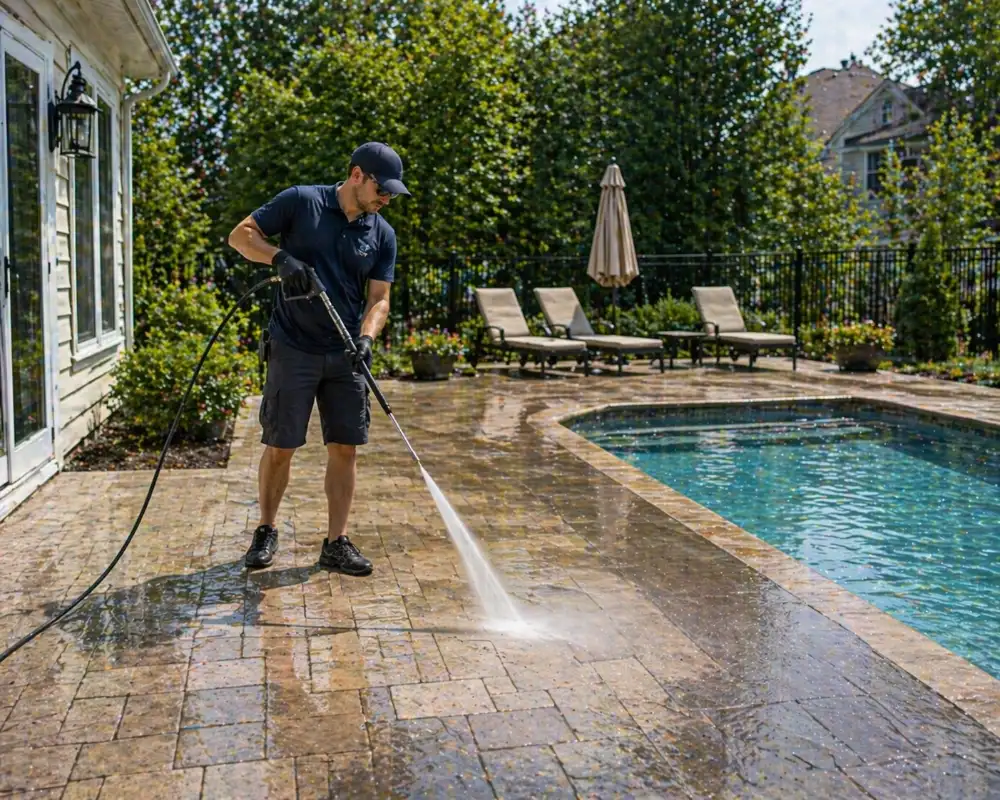
The freeze-thaw invisibility problem. Here is the specific Northern Virginia liability trap that makes this genuinely dangerous. Algae biofilm on concrete walkways is often visually subtle in winter. The growth does not disappear over winter. It goes dormant. When freeze-thaw events cycle through Loudoun and Fairfax in January and February, moisture trapped in algae-coated concrete creates a near-invisible slick surface that is indistinguishable from dry pavement at a glance. A guest approaching your front door on a January morning who slips on algae-coated concrete that appears perfectly dry has just created a premises liability situation that your homeowner’s insurance carrier will spend considerable effort examining.
The HOA Violation Side of the Problem: Virginia Law and What Your Association Can Actually Do
If you live in one of the thousands of Northern Virginia HOA communities throughout Ashburn, Brambleton, One Loudoun, Stone Ridge, Herndon, and Chantilly, algae-covered walkways and driveways are not just a safety issue. They are a potential covenant violation with real financial consequences.
Virginia’s Property Owners Association Act, codified in Virginia Code Title 55.1, Chapter 18, establishes the legal framework under which Northern Virginia HOAs operate and enforce their covenants. HOA boards throughout the region are empowered to inspect properties, issue violation notices, and assess fines for appearance standard failures that include biological growth on exterior hardscape surfaces.
Under Virginia Code Section 55.1-1819, HOA fines in Virginia are capped at $50 per violation per occurrence, with continued violations assessed on a daily or per-occurrence basis as specified in the association’s governing documents. The financial exposure from repeated violation fines accumulates over time, but the real cost of an HOA violation in Northern Virginia is less about the fine itself and more about the downstream consequences:
HOA violation notices become part of your property record. When you sell your home in Virginia, the seller is required to provide a disclosure packet to buyers. Outstanding HOA violations, unresolved notices, and history of covenant enforcement actions appear in or alongside this disclosure. A pattern of exterior maintenance violations, including repeated notices for algae-covered walkways, driveways, or siding, can complicate sale transactions and influence buyer negotiations.
HOA enforcement creates documented notice of a known hazard. This is the connection most homeowners do not make: an HOA violation notice for your algae-covered walkway is an official document establishing that you were informed the surface condition was substandard. In a premises liability context, this creates what Virginia courts recognize as actual notice of the hazardous condition. We will explain why that matters in the next section.
Community appearance standards in Loudoun County HOAs are actively enforced. Communities including Ashburn Farm, Brambleton, Kirkpatrick Farms, Stone Ridge, Lansdowne on the Potomac, and One Loudoun have architectural review committees and property standards committees that conduct regular inspections and issue notices for exterior appearance violations including biological growth on walkways, driveways, and siding. This is not theoretical. Northern Virginia HOA enforcement is one of the most active in the entire Mid-Atlantic region.
The Virginia Premises Liability Framework: How Algae on Your Sidewalk Creates Legal Exposure
Now the legal section that most homeowners have never read and genuinely need to understand.
Virginia premises liability law holds property owners responsible for maintaining safe conditions for visitors. Under Virginia Code Section 8.01-226, property owners owe a duty of care to ensure their premises are reasonably safe. To establish liability in a slip and fall case in Virginia, the injured party must prove that a dangerous condition existed, that the property owner knew or should have known about it, and that the property owner failed to take appropriate action to remedy it.
The legal concept that turns algae-covered sidewalks into a significant liability exposure in Northern Virginia is called constructive notice. Constructive notice means that a hazard existed long enough, and was visible enough, that a reasonably careful property owner should have discovered and addressed it. A green, visibly algae-coated walkway that has been building biological growth since spring meets the constructive notice standard without question by the time summer arrives. The owner did not need to be personally told about it. It was visibly there. They should have known.
Here is what makes Virginia’s legal framework particularly consequential for property owners:
Virginia is one of the strictest contributory negligence states in the country. Unlike most states that use comparative negligence (where both parties can share fault proportionally), Virginia follows pure contributory negligence. If the injured party is found to be even one percent at fault for their own fall, they may be barred from recovering any compensation whatsoever. This cuts both ways in the algae slip-and-fall scenario:
For the injured party, it creates pressure to show the hazard was not visible or avoidable. For the property owner, it creates an argument that a visible green walkway was an obvious hazard. However, Virginia case law recognizes an open-and-obvious doctrine that property owners sometimes invoke, but this defense applies only when the hazard is so apparent that a reasonable person exercising ordinary care would have seen and avoided it. An algae-coated walkway that looks merely slightly darker than surrounding concrete on an overcast day does not clearly meet this standard. Legal outcomes in these cases depend heavily on documentation, photographs, and the specific circumstances of the incident.
The two-year statute of limitations means liability follows you for years. Under Virginia law, a person injured in a slip and fall has two years from the date of the accident to file a lawsuit. This means that a guest who slipped on your algae-covered front walkway in September 2024 could still initiate legal action through September 2026. The hazard you addressed last month could still be the subject of a claim from last year.
Medical costs in Virginia slip-and-fall cases are genuinely substantial. Common injuries from slip and fall incidents include broken bones, sprained ankles, head injuries, and in severe cases long-term disability. Medical costs, lost wages, pain and suffering, and long-term care are all compensable in Virginia premises liability cases. Virginia does not cap damages in most personal injury cases, meaning a well-supported claim against a homeowner whose algae-covered walkway caused a serious injury can result in significant compensation awards. Your homeowner’s insurance covers this liability, but claims of this nature directly affect your insurance premiums and coverage status over time.
The Double Exposure Scenario: HOA Violation Plus Legal Liability
Here is the scenario that should clarify why professional sidewalk cleaning is not a cosmetic luxury in Northern Virginia HOA communities. It is a risk management investment.
A homeowner in an Ashburn community receives an HOA violation notice in June stating that their front walkway has biological growth and does not meet community appearance standards. The notice is filed. No cleaning is scheduled.
In August, a family member’s spouse visiting for a weekend gathering slips on the same algae-coated walkway, falls, and sustains a broken wrist requiring surgery.
The HOA violation notice from June now serves as documented proof that the homeowner had actual notice of the substandard surface condition and failed to act. The two-month gap between the violation notice and the accident establishes that the owner had adequate time to address the hazard. The injured party’s attorney uses the HOA notice as a central exhibit establishing the property owner’s knowledge of the dangerous condition.
This is not a hypothetical worst-case scenario. It is the logical sequence of events that Virginia premises liability attorneys work with in practice, and it is exactly what a $300 professional sidewalk cleaning appointment prevents.
What Professional Sidewalk and Walkway Cleaning Includes at Lawn Theory
Lawn Theory’s sidewalk and walkway cleaning service removes algae, mold, mildew, lichen, and biological buildup from every walkway and pathway surface connected to your property, using the correct method and chemistry for each specific material.
Concrete Walkways and Front Paths
Standard broom-finish and brushed concrete paths are the most common walkway material in Northern Virginia residential communities. Concrete is porous and absorbs algae and biological growth into its surface layer, which is why standard garden hose rinsing does not remove it. Our process includes:
Pre-treatment application of a soft wash cleaning solution containing sodium hypochlorite at appropriate concentration, applied at low pressure to kill biological growth at the root level rather than just displacing the surface appearance. Dwell time of 10 to 15 minutes to allow the solution to penetrate biofilm and kill the organisms chemically. Controlled pressure rinse using a surface cleaner attachment that provides even coverage without streaking or surface etching. Complete removal of biological material and rinse water, leaving the surface safe, clean, and free of the organisms that would otherwise return within weeks.
Brick and Paver Walkways
Brick pavers and interlocking concrete pavers present specific cleaning challenges because biological growth concentrates in the paver joints as well as on the surface faces. Standard pressure washing on paver systems can displace polymeric joint sand, destabilizing the installation. Our approach calibrates pressure to clear surface growth without compromising the joint sand, and addresses joint discoloration with targeted pre-treatment chemistry.
Natural Stone Paths
Flagstone, bluestone, travertine, and slate walkways require a soft wash approach at low pressure because high-pressure washing etches and permanently damages the stone surface. Natural stone is also particularly susceptible to dark tannin staining from leaves and organic material, which requires specific treatment chemistry distinct from general algae removal. Our patio and pool deck cleaning service and sidewalk cleaning both include natural stone protocols.
Entry Steps and Thresholds
Entry steps are the highest-traffic and highest-risk surface on any residential property from a slip-and-fall perspective. A guest approaching a front door traverses the entry steps before any other outdoor surface. Algae-coated entry steps are the most concentrated point of premises liability exposure on a Northern Virginia property. Our sidewalk cleaning service always includes entry steps as part of the connected walkway system.
How Sidewalk and Walkway Cleaning Connects to the Full Lawn Theory Exterior Program
Algae does not respect property zone boundaries. The same organisms colonizing your front walkway are also working on your driveway, siding, patio, roof, and deck. Addressing the full exterior in a coordinated professional cleaning program is the most cost-efficient approach and produces a more complete result than treating individual surfaces one at a time.
Many Northern Virginia homeowners combine sidewalk and walkway cleaning with:
Professional driveway cleaning to address the connected hardscape approaching the home, professional house washing for siding and exterior biological growth, patio and pool deck cleaning for outdoor entertaining surface safety, deck and fence cleaning for perimeter structure surfaces, gutter cleaning and brightening to eliminate the overflow moisture that feeds walkway algae growth directly below, exterior window cleaning for adjacent glass surfaces, and roof cleaning for the algae that originates on shingles and works its way down the property over time.
The exterior cleaning picture also connects directly to our lawn care and landscaping services including mulching and bed maintenance that removes the organic moisture reservoirs adjacent to walkways, tree and shrub care for the overhead canopy that creates the persistent shade environment where walkway algae thrives, and aeration and overseeding to ensure healthy turf borders that reduce moisture runoff onto hardscape surfaces.
If your outdoor spaces need upgrades alongside the cleaning, our build and outdoor living team handles walkways and pathways design and installation, patios and hardscapes, retaining walls and seating walls, and outdoor lighting installation that improves the visibility of pathways and eliminates the poor lighting condition that amplifies slip hazard risk in the early morning and evening hours.

Frequently Asked Questions: Slippery Sidewalks, HOA Violations, and Legal Liability in Northern Virginia
Q1: Can algae on my sidewalk really create legal liability in Northern Virginia? Yes, under Virginia premises liability law. Property owners in Virginia have a legal duty under Virginia Code Section 8.01-226 to maintain reasonably safe conditions for visitors. Algae biofilm on concrete sidewalks significantly reduces slip resistance when wet, creating a genuinely hazardous condition. If an invited guest or visitor slips on algae-covered concrete and can demonstrate that the property owner knew or should have known about the condition and failed to act, a premises liability claim is legally viable in Virginia. Algae that has been visibly building for weeks or months establishes constructive notice, meaning the owner should have discovered and addressed it.
Q2: What are HOA fines for sidewalk violations in Virginia? Virginia HOA fines are capped at $50 per violation per occurrence under Virginia Code Section 55.1-1819. However, continued violations can result in ongoing daily or per-occurrence assessments as specified in the association’s governing documents. Beyond the fine amount, the more significant consequences of HOA violation notices for sidewalk conditions include their appearance in property disclosure documents during home sales and their function as documentation of actual notice in any subsequent premises liability claim involving the same surface.
Q3: What is constructive notice and why does it matter for algae on walkways? Constructive notice is the legal concept that a hazard existed visibly for long enough that a reasonably careful property owner should have discovered and addressed it. In premises liability cases in Virginia, a property owner does not need to have been personally told about a hazardous condition for legal liability to attach. If green algae has been visibly growing on your front walkway for an entire spring and summer, a court can determine you had constructive notice of the hazardous condition regardless of whether you personally noticed it or received any formal complaint.
Q4: Does Virginia’s contributory negligence rule protect homeowners from sidewalk slip-and-fall claims? Virginia’s contributory negligence rule can provide a defense if the injured party was found to be even slightly at fault for their own fall. However, this is not a reliable protection against claims involving algae-covered walkways. A visitor exercising ordinary care who slips on a walkway that appears dry but is coated in invisible algae biofilm is unlikely to be found contributorily negligent. The open-and-obvious doctrine Virginia recognizes as a defense applies to clearly visible hazards, and algae that is subtle or damp-only activated does not consistently meet that threshold.
Q5: Which HOA communities in Northern Virginia most actively enforce sidewalk appearance standards? HOA communities throughout Loudoun County and Fairfax County actively enforce exterior appearance standards that include sidewalk and walkway conditions. Communities with documented active enforcement include Ashburn Farm, Brambleton, One Loudoun, Stone Ridge, Lansdowne on the Potomac, Kirkpatrick Farms, Belmont Country Club, South Riding, and Chantilly communities with architectural review committees. If you have received an HOA notice for any exterior appearance violation, sidewalk cleaning should be scheduled before the violation response deadline specified in your notice.
Q6: How often should sidewalks be cleaned to prevent algae buildup in Northern Virginia? Most Northern Virginia residential properties benefit from professional sidewalk and walkway cleaning once or twice per year. The spring cleaning window (April through May) removes winter organic accumulation and early algae establishment before summer heat accelerates growth. A fall cleaning (September through October) removes summer biological buildup and the tannin staining from leaf accumulation before winter. Shaded walkways under mature tree canopy in communities throughout Aldie, Brambleton, and Stone Ridge may benefit from twice-annual cleaning given the accelerated growth conditions our climate creates.
Q7: What cleaning method is safe for brick and paver walkways in Northern Virginia? Brick paver and interlocking concrete paver walkways require calibrated pressure cleaning that removes surface biological growth without displacing the polymeric joint sand that stabilizes the installation. High-pressure washing on paver systems at incorrect PSI or using a turbo nozzle can blast joint sand out of the gaps between pavers, creating destabilized surfaces that present their own trip hazard and require costly re-sanding. Professional cleaning assesses the paver system before selecting pressure and nozzle settings appropriate to the specific installation.
Q8: Does professional sidewalk cleaning affect my homeowner’s insurance in any way? Professional sidewalk cleaning reduces the premises liability risk associated with algae-covered walkways, which is ultimately a favorable factor for your homeowner’s insurance position. A documented pattern of property maintenance, including professional exterior cleaning records, can support your insurer’s assessment that you exercise reasonable care in maintaining your property. Conversely, HOA violation notices for exterior conditions that are subsequently involved in a slip-and-fall claim may be used by opposing counsel to establish that you had notice of the hazardous condition and failed to act, which complicates your insurer’s defense of a claim.
Q9: Can I clean my own sidewalks with a rented pressure washer to avoid the liability issue? You can clean concrete sidewalks with a rented pressure washer, but there are meaningful differences between DIY and professional results. Consumer-grade pressure washers typically lack the pre-treatment step (applying soft wash solution and allowing proper dwell time) that kills algae at the biological root level rather than just displacing surface growth. Algae treated only with pressure often returns within four to six weeks because the root organisms in the concrete pores were not killed. Professional cleaning that includes chemical pre-treatment and proper dwell time delivers significantly longer-lasting results because the biology is eliminated rather than temporarily removed.
Q10: Does removing algae from my sidewalk also help with my HOA appearance compliance? Yes, and this is one of the most direct connections between professional exterior cleaning and Northern Virginia HOA compliance. HOA appearance standards in communities throughout Ashburn, Brambleton, Herndon, and Chantilly typically specify that exterior hardscape surfaces including walkways and driveways must be free of biological growth, staining, and visible deterioration. Professional soft wash cleaning that removes algae, mold, mildew, and tannin staining from walkways simultaneously addresses the premises liability hazard and restores compliance with HOA appearance standards, eliminating both categories of risk in a single appointment.
Ready to Eliminate the Slip Hazard and the HOA Notice in One Appointment?
The green on your walkway is not just an eyesore. In Northern Virginia’s legal framework, it is a documented hazard that creates dual exposure: an HOA violation that goes in your property record and a premises liability risk that follows your address for two years under Virginia’s statute of limitations.
Lawn Theory’s sidewalk and walkway cleaning service removes the hazard completely, using the correct soft wash chemistry and controlled pressure for every surface material on your property. One appointment. Both problems solved. No paperwork required on your end.
We serve homeowners across Aldie, Ashburn, Brambleton, Loudoun County, Fairfax, Arlington, Chantilly, Herndon, Stone Ridge, Sterling, Falls Church, and all of Northern Virginia. Veteran-owned. Precision-focused. No shortcuts. See us on Instagram & Linkedin.
Here is how to get started:
- Explore our sidewalk and walkway cleaning service
- See our complete exterior cleaning program
- Bundle with driveway cleaning and house washing
- Request your free quote today
Call Lawn Theory: (703) 650-5655
Clean walkways. Zero HOA notices. Zero liability exposure. Let us handle all three.
Keep Reading: Exterior Cleaning
 Exterior Cleaning
 How to Remove Hard Water Stains from Windows in Northern Virginia (And Why They Keep Coming Back)
You cleaned your windows last spring. Spent a Saturday afternoon with Windex and elbow grease. Maybe even hired someone. They looked great…
 Exterior Cleaning
 Spring House Washing in Northern Virginia: Why Pollen Season Makes It Urgent
You wake up one Saturday morning in April, walk outside with your coffee, glance up at your house and stop dead in…
 Exterior Cleaning
 The Hidden Dangers of DIY Pressure Washing and When to Call a Professional
Many homeowners view Hidden Dangers of DIY Pressure Washing as a money-saving opportunity. Rent a machine for $60-$100/day, spend a Saturday morning…
Want this handled by the crew that wrote the guide?
Veteran-owned. Licensed & insured. Free walkthroughs across Northern Virginia — quotes in 24–48 hours.
Get Your Free Estimate