
5 Signs Your Roof Needs Professional Cleaning in Northern Virginia
Your roof is one of your Northern Virginia home’s most critical systems, protecting everything beneath it from rain, snow, hail, and the region’s intense UV radiation. Yet many homeowners only think about their roof when they notice a problem typically when dark streaks and discoloration have already begun destroying the shingles. By the time visible damage appears, the biological growth underneath has been silently shortening your roof’s lifespan for months or years.
This guide reveals five unmistakable signs that your Northern Virginia roof needs professional cleaning, explains the science behind each sign, and shows you why waiting costs significantly more than acting promptly. Whether you own a new construction home in Ashburn, a mid-century colonial in Arlington, or an estate property in Great Falls, this article will help you recognize when roof cleaning should move to the top of your home maintenance priority list.
Call (703) 650-5655 or Request a Free Roof Inspection Today!
Sign 1: Black Streaks and Dark Discoloration
Those dark streaks running down your roof aren’t just an aesthetic issue they’re a biological invasion. The culprit is Gloeocapsa magma, a blue-green algae that colonizes asphalt shingles across Northern Virginia. This organism feeds on the limestone filler material in asphalt shingles, breaking it down at the cellular level while it grows and spreads.
Gloeocapsa magma thrives in the exact conditions Northern Virginia provides: temperatures between 60-110°F, high humidity (our region averages 65-75% year-round), and regular moisture from rain and morning dew. The algae is nearly invisible in its early stages just microscopic organisms settling into the tiny pores of your shingles. Over weeks and months, their dark pigmentation becomes visible as black, gray, or green streaks that follow the water flow patterns down your roof.
Once visible, those dark streaks indicate substantial algae colonization. The organisms have consumed limestone from shingle surfaces, weakening the binding matrix that holds the granules in place. Research from the Asphalt Roofing Manufacturers Association (ARMA) shows that untreated algae-covered roofs have shingle lifespan reduced by 5-10 years. In Northern Virginia, where roofing material costs $8-$15 per square foot installed, the difference between a 25-year roof and a 15-year roof is tens of thousands of dollars.
Black streaks in Loudoun County, Fairfax County, and Prince William County are more visible in summer months as moisture and temperature activate the algae. North-facing roof sections and areas in tree shade show growth first because they retain moisture longer. If your Brambleton, Burke, or Gainesville home’s roof is showing black streaks, professional soft-wash roof cleaning is your next step.
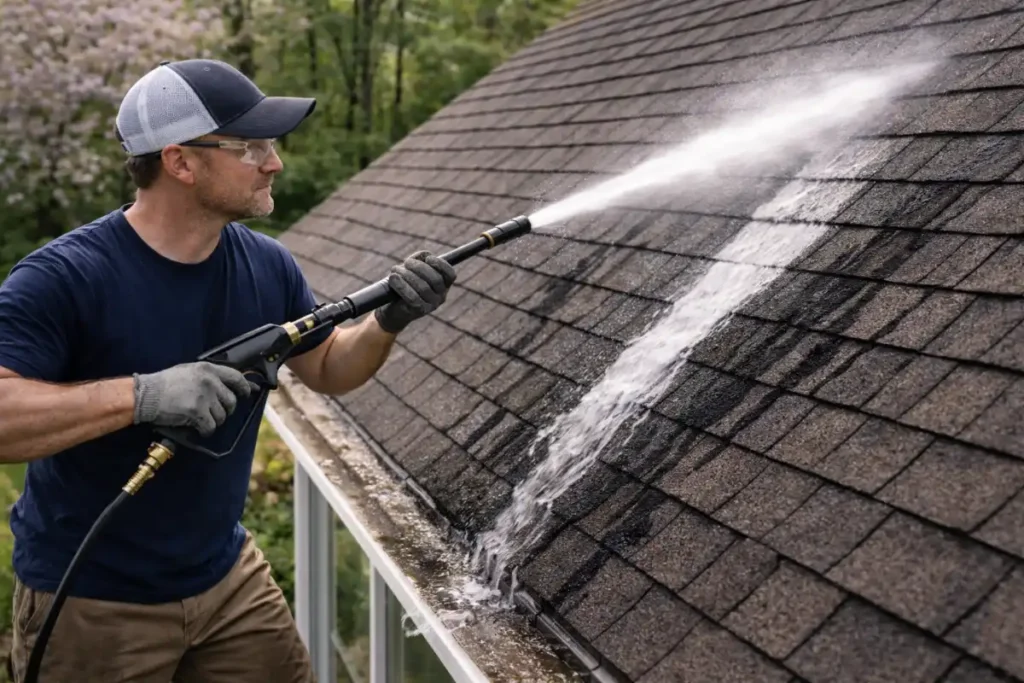
Sign 2: Green Moss or Lichen Growth
While Gloeocapsa magma creates dark streaks, moss and lichen create visible green or gray fuzzy patches on roofs. These organisms have different growth requirements than algae: they prefer cooler, wetter conditions and need moisture retention even in winter. Moss grows from spores and prefers acidic, nutrient-rich surfaces. Lichen (a combination of fungi and algae) is equally hardy and spreads aggressively once established.
Northern Virginia’s climate provides ideal conditions for moss and lichen growth. The region’s northern latitude means lower UV intensity on north-facing roof sections. Tree shade across Fairfax County neighborhoods like Burke Centre, McLean, and Vienna creates persistent moisture. Fall rains, winter sleet, and spring snowmelt keep roof surfaces saturated for extended periods. The region’s acidic soil (common throughout the Piedmont) washes airborne acids onto roofs, further favoring moss growth.
Moss growth is particularly prevalent in Arlington and Alexandria, where dense tree canopies create permanent shade. Properties in neighborhoods like Donaldson Run, Glencarlyn, and Seminary Hill frequently develop moss because their roofs rarely dry completely even after summer heat. Moss growth indicates that your roof is retaining moisture and remains wet for dangerously long periods — ideal conditions for wood rot, structural damage, and ice dam formation in winter.
Unlike algae (which only discolors surfaces), moss and lichen accumulate mass. The thick growth creates moisture retention pockets where water is trapped directly against shingles, accelerating granule loss and promoting mold growth underneath. Professional soft-wash roof cleaning removes moss at the root, killing spores and preventing rapid regrowth.
Sign 3: Rising Energy Bills
Here’s a sign many homeowners overlook: your roof’s ability to reflect sunlight directly impacts your home’s cooling costs. Asphalt shingles are manufactured with light-colored granules specifically to reflect UV radiation and reduce solar heat absorption. When algae, moss, and lichen cover those granules, your roof becomes dark and absorbs significantly more heat.
This effect is measurable and substantial. Studies by the Energy Information Administration show that heavily colonized roofs can increase cooling costs by 5-15% during summer months. In Northern Virginia’s humid climate with temperatures regularly exceeding 90°F from June through September, this translates to $300-$800 in additional cooling costs annually for an average home.
The mechanism is straightforward physics. Clean light-colored shingles reflect approximately 60-80% of incident solar radiation. Algae-covered dark shingles reflect only 20-40%, absorbing the difference as heat. That absorbed heat transfers through the roof deck into your attic and living spaces. Your air conditioning system works harder and longer to compensate, driving energy costs up while straining equipment toward earlier failure.
If your cooling costs have crept up year-over-year while your usage patterns haven’t changed, your roof’s growing biological contamination may be the culprit. Professional roof cleaning restores your roof’s reflectivity and can reduce summer cooling costs immediately. Many Loudoun County and Fairfax County homeowners report 10-20% reduction in AC costs after roof cleaning — savings that can exceed the cleaning cost within a single summer.
Sign 4: Neighbors Are Getting Their Roofs Cleaned
If you’re noticing your neighbors investing in roof cleaning, pay attention. They may be signaling something important about your neighborhood’s environmental conditions. Communities tend to develop similar patterns of algae and moss growth due to identical climate exposure, tree coverage, and soil chemistry.
When neighbors in your HOA community (Brambleton, Broadlands, Burke Centre, Dominion Valley, or others) begin scheduling roof cleaning, it often indicates that local conditions have reached a tipping point. Pollen loads have climbed, humidity levels are creating ideal growth conditions, or tree coverage has matured and begun creating shade that favors moss. Your roof, exposed to identical conditions, is likely developing similar colonization even if you haven’t noticed yet.
There’s also a property value component. Real estate agents throughout Northern Virginia increasingly recommend roof cleaning as part of pre-sale home preparation. A dark, streaked roof is one of the first things buyers notice and may trigger concerns about deferred maintenance. Communities where multiple homes are being cleaned and maintained create a positive upward spiral of curb appeal and property values. Communities where roofs are neglected can develop declining perception of maintenance standards.
Social proof matters in maintaining property values and neighborhood character. When half the homes on your street have clean roofs and yours doesn’t, it stands out — negatively affecting both your home’s perceived value and your actual resale appeal. Professional roof cleaning is one of the highest-ROI home improvements in Northern Virginia’s competitive real estate market.
Sign 5: Your Roof Is More Than 3 Years Old Without Cleaning
Perhaps the most straightforward indicator: if your roof hasn’t been professionally cleaned in more than 3 years, it almost certainly needs attention. In Northern Virginia’s humid continental climate, 3 years is the recommended maximum interval between professional roof cleaning cycles.
The timeline reflects biological growth rates in our region’s specific climate. First-year growth is typically minimal and microscopic — invisible to the naked eye. Second-year growth accelerates as initial algae and moss colonies establish robust bases and spread. By year three, visible streaking and discoloration appear on most Northern Virginia roofs. If you’re waiting until you can visually see significant growth before scheduling cleaning, you’re already 1-2 years behind the optimal maintenance curve.
Homes in heavy tree cover (Fairfax County’s Burke, Springfield, and Oakton; Arlington’s Donaldson Run and Glencarlyn; Alexandria’s Seminary Hill) should be cleaned every 2-3 years due to accelerated organic growth. Even homes with partial shade benefit from annual inspections and 3-year maximum cleaning intervals. Homes in full sun conditions may extend to 4-5 years between cleanings but still need regular monitoring.

Loudoun County’s newer homes (Ashburn, Brambleton, Broadlands, Stone Ridge) and Fairfax County’s established estates (McLean, Great Falls) show consistent 3-year growth patterns. Prince William County properties, especially those in Gainesville and Woodbridge, develop visible growth within 2-3 years due to high humidity. If you can’t remember the last time your roof was professionally cleaned, it’s time to schedule.
The Science Behind Roof Contamination
Understanding the mechanisms of roof degradation helps explain why waiting accelerates damage. Asphalt shingles consist of a fiberglass base mat, a layer of asphalt binder, and a coating of mineral granules. The granules serve critical functions: they protect the underlying asphalt from UV radiation, provide color, and enable rain water to flow cleanly down the roof.
Gloeocapsa magma attaches to limestone granules via microscopic holdfasts. These organisms then penetrate into the spaces between granules, reaching the asphalt layer beneath. As the algae consumes limestone and deposits dark pigmentation, it simultaneously weakens the granule-asphalt bond. Over time, colonized granules detach more readily, appearing as dark sediment in your gutters. The exposed asphalt beneath becomes vulnerable to UV damage and water penetration.
Moss and lichen create different damage patterns. As they grow thicker, they retain surface moisture indefinitely, preventing normal water drainage and drying cycles. Extended moisture exposure promotes fungal attack on the asphalt layer itself. The weight of mature moss (which can accumulate 1-3 inches thick in Northern Virginia’s climate) creates physical stress on shingle attachments, often lifting shingles and creating gaps where water infiltrates.
Both processes accelerate geometrically rather than linearly. Once 20-30% of a roof surface is colonized, the remaining uncolonized areas provide poor resistance to expansion. Organic contamination spreads 2-3x faster on a partially colonized roof than on a clean roof. This is why early intervention is so important — stopping growth at 10% colonization prevents the explosive growth that occurs once established populations reach critical mass.
Soft Wash vs Pressure Wash: Why Method Matters
Here’s where many homeowners make a critical mistake: hiring contractors who pressure wash roofs. High-pressure washing (typically 2,500-4,000 PSI) is absolutely wrong for asphalt shingles and can destroy them. The force dislodges protective granules, cracks tiles, splits shingles, and creates pathways for water infiltration. Most major shingle manufacturers (GAF, Owens Corning, CertainTeed, Asphalt Roofing Manufacturers Association) explicitly void warranties for pressure-washed roofs.
Professional soft washing (under 500 PSI) combined with specialized roof cleaning solutions is the only appropriate method. The solution — typically a low-concentration bleach or sodium hypochlorite with surfactants — is applied to the roof surface and allowed to dwell for 15-20 minutes. During dwell time, the solution kills algae spores at the cellular level, breaks down moss holdfasts, and loosens biological growth from granule surfaces.
After dwell time, a gentle rinse at very low pressure removes the dead organisms and cleaning solution. The organisms are killed before physical removal even begins, so dead algae and moss release naturally from the roof rather than being blasted away. The result is complete removal of contamination with zero damage to shingles, zero risk of water intrusion, and zero warranty impact.
Lawn Theory exclusively uses soft-wash methods for all roof cleaning in Northern Virginia. Our approach is manufacturer-approved, protective, and highly effective. Many customers are surprised to discover that a freshly soft-washed roof requires 1-2 rain cycles before the absolute maximum appearance improvement manifests — this is normal and indicates the treatment is continuing to work as remaining spores break down.
Roof Cleaning Costs and Recommended Frequency
Professional roof cleaning in Northern Virginia starts at $450 — final price depends on roof size, pitch, and material complexity. A standard 2,000-2,500 square foot home with a moderate pitch and asphalt shingles starts at $450. Larger homes, steep pitches, complex roof lines (with dormers, valleys, multiple peaks), and specialty materials (slate, tile, cedar shake) cost more due to increased complexity and safety requirements.
For Loudoun County homeowners, we recommend professional roof cleaning every 3 years as a baseline. Homes in tree-heavy areas (Stone Ridge, Willowsford, Broadlands) should be cleaned every 2-3 years. Homes with north-facing sections or in heavy shade should be prioritized. Fairfax County recommendations are similar, with properties in Burke, Springfield, and Oakton needing more frequent service due to mature tree canopy. Prince William County properties in Woodbridge, Manassas, and Gainesville should follow a 2-3 year cycle due to high humidity.
Professional roof cleaning costs far less than roof replacement (typically $8,000-$25,000 depending on home size and material). Even as a purely financial decision, maintaining roofs through regular soft-wash cleaning is economically logical. The ROI extends beyond financial — clean roofs also reduce cooling costs, improve curb appeal, maintain neighborhood property values, and provide homeowners with confidence that their most critical home system is protected. See us on Instagram & YouTube.

FREQUENTLY ASKED QUESTIONS
What exactly is Gloeocapsa magma?
Gloeocapsa magma is a blue-green algae that grows on asphalt shingles across Northern Virginia. It consumes the limestone filler in shingles while accumulating dark pigmentation that creates black streaks. The organism is airborne, thrives in humidity and warmth, and colonizes roofs slowly over 1-3 years. Once established, it accelerates shingle deterioration and reduces roof lifespan by 5-10 years.
Will pressure washing fix my roof’s black streaks?
No. High-pressure washing (which many contractors mistakenly use) damages asphalt shingles by stripping granules, cracking tiles, and voiding manufacturer warranties. Only soft-wash methods (under 500 PSI combined with specialized cleaning solutions) are safe and appropriate for roofs. Always require that your contractor use soft-wash exclusively.
How much does roof cleaning cost in Northern Virginia?
Professional soft-wash roof cleaning in Northern Virginia starts at $450 — final price depends on roof size, pitch, and material. A standard 2,000-2,500 sq ft home with asphalt shingles starts at $450. Larger homes, steep pitches, and specialty materials (slate, tile, cedar) cost more. This is minimal compared to roof replacement costs ($15,000-$30,000+).
How often should I have my roof cleaned?
We recommend professional roof cleaning every 3 years in Northern Virginia. Homes in heavy tree shade should be cleaned every 2-3 years. Homes with good sun exposure can extend to 3-4 years. Annual inspections help identify growth early. Once visible black streaks or moss appear, cleaning is overdue.
Does roof cleaning void my warranty?
Soft washing does not void warranties — in fact, manufacturers like GAF, Owens Corning, and CertainTeed recommend it. High-pressure washing absolutely voids warranties. Always use contractors certified to soft-wash and always request warranties on the cleaning work performed.
Can roof cleaning be done in winter?
Winter roof cleaning is challenging in Northern Virginia due to ice risk and freeze-thaw damage from wet surfaces. Spring (March-May) and fall (September-October) are ideal. If winter cleaning is necessary, wait for daytime temperatures above 40°F and ensure the roof dries fully.
Why does my roof still look bad after a month?
Some algae discoloration fades slowly over 1-2 rain cycles after treatment as spores break down and wash away. This is completely normal — it indicates the treatment is working. Full appearance improvement typically completes within 4-6 weeks. If significant streaking remains after 2 months, contact your contractor.
Keep Reading: Pressure Washing
 Pressure Washing
 How Much Does Pressure Washing Cost in Northern Virginia? (2026 Homeowner Guide)
Pressure washing cost in Northern Virginia is set by square footage, surface type, buildup and access, not a flat rate. Here is…
 Pressure Washing
 Trex Composite Deck Cleaning in Northern Virginia: Why the Method Totally Changes Compared to Wood
Picture this: your neighbor hires a pressure washing company to clean their beautiful new Trex Transcend deck in Brambleton. The crew shows…
 Pressure Washing
 Sprinkler Rust Stains on Your Northern Virginia Property: Why They Happen and How to Actually Fix Them
You designed your irrigation system to keep your lawn green and your landscaping thriving. Nobody told you it would also paint your…
Want this handled by the crew that wrote the guide?
Veteran-owned. Licensed & insured. Free walkthroughs across Northern Virginia — quotes in 24–48 hours.
Get Your Free Estimate