
Why Is My Lawn Turning Brown in Northern Virginia? Brown Patch, Drought, Grubs, and Other Causes
Why is my lawn turning brown? It is the question Northern Virginia homeowners ask most in late summer, and the honest answer is that brown grass is a symptom rather than a diagnosis. A brown lawn does not automatically mean the grass is dead, under-watered, or infected with fungus. In Northern Virginia, brown patches commonly come from brown patch disease, summer dormancy, uneven sprinkler coverage, white grubs, mowing stress, dog urine, chemical burn, compacted soil, poor drainage, or shade. The pattern, timing, roots, soil moisture, and condition of individual grass blades usually reveal the real cause.
The short answer: Start by checking the shape of the damage, when it appeared, whether the turf pulls up easily, and whether the soil is dry or saturated. Circular patches after humid nights suggest brown patch. Uniform browning during hot, dry weather suggests dormancy. Loose turf with damaged roots points toward grubs. Small spots with dark-green halos often indicate dog urine.
Brown grass is a symptom, not a diagnosis. Treating every brown area with more water, more fertilizer, fungicide, or insecticide can make the actual problem worse. This guide explains how Northern Virginia homeowners can narrow down the cause before deciding whether the lawn needs a simple maintenance correction, targeted treatment, fall overseeding, or professional diagnosis.
Lawn Theory provides lawn care and landscaping across Northern Virginia, including diagnosis-driven lawn pest and disease control, irrigation corrections, aeration, overseeding, and lawn renovation.
Key Takeaways
- Brown grass is a symptom, not a diagnosis. The pattern, timing, root condition, and soil moisture identify the cause.
- Circular patches after humid nights point to brown patch. Broad, uniform fading in dry heat points to summer dormancy.
- Turf that lifts like loose carpet means damaged roots, so check for white grubs before treating anything else.
- Repeating arcs, stripes, or one dry corner are irrigation coverage problems that more run time will not fix.
- Never apply fungicide simply because grass is brown. Several non-disease causes look identical from a distance.
- Fix the underlying cause before reseeding. New seed fails in the same wet low spot, shaded corridor, or broken sprinkler zone.
- Early fall is the strongest window in Northern Virginia to repair damaged tall fescue.
Why Northern Virginia Lawns Turn Brown So Easily
Northern Virginia sits in the turfgrass transition zone. Cool-season grasses, especially turf-type tall fescue, perform well during spring and fall but face intense pressure during hot, humid summers. Warm-season grasses tolerate summer heat better but spend much of the cooler season dormant and brown.
Virginia Tech identifies tall fescue as the most common turfgrass used in Virginia home lawns and brown patch as its most troublesome disease. The same guidance notes that summer diseases become more common when cool-season grasses shift from active growth into survival mode. That is exactly what happens during stretches of hot days, warm nights, heavy dew, thunderstorms, and high humidity. See the Virginia Tech lawn disease guide.
Local soils add another complication. Many Northern Virginia properties contain dense, compactable soil with a substantial clay component. Water may run off a hard slope, sit in a low area, or remain near the surface longer than expected. A lawn can therefore have drought stress and excessive moisture within a few yards of each other.
Mature subdivisions in Vienna, McLean, Reston, Herndon, Fairfax, and Arlington often have large trees, aging irrigation systems, compacted construction soil, and shaded side yards. Newer communities in Loudoun County and Prince William County may have disturbed subsoil, thin topsoil, drainage swales, and larger exposed lawns that heat up quickly. Those differences matter when diagnosing brown grass.
The correct response depends on what is happening beneath the colour change. A fungus affecting leaves is managed differently from an insect feeding on roots. Dormant grass needs a different response than chemically burned grass. A dry sprinkler zone cannot be corrected with fungicide, and a saturated low spot should not receive more irrigation.
Why Is My Lawn Turning Brown? Quick Diagnosis Chart
| Likely cause | Typical pattern | Best first check |
|---|---|---|
| Brown Patch Fungus | Circular, irregular, or horseshoe-shaped tan patches after hot, humid weather. Roots usually remain attached. | Stop evening watering and inspect individual blades at dawn. |
| Drought Stress or Dormancy | Broad, uniform fading near pavement, slopes, or high spots. Soil is dry several inches down. | Check soil moisture and irrigation coverage before increasing run time. |
| Irrigation Gap | Repeating arcs, stripes, wedges, or one dry corner after several rain-free days. | Audit sprinkler heads and measure output in several straight-sided containers. |
| White Grubs | Irregular thinning, animal digging, and turf that lifts because roots are damaged. | Lift a one-square-foot section and inspect the root zone. |
| Dog Urine | Small round or irregular spots, often with a dark-green edge in pet-use areas. | Compare the pattern with the pet’s normal route. |
| Fertilizer or Herbicide Burn | Streaks, overlap lines, spill shapes, or sharp-edged damage soon after an application. | Review the product, rate, weather, and application path. |
| Scalping or Mower Injury | Brown ridges, wheel tracks, torn tips, or damage in low spots after mowing. | Check mowing height, blade sharpness, and how much leaf was removed. |
| Poor Drainage | Yellow-brown thinning in low areas where soil stays wet or soft. | Check moisture after rain and trace runoff or downspout discharge. |
| Shade and Root Competition | Gradual thinning under trees or beside structures, often with dry soil near large roots. | Measure sunlight and inspect root competition before reseeding. |
| Other Fungal Disease | Small spots, greasy patches, orange dust, rings, or rapid collapse. | Obtain a confirmed diagnosis before selecting treatment. |
This table is a screening tool, not a laboratory diagnosis. Several problems can occur at the same time. A lawn stressed by drought may also show grub injury. Excessive nighttime watering can create disease while poor sprinkler distribution leaves nearby turf dry.
A Seven-Step Process to Diagnose Brown Grass
1. Study the shape before touching anything
Patterns are evidence. Stand back and look at the whole lawn before inspecting a single blade.
Circular or expanding patches suggest disease more than drought. Straight lines or repeated arcs often follow sprinkler coverage, fertilizer passes, mower wheels, or a buried utility. Damage along a driveway, patio, curb, or sidewalk commonly reflects heat, reflected sunlight, dry soil, salt, or limited irrigation coverage. Small isolated spots in a pet route point toward urine injury.
Take wide photos from the same location every two or three days. A rapidly enlarging patch needs faster attention than a stable patch that has not changed.
2. Match the timing to recent weather
Ask what happened before the lawn changed.
- Several humid nights, warm rain, or evening irrigation raise disease risk.
- A week of high heat and no meaningful rain raises drought and dormancy risk.
- Damage after fertilization, herbicide use, equipment cleaning, or a spill suggests chemical injury.
- Damage appearing in late summer with birds, skunks, raccoons, or loose turf suggests grubs.
- Damage immediately after mowing suggests scalping, dull blades, mowing wet turf, or cutting too much at once.
Keep in mind that symptoms can appear after the damaging event. Root injury may be underway before the lawn turns brown.
3. Perform the tug test
Grab a handful of affected turf and pull upward with moderate pressure.
If the leaves remain attached and the root system holds the soil, the problem may be leaf disease, drought, chemical damage, or mowing stress. If the turf lifts like loose carpet and has few roots, inspect the soil for white grubs or another root problem.
Virginia Cooperative Extension recommends confirming grub activity by sampling the soil rather than treating based on colour alone. Its white grub control guidance notes that birds and mammals digging for larvae can also be an important clue.
4. Check the soil, not just the blades
Push a screwdriver or soil probe several inches into healthy and affected areas. Compare resistance and moisture.
- Hard, dry soil suggests drought, hydrophobic soil, compaction, or poor sprinkler coverage.
- Wet soil in a brown area suggests excessive irrigation, drainage failure, root decline, or disease-favouring conditions.
- Dry soil beneath a sprinkler zone suggests a coverage or controller problem.
- Waterlogged soil in a low area indicates that adding seed alone will not solve the problem.
Homeowners with recurring low spots should review Lawn Theory’s drainage solutions and yard grading before repeatedly repairing the turf surface.
5. Inspect individual blades early in the morning
Disease clues are easiest to see while dew is present.
Look at blades near the advancing edge of a patch, not only the dead centre. Brown patch can create tan lesions with darker margins. Some fungal problems produce cottony or cobweb-like growth at dawn that disappears as the lawn dries. Rust leaves orange powder on fingers or shoes. Gray leaf spot creates lesions that can expand rapidly under warm, wet conditions.
Virginia Tech warns that symptoms of brown patch, Pythium blight, and gray leaf spot may overlap and that treatment recommendations differ. When symptoms are aggressive or unclear, a professional or Extension diagnosis is safer than guessing.
6. Audit irrigation coverage
Do not assume every brown spot means the controller needs more minutes.
Place several straight-sided containers across one irrigation zone, including healthy and brown areas. Run the system for a fixed period, then compare the water captured. Check for clogged nozzles, tilted heads, low pressure, blocked spray, incorrect head spacing, broken pipes, and zones running at the wrong time.
Virginia Tech’s summer lawn watering guidance recommends watering around sunrise to reduce prolonged leaf wetness. Night watering can increase fungal disease pressure, while overwatering wastes water and may increase runoff.
Lawn Theory can evaluate coverage, controller settings, and repairs through its irrigation and sprinkler system service.
7. Review everything applied or changed
Write down recent treatments and activity:
- Fertilizer type and rate
- Weed-control products
- Fungicides or insecticides
- Ice melt, pool chemicals, fuel, or cleaning products
- New pet routines
- Mowing height changes
- Irrigation schedule changes
- Construction or heavy foot traffic
- Tree removal, pruning, or new shade
A precise timeline often makes the cause obvious.
Brown Patch Fungus in Tall Fescue
Brown patch is one of the most common reasons Northern Virginia tall fescue develops circular or irregular brown areas during summer. The disease is associated with the pathogen Rhizoctonia solani and is favoured by warm, wet conditions, extended leaf wetness, and susceptible turf.
What brown patch usually looks like
Common signs include:
- Tan, brown, or straw-coloured patches ranging from several inches to several feet
- Circular, irregular, or horseshoe-shaped areas
- A darker outer margin that may be visible in the morning
- Tan lesions with darker borders on individual blades
- Symptoms that appear or expand after humid nights, rain, or evening watering
- Leaves damaged more severely than the roots in many cases
Virginia Tech states that brown patch occurs most frequently during warm, wet weather. Properly managed lawns often recover in fall, but severe disease combined with drought or heat stress can cause plant loss.
Conditions that make brown patch worse
Brown patch pressure increases when multiple risk factors occur together:
- Warm nights and high humidity
- Grass remaining wet for long periods
- Evening or excessive irrigation
- Heavy summer nitrogen growth
- Poor air movement
- Compacted or poorly drained soil
- Turf mowed too short
- A lawn with a previous disease history
A healthy mowing routine matters: keep tall fescue at a seasonally appropriate height, use sharp blades, and avoid removing too much leaf tissue at once.
What to do when brown patch is suspected
First, reduce conditions that favour disease:
- Move irrigation to early morning.
- Avoid frequent, shallow watering.
- Stop heavy nitrogen applications during active disease pressure.
- Raise the mowing height.
- Avoid mowing when the turf is wet.
- Improve air circulation around dense shrubs and low branches.
- Correct drainage or compaction that keeps the canopy wet.
- Clean mower equipment before moving from affected to unaffected areas.
Do not automatically remove all discoloured grass. Some blades may recover as conditions improve. Fungicides can be useful for valuable lawns, severe outbreaks, or recurring disease, but the product and timing must match the diagnosis. Lawn Theory’s fertilization and weed-control programs are designed around cool-season growth cycles rather than pushing tender growth during peak summer stress.
If circular patches are spreading and you cannot distinguish fungus from irrigation or insect damage, request a Lawn Theory lawn evaluation before applying another product.
Drought Stress and Summer Dormancy
Tall fescue can turn tan or brown during extended heat and moisture stress. This colour change may be dormancy, a survival response that reduces growth while the plant preserves its crown and roots.
Signs of drought stress or dormancy
- Broad areas fade from green to blue-green, gray-green, then straw-coloured
- Damage begins on high spots, slopes, thin soil, or near hot pavement
- Footprints remain visible because wilted blades do not spring back
- Soil is dry below the surface
- The pattern follows sunlight exposure and water distribution more than circles
- The turf remains rooted even though the leaves are brown
Virginia Tech notes that lawns receiving little water in summer may go dormant and that many recover when water returns. Severe drought can still kill portions of cool-season turf, so dormancy should not be treated as a guarantee.
Do not flood a dormant lawn
The correct response depends on the homeowner’s goal.
A lawn being kept actively green needs consistent, deep irrigation. A lawn allowed to go dormant may need only enough water to keep crowns alive during prolonged drought. Moving abruptly between drought and heavy watering can create additional stress and disease risk.
Before increasing irrigation time, audit coverage. A dry strip may receive no water even while the rest of the zone is overwatered. Professional sprinkler evaluation and irrigation correction is often more effective than adding minutes to every zone.
Irrigation Coverage Problems
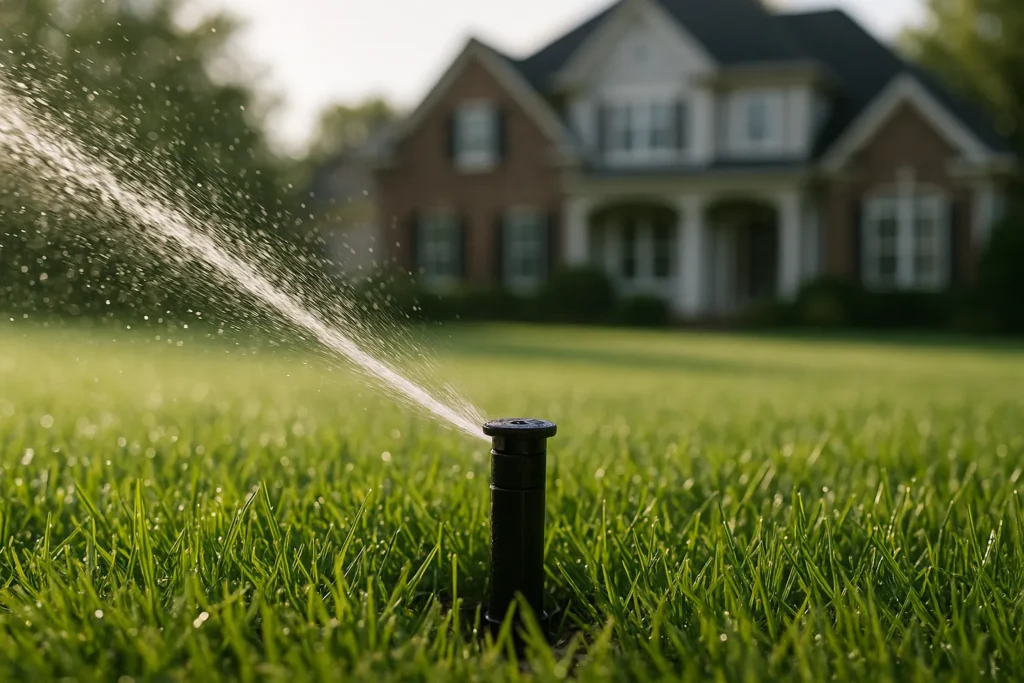
Uneven watering is one of the most overlooked causes of brown turf. The controller may run on schedule while a tilted head, blocked nozzle, pressure issue, or changed landscape prevents water from reaching the grass.
Patterns that suggest an irrigation problem
- A dry arc matching the edge of a sprinkler radius
- A wedge or strip behind a shrub, mailbox, fence, or parked vehicle
- Brown turf at the end of a zone with low pressure
- One consistently dry corner
- Green rings around heads with dry areas between them
- A dry slope where water runs off before soaking in
- Brown turf next to a new patio, walkway, or landscape bed that altered coverage
Use catch cups to measure output, not guesswork. If one container receives twice as much water as another in the same zone, extending the run time will worsen overwatering in the wet area.
Large properties in Great Falls, McLean, Ashburn, and Leesburg often have multiple microclimates and long irrigation runs. Each zone should be adjusted for sunlight, soil, slope, plant type, and head performance.
White Grubs and Root-Feeding Insects
White grubs are immature beetles that live in soil and feed on turf roots. Their damage is commonly misdiagnosed because the visible symptom is simply brown, thinning grass.
Signs that point toward grubs
- Irregular brown or thinning turf
- A soft or spongy feel underfoot
- Turf that lifts easily because roots have been eaten
- C-shaped white larvae in the upper soil
- Birds, skunks, raccoons, or other animals digging for food
- Recurring damage in the same favourable area
Do not treat only because beetles were seen in summer. A few grubs may be present without causing economically meaningful damage. Virginia Tech recommends sampling and identifying the pest before choosing control measures.
How to inspect for grubs
- Select the edge between healthy and damaged turf.
- Cut and lift approximately one square foot of sod.
- Inspect the top few inches of soil and the root zone.
- Count visible grubs and repeat in several locations.
- Replace the sod and water it back into place.
Treatment timing matters because young grubs are easier to control than larger, mature larvae. Products also differ between preventive and curative use. Applying the wrong material at the wrong stage can waste money and add unnecessary pesticide exposure.
Lawn Theory’s lawn pest and disease control begins with diagnosis instead of blanket treatment.
Dog Urine, Fertilizer Burn, and Other Salt Injury
Small dead spots are often blamed on fungus when the pattern is actually concentrated nitrogen and salt injury.
Dog urine spots
Dog urine commonly creates a brown or straw-coloured centre with a dark-green ring around it. The outer ring receives enough diluted nitrogen to stimulate growth, while the centre receives a damaging concentration.
Colorado State University Extension explains that concentrated nitrogen-containing compounds and salts in urine can injure turf. It also warns that supplements marketed to alter urine chemistry are not a reliable lawn solution and may create health concerns. See its dog urine lawn-damage guidance.
Practical options include:
- Train the dog to use a designated gravel, mulch, or tolerant planting area.
- Flush a freshly used spot with water when practical.
- Repair dead areas with seed or sod during the correct establishment window.
- Avoid unproven supplements intended solely to prevent lawn spots.
Fertilizer or herbicide burn
Application injury often follows a recognisable pattern:
- Straight spreader lines
- Overlap stripes
- Piles where a spreader was filled or stopped
- A tank spill shape
- Drift along a bed edge
- Damage confined to treated areas
Water may help dilute soluble salts after a fresh fertilizer spill, but it will not reverse tissue already killed. Do not add more products until the original application, rate, and weather conditions are reviewed.
A soil-informed plan is safer than trial and error. Fairfax County’s Home Turf healthy-lawn program begins with soil testing and develops nutrient recommendations intended to support turf while reducing unnecessary nutrient movement into the Chesapeake Bay watershed.
Mowing Damage, Scalping, and Pavement Heat
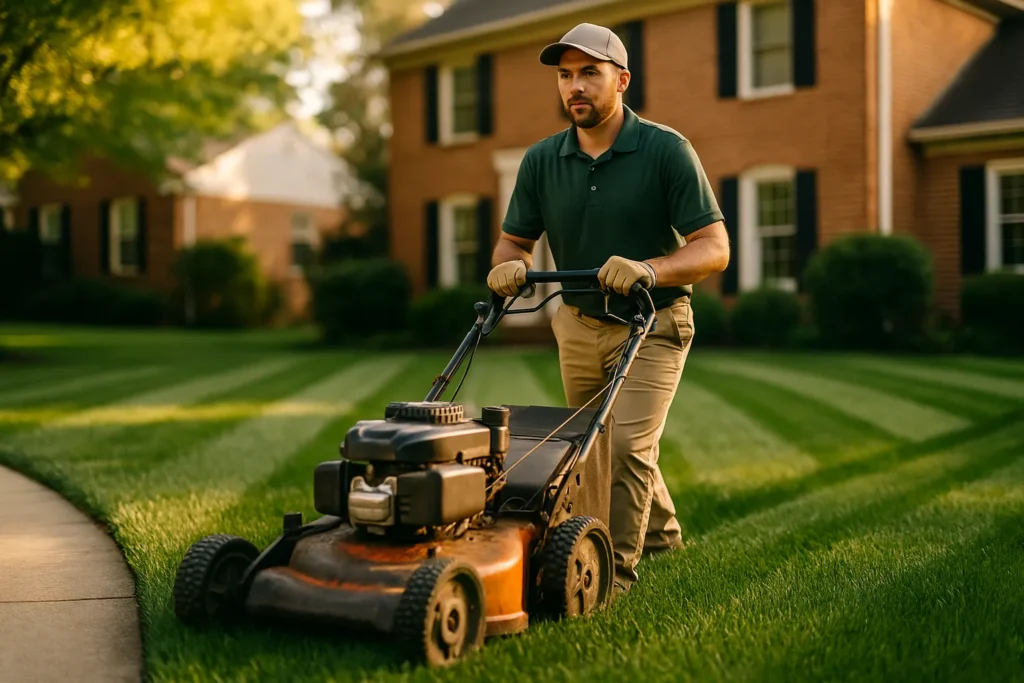
Mowing is one of the most frequent sources of preventable lawn stress.
Scalping
Scalping occurs when too much leaf tissue is removed or the mower cuts into crowns on uneven ground. It often appears on ridges, slopes, around tree roots, and where mower decks bounce.
Tall fescue should generally be maintained on the taller side during heat. Virginia Tech’s disease guidance recommends three to four inches, especially during drought and heat stress. A taller canopy supports deeper roots, shades the soil, and improves resilience.
Dull mower blades
Dull blades tear instead of cutting cleanly. The tips may look tan or shredded across the lawn. Torn tissue loses moisture faster and can be more vulnerable to disease.
Heat beside hard surfaces
Grass along driveways, walkways, curbs, patios, and south-facing walls may brown first because pavement stores and radiates heat while nearby soil dries quickly. The solution may involve adjusted irrigation, higher mowing, improved soil, or replacing narrow turf strips with planting beds or hardscape.
Properties with extensive pavement in Fairfax City, Vienna, Chantilly, and Manassas often show these edge effects during hot periods.
Compacted Soil and Drainage Problems
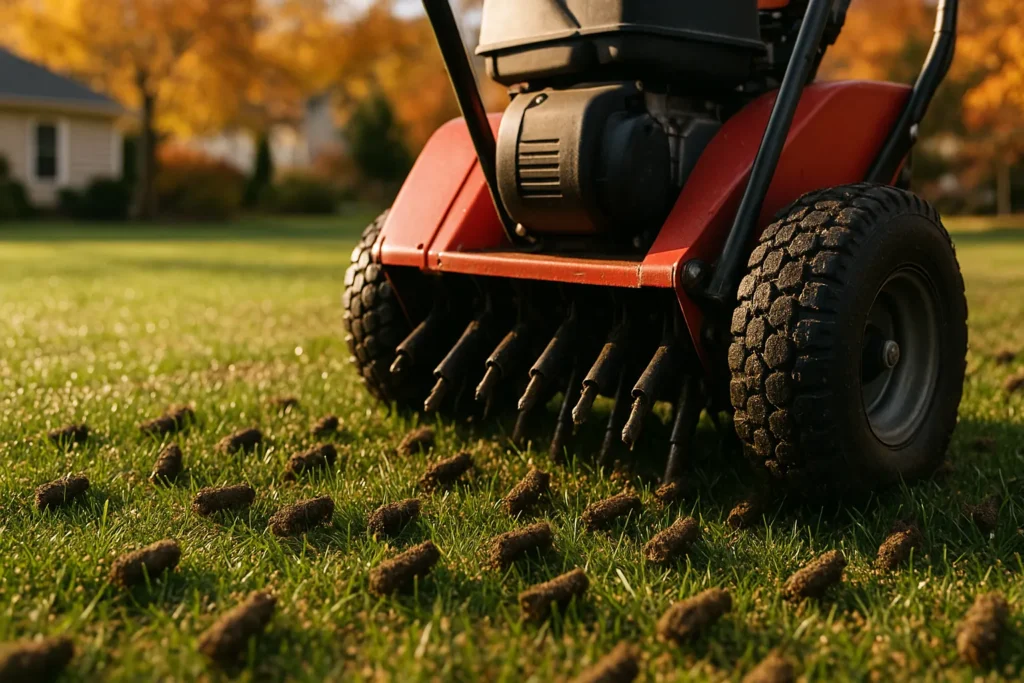
Compaction limits the movement of air, water, and roots. It can make a lawn dry because water runs off, or wet because water cannot move through the soil profile efficiently.
Signs of compaction
- Water puddles or runs off during normal irrigation
- A screwdriver is difficult to push into moist soil
- Turf thins along walking routes, play areas, or equipment paths
- Moss, algae, or moisture-loving weeds appear
- Roots remain shallow
- The same areas decline every summer
Core aeration removes small plugs and creates channels through compacted soil. For cool-season lawns, fall is usually the best time because the grass can recover under favourable growing conditions. Lawn Theory’s aeration and overseeding service addresses compaction and restores density, while its detailed guide explains when to aerate and overseed in Northern Virginia.
Drainage-related browning
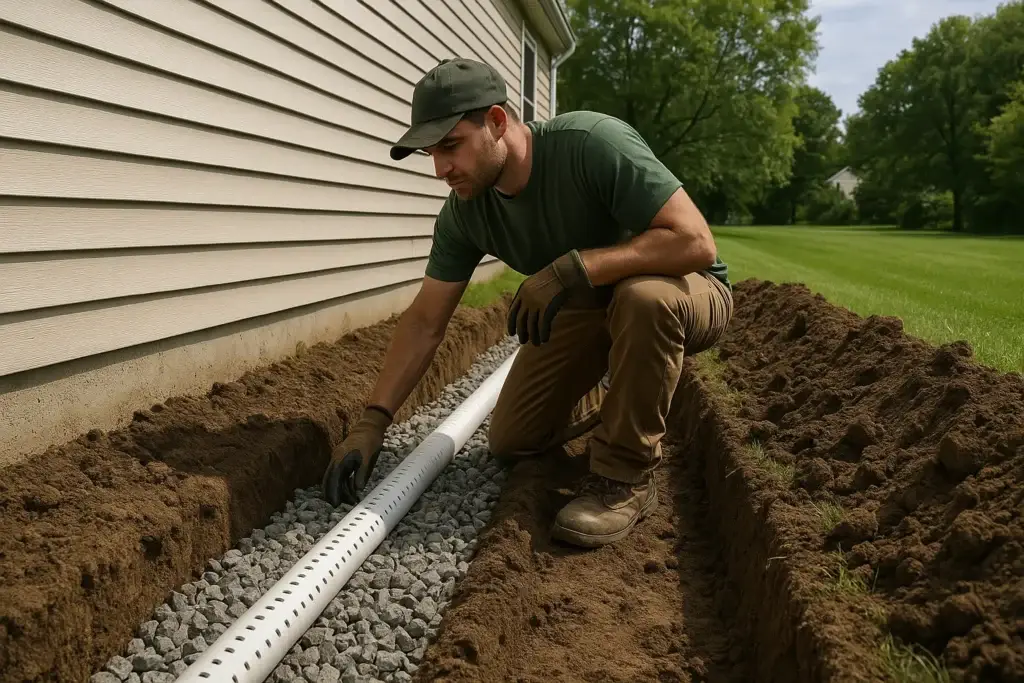
Brown grass in a wet low spot is not drought stress. Roots need oxygen. Chronic saturation can weaken turf, encourage disease, and leave an area unable to support dense grass.
The long-term fix may involve:
- Downspout extensions
- Surface regrading
- Catch basins
- French drains
- Soil correction
- Redirecting runoff without sending water onto neighbouring property
- Rebuilding the turf after the drainage issue is corrected
Repeatedly seeding the same wet area without correcting water movement wastes money. Lawn Theory combines yard drainage and grading with sod installation and lawn renovation when both the cause and the damaged turf need to be addressed.
Shade, Mature Trees, and Root Competition
Not every part of a property is suitable for dense turf.
Areas beneath mature trees may receive limited sunlight while roots compete aggressively for moisture and nutrients. Large trees can intercept rainfall, and the soil directly beneath the canopy may be drier than homeowners expect. At the same time, limited air movement can keep blades wet after dew or irrigation.
Signs that shade is the main problem
- Turf becomes progressively thinner beneath the canopy
- The area improves temporarily after seeding but declines again
- Grass leans toward available light
- Soil is full of large roots
- Disease repeatedly appears where drying is slow
- The area receives less than the light needed by the grass blend
Possible solutions include selective pruning by a qualified professional, choosing more shade-tolerant turf cultivars, reducing foot traffic, adjusting irrigation, expanding mulch beds, or redesigning the area with shade-adapted plants.
Lawn Theory’s tree and shrub care and landscape design and installation services can help determine whether turf should be improved or replaced with a more appropriate landscape treatment.
Other Lawn Diseases That Can Look Like Brown Patch
Brown patch is common, but it is not the only turf disease in Virginia.
Dollar spot
Dollar spot usually produces small straw-coloured spots that may merge. Individual blades can show lesions with darker borders. Unlike brown patch, low nitrogen can contribute to dollar spot susceptibility, which is why accurate diagnosis matters before changing fertilizer practices.
Gray leaf spot
Virginia Tech warns that gray leaf spot can become severe during prolonged warm, rainy periods and may damage tall fescue rapidly. Young seedlings can be especially vulnerable during establishment.
Pythium blight
Pythium can create greasy, matted, rapidly spreading areas under very wet, humid conditions. It should not be casually treated as ordinary brown patch.
Rust
Rust often leaves orange or rust-coloured powder on blades, shoes, mower decks, or pets. The turf may appear yellow or brown from a distance.
Red thread
Red thread can create pink, red, or coral-coloured threads at leaf tips, often in slower-growing or nutritionally stressed turf.
Fairy ring
Fairy rings may appear as dark-green circles, rings of mushrooms, or bands of dead turf. The underlying fungi interact with organic matter and soil moisture, so the solution is not the same as treating brown patch.
Gray, greasy, or collapsing turf needs immediate attention
Rapidly expanding damage, greasy leaves, extensive mycelium, or newly seeded turf collapsing over a few days deserves professional evaluation. Virginia Tech advises consultation when disease identification is uncertain because chemical-control recommendations vary.
What to Do During the First 48 Hours
When brown patches appear, avoid the urge to apply every possible treatment.
Day 1: Document and inspect
- Photograph the entire lawn and close-ups.
- Mark the patch edge with small flags to track expansion.
- Check irrigation settings and recent rainfall.
- Perform the tug test.
- Probe soil moisture.
- Inspect blades early in the morning.
- Review fertilizer, herbicide, and mowing history.
Day 1: Stop actions that can worsen several causes
- Stop evening irrigation.
- Do not add high-nitrogen fertilizer.
- Avoid mowing wet turf.
- Do not apply insecticide without finding insects.
- Do not apply fungicide solely because the grass is brown.
- Keep heavy traffic off stressed areas.
Day 2: Run targeted tests
- Conduct a catch-cup irrigation audit.
- Lift turf at the edge of suspected grub damage.
- Compare healthy and affected soil.
- Check sprinkler pressure and head rotation.
- Look for chemical spill or overlap patterns.
Day 2: Decide whether the problem is stable or urgent
A stable dry area caused by sprinkler coverage can be corrected methodically. A disease patch expanding overnight or newly established turf collapsing quickly requires faster diagnosis.
Lawn Theory can inspect the turf, irrigation, soil condition, and recent maintenance history in one visit. Contact Lawn Theory for a property-specific assessment instead of treating by guesswork.
Recovery Options by Cause
| Cause | Immediate response | Recovery path |
|---|---|---|
| Brown Patch | Reduce leaf wetness and confirm the disease. | Correct watering, mowing, and fertility. Overseed in fall only where turf was lost. |
| Drought or Dormancy | Verify soil moisture and sprinkler coverage. | Restore appropriate deep watering. Repair dead areas in early fall. |
| Irrigation Gap | Repair or adjust the affected zone. | Correct spacing, pressure, and scheduling before installing seed or sod. |
| Grubs | Confirm larvae and life stage. | Use appropriately timed control and rebuild cool-season turf when conditions support rooting. |
| Dog Urine | Flush fresh spots and redirect pet use. | Patch with seed in fall or use sod during a suitable establishment window. |
| Fertilizer Burn | Dilute fresh soluble salts and stop inputs. | Remove dead material. Seed in fall or use sod when irrigation is reliable. |
| Scalping | Raise the deck and sharpen blades. | Allow crowns to recover. Reseed in fall only if plants are dead. |
| Compaction | Reduce traffic. | Core aerate and improve soil contact during the early-fall growth window. |
| Poor Drainage | Stop excess irrigation and trace the water source. | Correct grade, downspouts, or drainage before repairing turf. |
| Deep Shade | Reduce expectations for turf. | Prune selectively or convert the area to an appropriate shade landscape. |
Should You Reseed, Overseed, or Install Sod?
The right repair depends on the amount of surviving turf and whether the original cause has been corrected.
Overseed when
- Existing turf is still present but thin
- Compaction has been relieved
- Disease activity is no longer aggressive
- Irrigation coverage is reliable
- The project can be completed during the fall establishment window
Professional aeration and overseeding is usually the best fit for widespread thinning where much of the lawn remains viable.
Spot-seed when
- Damage is limited to small areas
- Soil can be prepared properly
- The cause was temporary and has been resolved
- The homeowner can maintain consistent surface moisture during germination
Use sod when
- Immediate coverage is important
- Erosion risk is high
- Large dead areas need rapid restoration
- The seeding window has passed but conditions permit sod establishment
- A drainage or construction project disturbed the lawn
Lawn Theory’s sod installation and lawn renovation service is appropriate when damage is too extensive for ordinary overseeding.
Do not repair before fixing the cause
New seed will fail in the same saturated low spot, shaded corridor, untreated grub area, or broken sprinkler zone. Diagnosis must come before renovation.
A Northern Virginia Prevention Calendar
Late winter to early spring
- Inspect drainage after rain and snowmelt.
- Service irrigation before hot weather.
- Avoid heavy traffic on saturated soil.
- Apply crabgrass prevention only as part of a plan that accounts for any spring seeding.
- Sharpen mower blades.
Spring
- Mow regularly without removing more than one-third of the blade.
- Monitor sprinkler uniformity as growth accelerates.
- Use soil-test information to guide nutrient decisions.
- Watch shaded and poorly drained areas for thinning.
Early summer
- Raise mowing height before severe heat.
- Shift irrigation to early morning.
- Check for blocked or damaged sprinkler heads.
- Avoid excessive readily available nitrogen during high disease pressure.
- Begin monitoring for beetle and grub activity.
Mid to late summer
- Distinguish dormancy from disease before reacting.
- Inspect circular patches at dawn.
- Check soil moisture near pavement and on slopes.
- Sample for grubs if turf loosens or animals dig.
- Avoid aggressive renovation during peak heat.
Early fall
- Core aerate compacted tall fescue lawns.
- Overseed thin or damaged areas.
- Correct soil pH and nutrients based on testing.
- Repair irrigation before new seed is installed.
- Address drainage before replacing turf.
Fairfax County describes fall as the critical period for cool-season lawn fertilization and recommends soil testing before nutrient applications. Review its fall lawn-care guidance.
Late fall
- Continue mowing until growth stops.
- Remove heavy leaf cover before it mats the turf.
- Keep drains, swales, and downspout outlets clear.
- Document recurring disease or drainage areas for next year.
Lawn Theory offers leaf removal and seasonal cleanup and flexible lawn care programs for homeowners who want these tasks coordinated through one local crew.
DIY Diagnosis Versus Professional Help
Many isolated problems can be investigated by a careful homeowner. A sprinkler blockage, recent spill, pet spot, or mowing pattern may be obvious.
Professional help becomes more valuable when:
- Damage is spreading rapidly
- Several causes appear possible
- Turf lifts easily but no insects are found
- The lawn has repeated disease every summer
- A large area is affected
- New seed is failing
- Drainage and irrigation problems overlap
- Pesticide treatment may be necessary
- The homeowner is considering full renovation
- Valuable turf cannot be lost while waiting for trial-and-error results
A professional should still explain the diagnosis, evidence, treatment goal, limitations, and follow-up plan. Avoid providers who diagnose solely from a distant photo, recommend blanket pesticide applications without inspection, or promise that one treatment will permanently solve every brown patch.
Learn more about Lawn Theory’s local team and service process or browse the company’s Northern Virginia service areas.
How Local Conditions Change the Diagnosis
Northern Virginia is not one uniform lawn environment.
Fairfax County
Established properties in Reston, Herndon, Vienna, and McLean often combine mature shade, compacted soil, aging irrigation, and small microclimates. Brown turf under trees may involve both moisture competition and reduced airflow.
Loudoun County
Properties in Sterling, Ashburn, and Leesburg range from dense subdivisions to larger exposed lots. Newer grading, drainage swales, broad sunny lawns, and long irrigation zones can create sharp differences between wet and dry areas.
Prince William County
Homes in Manassas and Gainesville may have compacted development soil, large sunny front lawns, and heat-stressed turf near pavement. Irrigation uniformity and soil preparation are common variables.
Trees, slopes, and hardscape matter everywhere
A shaded McLean side yard and an open Gainesville corner lot should not receive identical watering, mowing, or renovation plans. The diagnosis should follow the property, not a generic calendar.
Frequently Asked Questions
Why did my lawn turn brown almost overnight?
Rapid change after warm, humid nights may indicate brown patch or another fungal disease. Irrigation failure can also become visible quickly during extreme heat. Inspect the pattern, soil moisture, roots, and blades before treating.
Is brown grass dead or dormant?
Dormant grass is usually evenly straw-coloured, remains rooted, and may recover when cooler weather and moisture return. Dead grass is brittle, lacks viable crowns, or does not recover after the underlying issue is corrected. Severe drought can kill portions of a dormant cool-season lawn.
How can I tell brown patch from drought stress?
Brown patch more often forms circular or irregular defined patches during hot, humid conditions and may show lesions on blades. Drought stress is usually broader, follows dry soil and poor coverage, and often starts near pavement, slopes, or exposed areas.
Does watering at night cause brown patch?
Night watering does not create the pathogen, but it prolongs leaf wetness and can increase fungal disease pressure. Virginia Tech recommends irrigation around sunrise to reduce the period that leaves remain wet.
How do I know whether grubs are killing my lawn?
Use the tug test and lift a small section at the edge of the damage. Grub-damaged turf may peel back because roots have been eaten. Confirm larvae in the soil before applying treatment.
Can too much fertilizer make grass brown?
Yes. Excess fertilizer can injure turf through salt concentration and may leave streaks, overlap lines, or spill-shaped damage. Heavy summer nitrogen can also encourage disease-susceptible growth in tall fescue.
Should I apply fungicide to every brown patch?
No. Brown grass can come from drought, insects, urine, chemical injury, mowing, drainage, shade, or multiple diseases. Fungicide should be used only when the target disease and timing justify it.
Will aeration fix brown patches?
Aeration helps when compaction, poor rooting, or limited water infiltration contributes to decline. It will not cure active grub damage, repair a broken sprinkler, correct dog urine, or solve severe shade by itself.
When should damaged tall fescue be reseeded?
Early fall is generally the strongest establishment window in Northern Virginia because soil remains warm while air temperatures become more favourable. The original cause must be corrected before seed is installed.
Can mowing spread lawn disease?
Mowing wet, infected turf can move contaminated clippings and debris. Clean equipment, mow when dry, use sharp blades, and avoid stressing the lawn by cutting too short.
Why is my lawn turning brown in the same spot every year?
Recurring damage usually points to a persistent site condition such as irrigation coverage, compacted soil, drainage, reflected heat, deep shade, root competition, recurring disease pressure, or a repeated pet route. Mapping the affected area each year can reveal the pattern.
How much does a professional lawn diagnosis cost?
Pricing depends on whether the visit is a stand-alone consultation, part of a treatment program, or connected to irrigation, drainage, or renovation work. Lawn Theory provides a free property walkthrough and written line-item estimate for recommended services. Use the outdoor cost calculator for initial planning, then request an on-site assessment for an exact scope.
Why Is My Lawn Turning Brown? Get a Diagnosis Before You Treat
Brown grass is the lawn’s way of reporting stress, but it does not identify the cause. The fastest path to recovery is a disciplined diagnosis: study the pattern, match it to the weather and maintenance history, inspect roots and soil, test irrigation, and confirm pests or disease before applying products.
Lawn Theory serves homeowners throughout Fairfax County, Loudoun County, Prince William County, Arlington, and Alexandria. The team can evaluate turf health, irrigation, compaction, drainage, pests, disease, and renovation needs as one connected property system.
Request a Lawn Theory lawn evaluation to receive a property walkthrough and written, line-item estimate. You can also explore more practical Northern Virginia lawn guidance on the Lawn Theory blog.
Keep Reading: Lawn Care
 Lawn Care
 Sprinkler System Winterization in Northern Virginia: Timing, Methods, and What Goes Wrong
Sprinkler winterization in Northern Virginia is about timing, not a fixed date. How to pick your shutdown week, how the three drainage…
 Lawn Care
 Fall Planting in Northern Virginia: Trees, Shrubs, and Mulch Done Right
Fall is the best time to plant trees and shrubs in Northern Virginia, but most failures trace to the first twenty minutes…
 Lawn Care
 The Fall Lawn Renovation Calendar for Northern Virginia: Dates, Seeding Rates, and Soil Temperature
Virginia Cooperative Extension puts the Northern Virginia seeding window at the last week of August through mid-September. Here are the exact dates,…
Want this handled by the crew that wrote the guide?
Veteran-owned. Licensed & insured. Free walkthroughs across Northern Virginia — quotes in 24–48 hours.
Get Your Free Estimate