
Standing Water in Your Yard: The Northern Virginia Homeowner’s Diagnostic Guide
Standing water in your yard almost always traces to one of six causes: perched water sitting on a compacted clay layer, a seasonally high groundwater table, negative surface grading, concentrated downspout volume, severe soil compaction, or shallow bedrock. Identifying which one you actually have — before anyone digs — is what decides whether regrading, a French drain, or a pump is the right answer.
The short answer: water pools because it cannot move sideways across the surface, cannot soak downward through the soil, or is being delivered faster than the ground can absorb it. Diagnose which of those three is failing, then match the fix. In Northern Virginia’s tight clay soils, drains that rely on soaking water into the ground frequently fail, while drains that carry water to a lower daylight point usually succeed.
Lawn Theory works on wet lots across Fairfax, Loudoun, and Prince William counties, and the pattern repeats: homeowners buy a solution before they have a diagnosis. This guide walks the diagnosis first. If you already know you need help, our drainage solutions and grading services handle grading, conveyance, and discharge as one system, and our landscape design and installation team rebuilds the yard around it so the repair does not look like a repair.
Key Takeaways
- Timing tells you the cause. Water that vanishes within hours is a surface-grading or volume problem. Water that lingers for days after the rain stops is a soil or groundwater problem, and it needs a completely different fix.
- Fairfax County treats neighbor drainage disputes as a civil matter. The county states plainly that drainage directed from private systems onto neighboring properties is a matter between the property owners — not something the county resolves for you.
- Dry wells often fail in Northern Virginia clay. If the soil will not percolate, a gravel-filled pit becomes a buried bathtub. Run a simple drawdown test before you commit to any infiltration-based design.
- A French drain needs somewhere to go. In tight clay it generally must daylight to a lower grade or discharge to a pump. A drain that ends in the same soil that caused the problem is not a drain.
- Virginia Cooperative Extension advises against siting rain gardens where clay content is high — which complicates the common local advice to solve clay-lot drainage with a rain garden.
- Land disturbance thresholds are lower than most homeowners expect. Fairfax regulates land-disturbing activity at 2,500 square feet under the Chesapeake Bay Act; Loudoun’s grading permit triggers at 5,000 square feet and counts a buffer around the work area.
- Never connect surface drains or gutters to the sanitary sewer. Fairfax County’s stormwater guidance says so explicitly.
- Repeated reseeding of a wet low spot is the most common wasted effort in Northern Virginia lawns. Turf cannot outgrow saturated soil.
Six Causes of Standing Water — and Why They Are Not Interchangeable
The Northern Virginia Soil and Water Conservation District, which serves Fairfax County, makes a distinction that almost no commercial drainage page bothers to make: wet yards are not one problem. The district’s guidance on wet yards and soggy soils separates perched water from naturally high groundwater, and names compacted soils, high clay content, and shallow bedrock as distinct contributors. Those are five different mechanisms with five different repairs.
1. Perched water sitting on a confining layer
Perched water is water that soaked in from above, traveled down through loose topsoil, and then hit a layer it cannot pass through — usually a dense clay subsoil or a compaction pan left by construction equipment. It sits there, saturating the root zone, while the deeper soil below stays comparatively dry. The tell is a yard that stays spongy for days without any obvious low point, often with a distinct squelch underfoot on ground that looks flat.
Perched water is the single most common cause on 1980s-through-2000s subdivisions where the builder scraped topsoil, ran heavy equipment over the subgrade all winter, and then spread a thin veneer of soil back over it before laying sod. You can find that boundary with a shovel: dig eight to twelve inches and look for the abrupt change from crumbly to dense, gray-mottled, hard-to-cut soil.
2. Seasonal high groundwater
This is entirely different. Here the water table itself rises close to the surface for part of the year — typically late winter through spring in Northern Virginia — and the low areas of your lot intersect it. The signature is seasonality: the wet area appears reliably from roughly February to May, dries out in summer, and returns. It is also frequently accompanied by a seep on a hillside that runs when it has not rained in a week.
This matters enormously for design, because a drain that intercepts groundwater has to sit at or below the water table to do anything, and any infiltration-based device — dry well, rain garden, infiltration trench — is essentially useless in that zone. Virginia Cooperative Extension’s rain garden specification explicitly requires the bottom of the garden to sit at least two feet above the seasonal high water table for exactly this reason.
3. Surface grading that pitches the wrong way
The simplest cause and the one most worth ruling out first. Water arrives, has nowhere lower to go, and sits in a bowl. Backyards on dense Fairfax lots frequently have a subtle reverse pitch toward the house created by settled backfill along the foundation, patio installations that raised the finished grade, or bed edging and mulch berms that dam the flow path. Grading problems are usually cheap to correct and are constantly misdiagnosed as needing a French drain.
The tell: the puddle drains within a few hours of the rain stopping once you cut a temporary channel through the low lip with a spade. If a shovel-width notch empties the puddle, you have a grading problem, not a soil problem.
4. Concentrated downspout volume
A roof is an enormous impervious surface, and a downspout concentrates a large fraction of it into a single point discharge. Even well-graded soil cannot absorb the output of a thousand square feet of roof arriving in a five-minute summer thunderstorm burst. The tell is obvious once you look for it: the wet area is directly downhill of a downspout, fans outward from it, and there is often a scoured, mulch-free, silt-stained path leading away from the discharge point.
Clogged or undersized gutters make this worse by dumping over the front edge in sheets. If your gutters overflow at the corners in heavy rain, fix that before you spend anything on the yard — gutter cleaning and brightening is often the cheapest drainage intervention on the property, and our post on fall gutter cleaning in Northern Virginia covers the seasonal timing.
5. Compacted soil
Compaction closes the pore space that water moves through. Virginia Cooperative Extension’s overview of soil and soil water relationships is a useful primer on why pore structure, not soil type alone, governs how fast water moves. Compaction shows up along walkways and gate paths, under play equipment, in dog runs, in parking-on-the-lawn zones, and across whole yards on newer construction.
Compaction is worth treating as a separate cause because it responds to a separate fix. Core aeration and overseeding will genuinely improve infiltration on a mildly compacted lawn. It will not fix a foot of construction-compacted subgrade, and it will do nothing at all for a groundwater problem.
6. Shallow bedrock
Parts of Northern Virginia — particularly along the western Loudoun ridges and in pockets of the Piedmont through Great Falls, Oakton, and Clifton — have rock close enough to the surface to act as a floor. Water soaks in, hits rock, and moves laterally along the rock surface rather than down. Homeowners discover this when a trench that was supposed to go thirty inches deep stops at fourteen. Shallow rock is also the reason a drainage bid can change dramatically once excavation starts.
The Diagnostic Decision Table
Use this table the way a technician would: start with what you observe, not with what you want to install. Every row points to a different first move.
| What you observe | Most likely cause | Confirming test | First move | What will NOT help |
|---|---|---|---|---|
| Puddle drains in 2-6 hours; clear low lip around it | Surface grading | Cut a spade-width notch through the low side; puddle empties | Regrade the low area or cut a shallow swale | A French drain, which adds cost without changing the pitch |
| Wet fan spreading from a downspout outlet | Downspout volume | Watch it during a storm; look for scour and silt lines | Extend or bury the downspout discharge well past the wet zone | Aeration, topsoil, or reseeding the fan |
| Yard spongy 2-5 days after rain, no obvious low point | Perched water on a compaction or clay pan | Dig 8-12 in and find an abrupt dense, gray-mottled layer | Percolation test, then a drain that daylights or a deep-tine approach | A dry well set in the same confining layer |
| Wet reliably Feb-May, dry by July, seep runs in dry weather | Seasonal high groundwater | Note whether water returns with no recent rain | Interceptor drain below the seep line, or a sump and pump | Rain garden, dry well, or any infiltration device |
| Whole lawn sheds water; footprints hold shape; thin turf | Compaction | Screwdriver test: probe resists past 2-3 in when soil is moist | Core aeration, organic matter, reduced traffic | A single drain line across one corner |
| Excavation stops shallow; rock fragments in the soil | Shallow bedrock or a rock shelf | Probe with a bar at several points across the wet area | Shallow conveyance routed along the rock surface to daylight | Deep trenching or any design needing vertical infiltration |
| Wet only where a bed, patio, or wall meets lawn | Built grade change damming flow | Trace the flow path uphill during rain | Add a through-wall drain, channel drain, or corrected transition | Adding more mulch or soil to the wet side |
How to Run the Diagnosis Yourself in One Rainy Week
You do not need equipment. You need to be outside at the right moments. Most homeowners only ever see the aftermath, which is the least informative view.
During the storm: watch the water move
- Put on boots and walk the property while it is actively raining hard. This is the only time flow paths are visible.
- Photograph every downspout discharging. Note which ones overflow at the gutter instead.
- Identify where water enters your property from uphill — a neighbor’s yard, a street, a shared swale, a driveway apron.
- Mark the puddle edges with landscape flags or sticks while they are at maximum extent.
- Check the foundation perimeter. Water standing against the wall is a priority above everything else on this list.
Twenty-four hours later: the drawdown check
Come back a day after the rain stops and re-mark the puddle edges. If the water is gone, you have a surface and volume problem — grading, downspouts, or a blocked flow path. If it has barely moved, the soil is not accepting water and you have a soil or groundwater problem. That single observation splits the entire solution set in half.
Seventy-two hours later: separating perched water from groundwater
Dig a hole roughly eighteen inches deep in the wet area with a post-hole digger or spade. Cover it loosely so nothing falls in and leave it overnight. If the hole is dry in the morning but the surrounding surface is still soggy, water is perched on a layer above the hole’s bottom. If the hole partially refills with water on its own, you are at or near the water table. Those two results lead to opposite designs.
The homeowner percolation test
This is the test that decides whether any infiltration-based solution is viable on your lot, and it takes almost no effort:
- Dig a hole about twelve inches across and twelve to eighteen inches deep, in the exact spot you are considering for a dry well or rain garden.
- Fill it with water and let it drain completely. This pre-soak saturates the surrounding soil so you measure real behavior, not first-fill absorption.
- Refill the hole and measure the water depth with a ruler taped to a stake.
- Measure again after one hour. The drop in inches per hour is your working percolation rate.
- Repeat in two or three locations. Percolation varies wildly across a single suburban lot because fill material does.
Interpretation is blunt. If the water level barely moves in an hour, infiltration is not going to carry your drainage load, and any design that depends on soaking water into that spot will fail. If it drops steadily, infiltration is at least on the table. Run the test in spring or after a wet stretch, not during an August dry spell when clay has cracked and will temporarily swallow water through the fissures — that gives a falsely optimistic result.
While you are digging, pull a soil sample. Virginia Cooperative Extension’s guide to soil sampling for residential areas explains how to collect one properly, and the Virginia Tech Soil Testing Laboratory processes routine residential samples inexpensively. Knowing your texture and organic matter tells you how much of the problem is fixable with soil work versus how much needs pipe.
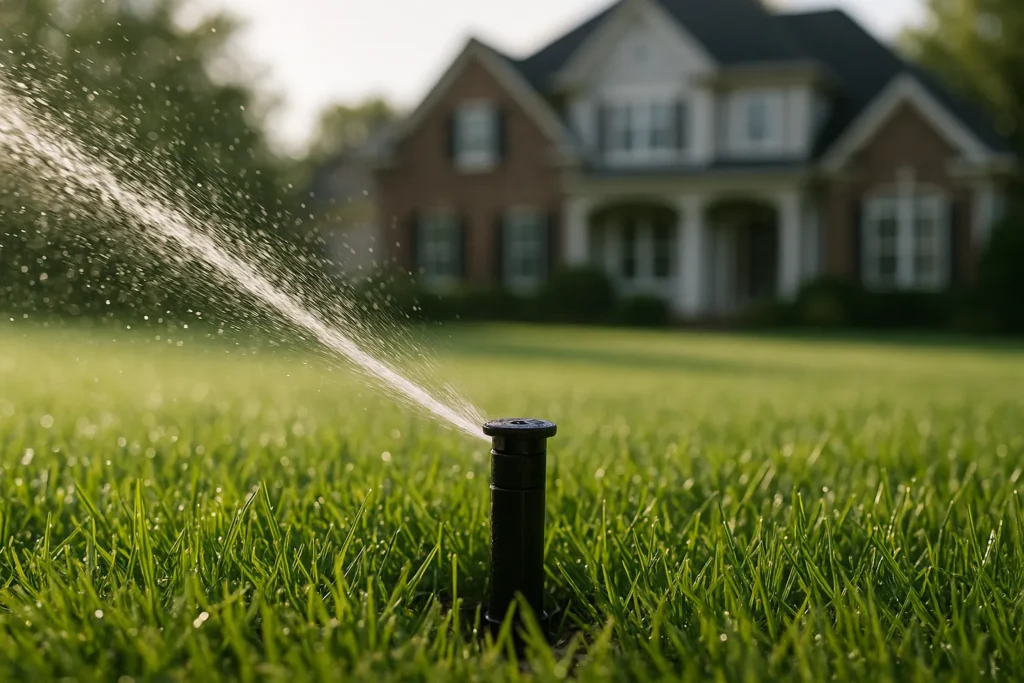
Rule Out the Irrigation System Before You Blame the Rain
A surprising share of “drainage” calls in Vienna, Reston, and Great Falls turn out to be irrigation calls. A leaking valve, a cracked lateral, a head that will not seat, or two zones with heavy overlap can keep a section of lawn saturated through an entire summer with no storm involved. The diagnostic is simple: shut the system off completely for ten days during a dry stretch. If the wet spot dries, the problem is the system, not the ground.
Even a correctly functioning system can overwhelm clay. Clay soils absorb water slowly, so a long single run cycle produces runoff and pooling while shorter cycle-and-soak runs of the same total volume do not. Our irrigation and sprinkler system services cover audits, zone rebalancing, and controller scheduling, and adjusting run times is usually the least expensive change on this entire page.
Why Northern Virginia Yards Hold Water in the First Place
None of this is bad luck. Several regional conditions stack on top of one another here.
- Clay-dominant soils. Fine-textured soils hold water tightly and release it slowly. That is a benefit in a July drought and a liability in a March thaw.
- Builder-scraped topsoil. Across subdivisions built from the 1980s through the 2000s, topsoil was stripped, the subgrade was compacted by machinery, and a shallow layer of soil was returned before sod went down. That creates a textbook perched-water profile.
- Sloped lots in Loudoun. Larger, steeper properties around Leesburg, Purcellville, and Aldie collect and concentrate runoff from uphill, which means the wet area is often nowhere near the water’s source.
- Dense inner-suburban lots. In Falls Church, Annandale, Arlington, and Alexandria, small lots put roofs, driveways, patios, and property lines close together, so runoff has very little distance to spread out.
- Mature tree root zones. Established oaks and maples create dense surface root mats that shed water and resist trenching. Cutting through a major root zone to install a drain trades one problem for another.
- Freeze-thaw cycling. Repeated freezing and thawing heaves soil, opens gaps around pipe, tilts catch basins out of level, and undoes marginal grading work over a few winters.
- Summer thunderstorm intensity. Regional rainfall is not evenly delivered. A large share arrives in short, violent bursts that no soil absorbs in real time, which is why sizing for average rainfall misses the point.
Persistently wet turf also creates knock-on problems that get billed to the wrong department. Saturated soil suffocates roots, invites moss and algae, and sets up the humid conditions that summer turf diseases exploit — something we cover in more detail in why your lawn turns brown in Northern Virginia. If you are treating the same patch for disease every summer, check the drainage before you buy another fungicide, and consider whether lawn pest and disease control is treating a symptom of a grading problem.
The Neighbor Question: What Fairfax County Actually Says
This is the part of drainage that no contractor brochure mentions, and it is the part most likely to cost you a relationship or a lawsuit. Fairfax County’s stormwater program is explicit about where its responsibility ends.
In its stormwater frequently asked questions, the county states that drainage directed from gutters, downspouts, or other private systems onto neighboring properties is a civil matter between the property owners. It also states that private drainage and erosion issues, along with ground water issues, are the responsibility of the property owner, and that the county cannot recommend a contractor or perform work outside a county easement. The county’s page on reporting a storm drainage problem follows the same line.
Read plainly, that means three things. First, if your solution pushes water onto the lot next door, do not expect the county to arbitrate — you and your neighbor will resolve it privately, potentially through counsel. Second, if a neighbor’s water is arriving on your property, the same is true in reverse. Third, the fact that a fix is legal to install is not the same as the fix being defensible if it damages someone else’s property.
The Northern Virginia Soil and Water Conservation District puts the engineering version of the same warning in its guidance on controlling runoff: discharging runoff to an unsuitable area will just move the problem downhill, and redirecting runoff without soaking it into the soil can negatively impact neighboring properties. That is a direct caution against the most common DIY move — running a pipe to the property line and calling it done.
Never connect a surface drain or gutter to the sanitary sewer
Fairfax County’s guidance on stormwater on your property states it directly: do not connect surface drains and gutters to the sanitary sewer. It is worth saying because older homes sometimes already have such a connection, and because a homeowner staring at an accessible cleanout in a wet yard occasionally has the idea. Storm and sanitary systems are separate for good reason, and adding clean rainwater to a sanitary line contributes to backups and overflows.
Practical rules for discharging without creating a dispute
- Discharge onto your own property, well inside your line, into a vegetated area that can spread and slow the flow rather than a point at the boundary.
- Use a spreader, level lip, or stone dissipation pad so water leaves as sheet flow instead of a jet.
- Do not concentrate several previously scattered flows into one new outlet aimed downhill.
- Check your plat for drainage easements and stormwater management easements before designing anything. Easements frequently sit exactly where people want to trench.
- Talk to the downhill neighbor before the work, not after. A five-minute conversation prevents most of these disputes.
- Photograph existing conditions before construction. If a dispute arises later, dated evidence of what the yard did before is worth having.
The 2,500-Square-Foot Land Disturbance Trap
Homeowners routinely check whether their patio needs a building permit, get told no, and assume they are clear. Land disturbance is a separate regulatory track with a much lower threshold, and drainage work is exactly the kind of project that trips it.
Fairfax County is subject to the Chesapeake Bay Preservation Act. According to the county’s land disturbance page, all land-disturbing activities of 2,500 square feet or more are regulated under the Erosion and Stormwater Management Ordinance and require an approved site-related plan before the disturbance begins. Critically, “land disturbance” is not limited to construction — it includes grading, excavating, filling, paving, and creating impervious area.
That threshold arrives faster than people expect. A hundred and fifty linear feet of drainage trench with a working corridor on either side, plus staging, plus a regraded low area, plus a new patio, adds up quickly. This is also why the sequence matters: the plan must be approved before disturbance, not discovered halfway through.
Loudoun County works differently. Per the county’s land disturbance page, a grading permit is required for land disturbance of 5,000 square feet or more — and the square footage calculation includes a ten-foot buffer around the project site, which almost nobody accounts for when estimating. Regardless of size, sensitive areas can trigger a permit on their own, including the Limestone Overlay, Mountainside Overlay, River and Stream Corridor Resources, Floodplain Overlay, and steep slopes of fifteen percent or greater. On a sloped Loudoun lot, that last one matters: a small drainage project on a steep grade can require a permit at any size.
Underneath both is state law. The Virginia Erosion and Stormwater Management Act requires localities administering a stormwater management program to regulate land disturbance of 10,000 square feet or more, or 2,500 square feet or more within a Chesapeake Bay Preservation Area.
| Jurisdiction | Land-disturbance trigger | What counts | Wrinkle most homeowners miss |
|---|---|---|---|
| Fairfax County | 2,500 sq ft or more requires an approved plan before disturbance | Grading, excavating, filling, paving, creating impervious area | A patio can be building-permit exempt while the combined project still trips the plan requirement |
| Loudoun County | 5,000 sq ft or more requires a grading permit | Land disturbance, calculated with a 10-foot buffer around the project site | Sensitive areas — including steep slopes of 15% or greater — can require a permit at any size |
| Virginia (statewide floor) | 10,000 sq ft, or 2,500 sq ft in a Chesapeake Bay Preservation Area | Land-disturbing activity under the Erosion and Stormwater Management Act | Localities may be stricter than the state floor, never looser |
Prince William County homeowners should confirm local requirements directly as well; our Prince William County service page, Fairfax County page, and Loudoun County page outline where we work in each. You can also run a quick pre-check with our permit and HOA checker. None of this substitutes for calling your county — requirements change, and the office of record is always the authority.
HOA review is a separate hurdle
Many Northern Virginia associations restrict visible drainage structures: exposed pipe outlets, channel drains crossing a front walk, above-ground pop-ups in a common-view area, French drain stone visible from the street, or any regrading that alters a community drainage pattern. In Ashburn, Brambleton, South Riding, and Stone Ridge in particular, plan on a written architectural review submission. Approval timelines can run weeks, so start that clock early rather than after the crew is scheduled.
Why French Drains Fail in Northern Virginia Clay
The French drain is the default answer in every neighborhood forum, and it is a genuinely good tool. It fails here for one reason more than any other: it was installed as an infiltration device in soil that does not infiltrate.
A French drain is a gravel-filled trench, usually with a perforated pipe at the bottom, that collects water along its length and moves it somewhere else. The collecting part works fine in clay. The “somewhere else” is where projects go wrong. If the trench simply ends in the ground, the water it collects has to soak into the surrounding soil — the same tight clay that caused the standing water in the first place. The result is a long, expensive gravel reservoir that fills, stays full, and then backs up to the surface.
In tight clay, the drain must daylight or go to a pump
There are really only three honest destinations for collected water on a clay lot:
- Daylight to a lower grade on your own property. The pipe emerges at a point lower than the drain’s low end and discharges onto a stable, vegetated area. This is the most reliable option and requires no power, but it requires elevation you may not have.
- A sump basin and pump. When there is no gravity outlet, water collects in a basin and is lifted to a discharge point. It works on flat lots, but it introduces electricity, a mechanical device, a check valve, freeze exposure on the discharge line, and a failure mode during power outages — which in this region tend to coincide with the exact storms that matter.
- Infiltration — only where a percolation test supports it. Legitimate in sandier or well-structured soils. On a lot where an eighteen-inch test hole barely drops in an hour, it is not a design; it is a hope.
This is why an experienced installer will ask about your outlet before they ask about the puddle. If someone quotes a French drain without walking the discharge route, they are quoting a trench, not a drainage system.
The dry well as buried bathtub
A dry well is an underground void — stone-filled pit or plastic chamber — that stores runoff and lets it seep into the surrounding soil. In heavy clay with a low percolation rate, a dry well is a storage tank with no outlet. It handles the first modest rain of a dry week, then stays saturated through every subsequent storm and provides essentially nothing when you need it. Homeowners describe this as the dry well “stopping working after a year.” It usually never worked; it just started full.
Dry wells do have a place: modest, intermittent volumes on soils that measurably drain, sited where a temporary saturated zone will not undermine anything. The percolation test earlier on this page is the gate. Run it before you buy chambers.
Other reasons a French drain underperforms
- Insufficient or reversed slope. A pipe laid by eye across a nearly flat yard can end up with bellies that hold water and silt.
- Fine sediment migration. Silt and clay particles wash into the stone and pipe over time, gradually cementing the void space closed. Appropriate filter fabric and clean, washed, angular stone slow this; fabric wrapped tight around a pipe in silty soil can accelerate blinding instead.
- Too shallow to intercept the water. A trench above the perched layer collects surface water only and leaves the saturated zone untouched.
- Sod or topsoil capped over the stone. Capping a surface-collection French drain with soil turns it into a subsurface drain that can no longer take in sheet flow.
- Crushed or separated pipe. Thin corrugated pipe under a driveway, a parked trailer, or a settled trench deforms. Solid-wall pipe belongs anywhere under load.
- No cleanouts. Without access risers, a silted line cannot be jetted and effectively has to be dug up.

Rain Gardens: The Specifications, and the Clay Contradiction Nobody Mentions
Rain gardens are a genuinely good stormwater practice and a popular recommendation on Northern Virginia landscaping sites. Before you build one, read what Virginia Cooperative Extension actually specifies. Publication SPES-13P, Rain Garden Design and Construction (Fox, Robinson and Sample, updated June 2024) gives concrete numbers:
- Sizing: divide the impervious area draining to the garden, in square feet, by 20 to get the rain garden size needed.
- Depth: a finished depth 6 to 8 inches lower than the surrounding soil surface.
- Setback: at least 10 feet from building foundations.
- Water table: the bottom of the garden at least 2 feet above the seasonal high water table.
- Drawdown: water should be held only temporarily and drain within 2 to 4 days, which is also the mosquito-control constraint.
Now the part that is routinely omitted locally. The same publication cautions against siting a rain garden where soil clay content is high. That sits in direct tension with the frequent local advice to solve a clay-lot drainage problem by building a rain garden. Both cannot be right for the same yard.
The honest reconciliation is this. A rain garden is a treatment and infiltration practice, not a dewatering device. It works when the surrounding soil can move the captured water down within the two-to-four-day window. On a tight clay lot with a poor percolation rate, an unamended depression will hold water past that window, kill the plantings, breed mosquitoes, and become a permanent pond. Building one on such a lot means substantially reconstructing the soil profile with an engineered media and, in many cases, adding an underdrain — at which point it is a bioretention cell with a pipe outlet, not a weekend rain garden.
Two practical rules follow. First, run the percolation test at the proposed location and compare against the 2-to-4-day drawdown target. Second, do not place a rain garden in the wettest part of your yard. That instinct is universal and backwards — a rain garden belongs where water can be routed to it and can then leave, not where water already refuses to leave. If your lot fails those tests, put the effort into a designed planting plan with water-tolerant species in the wet zone and route the actual volume elsewhere. Bed maintenance and mulching also matters here: mulch berms unintentionally built up along bed edges are one of the most common accidental dams in a suburban yard.
Solution Comparison: What Each Fix Actually Does
Every option below solves a specific problem. Used against the wrong diagnosis, each one wastes money at best and moves the damage somewhere worse at worst.
| Solution | What problem it solves | How it behaves in NoVA clay | Maintenance burden | When it is the WRONG choice |
|---|---|---|---|---|
| Downspout extensions (surface or buried) | Concentrated roof volume dumping near the foundation | Works well — it moves water rather than relying on soaking in | Low: keep outlets clear, check pop-ups seasonally | When the wet area is nowhere near a downspout, or when the extension just relocates the puddle |
| Regrading and swales | Negative pitch, bowls, and blocked surface flow paths | Very effective; clay holds a shaped grade well | Low: keep the swale mowed and free of fill, mulch, and debris | When water is coming up from below rather than sitting on top |
| French drain | Collecting subsurface and sheet flow along a line | Works only if it daylights lower or feeds a pump | Moderate: periodic flushing through cleanouts | When there is no outlet, or when a simple regrade would fix it |
| Catch basin plus solid pipe | A defined low point collecting a large surface volume | Strong performer; solid pipe resists silting better than perforated | Moderate: clear the grate and sump of leaves and sediment | When the water is dispersed rather than collecting in one spot |
| Dry well | Storing modest volumes for infiltration | Frequently fails; becomes a buried bathtub without percolation | Moderate to high, and hard to service once silted | Any lot where a percolation test shows minimal drawdown |
| Sump basin and pump | Flat lots and basements with no gravity outlet | Effective, but mechanical and power-dependent | High: test the pump, maintain the check valve, protect the discharge line from freezing | When gravity daylight is available — always prefer gravity |
| Rain garden | Treating and infiltrating roof or driveway runoff | Requires adequate percolation; VCE advises against high-clay sites | Moderate: weeding, mulch renewal, plant replacement | The wettest low spot on a tight clay lot |
| Permeable pavement and surfaces | Reducing new impervious area on patios and walks | Needs an engineered stone reservoir and, in clay, usually an underdrain | Moderate: joints must be vacuumed or refreshed to stay permeable | As a fix for an existing wet lawn — it prevents new runoff, it does not dewater old problems |
Hardscape elements can carry part of the load too. A properly pitched patio with a channel drain, a retaining wall with functioning weep holes and drainage stone behind it, or a walkway set to act as a subtle grade break all move water deliberately. Conversely, patios and hardscapes installed without a drainage plan are one of the most common causes of a brand-new wet spot in an otherwise fine yard.
Matching the Diagnosis to the Fix: Four Common Northern Virginia Scenarios
The flat backyard that stays soggy for days
Typical of a 1990s subdivision in Burke or Springfield. No obvious low point, no downspout nearby, spongy underfoot for three or four days. The eighteen-inch hole stays dry overnight while the surface is saturated — classic perched water on a compaction pan. The fix is rarely one thing: relieve compaction across the area, improve the surface pitch so water has a direction, and install a collection line that daylights if any grade exists to work with. Reseeding first is wasted effort.
The hillside seep that runs in dry weather
Common on larger sloped lots around Leesburg and western Loudoun. Water emerges partway down a slope and keeps running when it has not rained in a week. That is groundwater, not runoff. The correct response is an interceptor drain set across the slope above the seep and deep enough to catch the water-bearing layer, discharging to daylight further downslope. Grading the surface accomplishes nothing, and a rain garden below the seep will simply be permanently flooded. This kind of work often falls under a grading permit on a steep Loudoun lot, so confirm before excavation — our Leesburg drainage and grading page covers what that looks like locally.
Water pooling against the foundation
The highest-priority version of this problem regardless of neighborhood, and frequent in Vienna and Falls Church where backfill along older foundations has settled over decades. Almost always a combination of settled backfill creating negative pitch and downspouts discharging within a few feet of the wall. Correct the pitch away from the structure first, then extend the downspouts well beyond the corrected zone. Do not install a bed with edging that holds water against the wall, and do not solve it by piling mulch against the siding. See our Vienna drainage and grading page for how we approach foundation-adjacent regrading.
The narrow side yard between two houses
Endemic to newer high-density communities in Ashburn, Brambleton, and South Riding. Two roofs, two foundations, minimal width, and a shared swale that the builder cut and that both owners have since partially filled with mulch, stepping stones, or a shed pad. The fix is usually restoring the swale profile plus a collection line, and it very often requires coordinating with the neighbor because the flow path is shared. This is precisely the situation Fairfax County describes as a civil matter, so handle it cooperatively from the start. Our Ashburn drainage and grading page and Burke drainage and grading page show the same approach applied in two very different lot types.
Rebuilding the Lawn After Drainage Work
Drainage work is destructive by nature. Trenches, spoil piles, and machine tracks leave a yard looking worse before it looks better, and how the restoration is handled determines whether the repair is invisible in one season or obvious for three.

- Expect settlement. Backfilled trenches settle over the first several months, especially through freeze-thaw. A responsible plan includes returning to top-dress and reseed the trench line.
- Do not re-compact the repair. Driving equipment across the finished area to save a trip undoes the soil work you just paid for.
- Sod versus seed is a timing question. Sod gives immediate cover and erosion control on a fresh trench in any season; seed is cheaper but is genuinely reliable only in the late-summer-to-fall window for cool-season turf here. Our comparison of sod versus seed for Northern Virginia covers the tradeoff, and sod installation and lawn renovation is the route most homeowners take after major excavation.
- Fix the soil while it is open. The moment a trench is open is the cheapest time you will ever have to incorporate organic matter into the surrounding root zone.
- Reassess the turf plan. An area that has been chronically wet for years typically has thin, weak turf and a weed seed bank ready to take over. Plan a renovation, not a patch. Our lawn grade quiz is a quick way to gauge where the lawn currently stands.
What Actually Drives the Cost of a Drainage Project
Drainage pricing varies more than almost any other outdoor service because the same visible symptom can require wildly different work. Rather than quote figures that would be meaningless without seeing your lot, here are the variables that move a number up or down:
- Linear footage. The most obvious driver, and the one homeowners estimate most inaccurately — the run to a viable outlet is usually longer than the run across the puddle.
- Depth. A trench that must reach a perched layer or intercept groundwater costs disproportionately more than a shallow surface collector, because depth drives spoil volume, shoring considerations, and equipment choice.
- Access. If a machine can reach the work area, the job is one thing. If a fence, a narrow side yard, a steep slope, or a finished patio forces hand digging or small equipment and wheelbarrow haul, it is another entirely.
- Rock. Shallow bedrock or a boulder field changes both method and schedule, and it is the single most common reason a drainage project changes scope after it starts.
- Roots and existing utilities. Mature tree root zones, irrigation lines, low-voltage lighting, invisible fence, gas, and communication lines all require hand work or rerouting. Always have utilities marked.
- Discharge distance and outlet difficulty. A daylight point fifteen feet away is a different project from one a hundred and forty feet away across a lawn, and a pump system adds electrical work.
- Restoration scope. Sod, seed, mulch, plant replacement, hardscape cut and re-set, and irrigation repair are real line items, not afterthoughts.
- Permits and plan review. If the disturbance crosses a county threshold, plan preparation, review time, and inspection become part of the project timeline and budget.
- Materials specification. Solid versus perforated pipe, pipe diameter, washed angular stone versus whatever is cheapest, filter fabric type, and basin quality all separate a system that lasts from one that silts closed.
Because the range is so wide, an on-site assessment is the only honest way to price this work. Reach out through our contact page and we will walk the lot, trace the flow paths, and identify the outlet before proposing anything. You can also review our services if ongoing property care is part of the picture, and see where we work on our service areas page.
A Drainage Maintenance Calendar for Northern Virginia
A drainage system is infrastructure, and infrastructure that is never inspected fails silently. The common failure is not dramatic: a catch basin sump fills with leaves and silt, the grate blinds over, and one day during a hard rain the yard floods as if nothing had ever been installed.
| Season | Task | Why it matters here |
|---|---|---|
| Early spring | Walk the property during the first heavy rain after the thaw; re-mark any wet areas | Freeze-thaw heaving shifts grades, tilts basins, and opens pipe joints over winter |
| Spring | Clear grates, pull leaf mats and sediment from catch basin sumps, check outlet screens | Winter debris is the leading cause of a system that “stopped working” |
| Spring | Confirm each downspout outlet is open and discharging where intended | Pop-up emitters get buried, mowed over, and packed with soil |
| Late spring | Test any sump pump, check the check valve, verify the discharge line is clear | Pumps fail quietly and are usually discovered during the storm that needed them |
| Summer | Inspect after the first intense thunderstorm; look for scour, silt fans, and new low spots | High-intensity bursts reveal undersized or misrouted conveyance that gentle rain hides |
| Summer | Keep swales mowed and free of clippings, mulch, and stored items | A swale is only as good as its cross-section; a few inches of fill defeats it |
| Fall | Clean gutters, then clean them again after the main leaf drop | Overflowing gutters convert a roof into a point discharge at the foundation |
| Fall | Flush drain lines through cleanouts; clear all grates before leaves cover them | Sediment mobilized over the growing season settles in low points and bellies |
| Late fall | Protect exposed discharge lines and pump lines from freezing | A frozen outlet backs the entire system up during a winter rain-on-snow event |
| Winter | Observe where snowmelt collects and where ice forms repeatedly | Melt patterns reveal grade problems that summer vegetation conceals |
What happens when a drain silts up
Sediment does not arrive all at once. Fine clay and silt migrate into the stone envelope and pipe with every storm, gradually reducing the void space that gives a French drain its capacity. A system that handled a heavy storm in year one may handle only a moderate one by year six. If cleanouts were installed, the line can be jetted and much of the capacity recovered. If they were not, the practical options narrow to excavation. That single detail — whether the installer included access risers — is one of the best predictors of whether a drainage system has a serviceable life or a disposable one.
Eight Mistakes That Keep Northern Virginia Yards Wet
- Reseeding the same wet low spot every year. Grass seed cannot germinate reliably in saturated soil, and seedlings that do emerge drown or rot. This is the most repeated wasted expense in local lawns — fix the water first, then plant. We cover related patterns in our roundup of common lawn care mistakes.
- Adding topsoil to “level” a swale. That depression is doing a job. Filling it makes the yard look flatter and moves the ponding to wherever the water stops next — frequently against a foundation or onto the neighbor.
- Discharging at the property line. A pipe that ends a foot inside your boundary and points downhill is the classic setup for exactly the civil dispute Fairfax County declines to referee.
- Burying a downspout into an unknown existing pipe. Older properties have abandoned, crushed, and disconnected lines everywhere. Connecting to one without verifying where it goes and whether it flows can send roof water directly under a foundation or slab.
- Installing a French drain without identifying the outlet. Discussed above at length, and worth repeating because it is the most expensive version of this list.
- Treating a wet spot as a disease problem year after year. Chronically saturated turf will keep declining regardless of what is sprayed on it. Fungicide applied to a drainage problem is a subscription, not a cure.
- Building a rain garden in the wettest spot. Intuitive and backwards. A rain garden needs to drain within two to four days, which the wettest spot on a clay lot by definition will not do.
- Skipping cleanouts to save a small amount up front. A drainage system without access points cannot be maintained, only replaced.
DIY or Professional: Drawing the Line Honestly
Reasonable to do yourself
- The entire diagnostic sequence on this page — storm walk, drawdown check, test hole, percolation test.
- Surface downspout extensions and splash blocks.
- Gutter cleaning and confirming gutters are not overflowing.
- Clearing catch basin grates and sumps on an existing system.
- Small-scale grade corrections in a limited area with hand tools.
- Removing accidental dams: mulch berms, edging, stacked firewood, a filled swale.
- Reducing compaction on mild cases through aeration and organic matter.
Worth hiring out
- Anything requiring a survey-grade shot of elevations to confirm a viable outlet.
- Trenching near a foundation, retaining wall, septic field, or mature specimen tree.
- Any project likely to approach a county land-disturbance threshold, or any work in a Resource Protection Area, floodplain, or steep-slope overlay.
- Interceptor drains for groundwater, which have to be placed correctly in the vertical profile to do anything at all.
- Sump and pump systems, which involve electrical work and freeze-protected discharge.
- Regrading that changes where water leaves the property or crosses a shared flow path.
- Work inside a recorded drainage or stormwater easement.
The reason drainage rewards experience is that the visible symptom and the actual cause are often in different places. A homeowner digs where the water is. An experienced crew digs where the water comes from, and confirms where it can go, before anything is opened up. You can read more about how we approach outdoor work on our about page.
Frequently Asked Questions
How long is it normal for water to stand in a yard after heavy rain?
A few hours is normal after an intense storm, particularly in clay. Water still standing 24 hours after the rain stops indicates a real problem. Water still present after 48 to 72 hours points to a soil or groundwater cause rather than a simple surface issue, and it will not resolve on its own with better mowing, more seed, or a dry spell.
Can I redirect water onto my neighbor’s property if it flows downhill naturally?
Redirecting and concentrating are different from natural flow, and that difference matters. Fairfax County states that drainage directed from gutters, downspouts, or other private systems onto neighboring properties is a civil matter between the property owners, and that private drainage issues are the property owner’s responsibility. The Northern Virginia Soil and Water Conservation District warns that redirecting runoff without soaking it into the soil can negatively impact neighboring properties. In practice: discharge on your own land, spread the flow rather than jetting it, and talk to the neighbor first. This is not legal advice — if a dispute is already active, consult an attorney.
Will a French drain work in heavy clay soil?
Yes, provided it has a destination. A French drain collects water well in clay; what clay prevents is the water soaking away at the end of the line. In tight soils the drain generally must daylight at a lower grade on your property or discharge to a sump and pump. A French drain that simply ends underground in clay tends to stay full and stop performing.
Is a dry well a good idea on a Northern Virginia clay lot?
Usually not, unless a percolation test says otherwise. A dry well only works if the surrounding soil accepts water at a useful rate. Where it does not, the well fills and stays full — effectively a buried bathtub that handles the first small rain and nothing after. Dig a twelve-to-eighteen-inch test hole at the proposed location, pre-soak it, refill it, and measure the drop over an hour before committing.
Do I need a permit to fix drainage in my own yard?
It depends on how much ground you disturb and where. Fairfax County regulates land-disturbing activities of 2,500 square feet or more — including grading, excavating, and filling — and requires an approved plan before the disturbance. Loudoun County requires a grading permit at 5,000 square feet or more, calculated including a ten-foot buffer around the project site, and sensitive areas such as steep slopes of fifteen percent or greater can trigger one at any size. Verify with your county before starting; requirements change.
Why is my yard wet when it hasn’t rained in a week?
Three usual suspects. First, irrigation — a stuck valve, leaking lateral, or overlapping zone. Shut the system off for ten days and watch. Second, seasonal high groundwater or a hillside seep, which runs independently of recent rainfall and typically follows a late-winter-through-spring pattern here. Third, a leak in a service line or an upslope neighbor’s discharge. If the surface is fed by groundwater, surface grading will not change it.
Will core aeration fix standing water?
Only when compaction is the actual cause and it is limited to the upper few inches. Aeration meaningfully improves infiltration on a moderately compacted lawn and is worth doing as part of a broader plan. It will not correct negative grading, will not penetrate a construction-compacted subgrade, and does nothing for a high water table. Treat it as soil maintenance, not as drainage engineering.
Should I build a rain garden to solve my wet backyard?
Be careful with this one. Virginia Cooperative Extension’s rain garden publication specifies a finished depth 6 to 8 inches below the surrounding surface, at least 10 feet from foundations, a bottom at least 2 feet above the seasonal high water table, and a drawdown within 2 to 4 days — and it advises avoiding locations where soil clay content is high. A rain garden treats and infiltrates runoff routed to it; it is not a device for dewatering an already-saturated area. On a tight clay lot it typically requires reconstructed media and often an underdrain.
Can I connect my downspouts or yard drains to the sewer cleanout?
No. Fairfax County’s stormwater guidance states directly that surface drains and gutters should not be connected to the sanitary sewer. Storm and sanitary systems are deliberately separate, and adding rainwater to a sanitary line contributes to backups and overflows. If you suspect an older home already has such a connection, have it investigated rather than extending it.
What is the best time of year to have drainage work done in Northern Virginia?
Diagnosis is best in late winter and spring, when the ground is wet and the problem is visible and honest. Construction is generally easiest in late spring through early fall, when soil is workable and ruts are less severe. Late summer into fall has an additional advantage: it lines up with the ideal window for cool-season turf establishment, so the restoration seeding has the best chance of taking. Avoid diagnosing during a dry August — cracked clay temporarily absorbs water and will mislead you. More seasonal guidance is collected on our blog.
Start With the Diagnosis, Not the Trench
Almost every failed drainage project in Northern Virginia shares one root cause: a solution was chosen before the problem was identified. The good news is that the diagnostic work costs nothing but attention. Walk the property in the rain. Mark the puddles. Come back at 24 and 72 hours. Dig a test hole. Run a percolation test in two or three places. By the end of one wet week you will know whether you are dealing with surface water, perched water, groundwater, volume, or compaction — and that knowledge alone eliminates most of the ways this work goes wrong.
Then handle the parts that carry real consequences carefully: confirm the outlet, respect the land-disturbance thresholds in your county, keep discharge on your own property, and never tie stormwater into the sanitary sewer. If you would like a second set of eyes on a wet yard anywhere in Fairfax, Loudoun, or Prince William County, get in touch with Lawn Theory and we will walk the flow paths with you before anyone picks up a shovel.
This article is general guidance, not legal or engineering advice. Permit thresholds and stormwater requirements change — always verify current requirements with your county before beginning work.
Keep Reading: Lawn Care
 Lawn Care
 Sprinkler System Winterization in Northern Virginia: Timing, Methods, and What Goes Wrong
Sprinkler winterization in Northern Virginia is about timing, not a fixed date. How to pick your shutdown week, how the three drainage…
 Lawn Care
 Fall Planting in Northern Virginia: Trees, Shrubs, and Mulch Done Right
Fall is the best time to plant trees and shrubs in Northern Virginia, but most failures trace to the first twenty minutes…
 Lawn Care
 The Fall Lawn Renovation Calendar for Northern Virginia: Dates, Seeding Rates, and Soil Temperature
Virginia Cooperative Extension puts the Northern Virginia seeding window at the last week of August through mid-September. Here are the exact dates,…
Want this handled by the crew that wrote the guide?
Veteran-owned. Licensed & insured. Free walkthroughs across Northern Virginia — quotes in 24–48 hours.
Get Your Free Estimate