
Pool Deck Cleaning Guide for Northern Virginia: Safety, Aesthetics, and Maintenance
Pool season in Northern Virginia runs May through September, and a clean, safe pool deck is essential for family enjoyment, guest safety, and liability protection. Professional pool deck cleaning addresses both aesthetic and critical safety concerns that homeowners often overlook until after an accident occurs.
Pool decks develop algae growth, calcium deposits, and slippery surfaces faster than any other outdoor area due to constant water exposure, splashing, chlorine spray, and intense summer sun. This comprehensive guide covers Pool Deck Cleaning materials, safety, cleaning processes, and maintenance for pristine pool surrounds.
Why Pool Deck Cleaning Is a Safety Priority
Algae and mold growth on pool decks creates dangerous slip-and-fall hazards that pose immediate injury risk. Regular wet surfaces are slippery; algae-covered wet surfaces are treacherously slippery the combination of organic growth and moisture creates a frictionless surface. Ankle fractures and head injuries occur each year from preventable pool deck slips. Insurance studies show that more than 30% of pool-related injuries occur on deck surfaces, not in the water.
From a liability perspective, homeowners can be held responsible for injuries on their property if they failed to maintain safe conditions. Guests injured on your pool deck due to negligent maintenance could have grounds for a personal injury claim. This is particularly important for community pools in HOA properties (common in Brambleton, Broadlands, Burke Centre, and other Loudoun and Fairfax communities) where the HOA itself faces liability exposure.
Beyond liability, clean pool decks simply feel better underfoot, look more inviting, and create the aesthetic experience you want for entertaining. The minimal cost of professional cleaning (from $199) is an easy decision that eliminates risk and maximizes your pool investment’s enjoyment value.
Pool Deck Materials in Northern Virginia
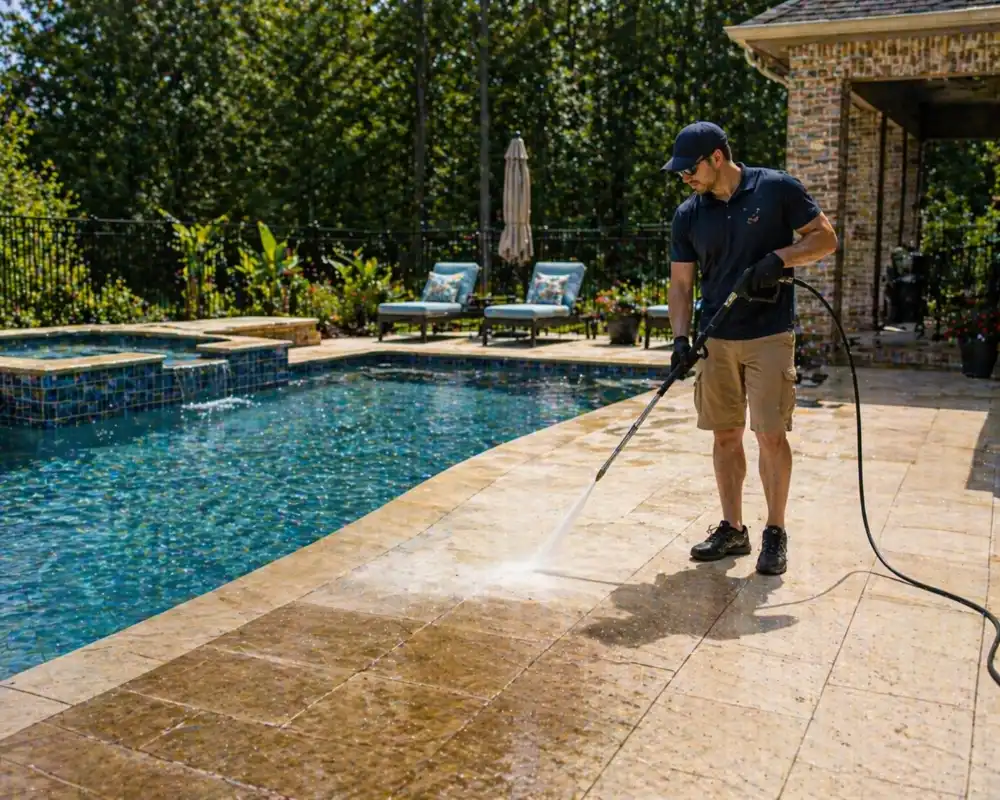
Pool decks throughout Northern Virginia employ various materials, each with specific cleaning requirements. Concrete is the most common, poured during construction for most residential pools. Pavers (stone, clay brick, composite) are popular in upscale homes in McLean, Great Falls, and Fairfax. Travertine and other natural stone are featured in premium properties. Stamped concrete, designed to resemble stone, appears in newer Gainesville and Brambleton homes. Each material has different durability, slip-resistance, and cleaning compatibility.
Pool Deck Algae Growth and Chemistry
Pool deck algae differs from roof or driveway algae. Chlorine from the pool creates a unique chemical environment that certain algae species tolerate. Constant water splashing and low-angle water spray during pool use create ideal algae growth conditions. The combination of nitrogen from pool chemicals, phosphates from body care products, and warm water creates a bacteria and algae paradise.
Professional pool deck cleaning combines pre-treatment with algae-killing solutions (specifically formulated to be pool-safe, not killing beneficial bacteria or affecting water chemistry) followed by gentle surface cleaning. This approach removes algae colonies that cause slipperiness while avoiding damage to pool equipment or water chemistry.
Professional Pool Deck Cleaning Process
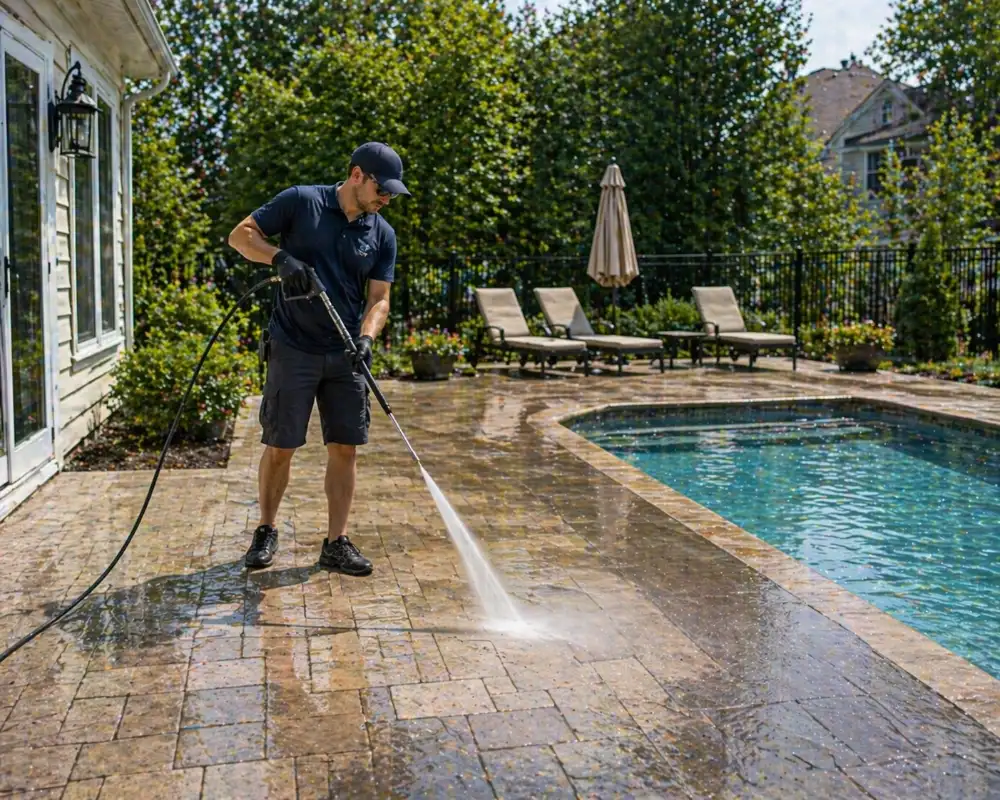
Lawn Theory’s pool deck cleaning process prioritizes safety, material preservation, and pool system integrity. First, all equipment is moved or protected to prevent water intrusion into pool systems. Next, a pre-treatment solution is applied to kill algae and biofilm at the root.
After dwell time, the deck surface is cleaned at appropriate pressure concrete tolerates higher pressure than natural stone. Professional surface cleaners ensure even, streak-free results. Care is taken around pool drains, return lines, and skimmers to prevent backflow or system damage.
Finally, a pool-safe rinse ensures no chemical residue remains that could affect water chemistry. For HOA community pools, this process is coordinated with pool management to minimize scheduling conflicts.
Community Pool Decks and HOA Considerations
Community pools in HOA neighborhoods (Brambleton, Broadlands, Ashburn Village in Loudoun; Burke Centre, Reston, Centreville Farms in Fairfax; Dominion Valley, Gainesville communities in Prince William) require quarterly or semi-annual professional cleaning. These high-traffic areas see hundreds of swimmers per week, accelerating algae growth and surface deterioration.
HOA communities typically budget $500-$1,500 annually for professional community pool deck maintenance. This is minimal compared to deck surface replacement costs ($3,000-$8,000) and liability exposure from preventable slip-and-fall injuries.
Sealing and Protective Treatments
After cleaning, many pool owners apply protective sealants to extend the life of pool deck surfaces. Concrete sealers create a hydrophobic surface that resists water penetration, reduces algae regrowth speed, and protects against UV fading. Paver joints can be re-sanded and sealed to prevent weed growth and maintain structural integrity.
Natural stone pool decks benefit from pH-neutral sealers that protect against chlorine and salt damage without altering appearance. Sealing typically lasts 2-3 years in pool environments due to constant water exposure.
Pool Deck Maintenance Schedule
Professional pool deck cleaning recommendations vary by pool type and usage. Residential pools typically benefit from quarterly spring-through-fall cleaning (April, June, August, October) or at minimum before opening and mid-summer. Community pools often require monthly cleaning during peak season (June-August) and quarterly off-season.
Between professional cleanings, regular brushing (weekly) and simple rinses (after heavy use) extend deck life and reduce algae acceleration. Managing pool chemistry properly also reduces deck algae growth.
Pool Deck Cleaning Costs
Professional pool deck cleaning in Northern Virginia starts at $250 for residential pools depending on size and condition. A typical 400-square-foot pool deck starts at $250. Community pool cleaning costs vary based on facility size but start at $300 per cleaning. Sealant application adds $200+ to the cost.
FREQUENTLY ASKED QUESTIONS
What is the cost for this service?
Pricing varies by property size and condition. Call (703) 650-5655 for a free estimate.
Are your solutions eco-friendly?
Yes, Lawn Theory uses biodegradable, plant-safe solutions for all exterior cleaning.
Do you serve my area?
Lawn Theory serves all of Northern Virginia including Loudoun, Fairfax, Prince William, Arlington, and Alexandria.
Request a free quote today — or explore our full range of exterior cleaning services to see everything we can do for your property in a single visit. Pool season is coming. Let’s get your space ready for it.
Keep Reading: Pressure Washing
 Pressure Washing
 How Much Does Pressure Washing Cost in Northern Virginia? (2026 Homeowner Guide)
Pressure washing cost in Northern Virginia is set by square footage, surface type, buildup and access, not a flat rate. Here is…
 Pressure Washing
 Trex Composite Deck Cleaning in Northern Virginia: Why the Method Totally Changes Compared to Wood
Picture this: your neighbor hires a pressure washing company to clean their beautiful new Trex Transcend deck in Brambleton. The crew shows…
 Pressure Washing
 Sprinkler Rust Stains on Your Northern Virginia Property: Why They Happen and How to Actually Fix Them
You designed your irrigation system to keep your lawn green and your landscaping thriving. Nobody told you it would also paint your…
Want this handled by the crew that wrote the guide?
Veteran-owned. Licensed & insured. Free walkthroughs across Northern Virginia — quotes in 24–48 hours.
Get Your Free Estimate