
Leaning Retaining Wall? Freeze-Thaw Warning Signs to Check Before Winter in Northern Virginia
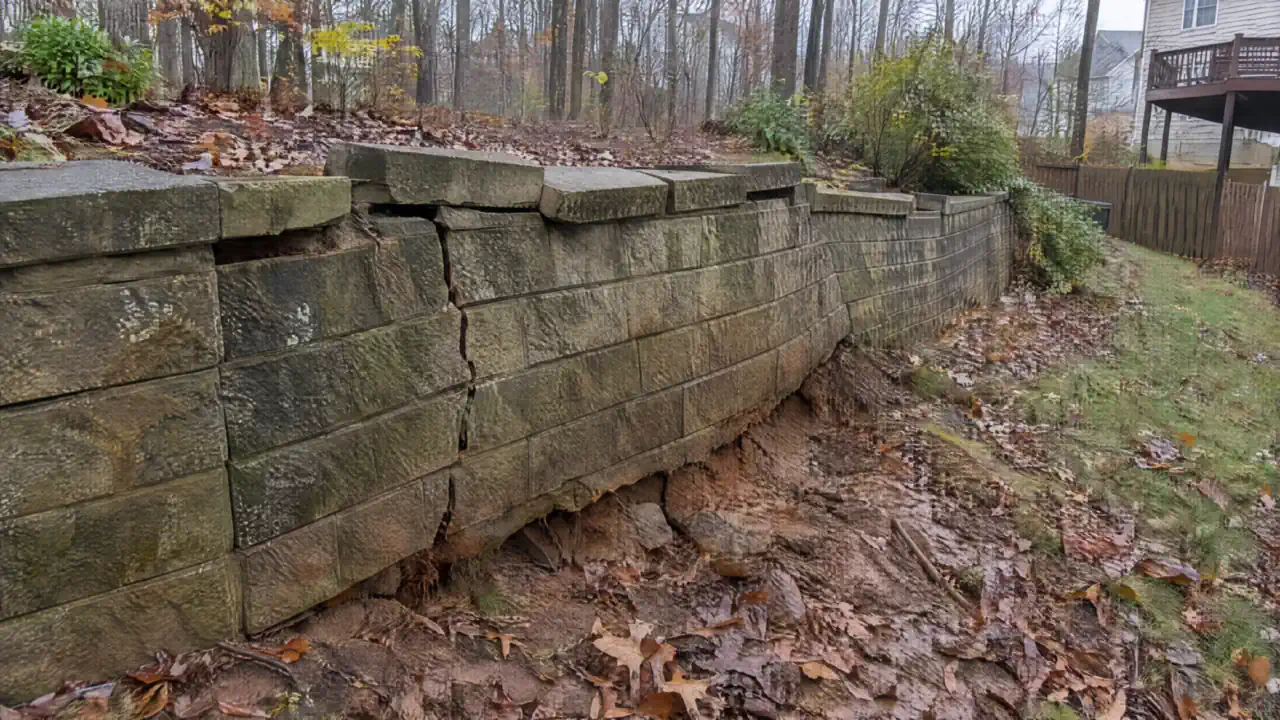
A leaning retaining wall is one of those problems that looks like a slow, harmless sag until the day it very much is not. Walls in Northern Virginia hold back some of the heaviest, wettest soil around, and once winter freeze-thaw cycles start working on saturated clay, a wall that was leaning a little in October can be leaning a lot by March. The good news is that walls almost always give you warning signs first, and late fall is the perfect time to read them.
The short answer: if your retaining wall is tilting forward, bulging in the middle, cracking, separating at the corners, or shedding soil and water from its base, it is under more pressure than it was built to handle, and that pressure usually comes from water. Before winter, clear the drainage, redirect downspouts, keep heavy loads off the top, and measure the lean so you can track movement. A wall that has moved more than about an inch, holds up a driveway or structure, or is taller than four feet deserves a professional assessment before the ground freezes.
Lawn Theory builds and rebuilds retaining walls across Fairfax, Loudoun, and Prince William, and many of the “new wall” projects we quote started as a leaning retaining wall someone hoped would hold one more winter. This guide covers the seven warning signs, why freeze-thaw makes them worse, and what repair actually looks like. If you want a pro to look at yours, our retaining walls and seating walls team does free walkthroughs.
Key Takeaways
- Most retaining wall failure in Northern Virginia starts with water. Poor drainage turns clay backfill into a heavy, saturated load.
- Freeze-thaw cycles expand trapped water and can push a leaning retaining wall further out of plumb each winter.
- Seven warning signs: lean, bulging, cracks, separating blocks or caps, soil and water at the base, settling behind the wall, and dry or muddy weep holes.
- Movement of more than about an inch from vertical usually means the wall is under significant stress.
- Before winter: clean drains, redirect downspouts, and keep snow piles, vehicles, and heavy loads off the top.
- In Fairfax County, walls retaining more than three feet of earth need a permit, and walls over four feet need a commercial retaining wall permit.
- Repairs range from drainage fixes to rebuilding with proper base, gravel backfill, drain pipe, and geogrid.
Why Retaining Walls Fail in Northern Virginia
Retaining walls do a hard job. Every foot of height holds back a wedge of soil that wants to slide downhill, and when that soil gets wet, it gets dramatically heavier. Northern Virginia’s clay drains slowly and holds water for days, which is exactly why drainage is the single biggest factor in whether a wall stands for decades or starts leaning in a few years. Our guide to clay soil in Northern Virginia explains why this soil behaves the way it does.
The usual suspects behind a leaning retaining wall
- No drainage behind the wall. Walls backfilled with native clay instead of clean gravel, with no drain pipe, trap water against the back of the wall.
- Hydrostatic pressure. Water pressure builds after heavy rain and can push harder than the soil itself.
- A weak base or shallow footing. A base that was too thin, poorly compacted, or built on soft soil settles, and the wall above it tips.
- Missing reinforcement. Taller segmental walls need geogrid layers tying the wall back into the slope.
- Extra loads on top. Driveways, parked cars, sheds, pools, and even big snow piles add weight the wall may not have been designed for.
- Misdirected water. A downspout dumping onto the slope above the wall loads it after every storm.
- Age and materials. Old timber walls rot from the inside, and dry-stacked walls without engineering eventually loosen.
How Freeze-Thaw Cycles Push a Leaning Retaining Wall Further
Northern Virginia winters are not brutally cold, but they swing above and below freezing over and over. That freeze-thaw cycling is what makes winter so hard on walls. Water trapped in saturated soil behind a wall freezes and expands, pushing outward. When it thaws, the soil settles slightly into the new gap. Repeat that dozens of times between December and March, and a wall can ratchet forward a little more each cycle.
Frost heave also attacks walls from below. If the base or footing was not built deep or well drained enough, frozen soil underneath can lift sections unevenly, which shows up as cracked caps, uneven courses, and leaning corners in spring. That is why the weeks before the first hard freeze are the best time to fix drainage problems.
7 Warning Signs of a Leaning Retaining Wall
Walk your wall after a heavy rain with a level, a tape measure, and your phone camera. Here is what to look for.
1. Visible lean or tilt
Hold a long level or a plumb line against the face. Many segmental walls are built with a slight intentional setback, so the question is whether the lean is increasing. Movement of more than about an inch from the wall’s original position usually means significant stress.
2. Bulging or bowing in the middle
A wall that pushes out in the middle while the ends stay put is a classic sign of water pressure building behind it.
3. Cracks in the face or caps
Horizontal cracks, stair-step cracks in mortared walls, and cracks that are getting wider all point to movement. Hairline cracks in a cap are less urgent, but worth tracking.
4. Blocks or caps separating
On segmental block walls, look for gaps opening between units, caps sliding off, and corners pulling apart. Corners are often the first place a leaning retaining wall shows trouble.
5. Soil, mud, or water at the base
Soil washing out from under the wall or through joints means the backfill is escaping, and persistent seepage through the face means water has nowhere better to go.
6. Settling or sinkholes behind the wall
Low spots, cracks in the lawn, or a patio sinking above the wall suggest soil is moving or washing out behind it.
7. Weep holes that stay dry or run muddy
Weep holes and drain outlets should run clear water after rain. Bone-dry outlets after a storm can mean the drainage is clogged. Muddy water carrying soil fines means the system is losing backfill.
| Warning sign | Urgency | Next step |
|---|---|---|
| Hairline cracks in caps, no movement | Low | Photograph and recheck monthly |
| Dry or clogged weep holes | Medium | Clear outlets and inspect drainage before winter |
| Soil or muddy water at the base | Medium to high | Fix drainage now; get the wall assessed |
| Blocks or caps separating, corners opening | High | Professional assessment before the ground freezes |
| Lean over about 1 inch, bulging, widening cracks | High | Keep loads and people away; call a professional or engineer |
| Wall supporting a driveway, structure, or neighbor’s property | High | Engineering review, regardless of size |
Retaining Wall Types and How Each One Fails
Not every leaning retaining wall fails the same way. Knowing what your wall is made of helps you read the warning signs.
| Wall type | Typical lifespan with good drainage | How it usually fails | Warning signs to watch |
|---|---|---|---|
| Timber or railroad tie | Shortest of the group | Wood rots, anchors loosen, wall bellies out | Soft or crumbling wood, bowing, leaning posts |
| Segmental concrete block | Decades | Drainage or base problems cause lean, bulging, cap shifts | Gaps between blocks, corners opening, wavy courses |
| Natural stone (dry-stacked) | Decades if well built | Stones loosen and shift as soil pushes and settles | Stones rotating outward, bulges, gaps |
| Mortared stone or block | Decades | Cracking from water pressure and frost | Stair-step or horizontal cracks, efflorescence, seepage |
| Poured concrete | Longest of the group | Cracking or tipping from water pressure or footing issues | Horizontal cracks, tilt, water seeping through cracks |
What a professional wall assessment covers
When we walk a leaning retaining wall, we look at more than the face. A good assessment checks the height and length of the wall, the amount and direction of movement, where water comes from above the wall, whether drainage outlets are working, what sits on top of the wall, the condition of the base and corners, and whether permits or engineering will be needed for repair. You should walk away knowing whether the wall needs monitoring, a drainage fix, a partial rebuild, or a full replacement.
How to document movement over winter
- Drive a stake a few feet in front of the wall at two or three points.
- Measure from each stake to the top and bottom of the wall.
- Write the numbers and date on a note in your phone, with photos.
- Recheck after big storms and monthly through March.
If the top measurement keeps shrinking, the wall is moving, and that record is gold for whoever designs the repair.
Before-Winter Checklist for Any Retaining Wall
Even healthy walls benefit from a little attention before freeze-thaw season.
- Clear weep holes and drain outlets of leaves, mulch, and soil.
- Redirect downspouts away from the slope above the wall. Clean gutters help too, which we cover in fall gutter cleaning in Northern Virginia.
- Fill low spots above the wall so water flows away instead of pooling against it.
- Keep heavy loads off the top. Do not park vehicles, stack firewood, or pile shoveled snow right behind a wall.
- Mark and measure. Set a stake a few feet in front of the wall and measure to the face at the top and bottom, then recheck monthly through winter.
- Keep plantings sensible. Shrubs and groundcovers on terraces help with erosion, but large trees right behind a wall can push it over time.
What Leaning Retaining Wall Repair Looks Like
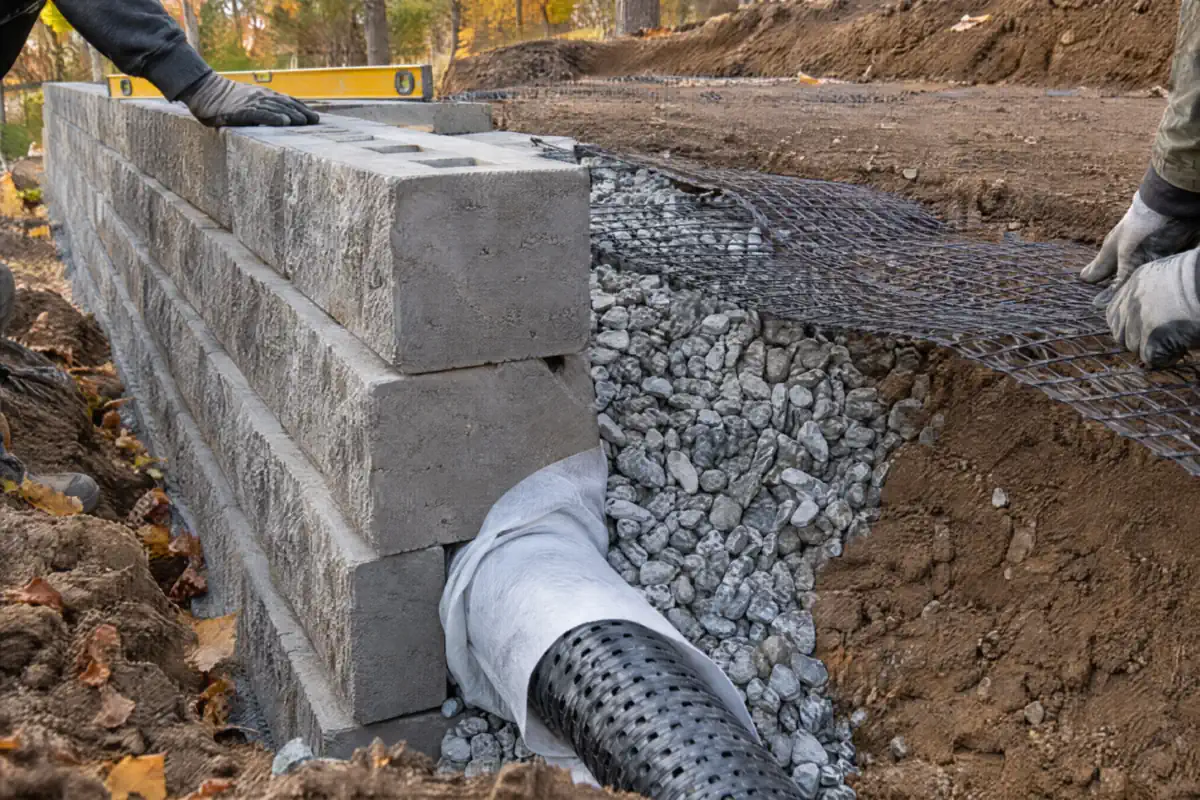
Repairs depend on why the wall is moving. A wall that is leaning because of drainage can sometimes be stabilized by fixing the water problem early. A wall with a failed base or missing reinforcement usually needs a section rebuilt or replaced.
Repair options, from simplest to most involved
- Drainage correction. Regrading, redirecting downspouts, and adding surface drains reduce the water load. Our drainage solutions and grading service handles this, and our guide to standing water in your yard explains how water moves on Northern Virginia lots.
- Partial rebuild. The affected section is taken down, the base is rebuilt, and the wall goes back up with clean gravel backfill, a drain pipe, and filter fabric.
- Full rebuild with reinforcement. Taller walls get geogrid layers extending back into the slope, and engineered designs where required.
- Replacement of timber walls. Rotting timber walls are usually replaced with segmental block or natural stone rather than patched.
Permits for retaining wall repair in Northern Virginia
Rebuilding a wall often needs the same approvals as building a new one. In Fairfax County, the residential retaining wall permit covers walls retaining more than three feet but less than four feet of earth, and walls retaining four feet or more require a commercial retaining wall permit. Loudoun and Prince William have their own thresholds. Our guide to patio, deck, and retaining wall permits in Northern Virginia covers the details, and the free permit and HOA checker gives you a quick read for your address.
What retaining wall work costs
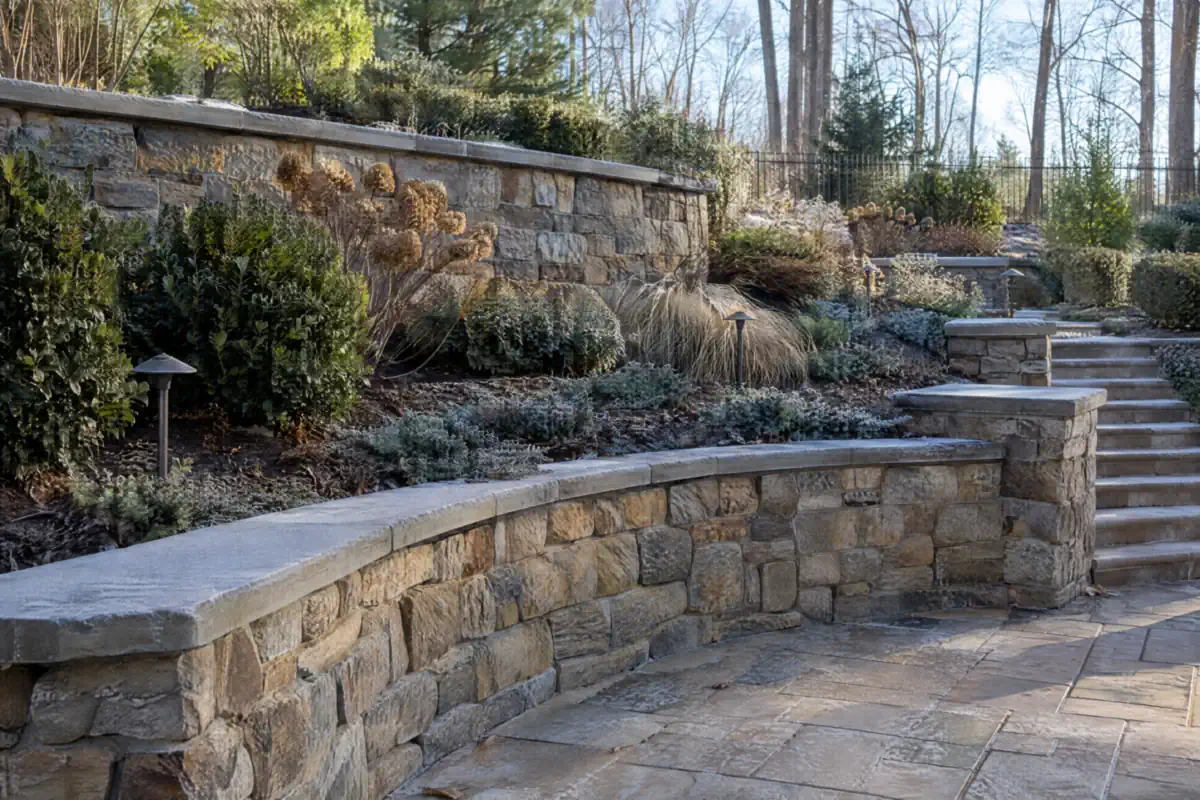
Lawn Theory’s retaining walls start at $95 per linear foot for standard segmental block, from $60 per square face foot for engineered tall walls, and from $120 per square face foot for premium natural stone or poured concrete. Most single-wall projects take one to three weeks to build once permits clear. The biggest cost drivers are height, length, access, drainage needs, and whether engineering is required.
Should You DIY a Leaning Retaining Wall Fix?
Clearing weep holes, redirecting downspouts, and regrading a low spot are reasonable homeowner tasks. Rebuilding a wall is not, especially if it is taller than about three feet, holds up a driveway or patio, or sits near a property line. A failed rebuild can be more expensive than the original repair, and a collapsing wall is a genuine safety hazard. If a wall supports anything important, an engineer should be involved.
Planning a Better Wall for Spring
If your leaning retaining wall is past saving, winter is a great time to plan its replacement so construction can start as soon as the ground allows. Many homeowners use the opportunity to add a seating wall, terraced beds, or steps that make a sloped yard far more usable. Explore our patios and hardscapes and walkways and pathways services, and if you are planting new terraces, our list of deer resistant plants for Northern Virginia is a smart place to start. We build walls across Fairfax County, Loudoun County, and Prince William County.
Frequently Asked Questions
Is a leaning retaining wall dangerous?
It can be. A wall that has moved more than about an inch, is bulging, or has widening cracks is under significant stress and could fail, especially after heavy rain or freeze-thaw cycles. Keep people, vehicles, and heavy loads away and get it assessed.
Can a leaning retaining wall be straightened?
Sometimes a section can be taken down and rebuilt with a proper base, drainage, and reinforcement. Pushing a wall back into place without fixing the cause rarely lasts. The right repair depends on why it is leaning.
Why is my retaining wall leaning forward?
Most often because water is building up behind it. Clay backfill, missing gravel drainage, clogged weep holes, and downspouts aimed at the slope all add pressure. Weak bases and missing geogrid on taller walls are other common causes.
Do I need a permit to repair a retaining wall in Fairfax County?
If the wall retains more than three feet of earth, yes. Fairfax County’s residential retaining wall permit covers walls retaining more than three but less than four feet, and taller walls need a commercial retaining wall permit.
How long should a retaining wall last?
A properly built segmental block or stone wall with good drainage can last for decades. Timber walls typically have a much shorter life because the wood eventually rots.
What is the best time to rebuild a retaining wall?
Plan in winter and build in spring or fall, when soil is workable and not frozen or saturated. Emergency stabilization should happen as soon as serious movement is spotted.
Do Not Let One More Winter Decide for You
A leaning retaining wall is telling you something, and freeze-thaw season is when it starts talking louder. Clear the drainage, take the weight off, measure the lean, and get a professional opinion before the ground freezes if the warning signs are piling up.
Lawn Theory is licensed and insured, and we handle permits, drainage, and construction from start to finish. Get your free estimate or call (703) 650-5655, and we will send a written, line-item quote within 24 to 48 hours.
Keep Reading: Outdoor Building
 Outdoor Building
Fire Pit Rules in Northern Virginia: Gas vs Wood, Costs, and Backyard Safety
Fire pit rules in Northern Virginia by county, plus how to choose between a gas vs wood fire pit and what really…
 Outdoor Building
Landscape Lighting Design for Northern Virginia Homes: A Practical Planning Guide
A practical planning guide to landscape lighting design for Northern Virginia homes: the three layers, nine core techniques, low-voltage system design, color…
 Outdoor Building
Do You Need a Permit for a Patio, Deck, or Retaining Wall in Northern Virginia?
Do you need a permit for a patio, deck, or retaining wall in Northern Virginia? Verified Fairfax, Loudoun, and Prince William thresholds…
Want this handled by the crew that wrote the guide?
Licensed & insured. Free walkthroughs across Northern Virginia — quotes in 24–48 hours.
Get Your Free Estimate