
#1 Garage Floor and Concrete Cleaning Service in Northern Virginia: The Complete Guide to Restoring What Years of Cars and Winters Have Destroyed
Be honest with yourself for a second. When did you last look at your garage floor really look at it and not immediately look away?
Oil stains. Tire marks. That white chalky powder that appeared after last February’s ice storm and never fully went away. Maybe some mystery brown streaks near the drain. And if you’re really unlucky, a couple of pockmarks in the concrete surface that weren’t there three years ago.
Your garage floor has been quietly taking abuse for years road salt tracked in off your car, engine fluid drips, freeze-thaw cycles, UV oxidation on concrete slabs adjacent to the driveway. And if you’ve been meaning to deal with it “when things calm down,” that day has arrived.
At Lawn Theory, Northern Virginia’s veteran-owned exterior cleaning company serving Aldie, Ashburn, Brambleton, Loudoun County, Fairfax, Arlington, Chantilly, Herndon, Stone Ridge, Sterling, and Falls Church, our garage floor and concrete cleaning service is one of the most satisfying transformations we deliver because the before-and-after on a properly cleaned garage floor is genuinely dramatic. And because a clean, sealed concrete floor does more for your property than you might expect.
Here’s the complete guide to why it matters, what Northern Virginia does to your concrete specifically, how professional cleaning works, and what Lawn Theory does differently.
Call us at (703) 650-5655 or contact us online.
What Is Garage Floor and Concrete Cleaning and Why Does Northern Virginia Make It Harder?
Garage floor and concrete cleaning is the professional removal of oil stains, grease deposits, tire rubber transfer, road salt residue, efflorescence, organic growth, and embedded grime from garage floors and adjacent concrete slabs using a combination of hot water pressure washing, commercial degreasers, surface cleaners, and targeted stain treatment compounds.
The reason Northern Virginia adds a layer of difficulty to everything concrete-related comes down to three specific regional conditions:
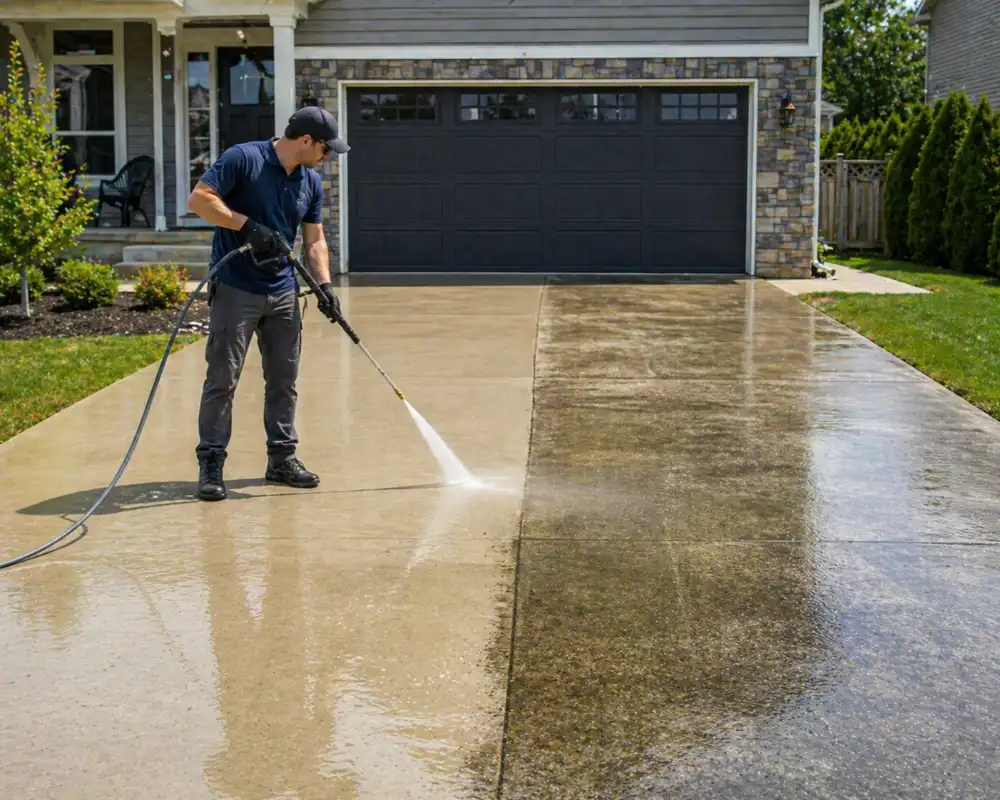
1. Road salt and de-icing chemical damage from NoVA winters. Virginia’s state and county road crews use calcium chloride and magnesium chloride as primary de-icing agents on roads throughout Loudoun County, Fairfax, and Arlington. These chemicals are more effective at lower temperatures than sodium chloride (table salt) — and significantly more corrosive to concrete. Every time you pull your car into the garage after driving on treated winter roads, you track in a brine solution that soaks into your garage floor’s porous concrete surface.
When temperatures drop again overnight, that brine inside the concrete freezes and expands — physically fracturing the concrete surface from the inside. This process is called spalling: the pitting, flaking, and surface erosion you see on Northern Virginia garage floors after a few winters. It starts as cosmetic roughness and progresses to structural weakening if the salt isn’t removed and the surface isn’t sealed.
2. Northern Virginia’s freeze-thaw cycle frequency. Our region doesn’t get the sustained cold of the northern Mid-Atlantic — we cycle repeatedly through freeze and thaw events throughout November–March. Each freeze-thaw cycle expands and contracts moisture inside concrete. Unsealed, contaminated concrete (especially concrete with road salt already embedded in the surface) experiences significantly more micro-fracturing per cycle than clean, sealed concrete. The result, over 3–5 winters, is a garage floor that looks far older than its actual age.
3. Clay-heavy soil runoff and organic growth in attached garages and adjacent slabs. Homes throughout Aldie, Brambleton, Ashburn, and Stone Ridge sit on Northern Virginia’s characteristic dense clay soil. Spring rains wash clay-laden runoff into driveways, garage aprons, and through garage door seals. Clay soil is sticky, fine-grained, and stains concrete surfaces in ways that standard pressure washing without pre-treatment doesn’t fully lift. Combine this with the humidity that makes our summers genuinely oppressive, and you have perfect conditions for algae and mold growth on exterior concrete slabs — the dark green-black discoloration you see on driveway aprons, walkways, and garage aprons throughout Loudoun County neighborhoods in August.
The 6 Enemies of Your Northern Virginia Garage Floor (And Concrete Slabs)
Understanding what’s attacking your floor is the first step to properly treating it. Here’s what Lawn Theory removes from Northern Virginia garage floors and concrete surfaces every season:
1. Motor Oil and Engine Fluid Stains
The most common garage floor problem across every Northern Virginia neighborhood — from Herndon town homes to Aldie single-family homes. Engine oil, transmission fluid, brake fluid, and coolant all penetrate porous concrete rapidly. Fresh oil stains are treatable with degreasers. Aged oil that’s been baked by years of temperature cycling requires hot water pressure washing combined with professional-grade degreaser pre-treatment to fully lift. Standard cold-water pressure washing moves aged oil around but doesn’t emulsify it — which is why many DIY attempts leave a ghost outline of the original stain after “cleaning.”
2. Tire Marks and Rubber Transfer
Hot tire marks on garage floors and driveway aprons are the result of softened rubber transferring from warm tires onto cool concrete under vehicle weight. This is especially common in attached garages with heated spaces — the temperature differential between a warm tire and cool slab creates ideal conditions for rubber transfer. Standard degreasers alone don’t address rubber deposits effectively; they require a specific alkaline surfactant combined with controlled pressure to lift the rubber without surface etching.
3. Road Salt and De-Icing Chemical Residue (Efflorescence)
The white, chalky powder you see on Northern Virginia garage floors and driveway surfaces after winter is efflorescence — a process where water-soluble salts migrate through concrete and crystallize on the surface as water evaporates. In garages regularly exposed to de-icing chemical trackout, efflorescence can be severe. More importantly, it’s a visible indicator that salt has been migrating through your concrete’s pore structure — accelerating the interior crystallization and spalling damage described above. Removing efflorescence requires specific acidic treatment compounds, not standard pressure washing, which can actually drive the salt deeper if applied incorrectly.
4. Rust Stains from Tools, Vehicles, and Metal Contacts
Metal tools left on concrete, steel vehicle components, bike racks, and seasonal equipment all produce rust staining on garage floors over time. Rust penetrates concrete’s surface layer and bonds to the calcium in the cement matrix — which is why it doesn’t respond to pressure washing or standard degreasers. Effective rust removal from concrete requires an oxalic acid or phosphoric acid treatment to chemically dissolve the iron oxide without etching the surrounding concrete.
5. Algae, Mold, and Organic Growth on Exterior Concrete Slabs
Garage aprons, driveway approaches, walkways, and patio slabs adjacent to garages develop biological growth — the green-black discoloration that makes them look neglected even if the house is otherwise maintained. This growth is accelerated by Northern Virginia’s humidity and the shade cast by many attached garages and carports. Standard cold pressure washing disrupts the surface appearance temporarily but doesn’t kill the organisms — which is why green reappears within weeks. Effective organic growth removal from concrete requires a sodium hypochlorite soft wash treatment applied before pressure washing, killing the biology at root level.
6. Construction Dust and Red Clay Staining
Newer construction homes throughout Brambleton, Stone Ridge, Aldie, and broader Loudoun County sit in neighborhoods where red clay soil is pervasive and construction dust — concrete, drywall, and masonry particulate — settles into garage floors during the build period and never fully leaves. Red clay staining on concrete requires specific pre-treatment to break down the iron-oxide binding before pressure cleaning.
Hot Water vs. Cold Pressure Washing for Garage Floors: Why It Matters
This is the technical differentiator that most homeowners don’t know to ask about — and the one that makes the biggest difference in oil stain results.
Cold water pressure washing (standard residential and most commercial pressure washers) uses hydraulic force to physically dislodge surface contaminants. It works well for organic growth, dust, and loose debris — but for petroleum-based stains like motor oil, grease, and tire rubber, cold water doesn’t provide the thermal energy needed to emulsify the hydrocarbon chains. Result: the stain moves, spreads slightly, and often leaves a ghost outline.
Hot water pressure washing (professional-grade equipment that heats water to 180–200°F) does something fundamentally different. The heat breaks down the molecular structure of petroleum hydrocarbons — literally melting the bond between the oil and the concrete surface — while the pressure removes the emulsified material. Think of it like the difference between washing greasy dishes in cold water versus hot water. The principle is identical. Hot water is the correct tool for oil stain removal from garage floors.
Lawn Theory’s garage floor and concrete cleaning service uses hot water pressure equipment for oil and grease staining — not because it’s more impressive, but because it’s the right tool for the specific chemistry of the problem.
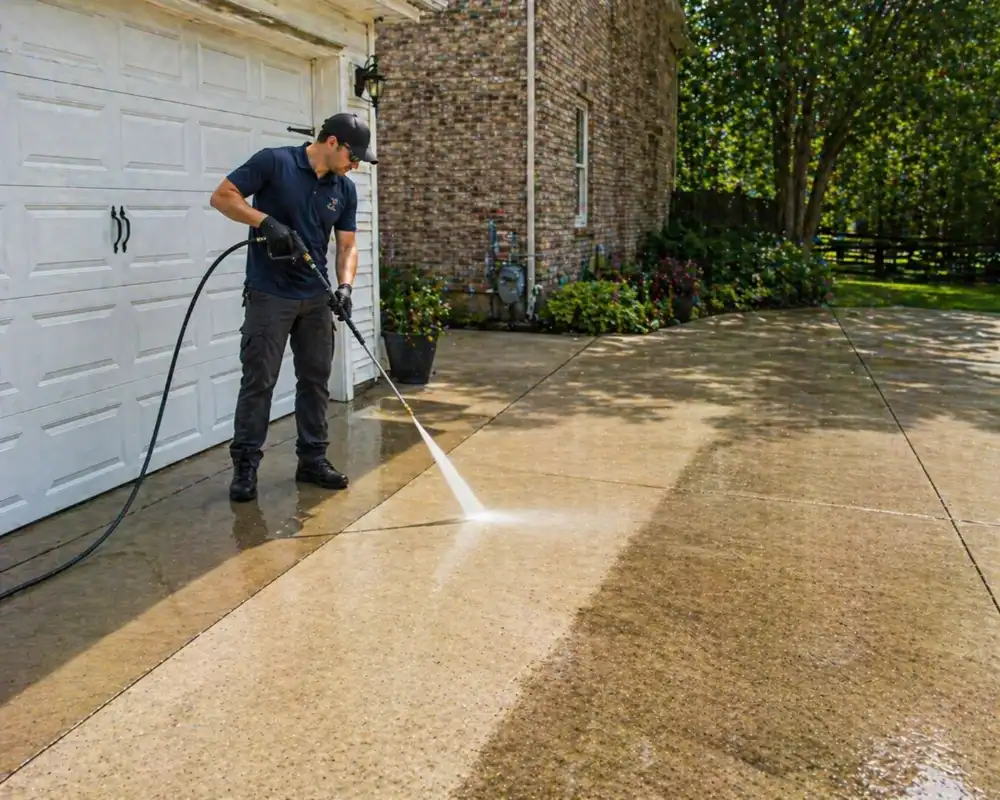
What Professional Garage Floor and Concrete Cleaning Includes at Lawn Theory
When our team arrives at your home in Ashburn, Aldie, Herndon, Chantilly, or Fairfax for a garage floor and concrete cleaning appointment, here’s exactly what happens:
Step 1 — Full surface assessment. We identify the stain types present (oil, rust, efflorescence, organic growth, tire rubber), assess the concrete condition (surface spalling, cracks, existing sealant), and determine the appropriate treatment sequence. Not every garage floor needs the same approach a floor with primarily organic growth needs different pre-treatment than one with severe oil and rust staining.
Step 2 — Pre-treatment application. Specific pre-treatment compounds are applied based on stain type and allowed to dwell:
- Commercial degreaser on oil, grease, and automotive fluid stains
- Sodium hypochlorite soft wash solution on organic growth (algae, mold, mildew)
- Acidic efflorescence remover on salt bloom and calcium carbonate deposits
- Rust treatment compound on iron oxide staining
Dwell time — typically 10–20 minutes depending on contamination level — allows the chemistry to work before pressure is applied. This is the step most DIY efforts skip, which is why their results are incomplete.
Step 3 — Hot water surface cleaning. We use a surface cleaner attachment (a rotating, enclosed pressure head that provides even coverage without the streaking pattern of a standard wand) combined with hot water at calibrated pressure — higher for standard concrete, lower for any sealed or coated surfaces. The surface cleaner covers the floor in systematic passes, lifting pre-treated staining completely.
Step 4 — Spot treatment and extraction. Residual spots — particularly deep-set oil stains or rust — receive targeted treatment with specialized compounds and extraction. This is where professional equipment earns its cost over rental units: professional-grade hot water extractors recover emulsified material rather than leaving it on the surface to dry and re-bond.
Step 5 — Complete rinse and drainage management. A thorough final rinse ensures all chemical residue and suspended contamination is removed from the surface. We manage water drainage to protect surrounding landscape beds and ensure no runoff enters storm drains with concentrated cleaning chemistry — an important consideration for Loudoun County and Fairfax County stormwater compliance.
Step 6 — Optional sealing (strongly recommended). After a clean, fully dry concrete surface, we offer concrete and paver sealing as an add-on. A quality penetrating sealer applied after professional cleaning:
- Fills concrete’s microscopic pores, dramatically reducing future stain penetration
- Blocks road salt migration into the concrete surface — the primary driver of spalling
- Makes future cleanings significantly easier and less frequent
- Extends the interval before the next professional cleaning from 12–18 months to 2–3 years
Garage Floor Cleaning and the Outdoor Living Connection
Here’s the angle no other Northern Virginia cleaning company makes — and it’s one that matters if you’ve invested (or plan to invest) in your property.
A clean, well-maintained garage floor is the foundation of a well-presented property. If you’re thinking about adding a workshop setup, converting garage space to a home gym, or simply making the garage a functional extension of your living space — professional cleaning and sealing is step one. You can’t put down epoxy coating, interlocking rubber tiles, or specialty floor paint over a contaminated or spalling concrete surface. Clean and sealed concrete is the canvas.
And if your outdoor space includes a driveway apron, courtyard, or approach that flows visually from your garage to your patios and hardscapes or outdoor living design — a professional concrete cleaning creates visual cohesion across the whole exterior. Your walkways and pathways and driveways and entrances are part of that same presentation, and all three can be handled in a single appointment.
Many Lawn Theory clients combine garage floor and concrete cleaning with:
- Professional driveway cleaning — the driveway approach and garage apron are the same visual surface; cleaning one and not the other stands out
- Patio and pool deck cleaning — clean the full hardscape circuit around your home in one visit
- Sidewalk and walkway cleaning — extend the clean concrete from garage to front entry
- Professional house washing — a clean exterior from siding to slab creates the full curb-appeal transformation
- Gutter cleaning and brightening — address all exterior maintenance in one coordinated appointment
And while we’re transforming your outdoor hardscape, our lawn care and landscaping team handles everything from fertilization and weed control to mulching and bed maintenance and landscape design and installation — so the green spaces surrounding your freshly cleaned concrete look equally sharp.
If you’re planning to build out your outdoor space, our Build & Outdoor Living team covers retaining walls and stonework, outdoor kitchens, pergolas and pavilions, fire pits and fireplaces, and complete hardscaping services — so you can go from a clean, restored concrete foundation to a fully transformed outdoor living space with one company.
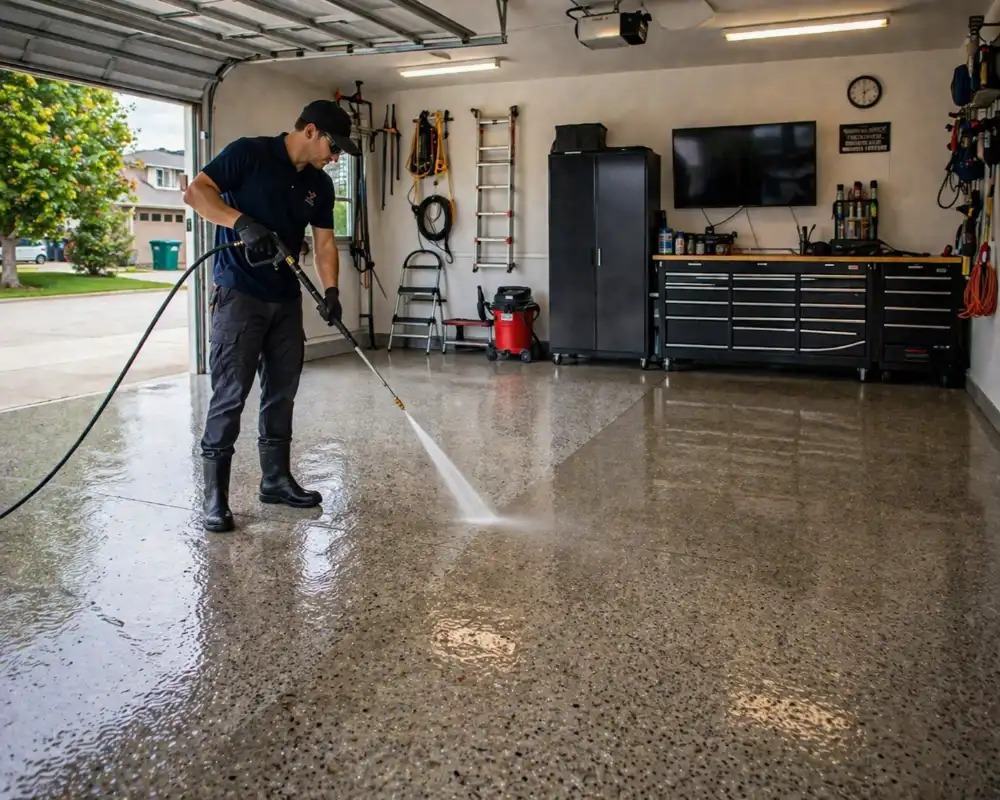
When to Schedule Garage Floor and Concrete Cleaning in Northern Virginia
Timing your cleaning correctly maximizes both results and longevity:
Late March – April (Best): After the last freeze event and before summer humidity begins. Salt residue from winter has accumulated fully, the ground is thawed, and cleaning before spring rains prevents road salt from being driven deeper by spring moisture. This is the highest-impact timing for Northern Virginia garage floors.
September – October (Second best): Pre-winter cleaning removes summer organic growth and biological buildup before freeze-thaw cycles begin. Sealing in fall protects the surface through the entire winter de-icing season — the period when protection matters most.
Before epoxy coating or floor painting: Any time you plan to apply a protective coating, sealing, or epoxy system, a professional clean is required. Epoxy bonds fail on contaminated concrete — it’s the #1 cause of peeling and delamination in DIY epoxy installations.
Before listing your home for sale: Loudoun County and Fairfax County’s active real estate markets are competitive. A garage floor that looks like a crime scene versus one that looks clean and sealed is a documented factor in home inspection impressions and buyer confidence. Our exterior cleaning services are one of the highest-ROI pre-sale investments available.
Frequently Asked Questions: Garage Floor and Concrete Cleaning in Northern Virginia
Q1: Can professional cleaning remove old oil stains from a garage floor?
Yes — with the right equipment and process. Old, baked-on oil stains require hot water pressure washing combined with a commercial alkaline degreaser pre-treatment to properly emulsify the hydrocarbons that have bonded into the concrete. Standard cold-water pressure washing moves the stain but doesn’t remove it. Hot water equipment at 180–200°F breaks down the petroleum bond and allows extraction. Very deep, multi-year stains may show a faint shadow after cleaning — this is residual staining below the surface layer — but the vast majority of the staining will be removed.
Q2: What is the white powder appearing on my garage floor after winter?
That’s efflorescence — a process where water-soluble salts (primarily from road de-icing chemicals tracked in on vehicles) migrate through the concrete’s pore structure and crystallize on the surface as moisture evaporates. It’s a visible indicator that salt has been cycling through your concrete, and it requires specific acidic treatment compounds to remove properly. Standard pressure washing doesn’t address efflorescence chemistry and can actually push salts deeper into the slab if applied at high pressure.
Q3: How often should I have my garage floor professionally cleaned?
Most Northern Virginia homeowners benefit from professional garage floor cleaning once per year — ideally in spring (March–April) after the winter de-icing season. Sealing after cleaning extends the interval to every 2–3 years for homeowners with relatively clean garages and sealed floors. Garages with regular vehicle maintenance, significant oil drips, or heavy winter salt trackout benefit from annual spring cleaning regardless of sealing status.
Q4: Is pressure washing safe for all garage floor surfaces?
Standard broom-finish and exposed aggregate concrete handles professional pressure washing well. Sealed or coated concrete (including epoxy-coated floors) requires lower pressure and specific non-abrasive cleaning solutions — high-pressure washing on epoxy coatings can delaminate the coating at edges and seams. Polished or ground concrete requires professional assessment before any pressure washing. Our team assesses surface type before selecting equipment and pressure settings.
Q5: How much does professional garage floor and concrete cleaning cost in Northern Virginia?
Professional garage floor and concrete cleaning in Northern Virginia starts at $199 — final price depends on garage size, surface condition, stain types, and whether exterior concrete slabs (driveway apron, walkways) are included. Adding concrete sealing after cleaning typically runs an additional from $0.25 per square foot. Bundling with driveway cleaning, patio cleaning, or whole-home exterior cleaning significantly reduces per-service costs compared to scheduling separately.
Q6: Can road salt really damage my garage floor structurally?
Yes — this is one of the most underappreciated maintenance issues for Northern Virginia homeowners. Calcium chloride and magnesium chloride (the primary de-icing agents used on Northern Virginia roads) form a brine solution when they contact moisture. This brine penetrates unsealed concrete, and when temperatures drop, the moisture inside the concrete freezes and expands — physically fracturing the surface in a process called spalling. Over 3–5 winters of repeated exposure, spalling transforms a smooth garage floor into a pitted, flaking surface. Annual cleaning and quality sealing is the most cost-effective prevention.
Q7: Should I seal my garage floor after professional cleaning?
Sealing after cleaning is strongly recommended and dramatically extends both the cleanliness and the structural protection of your garage floor. A quality penetrating sealer fills concrete’s microscopic pore structure, blocking oil, salt, and moisture from penetrating the surface layer. The result is a floor that repels future staining, resists de-icing chemical damage, and is significantly easier to clean in subsequent years. The cost of sealing is modest compared to the concrete repair or resurfacing costs it prevents.
Q8: Can you clean concrete adjacent to my garage — driveway, walkways, apron?
Yes — many homeowners include the garage apron, driveway approach, walkways, and any adjacent concrete or paver surfaces in the same appointment. Addressing the full connected concrete surface creates visual cohesion and ensures you’re not looking at a clean garage floor next to a stained driveway apron. Our driveway cleaning service and sidewalk and walkway cleaning pair naturally with garage floor cleaning.
Q9: Do I need to move everything out of my garage before you clean?
We ask that vehicles are moved out of the garage before our arrival and that the floor area is reasonably clear. Large stored items along walls don’t need to be moved — we work around them. We protect any items close to the cleaning area from splash. The full cleaning process typically takes 1.5–3 hours for a standard 2-car garage floor, depending on stain severity and whether sealing is included.
Q10: Can Lawn Theory help with outdoor living improvements after the concrete is cleaned?
Absolutely — and this is one of the things that genuinely sets Lawn Theory apart. Once your garage floor and concrete are professionally cleaned and restored, our outdoor living design and build team can plan and execute any property improvements you’ve been considering — from patio design and installation to retaining walls, outdoor kitchens, or landscape renovations. One company. Complete outdoor capability. No handoff, no contractor coordination headache.
Ready to Transform Your Garage Floor and Concrete? Let’s Do This.
Your garage floor has earned its battle scars. But that doesn’t mean it gets to stay that way.
At Lawn Theory, we bring the same military precision to concrete cleaning that we bring to every surface we work on. Hot water equipment for oil stains that cold pressure can’t touch. Proper efflorescence chemistry for Northern Virginia’s salt damage reality. And a process that doesn’t just make it look clean, it protects the concrete from everything the next winter season is going to throw at it. See us on Instagram & YouTube.
Proudly serving: Aldie · Ashburn · Brambleton · Loudoun County · Fairfax · Arlington · Chantilly · Herndon · Stone Ridge · Sterling · Falls Church — and all of Northern Virginia
Get started today:
See our garage floor & concrete cleaning service → Explore all exterior cleaning services → Bundle with driveway cleaning & house washing → Request your free, no-pressure quote
📞 Call us directly: (703) 650-5655
Clean floor. Protected concrete. One less thing on the list.
Keep Reading: Pressure Washing
 Pressure Washing
 How Much Does Pressure Washing Cost in Northern Virginia? (2026 Homeowner Guide)
Pressure washing cost in Northern Virginia is set by square footage, surface type, buildup and access, not a flat rate. Here is…
 Pressure Washing
 Trex Composite Deck Cleaning in Northern Virginia: Why the Method Totally Changes Compared to Wood
Picture this: your neighbor hires a pressure washing company to clean their beautiful new Trex Transcend deck in Brambleton. The crew shows…
 Pressure Washing
 Sprinkler Rust Stains on Your Northern Virginia Property: Why They Happen and How to Actually Fix Them
You designed your irrigation system to keep your lawn green and your landscaping thriving. Nobody told you it would also paint your…
Want this handled by the crew that wrote the guide?
Veteran-owned. Licensed & insured. Free walkthroughs across Northern Virginia — quotes in 24–48 hours.
Get Your Free Estimate