
Spotted Lanternfly Egg Masses in Northern Virginia: Find Them, Destroy Them, and Clean Up the Sooty Mold
Spotted lanternfly egg masses are the gift that keeps on giving, and not in a good way. Right now, across Fairfax, Loudoun, Prince William, Arlington, and Alexandria, female lanternflies are busy smearing gray, putty-like egg masses onto tree trunks, fences, patio furniture, firewood, and the underside of your grill. Every mass you miss this fall can hatch into dozens of hungry nymphs next spring, and every adult that survived this summer probably left your deck and siding speckled with sticky honeydew and black sooty mold.
The short answer: scrape spotted lanternfly egg masses off every surface you can reach between now and early spring, drop the scrapings into a bag or jar of rubbing alcohol or hand sanitizer, and throw it away. Then clean the sooty mold off decks, siding, and patios once the adults die off in the first hard frosts, using a gentle soft wash on siding and wood rather than a blast of high pressure. Do both, and next summer is a lot less sticky.
Lawn Theory works on trees, shrubs, decks, and siding across Northern Virginia, and this is the one pest that lands squarely on both sides of our business. This guide walks you through how to find and destroy spotted lanternfly egg masses, how to tell them from look-alikes, and how to clean up the mess the adults left behind without damaging your home. If you would rather hand the whole thing off, our tree and shrub care and exterior cleaning crews handle both halves.
Key Takeaways
- Spotted lanternfly egg masses are laid from September until cold weather kills the adults, and they hatch in spring.
- Each mass holds roughly 30 to 50 eggs, so scraping even a handful this winter makes a real dent.
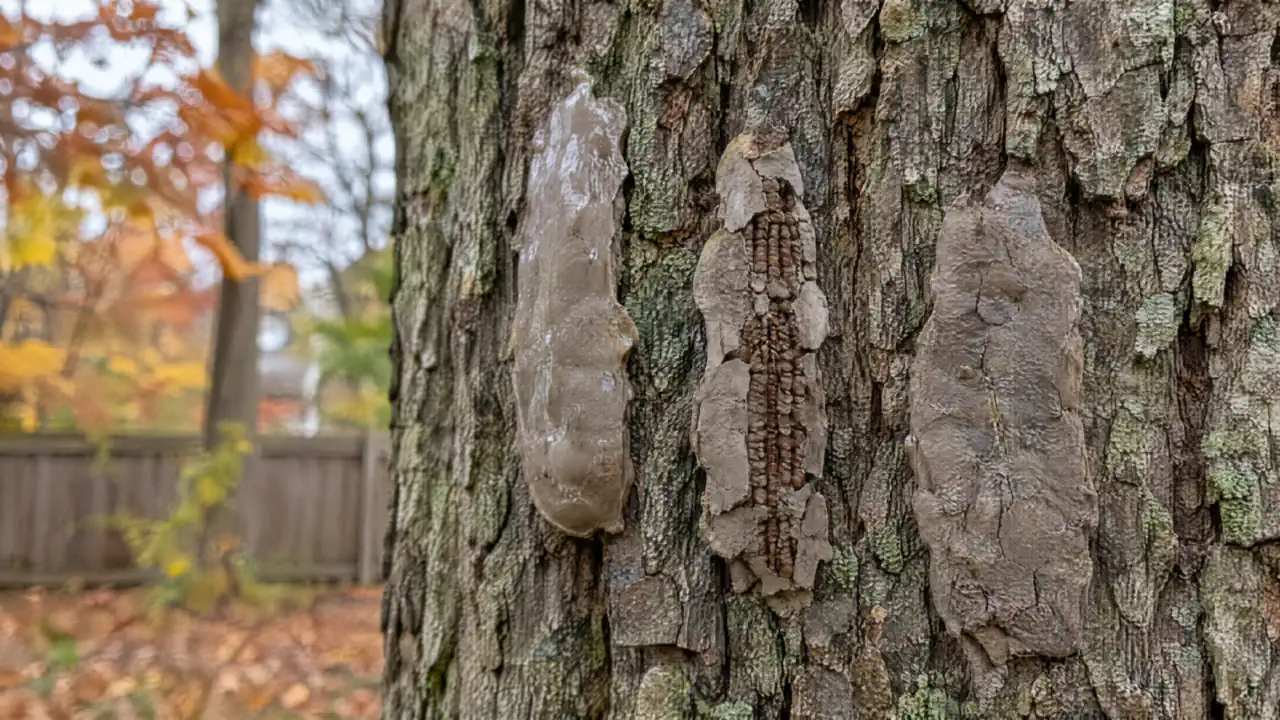
- Fresh masses look shiny and gray. Older ones look like dried mud or lichen, which is how they hide in plain sight.
- Scrape masses into a bag or jar with rubbing alcohol or hand sanitizer. Contact and systemic insecticides do not work on eggs.
- Virginia repealed its lanternfly quarantine in 2025 because the insect is now established statewide, so every Northern Virginia yard is fair game.
- Honeydew from feeding adults grows black sooty mold on decks, siding, patios, cars, and grills.
- Clean sooty mold after the adults die off, with low-pressure soft washing on siding and wood. High pressure can force water behind siding and gouge decking.
Spotted Lanternfly in Northern Virginia: Where Things Stand in 2026
If you remember the early days of lanternfly quarantines and reporting hotlines, things have changed. The Virginia Department of Agriculture and Consumer Services repealed the state’s spotted lanternfly quarantine effective March 27, 2025, after determining it was no longer slowing the spread. At that point, 67 Virginia cities and counties already had reproducing populations, and state agencies stopped asking residents to report sightings.
Translation for Northern Virginia homeowners: the spotted lanternfly is not coming, it is here. Prince William County has said the insect can be found nearly anywhere you look, and Fairfax County actively encourages residents to destroy egg masses. Nobody is going to eradicate it from the region, but you can absolutely reduce the population on your own property, and fall and winter are when egg masses give you the biggest return on effort.
Why spotted lanternfly egg masses matter more than the adults
Swatting adults in August feels satisfying, but by then they have already done their feeding. Destroying spotted lanternfly egg masses stops the next generation before it starts. According to Northern Virginia Magazine, lanternflies lay egg masses from late summer into early winter, and each mass contains between 30 and 50 eggs. Scrape ten masses off your maple and you may have just prevented several hundred nymphs from climbing your trees in May.
How to Identify Spotted Lanternfly Egg Masses
This is the part where you become a bark detective. Spotted lanternfly egg masses are about 1.5 inches long and half an inch wide. Virginia Cooperative Extension describes them as shiny and gray with a waxy protective coating when fresh, turning duller and cracked over time until they look like a smear of dried mud or a patch of lichen. Old, hatched masses show neat rows of small holes or seed-like casings.
Where lanternflies lay their eggs
The short answer is anywhere flat and stationary. Common spots on Northern Virginia properties include:
- Tree trunks and the underside of branches, especially maples, black walnut, willow, and tree of heaven, the lanternfly’s favorite host.
- Fences, decks, and railings, particularly on the shaded side.
- Stone, brick, and concrete, including retaining walls and foundation walls.
- Outdoor furniture, grills, planters, and play sets.
- Firewood stacks, stored lumber, and pallets.
- Vehicles, trailers, and boats parked near infested trees.
Once leaves drop in November, masses on trunks become much easier to spot. Females also lay high in tree canopies, so a pair of binoculars is not overkill.
Spotted lanternfly egg masses vs look-alikes
Not every gray blob is an enemy. Virginia Tech’s guide to possible spotted lanternfly egg mass look-alikes is worth a quick look, because lichens, spongy moth egg masses, and even dried bird droppings get scraped by mistake every winter.
| What you see | Likely ID | Tells |
|---|---|---|
| Flat, gray, putty-like smear, about 1.5 by 0.5 inches | Spotted lanternfly egg mass | Waxy when fresh, cracks like dried mud with age |
| Rows of small holes or seed-like casings in a smear | Hatched spotted lanternfly egg mass | Already hatched, but scraping still helps you track activity |
| Fuzzy, tan, felt-like patch | Spongy moth egg mass | Fuzzy texture, not smooth or waxy |
| Gray-green or blue-green crust that spreads in rings | Lichen | Harmless to trees, part of the bark surface |
| Chalky white or black splatter | Bird droppings | Irregular shape, no wax coating |
How to Destroy Spotted Lanternfly Egg Masses: Step by Step
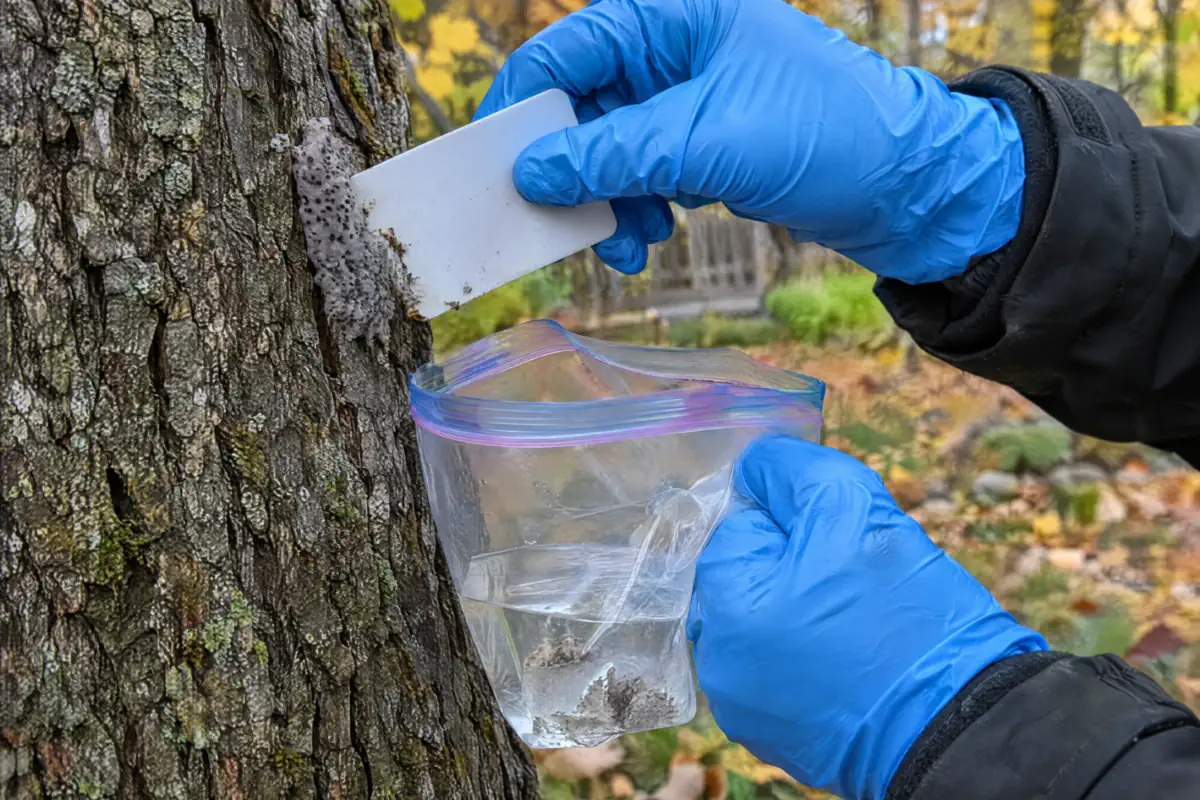
Good news: this is one of the cheapest pest control jobs on earth. You need a plastic card, a zip-top bag, and rubbing alcohol. Here is the process Virginia Cooperative Extension and Fairfax County both recommend.
- Fill a zip-top bag or jar with a few inches of rubbing alcohol or hand sanitizer.
- Hold the bag under the mass and scrape firmly with a plastic card, putty knife, or anything hard and flat.
- Get the whole thing. Eggs sit in rows under the coating, so scrape down to the surface.
- Seal the bag and let the eggs soak, then throw it in your household trash.
- No bag handy? Smashing the mass thoroughly with a hard object also works.
- Check again every few weeks through early spring, because laying continues until cold weather kills the adults.
What does not work on lanternfly eggs
Extension is clear that contact and systemic insecticides are not effective against spotted lanternfly egg masses. Dormant or horticultural oil can be used as a late-winter spot treatment on masses you cannot reach, but scraping beats spraying for a typical yard. And please do not take a pressure washer to tree bark. You will damage the tree long before you bother the eggs.
Do not move eggs to a new neighborhood
Lanternflies spread largely by hitchhiking. Before you haul firewood to a cabin, move patio furniture, or take a trailer out of state, check it for spotted lanternfly egg masses. If you are stocking up on firewood for the season, our guide to fire pit rules in Northern Virginia is a good reminder to burn local wood and inspect every stack.
Protecting Your Trees From Spotted Lanternfly
Lanternfly feeding rarely kills healthy, established trees in a home landscape, but heavy feeding stresses them, and stressed trees are more vulnerable to drought, disease, and borers. After the long 2026 drought, many Northern Virginia trees are already running on fumes, which we discussed in our drought damaged lawn recovery guide.
- Remove tree of heaven where you can. It is the lanternfly’s preferred host and an invasive species in its own right. Large specimens need professional removal because they resprout aggressively.
- Keep trees healthy. Proper mulching, watering during dry spells, and correct pruning go a long way. Our post on fall planting trees and shrubs covers mulch rings and root flare basics.
- Get heavily infested trees evaluated. Systemic treatments for high-value trees should be handled by a licensed applicator who can choose the right product and timing.
- Scrape every winter. Consistent egg removal across a neighborhood makes the biggest difference.
Lawn Theory’s tree and shrub care service starts at $199 per visit and can be bundled into seasonal maintenance. We serve homeowners across Fairfax County, Loudoun County, and Prince William County.
The Sticky Aftermath: Honeydew and Sooty Mold on Decks and Siding
Now for the part of the spotted lanternfly story that shows up on your house. Feeding lanternflies excrete a sugary liquid called honeydew, and it rains down on everything under an infested tree. That sticky film is the perfect growing surface for sooty mold, a black fungus that coats decks, railings, siding, patio furniture, grills, cars, and even plants.
Sooty mold is mostly a cosmetic problem, but it is a stubborn one. It makes decks slippery, stains vinyl and painted surfaces, and attracts yellow jackets and other stinging insects that love the sugar. If your deck looked like someone sprayed it with diluted coffee this summer, sooty mold is the likely culprit.

When to clean sooty mold
Timing matters. While adults are actively feeding, honeydew keeps falling, so a deep clean in August can look dirty again within days. Virginia Cooperative Extension suggests rinsing affected surfaces with a garden hose every day or two during heavy feeding, just to keep the fungus from taking hold. Once hard frosts kill off the adults, the dripping stops for the season, which makes late fall the smart time for a thorough cleaning that actually lasts.
How to clean sooty mold safely
| Surface | Best method | Avoid |
|---|---|---|
| Vinyl, fiber cement, painted siding | Low-pressure soft wash with a mold and mildew detergent, then rinse | High pressure that forces water behind siding |
| Wood decks and railings | Wood-safe low pressure plus a cleaner and brightener | Pressure that raises grain or gouges boards |
| Composite decking | Mild cleaner, soft brush, gentle rinse per manufacturer guidance | Harsh scrubbing pads and high PSI |
| Concrete, pavers, stone | Pressure washing or a surface cleaner with pre-treatment | Leaving runoff to pool against plants |
| Patio furniture and grills | Warm soapy water and a soft brush | Abrasive cleaners on finishes |
| Trees and shrubs | Let rain and time handle it | Pressure washing living plants |
The biggest mistake we see is a rented pressure washer turned up high on siding and wood. It feels productive, but it can drive water behind siding, strip paint, etch decking, and void manufacturer warranties. Our post on the hidden dangers of DIY pressure washing explains why, and if you have a composite deck, read our guide to Trex composite deck cleaning before you start.
Professional soft washing for lanternfly cleanup
Lawn Theory’s professional house washing uses low pressure and biodegradable detergents that kill mold and mildew on siding, and runs $299 for homes up to 1,500 square feet, $449 for 1,500 to 2,500 square feet, and $649 for larger homes. Deck and fence cleaning starts at $250, and our patio and pool deck cleaning handles the hardscape. Want a ballpark first? Try the house wash instant quote. Sooty mold that sits for years can also chip away at curb appeal, which we cover in how mold and mildew affect your home value.
Your Fall and Winter Spotted Lanternfly Action Plan
| When | What to do |
|---|---|
| Late October to November | Clean sooty mold off siding, decks, and patios after the first hard frosts; start scraping egg masses |
| November to December | Scan bare trunks and branches with binoculars; check firewood, furniture, and fences |
| January to February | Keep scraping; consider dormant oil spot treatment on unreachable masses |
| March to April | Final egg mass sweep before hatching; plan tree care and remove tree of heaven |
| May onward | Watch for black, white-spotted nymphs; rinse honeydew early if adults return |
While you are outside, keep an eye on the rest of the property too. Leaf season is in full swing, so check our guide to leaf collection in Northern Virginia for county pickup dates and rules.
Frequently Asked Questions
When do spotted lanternflies lay egg masses in Northern Virginia?
Adults begin laying spotted lanternfly egg masses in September and continue until cold weather kills them, which is usually late fall into early winter. The eggs overwinter and hatch in spring, so you can scrape masses any time between fall and early spring.
How many eggs are in a spotted lanternfly egg mass?
Each mass typically holds about 30 to 50 eggs. That is why destroying egg masses in winter is one of the most effective things a homeowner can do to reduce next year’s population.
What is the best way to kill spotted lanternfly eggs?
Scrape the mass into a bag or jar containing rubbing alcohol or hand sanitizer, seal it, and throw it away. Smashing the mass thoroughly also works. Contact and systemic insecticides are not effective on eggs.
Do I still need to report spotted lanternfly in Virginia?
No. Virginia repealed its spotted lanternfly quarantine in 2025 because the insect is established across much of the state, and state agencies no longer ask residents to report sightings. Destroying egg masses is still strongly encouraged.
Will sooty mold damage my siding or deck?
Sooty mold is mostly cosmetic, but it stains surfaces, makes decks slippery, and attracts stinging insects. Left for years, it can contribute to staining and surface wear. Soft washing removes it safely once the adults are gone for the season.
Can I pressure wash sooty mold off my house?
Siding and wood decks should be soft washed with low pressure and the right detergent. High pressure can force water behind siding, strip paint, and damage wood. Concrete and pavers can handle true pressure washing.
Get Ahead of Next Year’s Lanternflies
Spotted lanternfly egg masses are small, ugly, and surprisingly easy to destroy once you know what you are looking for. Scrape them all winter, protect your trees, and clean off the sooty mold once the adults are gone, and you will start next season with fewer bugs and a cleaner house.
If you would rather leave the bark inspections and soft washing to a crew that does this every day, Lawn Theory is licensed and insured, and we serve homes across Northern Virginia. Get your free estimate or call (703) 650-5655, and we will send a written, line-item quote within 24 to 48 hours.
Keep Reading: Lawn Care
 Lawn Care
Deer Damage in Northern Virginia Winters: Protecting Shrubs and Choosing Deer Resistant Plants
Deer resistant plants for Northern Virginia yards, plus how to protect shrubs and young trees from winter deer damage with netting, trunk…
 Lawn Care
Closing Out the Lawn Season in Northern Virginia: Last Mow Height, Final Fertilizer, and Virginia’s Rules
The last mow of the season, the final fertilizer application, and Virginia's lawn fertilizer rules: how to close out your Northern Virginia…
 Lawn Care
Leaf Collection in Northern Virginia: Mulch, Bag, or Set Out for Fairfax, Arlington, and Alexandria Pickup
Leaf collection in Northern Virginia for 2026: Fairfax County, Arlington, and Alexandria vacuum pickup rules, when to mulch leaves instead, and Alexandria's…
Want this handled by the crew that wrote the guide?
Licensed & insured. Free walkthroughs across Northern Virginia — quotes in 24–48 hours.
Get Your Free Estimate