
When to Apply Grub Control in Northern Virginia — Miss This Window and You’ll Pay More
There’s a specific three-week window every summer in Northern Virginia when professional grub control costs a fraction of what it costs in August. And every year, thousands of Loudoun County and Fairfax homeowners miss it not because they don’t care about their lawn, but because grubs are underground, invisible, and completely silent right up until the moment your grass starts dying in patches the size of manhole covers.
When to apply grub control in Northern Virginia is one of those questions where the answer is brutally time-sensitive. Get it right and you spend from $150 on a preventative treatment that protects your entire lawn through the season. Get it wrong and you spend from $400 on a curative rescue treatment in September followed by lawn restoration, reseeding, and the very real possibility that you’re still explaining dead patches to visitors come October.
At Lawn Theory, Northern Virginia’s veteran-owned lawn care and landscaping company serving Aldie, Ashburn, Brambleton, Loudoun County, Fairfax, Arlington, Chantilly, Herndon, Stone Ridge, Sterling, and Falls Church, our lawn pest and disease control service handles grub prevention and treatment across the region every season. We’re going to give you the full picture the biology, the exact timing, the product differences, the cost math, and why Northern Virginia’s specific conditions make precision timing matter more here than almost anywhere else in the Mid-Atlantic.
The Quick Answer: When to Apply Grub Control in Northern Virginia
Preventative treatment window: Late May through early July.
- Chlorantraniliprole-based products (GrubEx, BioAdvanced Season Long): Apply late May through June 30 — the wider window, lower toxicity to beneficial insects
- Imidacloprid-based products (Merit, Scotts GrubEx Plus): Apply mid-June through early July — tighter window, closer to egg-hatch timing
Curative treatment window: Late July through mid-September.
- For active infestations with visible damage
- Costs more, requires more product, and results in lawn recovery time even after treatment
- The window where you’re paying significantly more for significantly less certainty
Everything below explains exactly why these windows exist — and why Northern Virginia’s specific Japanese beetle population, soil conditions, and summer climate make precision timing the difference between a $200 service call and a $2,000 lawn restoration.
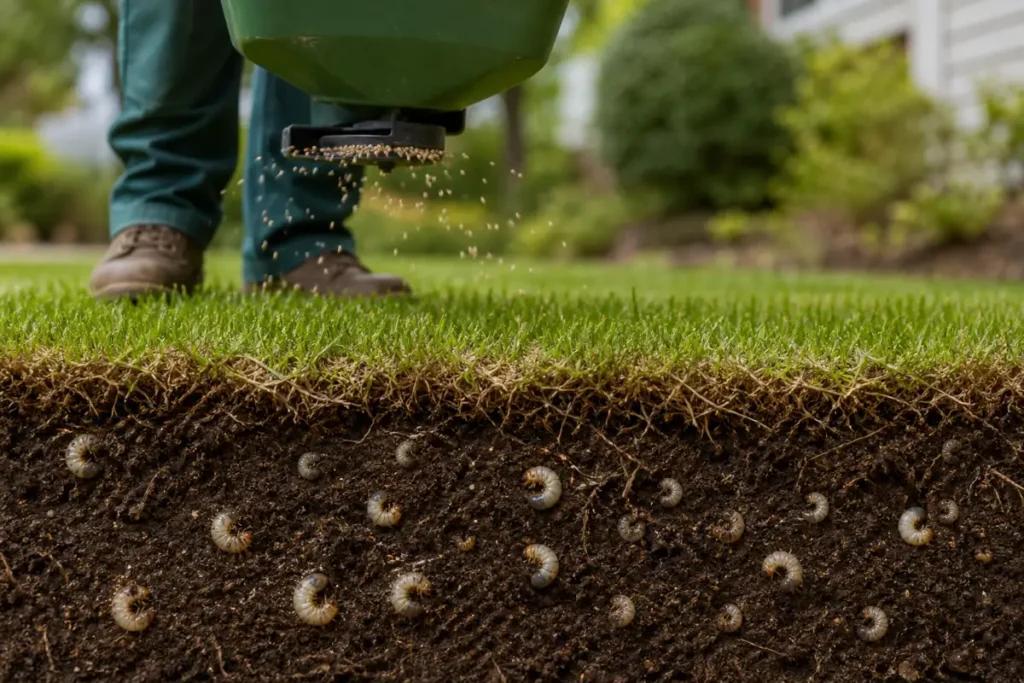
Why Northern Virginia Is Ground Zero for Grub Damage
Not all parts of the country deal with grubs equally. Northern Virginia is in a particularly active zone for Japanese beetle (Popillia japonica) populations — the primary driver of residential lawn grub damage across Loudoun County, Fairfax, Arlington, and Prince William County.
Japanese beetles have been well-established throughout Virginia since the early 1970s, according to Virginia Tech Cooperative Extension. Our region’s combination of warm, humid summers, irrigated residential lawns, dense suburban landscaping, and the sheer density of host plants — roses, linden trees, crabapples, ornamental grapes — creates ideal feeding and breeding conditions for adult beetles season after season.
Here’s what makes Northern Virginia’s situation particularly acute:
Dense irrigation coverage. Neighborhoods throughout Ashburn, Brambleton, Stone Ridge, and Herndon feature professionally installed irrigation systems that maintain moist, lush turf through summer. Female Japanese beetles specifically prefer moist soil for egg-laying — consistently irrigated lawns in Northern Virginia HOA communities are magnets for egg-laying activity in July and August.
Warm soil temperatures arrive early. Northern Virginia’s Zone 7 classification means soil temperatures reach the 65–70°F threshold that triggers grub activity earlier than more northern Mid-Atlantic states. This pushes the effective preventative treatment window earlier in the season than guidance written for Maryland’s northern counties or Pennsylvania would suggest.
High host plant density. The ornamental landscaping common throughout Loudoun County neighborhoods — roses, lindens, Japanese maples, crape myrtles, and fruit trees — provides adult Japanese beetles with abundant food sources that sustain adult populations and extend the egg-laying period. More adults feeding longer means more eggs in more lawns.
Mature, established turf. Northern Virginia’s developed communities feature established lawns with deep thatch layers — exactly the environment where grubs thrive during their root-feeding phase. New construction in Aldie, Stone Ridge, and western Loudoun is particularly vulnerable in the first 2–3 seasons after installation.
The Japanese Beetle Lifecycle in Northern Virginia: Month by Month
Understanding the lifecycle is the foundation of understanding why timing matters so much. Here’s how it plays out specifically in Northern Virginia, based on Virginia Tech Extension data and our own field experience across Loudoun County and Fairfax:
Winter (November–April): Overwintering deep in soil. Japanese beetle grubs survive Northern Virginia winters by burrowing 8–10 inches deep into the soil, below the frost line. They’re dormant, protected, and completely untreatable. No insecticide reaches them at this depth effectively.
Early Spring (April–May): Grubs resurface and feed. As soil temperatures climb above 50°F in April, mature third-instar grubs move back up toward the root zone and resume feeding before pupating. These large, mature grubs are resistant to most insecticides — which is why spring treatment of the previous year’s grubs is largely ineffective. This is a critical point many homeowners miss: applying grub control in March or April targets grubs that are already too large and too close to pupation to be killed effectively.
Late Spring to Early Summer (Late May–June): Adult beetles emerge. Adult Japanese beetles emerge from the ground beginning in late June in Northern Virginia — with most of the adult population above ground by mid-July. Before emergence, they’re in the pupal stage just below the surface. This is the window when chlorantraniliprole-based preventative products should be in the soil — applied in late May or June, these products are already moving through the soil profile by the time adults emerge and begin laying eggs.
Summer (July–August): Peak adult activity and egg-laying. This is the season Northern Virginia homeowners know best — the shimmering, metallic-green beetles swarming roses, linden trees, and ornamental plants in July. While adults feed above ground (causing their own damage to over 300 plant species), females are simultaneously tunneling 2–4 inches into moist lawn soil to lay eggs. Each female lays 40–60 eggs over the summer — one adult female per 10 square feet represents a significant future grub load.
Mid-July through August: Egg hatch — the critical target. Eggs hatch approximately 8–9 days after being laid and require soil moisture to develop. The tiny first-instar grubs that hatch are the primary target of all preventative grub control products. These young grubs are small, close to the surface, and maximally vulnerable to insecticide. This is why preventative products applied in June are timed to reach peak effectiveness precisely during this window.
August–September: Grubs grow, feed aggressively, damage becomes visible. Second and third-instar grubs feed voraciously on grass roots throughout August and September — the period when most Northern Virginia homeowners first notice the problem: brown patches, spongy turf, grass that lifts like carpet, and skunks or raccoons digging up sections overnight. By the time damage is visible, grubs are already large enough that preventative products are ineffective and curative rescue chemistry is required.
Fall (October–November): Grubs burrow down for winter. As soil temperatures cool, third-instar grubs burrow back down to overwinter — and the cycle repeats next year.
Preventative vs. Curative Grub Control: The Northern Virginia Cost Comparison
This is the section that motivates action — because the cost difference between prevention and rescue is significant, and the results still aren’t equivalent even at the higher curative price.
Preventative Grub Control (Late May – Early July)
How it works: Preventative products — typically imidacloprid (Merit/GrubEx) or chlorantraniliprole (Acelepryn/GrubEx Season Long) — are applied before egg hatch and work by targeting first-instar grubs as they emerge from eggs. The product needs 4–6 weeks in the soil before peak effectiveness, which is why June application is critical for July–August egg hatch.
Professional treatment cost: From $150 for a standard Northern Virginia residential lawn (approx. 5,000–8,000 sq ft)
Effectiveness rate: 85–95% reduction in grub populations when applied within the optimal window
Result: Your lawn shows zero visible grub damage. You water, mow, and fertilize through the season without pulling up dead patches in September.
Curative Grub Control (Late July – Mid-September)
How it works: Curative products — primarily trichlorfon (Dylox/BioAdvanced 24-Hour Grub Killer) or carbaryl — kill grubs on contact within 24–72 hours. They’re fast-acting but target grubs that are already actively damaging your lawn. They work best on young grubs (first and second instar) in July–early August; by late August and September, third-instar grubs are large, deep, and significantly harder to kill.
Professional treatment cost: From $300 — final price depends on infestation severity and lawn area
Effectiveness rate: 50–80% — lower than preventative, with diminishing returns as the season progresses and grubs grow larger
Plus the costs that come after:
- Lawn restoration for dead patches: from $200 — final price depends on size and method
- Reseeding or sodding damaged sections: $0.30–$2.50 per square foot
- Additional fertilization and water to support recovery: ongoing cost through fall
The math is straightforward: A $200 preventative treatment in June versus $400+ curative treatment in September plus $500 in lawn restoration equals a $700+ penalty for missing the window. And the curative approach still means you’re looking at dead patches through September and October.
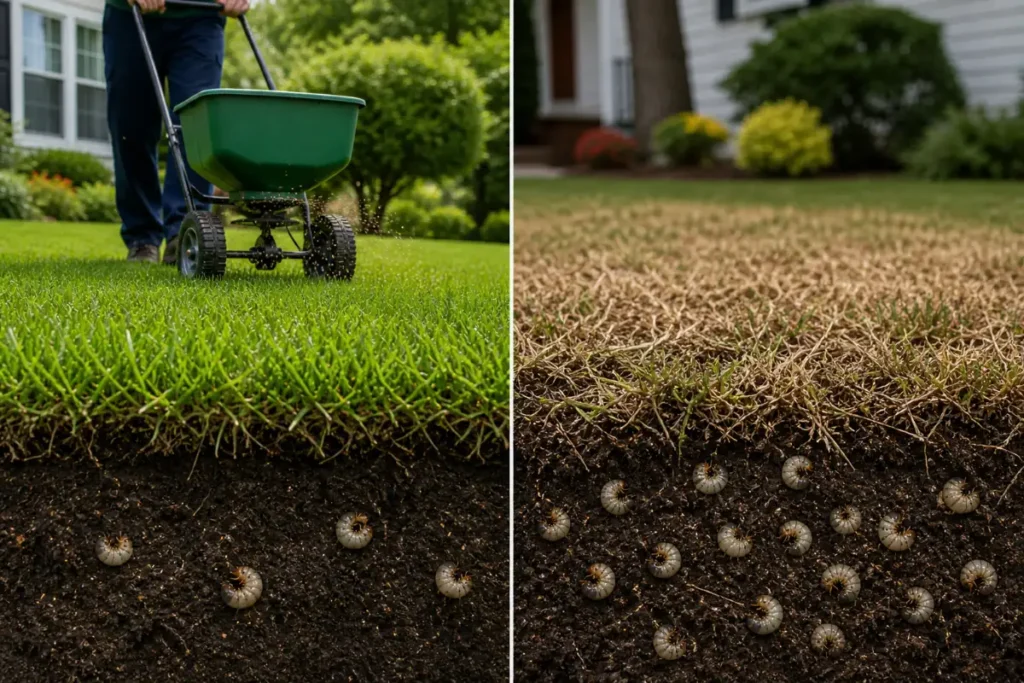
Chlorantraniliprole vs. Imidacloprid: Which Product Is Right for Northern Virginia Timing?
This is the product chemistry detail most grub control articles skip — and it’s exactly what determines whether your June application actually works.
Chlorantraniliprole (Acelepryn, GrubEx Season Long)
- Application window in Northern Virginia: Late April through June 30 — but May/June is ideal
- How it works: Absorbed into the soil and taken up by plant roots; grubs ingest it as they feed on roots. Slower-acting but longer residual control
- Key advantage: Significantly lower toxicity to beneficial insects (bees, fireflies, ground beetles) than imidacloprid-based products — an important consideration for Northern Virginia homeowners with pollinator-attracting gardens and landscape planting beds
- Best choice if: You’re applying in May or early June, or have significant pollinator plants in your landscape
Imidacloprid (Merit, Scotts GrubEx Plus, various)
- Application window in Northern Virginia: Mid-June through early July
- How it works: Systemic neonicotinoid absorbed by soil and plant tissue; highly effective against first-instar grubs at egg hatch
- Key advantage: Faster activation than chlorantraniliprole; tighter timing means more direct targeting of the egg-hatch window
- Best choice if: You’re applying in June–early July and want the most direct preventative efficacy
The professional advantage: Lawn Theory’s lawn pest and disease control service determines the right product based on your specific application timing, lawn conditions, irrigation schedule, and the presence of sensitive garden areas — not a one-size-fits-all approach.
5 Signs You Already Have a Grub Problem in Your Northern Virginia Lawn
Not sure whether you’re dealing with grubs or just summer heat stress? Here’s how to tell:
1. Brown patches that don’t respond to watering. Summer drought stress turns grass brown but recovers with irrigation. Grub damage doesn’t — the roots are severed, so water doesn’t reach the plant. If watering your brown patches doesn’t green them up within 48 hours, grubs are a strong suspect.
2. Turf that lifts like carpet. Pull back a corner of a brown patch. If the turf rolls up in a section, revealing bare soil and white C-shaped larvae underneath, you have active grubs. Healthy turf stays firmly attached to soil even when pulled — roots are intact. This is the definitive field test.
3. Spongy, soft turf that feels “springy” underfoot. Early-stage grub feeding destroys the root mat before the turf fully detaches. The spongy feeling is the first symptom before visible browning begins.
4. Increased bird, skunk, and raccoon activity. Birds, skunks, and raccoons are nature’s grub detectors. If you’re suddenly seeing crows systematically probing your lawn, or finding cone-shaped digging holes overnight — something is telling them there’s food underground. That something is grubs.
5. Brown patches that expand week over week. Heat stress damage tends to be somewhat uniform and stationary. Grub damage patches expand because the grubs are moving as they feed, progressively destroying more root area. A brown patch that’s noticeably larger than it was two weeks ago is almost certainly biological, not environmental.
If you’re seeing two or more of these signs, dig a 1-square-foot sample 2–3 inches deep in a damaged area. More than 6–7 grubs per square foot typically indicates a population dense enough to cause turf damage and warrants professional treatment.
The Irrigation Paradox: Why Watering Your Northern Virginia Lawn Increases Grub Risk
Here’s a counterintuitive insight from Virginia Cooperative Extension that almost no one knows — and it’s directly relevant to Northern Virginia’s irrigation-heavy HOA neighborhoods:
Female Japanese beetles prefer to lay eggs in moist, well-irrigated soil.
This means that the beautifully maintained, regularly irrigated lawns in Ashburn Farm, Brambleton, One Loudoun, and similar communities are actively more attractive to egg-laying beetles than dry, drought-stressed lawns in July and August. The irrigation that keeps your turf green and healthy during summer is simultaneously making it a preferred nursery for beetle eggs.
This doesn’t mean you should let your lawn die to deter beetles — the damage from summer dormancy is worse than the grub risk. It means that irrigated lawns in Northern Virginia should treat preventative grub control as a non-negotiable part of the annual lawn care maintenance plan, not an optional add-on.
The corollary: if you can reduce irrigation frequency specifically during July 1–August 15 (peak egg-laying period) without allowing permanent turf damage, eggs in dry soil have significantly higher mortality rates. It’s a delicate balance — but one our aeration and overseeding team and lawn care specialists can help you navigate with a targeted summer care plan.
How Grub Damage Affects Your Outdoor Living Investment
There’s an angle to grub control that most lawn care articles skip entirely — and it matters deeply if you’ve invested in your Northern Virginia outdoor space.
Grub damage doesn’t stop at your lawn’s edge. Here’s what serious grub infestations do to the full outdoor experience:
Landscape beds and planting areas. Grubs don’t exclusively feed on grass roots — they also consume the roots of annuals, perennials, and young shrubs in adjacent landscape planting beds. If you’ve invested in a landscape design and installation project with specimen plantings, a grub outbreak in adjacent turf can migrate into bed areas and damage plant root systems.
Hardscape surrounds. Dead, detached turf alongside patios and hardscapes, walkways and pathways, and driveways and entrances doesn’t just look bad — it destabilizes the edge between turf and hardscaping, allowing encroachment of weeds, erosion of edging, and structural undermining of paver installations when roots no longer hold the adjacent soil in place.
Curb appeal and outdoor living usability. A back lawn with large brown dead patches isn’t where anyone wants to host a summer gathering near the outdoor kitchen or fire pit. The lawn is the carpet of your outdoor living room — and grub damage is the equivalent of a fire in the middle of the rug.
The full lawn care services at Lawn Theory — including lawn fertilization and weed control, aeration and overseeding, and lawn pest and disease control — are designed as a coordinated system. Grub prevention is one piece of a complete lawn health program, not a standalone transaction. And our tree and shrub care service addresses the adult beetle damage to ornamental plants that accompanies every grub season.
The Lawn Theory Grub Control Process
When our team applies grub control treatment to a Northern Virginia property, here’s the exact process:
1. Timing confirmation. We verify your specific application timing against current soil temperature data and Japanese beetle emergence tracking for Loudoun County and Fairfax. Product selection follows timing — not the other way around.
2. Product selection based on conditions. Chlorantraniliprole for early-window applications and pollinator-sensitive landscapes. Imidacloprid for mid-June through July applications where maximum first-instar targeting is the priority.
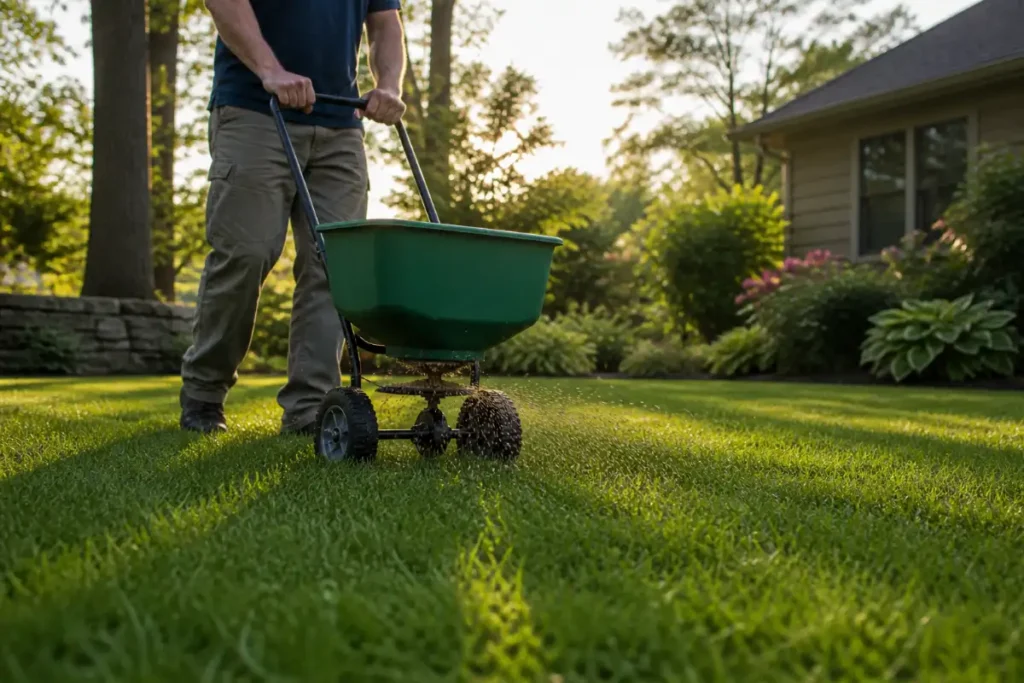
3. Calibrated application. Granular products are spread at the labeled rate using calibrated spreaders — not estimated by hand. Over-application doesn’t improve results and creates unnecessary chemical load; under-application leaves gaps in coverage.
4. Immediate irrigation activation. Preventative grub products must be watered in within 24–48 hours of application — ideally ½ inch of water within 24 hours — to move the active ingredient into the soil profile where grubs will encounter it. We confirm irrigation schedule and provide specific instructions.
5. Follow-up assessment. Our lawn care and maintenance program includes monitoring for grub activity in August — watching for the early brown patch indicators that suggest treatment re-evaluation is needed.
Frequently Asked Questions: Grub Control Timing in Northern Virginia
Q1: When is the best time to apply grub control in Northern Virginia? The optimal preventative window for grub control in Northern Virginia is late May through early July, depending on the product used. Chlorantraniliprole-based products (GrubEx Season Long, Acelepryn) should be applied from late May through June 30. Imidacloprid-based products (Merit, GrubEx Plus) are best applied mid-June through early July to align with Japanese beetle egg-hatch timing in our Zone 7 climate. Applications made after mid-July are significantly less effective as preventative treatments.
Q2: Is it too late to apply grub control in August? By August, preventative products are no longer effective — grubs have hatched and are actively feeding, and some are already entering their second instar stage (larger and harder to kill). August requires curative treatment with fast-acting compounds like trichlorfon (Dylox) or carbaryl, which work within 24–72 hours but cost more, have lower overall efficacy, and must be followed by significant irrigation to activate. If you’re seeing brown patches in August, curative treatment can still help, but you’ll also need to plan for lawn restoration in September.
Q3: How do I know if my lawn has grubs? The definitive test is to cut three sides of a 12-inch square of turf and fold it back, then dig 2–3 inches into the soil beneath. Count the white, C-shaped larvae you find. Fewer than 5 per square foot is generally tolerable for a healthy lawn. More than 6–7 per square foot in multiple test areas indicates a population that will cause visible damage. Other indicators include: brown patches that don’t respond to watering, turf that lifts easily, spongy turf texture, and increased bird or skunk activity.
Q4: What grass type in Northern Virginia is most resistant to grub damage? Tall fescue — the most widely planted cool-season grass in Northern Virginia — has the deepest root system of the common cool-season grasses and shows the greatest tolerance to grub feeding. Because its roots extend significantly deeper than Kentucky bluegrass or perennial ryegrass, moderate grub populations (4–6 per square foot) may not cause visible damage in a healthy fescue lawn. This is one of several reasons we recommend tall fescue for new lawn installations throughout Loudoun County and Fairfax. Our sod installation and lawn renovation service uses turf-type tall fescue as the standard for new or replacement installations.
Q5: Should I apply grub control every year in Northern Virginia? For most properties in Northern Virginia — particularly irrigated lawns in HOA communities, homes adjacent to ornamental plantings, and properties with a history of Japanese beetle adult activity — annual preventative grub control is the appropriate standard. Properties that are not irrigated and have no history of grub damage may be able to reduce treatment frequency, but the risk calculation changes year to year based on adult beetle populations and summer rainfall patterns. Our lawn pest and disease control program includes annual monitoring to make this determination based on your specific property history.
Q6: Does grub control harm beneficial insects and pollinators? This is a legitimate and important concern. Chlorantraniliprole-based products have been shown to have significantly lower toxicity to beneficial insects — particularly bees, fireflies, and ground beetles — compared to imidacloprid-based products. For lawns adjacent to flowering plants, gardens, or managed pollinator habitats, chlorantraniliprole is the preferred choice. All grub control products should be applied strictly according to label directions, and lawns should be mowed before application to ensure there are no open flowers in turf that could expose pollinators to the product.
Q7: Can I apply grub control myself, or should I hire a professional? DIY grub control products are available at home improvement stores, but professional application delivers meaningfully better results for two reasons. First, timing and product selection are critical — applying the wrong product outside the effective window produces poor results regardless of how carefully you follow label directions. Second, professional-grade spreader calibration ensures even, complete coverage at the correct rate. Uneven application leaves gaps where grubs survive to damage turf. Our lawn pest and disease control service includes timing assessment, product selection, calibrated application, and follow-up monitoring as a complete package.
Q8: What happens to my lawn if I don’t treat for grubs? If grub populations exceed 6–7 per square foot in a Northern Virginia lawn and no treatment is applied, turf damage typically becomes visible in August–September as brown patches appear where grubs have severed the root system. Damage accelerates when skunks and raccoons begin digging for grubs, creating additional mechanical damage. Without treatment, the damaged areas require reseeding or sodding in fall — a process that requires aeration and overseeding services and consistent follow-up fertilization to restore the lawn to full density before winter.
Q9: Does aerating my lawn help with grub control? Aeration doesn’t eliminate grubs directly, but it does improve turf health in ways that increase grub tolerance. Deeper roots, reduced thatch, and improved soil drainage all make turf more resilient to root feeding at moderate grub densities. We recommend core aeration in fall as a standard practice for all Northern Virginia lawns — both for its direct turf health benefits and as part of the lawn fertilization and weed control foundation that keeps grass dense enough to withstand the population loads that don’t cause visible damage.
Q10: How long after grub treatment does my lawn recover? Following preventative grub control applied in the correct window, your lawn typically shows no grub damage at all — the treatment works and the grass continues growing normally through the season. Following curative treatment of an active infestation, dead patches where roots were already destroyed will not green up spontaneously — those areas require aeration and overseeding in September or sod installation to restore. Expect 6–10 weeks from fall seeding to full recovery in damaged areas.
Don’t Miss the Window. Book Your Grub Control Now.
You’ve got from late May through early July. That’s it. After that, you’re playing defense — paying more, getting less, and watching brown patches spread through August while you wait for curative treatment to work.
Lawn Theory makes it simple: call us now, we assess your lawn, select the right product for your specific timing, apply it correctly, and water it in. Then you spend the rest of summer enjoying your outdoor space instead of diagnosing it. See us on Instagram & Linkedin.
We serve homeowners across Aldie · Ashburn · Brambleton · Loudoun County · Fairfax · Arlington · Chantilly · Herndon · Stone Ridge · Sterling · Falls Church — and all of Northern Virginia.
Here’s how to get started:
Explore our lawn pest and disease control service→ See our full lawn care and landscaping program → Add aeration and overseeding to your fall plan → Request your free grub control quote
📞 Call Lawn Theory: (703) 650-5655 or request your free on-site estimate today.
The window is open. Protect your lawn while it is.
Keep Reading: Lawn Care
 Lawn Care
 Sprinkler System Winterization in Northern Virginia: Timing, Methods, and What Goes Wrong
Sprinkler winterization in Northern Virginia is about timing, not a fixed date. How to pick your shutdown week, how the three drainage…
 Lawn Care
 Fall Planting in Northern Virginia: Trees, Shrubs, and Mulch Done Right
Fall is the best time to plant trees and shrubs in Northern Virginia, but most failures trace to the first twenty minutes…
 Lawn Care
 The Fall Lawn Renovation Calendar for Northern Virginia: Dates, Seeding Rates, and Soil Temperature
Virginia Cooperative Extension puts the Northern Virginia seeding window at the last week of August through mid-September. Here are the exact dates,…
Want this handled by the crew that wrote the guide?
Veteran-owned. Licensed & insured. Free walkthroughs across Northern Virginia — quotes in 24–48 hours.
Get Your Free Estimate