
Fall Gutter Cleaning in Northern Virginia: Why September Through November Is Critical
Fall gutter cleaning is non-negotiable in Northern Virginia. The region’s abundant deciduous trees white oaks, sugar maples, red maples, tulip poplars, sycamores, sweetgum trees, and numerous other species — produce massive leaf drop from mid-September through November. This seasonal leaf fall, combined with tree seed pods, helicopter seeds, and wind-driven debris, loads gutters with debris that prevents proper drainage. Gutters clogged with leaves and debris cause water backup that damages gutters, fascia boards, siding, and roof edges. Water overflow from clogged gutters can cause foundation damage, landscaping erosion, and interior water infiltration. Fall gutter cleaning isn’t optional maintenance; it’s essential protection for your home’s structure and property value.
This comprehensive guide explains why fall gutter cleaning is critical in Northern Virginia’s climate, identifies the specific trees that cause the most gutter problems, describes the signs that gutters need cleaning, outlines the professional gutter cleaning process including exterior brightening, compares DIY versus professional approaches, and provides cost guidance. Understanding fall gutter maintenance helps homeowners protect their property from water damage that can cost thousands to repair.
Call (703) 650-5655 or request a free Gutter cleaning estimate today.
Why Fall Gutter Cleaning Is Non-Negotiable
Gutters serve a critical function: channeling roof water away from your home’s foundation, protecting the foundation from water damage and erosion. When gutters become clogged with leaves and debris, water cannot flow through the gutter system. Instead, water backs up on the roof (shortening shingle life), overflows over gutter edges (saturating fascia and causing rot), and cascades down siding (causing water intrusion and mold growth). Some overflow water reaches the foundation perimeter (causing foundation cracks and water intrusion in basements and crawl spaces).
Northern Virginia’s freeze-thaw cycles (common from December through March) make clogged gutters particularly dangerous. Water that accumulates in clogged gutters freezes, creating ice dams. These dams block water flow, forcing water to back under roof shingles and into the home’s interior. The combination of autumn leaf fall and winter freeze-thaw makes fall gutter cleaning essential prevention against winter water damage.
The financial impact of ignoring fall gutter cleaning can be substantial. Water damage to fascia boards, soffit, siding, and roof edges requires replacement ($1,000-$3,000+). Foundation crack repair can exceed $5,000. Interior water damage remediation, mold removal, and replacement of damaged materials can reach $10,000+. A $200+ fall gutter cleaning prevents potential damage costs that can exceed $20,000. The ROI on professional gutter cleaning is exceptional.
Northern Virginia’s Leaf Season Timeline
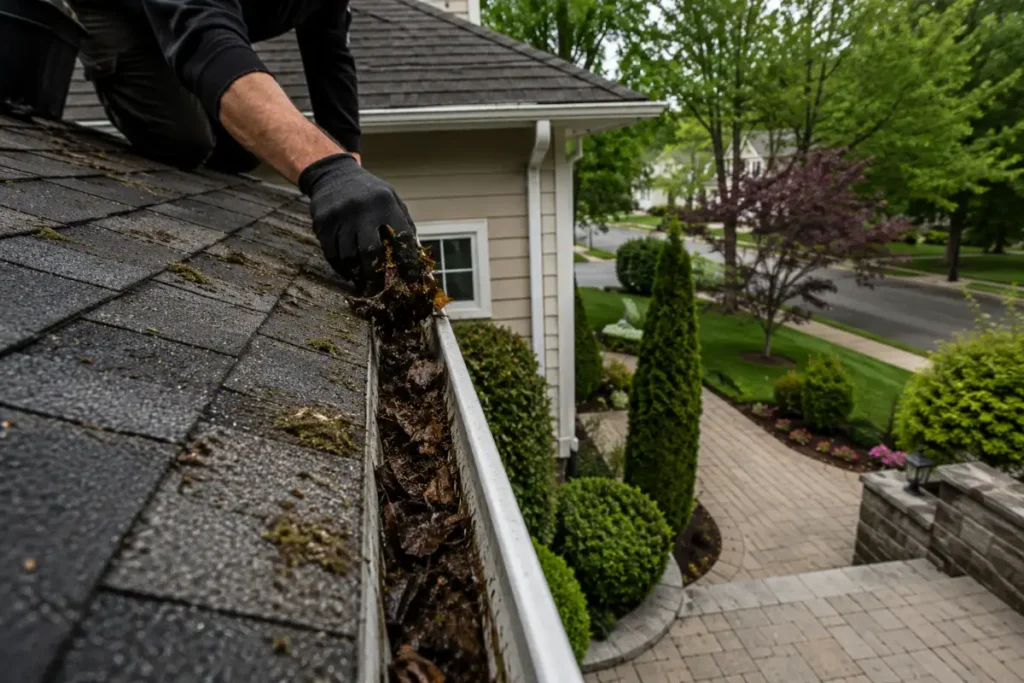
Northern Virginia’s leaf season follows a predictable pattern. Early fall (September): Trees begin dropping leaves, but leaf volume remains moderate. Mid-fall (October): Leaf drop accelerates dramatically as temperatures cool. Peak leaf drop occurs during the first three weeks of October across most of Northern Virginia. Late fall (November): Remaining leaves fall, and tree seed pods and helicopter seeds continue dropping. December onwards: Leaf drop slows, but occasional late-dropping branches and wind-driven debris continue entering gutters through winter.
The timing is crucial for scheduling. Gutters should be cleaned once before peak leaf season (mid-September) for homes with moderate tree coverage, removing any summer debris and ensuring system readiness. A second cleaning after peak leaf drop (early November) ensures gutters are clear before winter freeze-thaw cycles begin. For homes in heavily wooded areas (Burke Centre, Stone Ridge, Willowsford in Fairfax/Loudoun, or tree-dense Arlington neighborhoods), a third cleaning in late November is justified. Communities with dense tree coverage may benefit from periodic mid-season cleanings (October) during peak leaf drop.
Trees That Cause the Most Gutter Problems
Not all trees drop leaves at the same rate or create equal gutter problems. Understanding which trees most significantly impact gutter cleanliness helps predict cleaning frequency needs. White oaks (common throughout Northern Virginia, particularly in established neighborhoods like McLean, Great Falls, and Burke) drop massive leaf volumes in October. A single white oak can drop 100+ pounds of leaves and acorns. A property with multiple white oaks can have thousands of pounds of debris entering gutters.
Sugar maples and red maples (dominant in Arlington, Alexandria, and northern Fairfax County) drop tremendous leaf volumes and produce winged seeds (samaras) that helicopter into gutters. A single mature maple tree drops 1,000+ leaves. Properties with multiple maples face significant gutter loading. Tulip poplars (abundant in established Virginia neighborhoods) drop leaves and seed pods. Sweetgum trees (common throughout Northern Virginia) drop prickly seed balls that lodge in gutters and attract debris accumulation. Sycamores (found along streams and properties with moisture) drop leaves, seed balls, and bark debris.
Pine and conifer trees present a different challenge: instead of deciduous leaves, they drop needles continuously (some dropping more heavily in fall) and produce pinecones. Needles pack tightly in gutters and are difficult to remove, sometimes requiring hand removal rather than flushing. Properties with significant pine coverage face perpetual gutter maintenance challenges.
The specific tree mix on your property determines gutter cleaning frequency. A Brambleton or Broadlands property with several white oaks requires multiple cleanings. A Burke Centre property with established maple coverage needs frequent attention. A property in Arlington or Falls Church with dense urban tree canopy requires regular seasonal cleaning. Professional gutter cleaning companies assess your specific property’s tree coverage and recommend appropriate cleaning frequency.
Signs Your Gutters Need Cleaning
Several visible and audible signs indicate clogged gutters. Standing water in gutters after rain is the most obvious sign — gutters should drain completely within an hour after rain stops. Water pools or overflows over the gutter edge during moderate rain indicate blockage. Sagging gutters indicate debris weight accumulation — excess weight strains gutter fasteners and can cause permanent damage. Visible leaves, debris, or seed pods overflowing from gutter tops indicate blockage. Discolored gutter fascia below overflow points indicates repeated water exposure from gutter overflow.
More subtle signs include water staining on siding beneath gutter ends (from repeated overflow), erosion or washout areas in landscaping directly below gutters (from overflow cascading), and moss or algae growth on gutters and fascia (indicating persistently wet conditions from drainage failure). Interior signs include water stains on ceiling near exterior walls, damp basement walls, or visible mold growth in attics or crawl spaces near the roof edge.
The best approach is proactive seasonal cleaning rather than reactive cleaning based on visible signs. By the time signs of clogged gutters become obvious, damage may already be occurring. Preventive fall and spring cleaning ensures gutters never reach problematic blockage levels.
Professional Gutter Cleaning Process
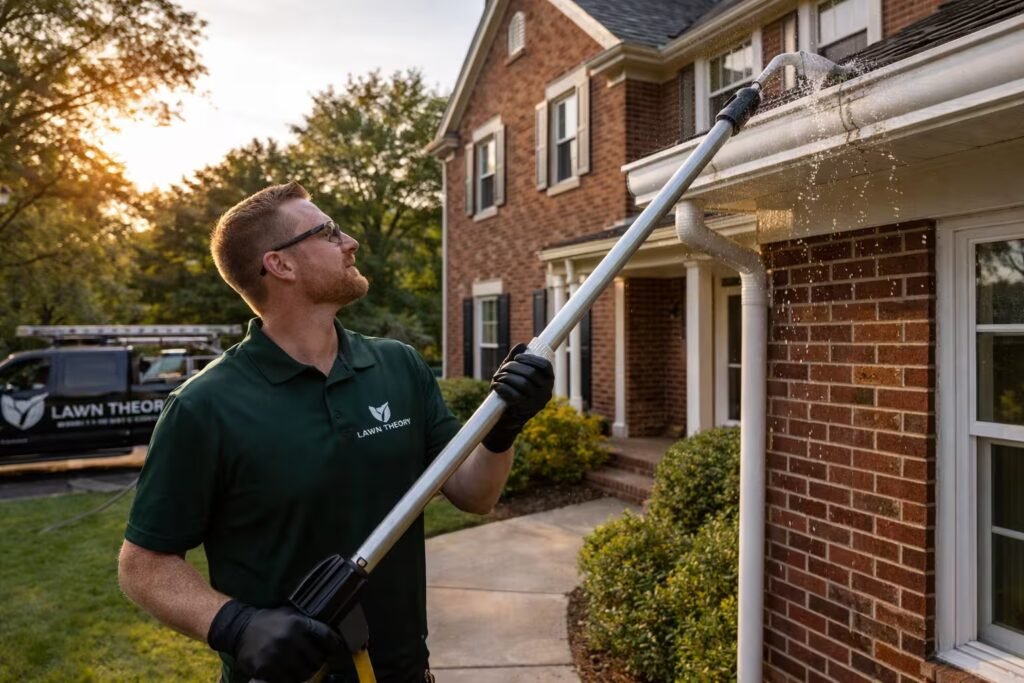
Professional gutter cleaning follows a systematic process designed to thoroughly clear gutters, flush downspouts, and confirm proper drainage. First, all debris is removed from gutters by hand, using small scoops designed specifically for gutter work. Leaves, sticks, seed pods, and accumulated sediment are carefully removed from entire gutter length. Technicians carefully work along gutter runs, removing debris from valleys where debris naturally accumulates, from areas beneath tree branches where debris concentration is heaviest, and from gutter near downspout openings where debris jams.
Next, downspouts are flushed with pressurized water to clear any internal blockage. A blocked downspout can prevent proper drainage even if gutters are clean. Flushing confirms that water flows freely through the entire drainage system from roof to ground. For fully clogged downspouts, pressure flushing may require several passes to clear.
Finally, the gutter system is tested by running water through it to verify proper flow and drainage. Technicians observe water flowing through gutters, confirming it doesn’t back up or overflow, and observe water exiting downspouts onto appropriate splash blocks or drainage extensions. Any observed issues (loose fascia, damaged gutters, downspout misalignment) are noted for homeowner review.
Gutter Brightening
After gutter cleaning, many homeowners choose gutter brightening — professional cleaning of the gutter exterior to remove dark staining, oxidation, and black discoloration from organic growth. Gutters naturally develop black streaks (from algae and mold colonization), white discoloration (from mineral deposits and oxidation), and overall dingy appearance. Professional gutter brightening applies specialized cleaning solutions to dissolve these stains, followed by gentle pressure rinsing to restore gutter appearance.
Gutter brightening restores aluminum gutters to near-original appearance and brightens painted steel gutters significantly. The process starts at $175 per gutter cleaning (so total cleaning plus brightening starts at $250 versus from $150 for cleaning alone). The aesthetic improvement is striking — gutters that appeared old and neglected become bright and well-maintained, improving overall home curb appeal.
DIY vs Professional Gutter Cleaning
DIY gutter cleaning using personal ladders and hand scoops is possible but risky. Ladder-related injuries are among the most common home injuries. Standing on a ladder with one hand holding debris while maintaining balance is inherently unstable. Reaching sideways or backward on a ladder, necessary to reach gutter ends and corners, creates dangerous biomechanics. Falls from eight-foot gutters result in serious injuries: broken bones, head injuries, spinal injuries.
Beyond safety, DIY gutter cleaning has quality limitations. Without proper equipment, it’s difficult to thoroughly clear compacted debris. Downspouts often aren’t flushed properly, leaving partial blockages. Without a water test, you may not confirm proper flow. The time investment is substantial — a 40-foot gutter run takes 2-3 hours for untrained homeowners using ladders.
Professional gutter cleaning eliminates safety risk, ensures thorough cleaning and flushing, confirms proper system operation, and starts at $175 — final price depends on gutter length and additional services. For most homeowners, the modest cost is well worth the safety benefit, quality assurance, and time savings.
Costs
Professional gutter cleaning costs vary based on gutter length, property height, debris accumulation, and additional services. Typical costs for residential properties: Single-story homes with 100-150 linear feet of gutter: from $175. Two-story homes with 150-250 linear feet of gutter: from $200. Larger or more complex homes: from $300.
Add $75+ for gutter brightening service. Add $50-$100 if gutter repairs (loose fasteners, minor dents) are needed. Add $50+ if downspout extensions or splash blocks are installed or repaired.
Most homes benefit from two professional cleanings annually: one pre-season (mid-September) and one post-season (early November). Annual gutter maintenance cost: from $350 for typical homes. This investment prevents thousands of dollars in potential water damage.
FAQs
Q: How often should gutters be cleaned? A: Most properties benefit from cleaning in mid-September and early November, plus additional mid-season cleaning if tree coverage is heavy. Properties with minimal tree coverage may need only one annual cleaning.
Q: Can gutter guards prevent the need for cleaning? A: Gutter guards reduce debris entry but don’t eliminate cleaning needs, particularly in areas with heavy leaf drop. Most guards still require periodic cleaning.
Q: What’s the damage risk if I skip fall gutter cleaning? A: Water damage to fascia, siding, roof edges, and foundation can exceed $10,000-$20,000. Ice dams in winter compound the problem. The risk far exceeds the cleaning cost.
Q: Should I clean gutters myself or hire professional? A: Safety hazards make professional cleaning the recommended approach for most homeowners. The modest cost is worth the safety benefit and quality assurance.
Schedule Your Fall Cleaning
Fall gutter cleaning is essential maintenance that protects your home from water damage, extends gutter lifespan, and ensures proper roof drainage through freeze-thaw cycles. Schedule professional gutter cleaning now to protect your Northern Virginia home through the critical fall and winter seasons. See us on Instagram & TikTok.
Keep Reading: Exterior Cleaning
 Exterior Cleaning
 Slippery Sidewalks and HOA Violations in Northern Virginia: How Algae Becomes a Legal Liability Problem
There are two ways to learn this lesson. The easy way: read this article, schedule a sidewalk cleaning appointment, and spend your…
 Exterior Cleaning
 How to Remove Hard Water Stains from Windows in Northern Virginia (And Why They Keep Coming Back)
You cleaned your windows last spring. Spent a Saturday afternoon with Windex and elbow grease. Maybe even hired someone. They looked great…
 Exterior Cleaning
 Spring House Washing in Northern Virginia: Why Pollen Season Makes It Urgent
You wake up one Saturday morning in April, walk outside with your coffee, glance up at your house and stop dead in…
Want this handled by the crew that wrote the guide?
Veteran-owned. Licensed & insured. Free walkthroughs across Northern Virginia — quotes in 24–48 hours.
Get Your Free Estimate