
The Complete Guide to Concrete Cleaning in Northern Virginia: Driveways, Sidewalks, Garage Floors, and More
Concrete surfaces dominate most Northern Virginia properties: driveways, sidewalks, patios, and garage floors are essential elements of home exteriors and important property investment areas. Each concrete surface develops different stain types based on its location, use, exposure to the elements, and underlying soil conditions. A driveway in Ashburn develops different staining patterns than one in Burke; a garage floor in Arlington shows different stains than one in Gainesville; a patio in McLean has unique challenges compared to one in Alexandria. Each surface requires specific cleaning approaches tailored to stain type, concrete condition, and environmental factors.
This complete guide covers all concrete cleaning scenarios with stain-specific removal techniques, addressing the most common concrete challenges Northern Virginia homeowners face. Understanding concrete staining, removal methods, professional equipment and techniques, sealing strategies, and cost expectations helps homeowners make informed decisions about their property’s concrete maintenance.
Introduction to Concrete Cleaning
Concrete is porous and absorbs liquids that create permanent staining if not addressed promptly. Once stains penetrate the concrete’s surface pores, they cannot be removed with simple water cleaning or light pressure washing. Professional concrete cleaning uses pressure washing combined with targeted chemical pre-treatments designed to break down specific stain types, followed by high-pressure extraction to remove residue from deep within the concrete’s porous structure.
The concrete age, finish type (sealed vs unsealed), and exposure history all affect cleaning strategy. New concrete (less than 5 years old) in good condition typically responds well to standard pressure washing. Older concrete with deteriorated surfaces, previous staining, or heavy use requires more aggressive treatment. Sealed concrete requires different cleaning agents than unsealed concrete to avoid stripping the sealant.
Types of Concrete Surfaces
Concrete appears in multiple residential applications: poured concrete driveways (most common in Northern Virginia), stamped concrete driveways and patios (popular in upscale communities like Brambleton, McLean, and Great Falls), exposed aggregate concrete (decorative finish showing pebbles), broom-finished concrete (textured for slip resistance), and polished concrete (often in garage floors for aesthetic appearance). Each finish has different stain removal requirements and cleaning pressure tolerances.
Concrete also appears in sidewalks and walkways throughout Northern Virginia’s neighborhoods. Arlington’s compact urban sidewalks, Alexandria’s historic brick-and-concrete mixed walkways, Loudoun County’s wide suburban sidewalks, and Fairfax County’s diverse neighborhood sidewalks each develop characteristic staining. Understanding surface type guides treatment approach and pressure selection.
Common Concrete Stains and How to Remove Them
Concrete staining complexity varies dramatically based on stain type. Some stains are surface deposits (easily removed); others are discoloration from chemical reaction or penetration (requiring specialized treatment); others are permanent alterations to the concrete’s appearance (requiring acceptance rather than removal). Understanding stain type is the first step in developing effective removal strategy.
Oil and Grease Removal
Garage floors and driveways accumulate oil drips from vehicle maintenance and normal vehicle operation. A single oil drip creates a spot that spreads through repeated exposure, eventually affecting 10-20 square feet. Oil staining is one of the most common concrete problems in Northern Virginia. Fresh oil stains respond to simple degreasing and pressure washing; old, set-in oil stains in a Gainesville garage that’s been in use for 20 years require aggressive chemical treatment and hot water extraction.
Professional oil removal uses commercial degreasers applied as pre-treatment, dwelling 10-15 minutes while surfactant chemistry breaks apart oil molecules. Hot water extraction at 2,500-3,500 PSI lifts the broken-down oil from deep concrete pores. Stubborn stains may require secondary treatment. For severe staining, enzymatic degreasers work more effectively than chemical surfactants, actually digesting oil molecules rather than merely breaking them apart mechanically.
Cost for oil stain removal varies: light stains respond to standard driveway cleaning (from $0.20/sq ft, from $199 for residential driveways). Heavy oil accumulation in garage floors may require specialized treatment (from $300 — final price depends on extent). The investment prevents the permanent appearance damage that results from oil saturation in concrete.
Rust Stain Removal
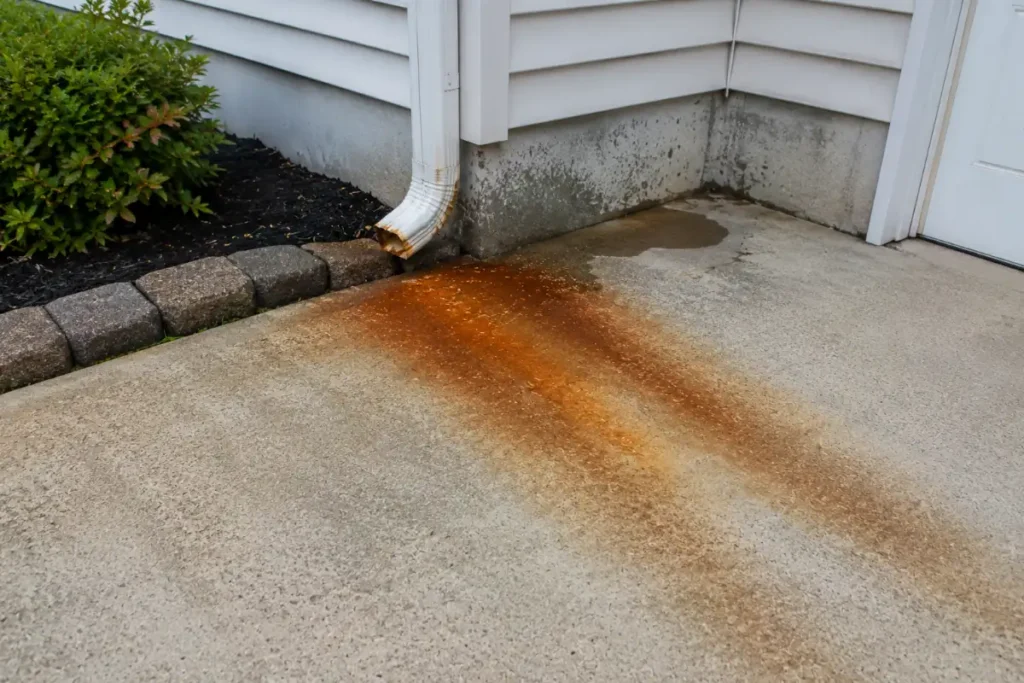
Northern Virginia’s well water often contains iron minerals that create rust staining on concrete. In western Loudoun (Purcellsville, Hamilton, Lovettsville), in western Fairfax (Great Falls area), and throughout Prince William County, rust staining from sprinkler system overspray, well water discharge, and iron-bearing irrigation creates distinctive orange-brown discoloration. Rust stains are particularly prevalent in communities with heavy landscaping and automatic irrigation systems.
Rust stain removal requires chelation chemistry (binding iron molecules and removing them) rather than mechanical pressure. Professional rust removers containing oxalic acid or similar chelating agents are applied to rust-stained areas, allowed to dwell 5-10 minutes while chelating iron, then pressure washed for extraction. The process must be carefully applied because the chemistry can damage some concrete types if not properly controlled. Professional application ensures appropriate concentration and dwell time.
For rust stains caused by irrigation system overspray, addressing the irrigation system to reduce water application to hardscapes prevents recurrence. Cost for rust stain removal: from $199 — final price depends on extent, from $199 for moderate staining on driveways or foundations.
Algae and Organic Growth
Concrete sidewalks and patios, particularly in shaded areas under tree canopy, develop green or black algae and slippery fungal growth. This organic growth is particularly aggressive in Arlington’s dense tree canopy neighborhoods (Donaldson Run, Glencarlyn) and in Burke Centre’s established neighborhoods. The growth creates safety hazards (slippery surfaces) and aesthetic degradation.
Algae removal uses algaecide pre-treatment combined with pressure washing. The algaecide kills the organisms at the cellular level, then pressure washing removes the dead matter. Pressure levels of 2,500-3,500 PSI effectively remove organic growth while not damaging most concrete surfaces. Surface cleaners provide even, overlap-free results. For safety-critical surfaces like pool decks, the removal is particularly important.
Prevention of algae regrowth involves reducing shade (if possible, pruning overhanging branches) and sealing the concrete surface. Sealed concrete sheds water more efficiently, reducing moisture that algae needs. Cost for algae removal and treatment: from $200 for typical driveway or patio areas.
Red Clay Staining
Red clay staining is the signature Northern Virginia concrete challenge, particularly in Prince William County (Woodbridge, Gainesville, Manassas area). The region’s red clay soil splashes onto concrete during rainstorms, creating a permanent reddish-brown discoloration that doesn’t wash away with normal rainfall. Properties in newer developments in the Gainesville-Haymarket corridor often show severe red clay staining within the first year of construction. The stain is not surface dirt but chemical reaction of clay minerals with concrete.
Red clay stain removal uses specialized acidic or oxidizing treatments that break down the clay-concrete bond. Pre-treatment with appropriate chemistry dwells 10-15 minutes while dissolving the clay-concrete connection. Pressure washing at 2,500-3,000 PSI extracts the broken-down clay. Proper protective measures must be used because the chemistry can affect certain surface finishes. Professional application is important to ensure appropriate treatment without over-aggressive chemistry.
Prevention involves reducing splash potential: keeping landscaping mulch away from concrete edges, directing downspout flow away from concrete, and applying protective sealant to driveways. Cost for red clay stain removal: from $200 for moderate staining, potentially more for extensively stained older driveways.
Professional Equipment and Techniques
Professional concrete cleaning uses commercial-grade equipment far superior to consumer rental pressure washers. Hot water pressure washers deliver heated water (140-200°F) that more effectively breaks down oils, greases, and some organic stains than cold water. Surface cleaners with rotating nozzles provide even, streak-free cleaning across wide areas, preventing the striping that occurs with handheld spray patterns. Commercial-grade equipment handles high-volume work without the stress damage that occurs on rental equipment.
Professional technicians understand pressure optimization for different concrete types and stain scenarios. Too low pressure leaves stains uncleaned; too high pressure can damage or spall concrete surfaces. Experience guides pressure selection. For stamped concrete driveways in Brambleton, for example, professionals use lower pressure (2,000-2,500 PSI) to preserve decorative details. For exposed aggregate concrete, professionals adjust angle and pressure to avoid dislodging aggregate. For simple flat concrete, higher pressure (3,000+ PSI) effectively cleans.
Chemical pre-treatments are the critical differentiator between professional and DIY cleaning. Professional-grade degreasing agents, algaecides, rust removers, and clay stain solutions are far more effective than consumer products. Professional training ensures appropriate chemical selection and safe application.
Concrete Sealing After Cleaning
After professional cleaning, concrete sealers provide protective coating that extends cleanliness and protects the investment. Penetrating sealers soak into concrete pores, creating hydrophobic barrier that repels water and resists staining. Acrylic sealers create topical coating that enhances appearance while providing protection. Epoxy and polyurethane sealers provide maximum durability for high-traffic areas like garage floors.
Sealers typically last 2-3 years depending on traffic and exposure. For driveways, high winter salt exposure in Northern Virginia can reduce sealant lifespan. For garage floors, regular vehicle traffic can wear sealant. Patio and sidewalk sealers generally last the full 2-3 years with minimal wear. Professional sealant application ensures proper curing and longevity.
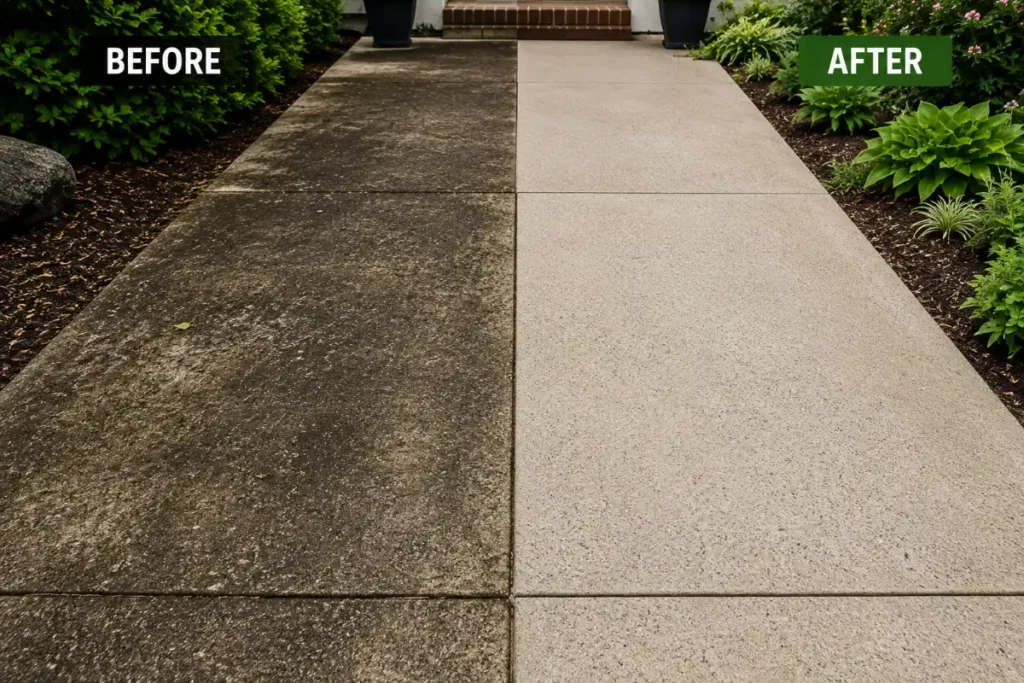
Sealer costs start at $200 — final price depends on concrete area, sealant type, and application method. A driveway starts at $250 for sealant application; a garage floor starts at $199. The investment protects the expensive concrete investment and maintains cleanliness longer.
Costs by Surface Type
Driveway cleaning for typical residential driveways (350-500 sq ft): from $199 with average start at $250. Complex or heavily stained driveways cost toward the higher range. Specialty cleaning (rust removal, red clay treatment) adds $100+. Sealant application adds $250+.
Garage floor cleaning for 2-3 car garage (400-500 sq ft): from $200. Heavily oiled floors requiring enzymatic treatment cost toward higher range. Sealant application adds $150+.
Patio cleaning depending on size and material: from $199. Stamped concrete or natural stone requires lower pressure and specialized techniques, potentially costing more. Sealant adds $200+ — final price depends on area.
Sidewalk and walkway cleaning: from $0.25 per square foot, from $199 for residential walkways. Commercial sidewalks cost more due to length and heavy staining from foot traffic.
FAQs
Q: Can I pressure wash concrete myself? A: Light pressure washing of flat concrete is lower-risk DIY than deck or siding cleaning. However, many homeowners use excessive pressure that damages concrete, or fail to treat stains with appropriate chemistry, leaving stains uncleaned. Professional results are superior and risk-free.
Q: What PSI should I use on concrete? A: 2,500-3,500 PSI is typical for residential concrete. Stamped or decorated concrete should use 2,000-2,500 PSI to preserve details. Soft concrete or weak mortar should use lower pressure.
Q: Will sealing my driveway prevent stains? A: Sealant reduces stain absorption and makes cleaning easier, but doesn’t make concrete stain-proof. Regular maintenance cleaning extends sealant life and keeps concrete looking new.
Get Your Concrete Cleaned
Concrete staining is inevitable in Northern Virginia’s climate and soil conditions, but professional cleaning restores concrete surfaces to near-original appearance. Understanding stain types, treatment options, and maintenance strategies helps homeowners protect their concrete investment. Contact Lawn Theory for professional concrete cleaning that addresses your property’s specific staining challenges. See us on Instagram & Linkedin.
Call Lawn Theory: (703) 650-5655 or request your free on-site estimate today.
Keep Reading: Pressure Washing
 Pressure Washing
 How Much Does Pressure Washing Cost in Northern Virginia? (2026 Homeowner Guide)
Pressure washing cost in Northern Virginia is set by square footage, surface type, buildup and access, not a flat rate. Here is…
 Pressure Washing
 Trex Composite Deck Cleaning in Northern Virginia: Why the Method Totally Changes Compared to Wood
Picture this: your neighbor hires a pressure washing company to clean their beautiful new Trex Transcend deck in Brambleton. The crew shows…
 Pressure Washing
 Sprinkler Rust Stains on Your Northern Virginia Property: Why They Happen and How to Actually Fix Them
You designed your irrigation system to keep your lawn green and your landscaping thriving. Nobody told you it would also paint your…
Want this handled by the crew that wrote the guide?
Veteran-owned. Licensed & insured. Free walkthroughs across Northern Virginia — quotes in 24–48 hours.
Get Your Free Estimate