
How to Get Rid of Lawn Weeds in Northern Virginia (The Complete, No-Nonsense Guide) or Weed Control Service
If you have ever spent a Saturday pulling dandelions only to see them back by Thursday, welcome to the club. It is an enormous club. Roughly half of all Northern Virginia homeowners are in it, and the dues are paid in frustration, sore backs, and empty bottles of weed killer that barely made a dent.
Here is the truth about how to get rid of lawn weeds in Northern Virginia: the problem is almost never about which weed spray you bought. It is about timing, soil health, grass density, and understanding why our specific regional climate makes weed control harder here than almost anywhere else in the Mid-Atlantic.
At Lawn Theory, a veteran-owned lawn care and landscaping company proudly serving Aldie, Ashburn, Brambleton, Loudoun County, Fairfax, Arlington, Chantilly, Herndon, Stone Ridge, Sterling, and Falls Church, our lawn fertilization and weed control service treats hundreds of Northern Virginia lawns every season. We know exactly which weeds are invading your neighborhood, what drives them, and what actually eliminates them for good.
This guide gives you the complete picture, from weed identification through seasonal treatment timing, DIY options, and the professional approach that delivers lasting results.
Call Lawn Theory: (703) 650-5655 or request your free on-site estimate today.
Why Getting Rid of Lawn Weeds Is Harder in Northern Virginia
Before we get into what to do, you need to understand why your weed problem is not your fault. Northern Virginia’s conditions create a genuinely aggressive weed environment.
Clay-heavy soil is weed paradise. Most of Loudoun County and Fairfax County sits on dense Virginia clay. Clay compacts easily, drains poorly, and creates the kind of stressed, oxygen-deprived root environment where grass struggles and weeds thrive. Crabgrass, nutsedge, and ground ivy are practically doing victory laps in compacted clay soil while your tall fescue quietly gives up.
Northern Virginia is a transition zone. Our region sits at the boundary between cool-season and warm-season grass territory. That means we have the right conditions to grow both cool-season weeds (chickweed, annual bluegrass, henbit) in spring and fall AND warm-season weeds (crabgrass, spurge, nutsedge) in summer. Most parts of the country only deal with one category. We deal with both.
High humidity accelerates weed spread. Our summers regularly sit at 70 to 90 percent relative humidity. Broadleaf weeds, grassy weeds, and invasive species all reproduce and spread faster in warm, humid conditions. A single crabgrass plant can produce up to 75,000 seeds in one growing season, and our climate is practically designed to maximize that number.
Thin turf is an open invitation. The number one reason weeds win in Northern Virginia lawns is thin, weak turf. Stressed fescue that got scalped during summer drought, bare patches from grub damage, or low-fertility soil that cannot support dense grass growth all create open real estate that weeds gladly colonize. Dense, healthy grass is the single most effective weed barrier that exists, and most Northern Virginia lawns never quite achieve it without a focused lawn care program.
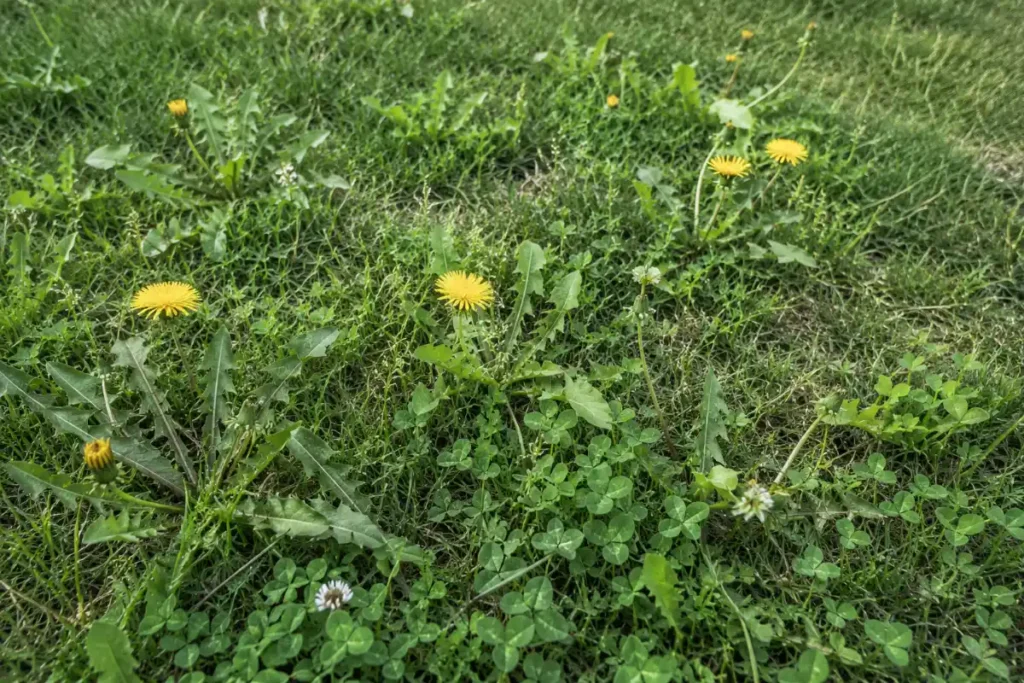
The 8 Most Common Lawn Weeds in Northern Virginia (And Why Each One Is Annoying)
Identifying your specific weed enemy is the first step to choosing the right treatment. Here are the weeds Lawn Theory sees most frequently across Loudoun County, Fairfax, Arlington, and the broader NoVA market.
1. Crabgrass (Digitaria spp.)
The undisputed heavyweight champion of Northern Virginia lawn frustration. Crabgrass is a warm-season annual grassy weed that germinates when soil temperatures reach 55 to 65 degrees Fahrenheit, which in our region typically happens in mid-spring. It grows in thick, ugly clumps in thin or bare lawn areas and produces up to 75,000 seeds per plant before dying off at the first frost, each seed waiting in the soil to germinate next spring. Crabgrass spreads outward in a crab-like pattern and can completely overtake thin turf in a single season.
Why it is so stubborn: Crabgrass cannot be killed effectively with post-emergent herbicides once it is established. The window for killing it is narrow. Pre-emergent control is the only reliable strategy.
2. Dandelions (Taraxacum officinale)
Everyone knows dandelions. The bright yellow flowers turn into seed globes that your neighbor’s kid gleefully blows across your lawn while making a wish. Dandelions are perennial broadleaf weeds with a deep taproot that can reach 10 to 15 inches into the soil. Pull the leaves and the root regenerates. Miss even a small piece of the root during hand-pulling and it comes right back.
Why they keep coming back: The taproot stores energy that sustains the plant even after the above-ground portion is removed or treated. Effective control requires a broadleaf herbicide that moves systemically into the root.
3. Wild Violet (Viola sororia)
Wild violet is the weed that makes experienced lawn care professionals sigh. It is a perennial broadleaf weed with heart-shaped leaves and a waxy leaf coating that actively repels most herbicide formulations. It spreads through both seeds and underground rhizomes, meaning pulling it almost guarantees it regrows from root fragments. Wild violet is especially common in shaded Northern Virginia yards with moist soil throughout Brambleton, Aldie, and tree-heavy neighborhoods in Loudoun County.
Why it drives people insane: Its waxy leaf coating requires specialized herbicides with surfactants to penetrate, and multiple applications over multiple seasons are often needed for full control.
4. Ground Ivy (Glechoma hederacea)
Also called creeping Charlie, ground ivy is a perennial broadleaf weed that spreads along the soil surface through long, creeping stems called stolons. It has small, rounded leaves with scalloped edges and produces tiny purple flowers. Ground ivy loves shaded, moist areas and low-fertility soil, which describes a significant portion of Northern Virginia yards with mature tree coverage.
Why it is persistent: Ground ivy spreads both by seed and by stolon, meaning it can root wherever a stem contacts soil. A single plant can cover several square feet in a season.
5. Nutsedge (Cyperus esculentus)
Nutsedge is not technically a broadleaf weed or a grassy weed. It is a sedge, and it requires completely different chemistry to control. Yellow nutsedge grows faster than grass, stands taller than the surrounding turf after mowing, and has a triangular stem cross-section. It thrives in wet, poorly drained areas of the lawn, which is highly relevant in Northern Virginia given our clay soil and low-lying lot areas throughout communities in Ashburn and Herndon.
Why standard weed killers fail: Broadleaf herbicides and most grassy weed controls have zero effect on nutsedge. Treating it with the wrong product is a complete waste of time and money.
6. Chickweed (Stellaria media)
Chickweed is a cool-season annual broadleaf weed that loves late winter and early spring in Northern Virginia. It appears when most homeowners are not thinking about lawn care yet, grows low to the ground with small white star-shaped flowers, and can form thick mats in thin turf areas before the grass wakes up enough to compete. It dies off in summer heat but leaves thousands of seeds that germinate again next fall.
Why it catches homeowners off guard: Chickweed is already well-established by the time many Northern Virginia homeowners notice it in March or April.
7. Clover (Trifolium repens)
White clover is a low-growing perennial broadleaf weed that spreads aggressively in lawns with poor fertility and low soil pH. It fixes nitrogen from the air, which actually gives it a competitive advantage over grass in nitrogen-deficient soil. Clover is recognizable by its three-leaflet leaves and small white flowers, and it spreads through above-ground stolons that root wherever they contact soil.
The soil pH connection: Clover thrives in acidic soil, which is extremely common in Northern Virginia given our clay-heavy, organic-matter-deficient soils. Correcting soil pH with lime is often as important as herbicide treatment for long-term clover control.
8. Annual Bluegrass (Poa annua)
Annual bluegrass is a cool-season grassy weed that germinates in fall and becomes visible in late winter and early spring, often appearing as light-green patches in the lawn. It produces seed heads and dies when summer heat arrives, leaving bare spots that are immediately colonized by warm-season weeds. Annual bluegrass is especially common in compacted, poorly draining Northern Virginia clay soil.
The Northern Virginia Weed Control Calendar: What to Do and When
This is the section that separates effective weed control from chasing your own tail. Timing is everything, and here is exactly how Lawn Theory structures a full-year weed control program for Northern Virginia lawns.
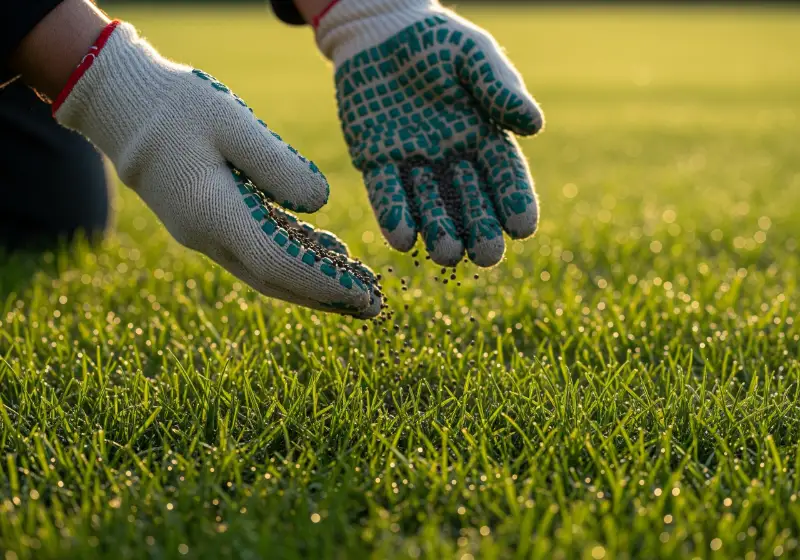
Late Winter to Early Spring (February to March): Pre-Emergent Application Window One
This is the single most critical window in the entire weed control calendar. Pre-emergent herbicides create a chemical barrier in the soil that prevents weed seeds from germinating. For Northern Virginia, the target window for the first crabgrass pre-emergent application is when soil temperatures reach 50 degrees Fahrenheit consistently, typically late February to mid-March depending on the year.
What to apply: A pre-emergent herbicide containing prodiamine, pendimethalin, or dithiopyr. These are the active ingredients in products like Barricade, Pendulum, and Dimension.
The timing trap: Apply too early and the product breaks down before crabgrass germinates. Apply too late (after forsythia blooms have faded in your area) and crabgrass has already germinated and the pre-emergent window is closed.
What about overseeding? Pre-emergents prevent ALL seeds from germinating, including grass seed. You cannot apply pre-emergents and overseed in the same window. Fall is the correct time for overseeding in Northern Virginia, which avoids this conflict. Our aeration and overseeding service is timed specifically to avoid pre-emergent conflicts.
Spring (April to May): Post-Emergent Broadleaf Treatment
Once temperatures warm in April and May, broadleaf weeds like dandelions, clover, and wild violet enter active growth and become susceptible to post-emergent herbicide applications. This is the window to treat visible broadleaf weeds with selective broadleaf herbicides that target weeds without harming your tall fescue.
What to look for: Products containing 2,4-D, dicamba, mecoprop (MCPP), or triclopyr are effective against most Northern Virginia broadleaf weeds. Many professional formulations combine two or three of these active ingredients for broader control.
Wild violet exception: Wild violet requires a specialized approach due to its waxy leaf coating. Professional products with added surfactants and repeat applications are often needed. This is one area where DIY products consistently underperform professional treatments.
Soil testing and lime application: If clover is a persistent problem in your lawn, get a soil test before treating. Our lawn fertilization and weed control program includes soil testing to determine whether low pH is the underlying driver of your broadleaf weed pressure. Lime application to bring soil pH into the 6.0 to 6.8 range that tall fescue prefers is often more impactful than herbicide alone.
Summer (June to August): Nutsedge and Crabgrass Breakthrough Management
Summer in Northern Virginia is weed season for warm-season annual weeds. If your pre-emergent program was effective, you should be managing breakthrough rather than a full infestation.
Nutsedge control: June through August is the correct window to treat yellow nutsedge with halosulfuron-methyl or sulfosulfuron-based products (Sedgehammer, Dismiss). These are sedge-specific active ingredients. General broadleaf herbicides will not touch nutsedge.
Crabgrass breakthrough: If crabgrass appears despite pre-emergent application, post-emergent crabgrass killers containing quinclorac or fenoxaprop can suppress young plants effectively. These products become less effective as crabgrass matures, so treat as early as possible.
Summer mowing height is critical: Mowing tall fescue at 3.5 to 4 inches during summer shades the soil surface and dramatically reduces weed seed germination. This is one of the most underutilized weed control strategies available. Keeping the lawn at the correct height year-round is a genuine weed suppression tool, not just an aesthetic choice.
Fall (September to October): Overseeding, Second Pre-Emergent, and Cool-Season Weed Control
Fall is the most important season for lawn renovation in Northern Virginia, and it is also a critical weed control window.
Fall overseeding: Thick, dense turf is the most effective weed barrier available. Fall overseeding following core aeration fills in the thin areas where weeds establish. Our aeration and overseeding service is specifically timed to the late August through mid-October window that gives cool-season fescue the best germination conditions.
Second pre-emergent application: If your lawn has a history of chickweed, annual bluegrass, or hairy bittercress, a fall pre-emergent application prevents these cool-season weed seeds from germinating. The timing is early September to early October. Note that fall pre-emergents cannot be applied if you are overseeding, because they will also prevent your grass seed from germinating. The sequence matters: overseed first, wait 6 to 8 weeks, then apply fall pre-emergent if needed.
Broadleaf perennial weed treatment: Fall is actually the most effective time of year to treat persistent perennial broadleaf weeds like wild violet, ground ivy, and clover. As these plants move nutrients into their root systems in preparation for winter, they carry systemic herbicides more effectively down into the root zone. Fall treatment of wild violet and ground ivy delivers significantly better results than spring applications of the same products.
The Dense Lawn Strategy: Why the Best Weed Control Is Not a Herbicide
Here is the insight that most weed control articles either bury or skip entirely: the most effective, long-term weed control in Northern Virginia is a dense, healthy, properly fertilized tall fescue lawn that physically crowds out weed seeds before they germinate.
Weeds do not create bare spots. Bare spots create weeds. Bare spots come from grub damage, drought stress, disease, scalping, poor fertility, or compacted soil. Address the underlying cause of the bare spot and you eliminate the on-ramp for the next wave of weeds.
This is why Lawn Theory’s approach to weed control is never just about applying herbicide. It is about building a complete lawn health system that makes your grass so competitive that weeds simply do not get the foothold they need.
That complete system includes:
Fertilization on a proper schedule. Our lawn fertilization and weed control program feeds Northern Virginia tall fescue on a seasonal schedule that builds root depth, increases turf density, and supports the vigorous growth that crowds out weeds naturally. Over-fertilizing in spring creates weak, fast-growing top growth. Under-fertilizing creates the thin turf that weeds love. Timing and rates matter enormously.
Core aeration for clay soil relief. Northern Virginia’s clay soil compacts under foot traffic and the weight of freeze-thaw cycles. Compacted soil reduces oxygen availability, slows root growth, and increases surface moisture that favors weed germination. Our aeration and overseeding service pulls plugs of soil from the lawn, allowing air, water, and nutrients to reach the root zone and dramatically improving root health and turf density.
Overseeding to fill thin areas. Thin turf is weed habitat. Overseeding after aeration fills in those thin areas with new, vigorous grass plants that compete directly with weed seeds for space, water, and light. A lawn overseeded consistently every two to three years maintains the density that makes weed control a maintenance task rather than a restoration project.
Soil pH correction with lime. If you have persistent clover, ground ivy, or annual bluegrass despite consistent weed treatment, soil pH is almost certainly part of the problem. Our lawn fertilization and weed control program includes lime applications calibrated to soil test results, bringing Northern Virginia’s notoriously acidic clay soils into the pH range where tall fescue thrives and many common weeds struggle.
Proper mowing height. Mowing tall fescue at 3.5 to 4 inches is a genuine weed control practice. Taller grass shades the soil surface, raises the soil temperature tolerance threshold, and prevents weed seeds from receiving the light they need to germinate. Maintain the correct height throughout the season, including the transition to the slightly lower fall mowing height before winter.
When Professional Weed Control Beats DIY Every Time
Consumer herbicide products work for isolated, surface-level weed problems in otherwise healthy lawns. They underperform in several specific Northern Virginia situations:
Wild violet infestations. The waxy cuticle on wild violet leaves repels most consumer product formulations. Professional-grade products with penetrant surfactants are required for meaningful control.
Nutsedge. Consumer nutsedge products exist but are frequently under-concentrated. Professional products deliver the active ingredient concentrations that actually work, applied at exactly the right rate for your lawn area.
Persistent perennial weed populations. Ground ivy, nutsedge, and wild violet that have been in a lawn for multiple seasons have extensive root systems. Consumer products applied at consumer concentrations often cause temporary top-kill without systemic root penetration. The weed regrows from the root within weeks.
Lawns with mixed grass types. Not all herbicides are safe on all grasses. Some products that control weeds in tall fescue will injure or kill bermuda, zoysia, or Kentucky bluegrass. Identifying your grass type before selecting a herbicide is critical. Getting it wrong means killing your lawn, not the weeds.
Sod installation and lawn renovation. If your lawn has more than 40 to 50 percent weed coverage, weed control alone is not the answer. Sod installation or a complete lawn renovation starting with a non-selective cleanup treatment followed by fresh seeding or sodding delivers results that incremental weed treatment never can.
The other services in the Lawn Theory ecosystem reinforce and protect your weed control investment directly. Clean landscape beds maintained by our mulching and bed maintenance team prevent weed seed migration from beds into turf edges. Proper tree and shrub care reduces the shade and soil moisture conditions that favor ground ivy and wild violet in problem areas of the yard. And comprehensive lawn pest and disease control addresses grub damage and fungal disease before they create the bare patches that invite weed colonization.
A weed-free lawn is also the most satisfying backdrop for the outdoor living spaces our Build and Outdoor Living team designs and installs throughout Northern Virginia. Green, dense turf surrounding a custom patio, pergola, or outdoor kitchen is the full outdoor living vision that makes the investment worthwhile. Weeds creeping through the grass adjacent to your patio undermine the entire aesthetic. A professional lawn care program handles both the turf and the outdoor space as a connected outdoor environment, not separate maintenance categories.
Frequently Asked Questions: How to Get Rid of Lawn Weeds in Northern Virginia
Q1: What is the best time to apply weed control in Northern Virginia? The most critical weed control window in Northern Virginia is late February to mid-March, when pre-emergent herbicides should be applied before soil temperatures reach 55 degrees Fahrenheit and crabgrass begins to germinate. The second most important window is fall (September to October) for perennial broadleaf weed control and cool-season weed prevention. A complete annual program includes applications in late winter, spring, summer for breakthrough, and fall for perennial control and overseeding support.
Q2: How do I get rid of crabgrass in my Northern Virginia lawn? Crabgrass is best controlled with pre-emergent herbicides applied before germination in late February to mid-March. Once crabgrass is established, post-emergent products containing quinclorac can suppress young plants, but become less effective as the plant matures. The most reliable long-term crabgrass strategy is pre-emergent application combined with overseeding in fall to increase turf density that naturally crowds out germinating crabgrass seeds the following year.
Q3: Why do my dandelions keep coming back after treatment? Dandelions have a deep taproot that can reach 10 to 15 inches into the soil. Consumer broadleaf herbicides often cause top-kill without fully penetrating the root, and the plant regenerates from the surviving root tissue. Effective dandelion control requires a systemic broadleaf herbicide containing 2,4-D, dicamba, or triclopyr that moves down into the root system, ideally applied when the plant is actively growing in spring or early fall. Multiple treatments one to two weeks apart are often needed for full elimination of established plants.
Q4: How do I get rid of wild violet in Northern Virginia? Wild violet is one of the most difficult weeds to control in Northern Virginia because its waxy leaf coating repels most herbicide formulations. Effective control requires professional-grade broadleaf herbicides with added surfactants that help the active ingredient penetrate the leaf surface, applied during active fall growth when the plant is moving nutrients into its root system. Multiple applications over two to three seasons are typically needed for full control of established wild violet populations.
Q5: Is clover a weed, and how do I get rid of it? White clover is classified as a broadleaf weed in turf management contexts. It responds to broadleaf herbicide applications containing 2,4-D or dicamba, but persistent clover infestations are often a symptom of acidic or nitrogen-deficient soil rather than a pure weed control problem. Addressing soil pH with lime applications and improving turf fertility are often more impactful for long-term clover reduction than herbicide alone.
Q6: What kills nutsedge but not grass in Northern Virginia? Nutsedge requires sedge-specific herbicides containing halosulfuron-methyl (Sedgehammer) or sulfosulfuron (Dismiss) for effective control. Standard broadleaf herbicides and most grassy weed killers have no effect on nutsedge because it is a sedge, not a broadleaf or grass species. Treatment timing is June through August when nutsedge is actively growing, and multiple applications 6 to 8 weeks apart are typically needed for persistent infestations.
Q7: Can I apply pre-emergent and overseed at the same time? No. Pre-emergent herbicides prevent all seeds from germinating, including desirable grass seed. Applying pre-emergent and overseeding simultaneously will result in failed germination of your grass seed. The correct sequence is to overseed in fall (late August to mid-October for Northern Virginia) and wait 6 to 8 weeks before applying any fall pre-emergent for cool-season weed prevention.
Q8: How thick does my lawn need to be to naturally suppress weeds? The target is 6 to 8 grass plants per square inch for a lawn with competitive weed suppression capability. In practical terms, this is a lawn that looks fully filled-in with no visible soil between grass plants at ground level. Northern Virginia tall fescue lawns that are aerated and overseeded annually or every two years, fertilized appropriately, and mowed at 3.5 to 4 inches maintain the density needed for natural weed suppression.
Q9: How do I get rid of weeds without chemicals in Northern Virginia? Organic weed control options for Northern Virginia include: hand-pulling with a weeder tool that removes the entire taproot (effective for dandelions in small numbers), corn gluten meal as an organic pre-emergent for crabgrass prevention (less effective than synthetic pre-emergents but non-chemical), and vinegar-based contact herbicides for spot treatment (non-selective, will also kill grass, and does not control perennial roots). The most effective non-chemical long-term strategy is building dense turf through overseeding, aeration, and proper fertilization, which crowds out weeds naturally without relying solely on chemical control.
Q10: How long does it take to get a weed-free lawn in Northern Virginia? Building a genuinely dense, weed-resistant lawn in Northern Virginia typically takes two to three complete annual treatment cycles with a comprehensive weed control, fertilization, aeration, and overseeding program. Lawns that start with significant weed populations may need a renovation (overseeding or sodding) to establish initial turf density before the maintenance program can sustain it. There is no product that delivers a weed-free lawn in one season, but a properly managed program delivers noticeable improvement each season and builds toward a lawn that naturally resists weed invasion.
Ready for a Weed-Free Northern Virginia Lawn?
You now have the full picture. Weeds win in Northern Virginia when timing is off, turf is thin, soil is acidic, and mowing is wrong. Every single one of those factors is addressable with the right program and the right team.
At Lawn Theory, we do not sell a one-size-fits-all spray and pray approach. We build a complete weed control program that is timed to Northern Virginia’s specific seasonal windows, calibrated to your specific weed pressure, and supported by the aeration, overseeding, and fertilization services that build the dense, healthy turf that wins the long game against weeds.
We serve homeowners across Aldie, Ashburn, Brambleton, Loudoun County, Fairfax, Arlington, Chantilly, Herndon, Stone Ridge, Sterling, Falls Church, and all of Northern Virginia. Veteran-owned. Precision-focused. No shortcuts. See us on Instagram & Linkedin.
Here is how to get started:
- Explore our lawn fertilization and weed control service
- See our aeration and overseeding service
- Browse our full lawn care and landscaping program
- Request your free quote today
Call Lawn Theory: (703) 650-5655
Your weeds have been here long enough. Let’s end it.
Keep Reading: Lawn Care
 Lawn Care
 Sprinkler System Winterization in Northern Virginia: Timing, Methods, and What Goes Wrong
Sprinkler winterization in Northern Virginia is about timing, not a fixed date. How to pick your shutdown week, how the three drainage…
 Lawn Care
 Fall Planting in Northern Virginia: Trees, Shrubs, and Mulch Done Right
Fall is the best time to plant trees and shrubs in Northern Virginia, but most failures trace to the first twenty minutes…
 Lawn Care
 The Fall Lawn Renovation Calendar for Northern Virginia: Dates, Seeding Rates, and Soil Temperature
Virginia Cooperative Extension puts the Northern Virginia seeding window at the last week of August through mid-September. Here are the exact dates,…
Want this handled by the crew that wrote the guide?
Veteran-owned. Licensed & insured. Free walkthroughs across Northern Virginia — quotes in 24–48 hours.
Get Your Free Estimate