
How Mold and Mildew Affect Your Home Value in Northern Virginia: What Every Homeowner Must Know
Mold and mildew on your home’s exterior aren’t just cosmetic problems that disappear with a light rain or a season of weathering. They actively reduce your home’s market value, damage building materials through biological processes, and create potential health concerns for your family. Many Northern Virginia homeowners don’t realize that visible exterior mold and mildew can reduce property values by 5-10% sometimes $30,000-$70,000 on a $600,000-$1,000,000 Loudoun County or Fairfax County home. The financial impact of ignoring exterior mold is substantial, making professional cleaning not a luxury but a financial protection strategy.
Understanding How Mold and Mildew Affect Your Home Value and growth cycle in Northern Virginia’s climate, the specific financial impact on property values, the material damage progression that occurs if mold is left untreated, and the preventive power of regular professional cleaning helps explain why professional exterior cleaning investment is actually financial protection. This comprehensive guide covers the science of mold growth, financial impacts quantified from real estate data, and the prevention strategy that protects your investment.
Call us: (703) 650-5655 or request a Quote.
How Mold and Mildew Grow on Northern Virginia Homes
Northern Virginia’s climate is ideal for mold and mildew growth. The region’s humidity, moderate temperatures, abundant tree coverage, and seasonal patterns create perfect conditions for fungi colonization. Mold spores are ubiquitous in the outdoor environment they exist everywhere, waiting for the right conditions to germinate and spread. On your home’s exterior, conditions are frequently ideal: moisture from dew, humidity, and rain; organic debris from trees; and surfaces (siding, roofing, wood) that provide perfect substrate for growth.
Gloeocapsa magma (the black algae that appears as dark streaks on roofs) thrives in Northern Virginia’s humid climate. The organism photosynthesizes, producing dark pigmentation that protects it from UV damage, creating the characteristic black streaking visible on north-facing roof slopes. Once established, the algae colony attracts moisture, creates biofilm, and accelerates water retention on roofing materials. The fungal growth cycles through optimal conditions: spring pollen feeds initial growth, summer heat accelerates reproduction, fall moisture perpetuates growth, and even winter conditions don’t kill established colonies.
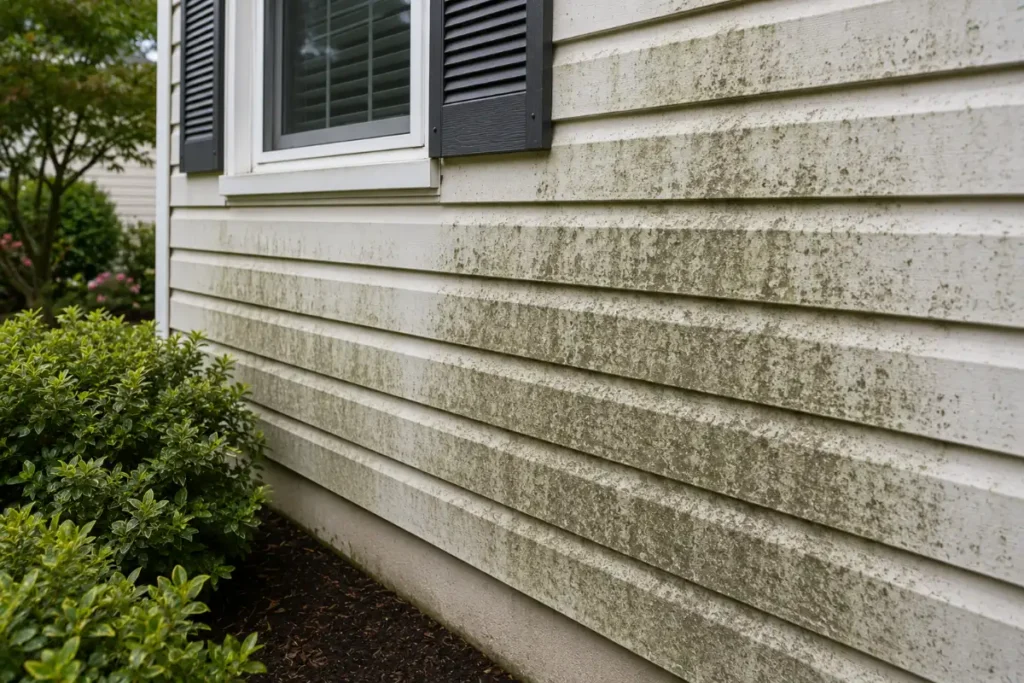
On siding, mildew (non-algae fungi) grows in shaded areas, under tree canopy, on north-facing walls, and in areas prone to moisture retention. Ashburn, Brambleton, and Broadlands in Loudoun County have extensive tree coverage that creates persistent shade, accelerating mildew growth on siding. Burke Centre, Vienna, and Oakton in Fairfax County experience the same challenge. The humid Potomac basin climate means that moisture rarely fully evaporates from shaded areas, allowing fungal growth to persist year-round.
The Financial Impact: Home Value Reduction
Real estate data consistently demonstrates that homes with visible exterior mold and mildew show measurable home value reduction. Studies from multiple major real estate markets (including Northern Virginia specific data from Loudoun and Fairfax County MLS records) show that homes with visible exterior mold and algae growth sell for 5-10% less than comparable homes without visible mold. For a $700,000 home in Brambleton or McLean, this represents a $35,000-$70,000 reduction in sale price. For a $500,000 home in Arlington or Alexandria, this represents a $25,000-$50,000 reduction.
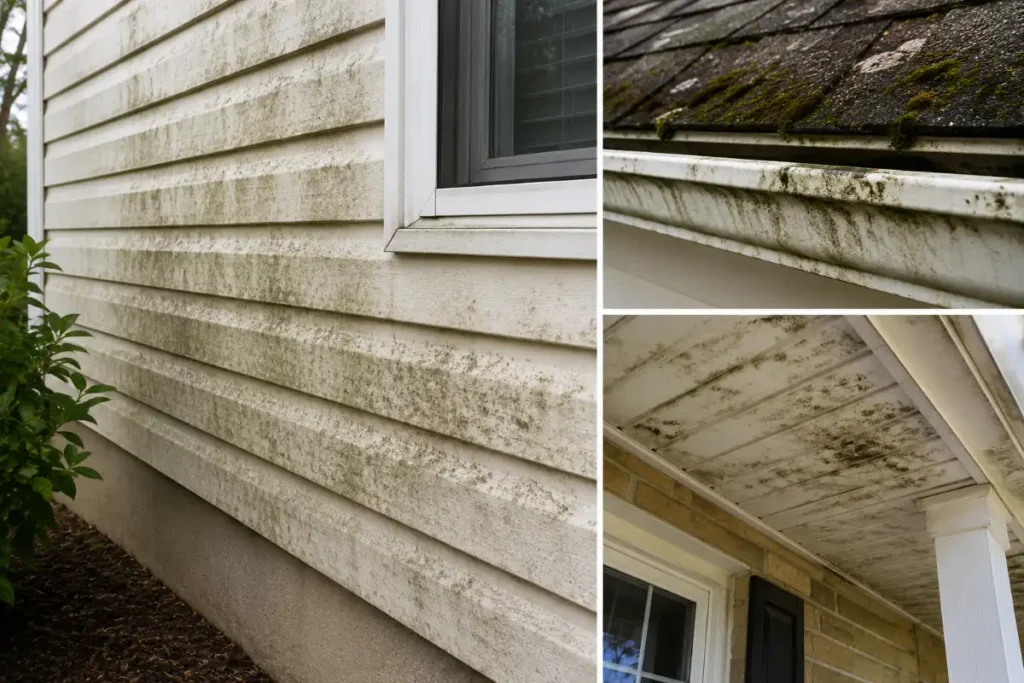
The perception-based financial impact is significant because home buyers view exterior mold as a red flag. Even if the mold hasn’t caused structural damage, buyers worry: What else might be wrong if the exterior wasn’t maintained? Is there moisture intrusion inside the home? Are there interior mold problems? Does the homeowner neglect maintenance generally? A moldy exterior creates doubt that extends beyond the actual condition of the home. Professional appraisers note visible exterior mold in property condition descriptions, which influences lending decisions and appraised values.
Beyond sale price impact, homes with documented exterior mold face insurance challenges. Some insurance companies require professional remediation before issuing policies. Mortgage lenders may require mold remediation before approving financing. The costs of remediation mandated by lenders or insurers far exceed the cost of preventive professional cleaning. A $400+ annual house washing prevents the $10,000+ mold remediation that might be required if water damage occurs.
Health Implications for Your Family
While exterior mold itself doesn’t directly contact your family in the way interior mold does, exterior mold colonies produce spores that become airborne and are drawn into homes through HVAC intake, open windows, and door openings. Mold spores are respiratory irritants, triggering or exacerbating asthma, allergies, and other respiratory conditions. People with compromised immune systems face increased risk from mold spore exposure. Children and elderly family members are particularly vulnerable.
Studies show that homes with visible exterior mold tend to have higher interior mold spore counts than comparable homes without exterior mold. The exterior fungal growth doesn’t cause the interior mold, but it indicates conditions (moisture, humidity) that promote interior mold growth as well. Homes in Arlington, with its dense urban environment and proximity to the Potomac River, often show higher interior mold incidence when exterior mold is visible. Alexandria waterfront properties face similar challenges due to river proximity and resulting humidity.
The health argument for professional exterior cleaning is compelling: regular cleaning reduces exterior mold spore production, which reduces airborne spore concentrations, which reduces family respiratory exposure. For families with members suffering from asthma, allergies, or immune compromise, professional exterior cleaning becomes a health intervention strategy, not just a cosmetic service.
How Mold Damages Building Materials
Mold and mildew don’t just sit on surfaces looking unsightly they actively damage building materials through biochemical processes. Mold produces organic acids that break down paint, stain, and sealant coatings. The biological growth creates moisture traps that prevent water evaporation, allowing water to penetrate deeper into materials. On roofing materials, algae growth traps moisture that promotes ice dam formation in winter, increases water saturation, and accelerates shingle granule loss and deterioration.
On wood materials (siding, trim, decks, fences), mold and mildew create conditions for wood rot. Fungal enzymes literally digest wood cellulose, converting wood fiber into food for fungal growth. The process is gradual a fence showing mold might develop soft spots and rot within 2-3 years if untreated. A wooden deck with persistent mold develops structural weakening that creates safety hazards. Wood affected by rot cannot be salvaged; affected boards must be replaced entirely. The cost of replacing deck boards is approximately $100-$200 per board; a deck with 40-60 damaged boards represents $4,000-$12,000 in replacement cost.
On concrete and masonry, mold and algae retain moisture that promotes freeze-thaw damage in Northern Virginia’s climate. Water that penetrates porous concrete or mortar joints freezes in winter, expanding and creating cracks. Freeze-thaw cycling accelerated by mold-retained moisture can cause concrete spalling and mortar joint failure within 3-5 years. Driveway replacement costs $3,000-$5,000 for typical residential properties. Early professional cleaning prevents the $5,000 driveway replacement.
Material Damage Progression Timeline
Without professional cleaning, exterior mold and mildew follow a predictable damage progression. Year 1: Mold appears as superficial discoloration on siding, roofing, or other surfaces. The growth is purely cosmetic at this stage, but the organism is colonizing the surface. Year 2-3: Mold colonies deepen in color, become more extensive, and begin producing organic acids that degrade coatings. Paint begins showing discoloration. Roofing granules begin separating. Wood siding shows graying. Year 3-5: Organic acids penetrate coatings. Paint begins peeling. Water begins penetrating beneath paint on wood surfaces, promoting rot initiation. Concrete spalling begins as freeze-thaw cycles accelerate.
Year 5+: Structural damage becomes irreversible. Deck boards show soft spots and rot. Roof shingles fail to shed water, promoting leaks. Siding paint peels extensively, exposing bare wood to weather damage. Concrete driveways develop wide cracks and potholes. Mortar joints in masonry deteriorate, weakening the structural bond. At this stage, repair costs exceed material replacement costs; it becomes financially sensible to replace rather than repair.
Professional cleaning interrupts this progression at any stage. A home in Year 3 with visible mold can be cleaned, stopping the damage progression and preserving the materials. Annual or biennial cleaning prevents the progression from reaching Years 5+ damage stages. The financial logic is compelling: $400+ annual cleaning prevents $5,000-$30,000 material replacement costs.
Prevention Through Professional Cleaning
Regular professional exterior cleaning is the primary prevention strategy for mold and mildew damage. Professional soft washing at appropriate low pressure using biodegradable, mold-killing solutions kills established fungal colonies and prevents their regrowth for 12-18 months. The process addresses both cosmetic mildew (which is purely surface growth) and deeper algae colonization (which can penetrate surface coatings).
Timing of professional cleaning matters significantly. Spring cleaning (April-May) prevents pollen-fed mold growth during summer. Fall cleaning (September-October) removes accumulated summer growth before winter moisture accumulation. Annual or biennial cleaning maintains surfaces in perpetual optimal condition, preventing the damage progression described above. For properties in Brambleton, Stone Ridge, Willowsford, and other tree-heavy communities with accelerated mold growth, semi-annual cleaning may be justified.
After professional cleaning, optional sealant application provides additional protection. Concrete sealers prevent water penetration that allows freeze-thaw damage. Wood sealers prevent moisture absorption that promotes rot. Roof protective sealants extend shingle life. Sealants, typically lasting 2-3 years, work synergistically with professional cleaning to maximize material lifespan and prevent mold regrowth.
Cost Comparison: Cleaning vs. Neglect
The financial analysis is straightforward. Annual professional house washing: from $400. Annual driveway cleaning: from $200. Biennial roof cleaning: $350-$750 (half that cost annually). Total annual prevention cost: from $600 — final price depends on services. Over a 10-year period, total prevention investment: from $6,000.
Compare this to the costs of neglect. Deck replacement due to rot: $8,000-$15,000. Driveway replacement: $3,000-$5,000. Roof replacement: $15,000-$30,000. Siding replacement: $10,000-$25,000. Mold remediation if water damage occurs: $5,000-$15,000. A single major repair often exceeds the entire decade of preventive cleaning costs. More significantly, neglected properties suffer 5-10% home value reduction at sale, representing $35,000-$70,000 loss on a typical Northern Virginia property.
The ROI calculation for professional exterior cleaning is compelling: $10,000 in prevention spending avoids $50,000+ in potential damage costs and protects $40,000+ in home value. It’s one of the highest-ROI home maintenance investments available. The question isn’t whether to invest in professional cleaning; the question is whether to pay for cleaning or for the far more expensive repairs that result from mold-induced damage.
Frequently Asked Questions
Q: Does power washing damage surfaces like soft washing?
A: High-pressure power washing can damage some materials; professional soft washing at 300-500 PSI is gentler and specifically designed to kill mold without material damage.
Q: Is exterior mold a sign of interior mold?
A: Exterior mold indicates conditions (moisture, humidity) that may promote interior mold growth. If you see exterior mold, professional assessment of interior conditions is wise.
Q: Can mold on my house make me sick?
A: Mold spores produced by exterior mold become airborne and can be drawn into homes, potentially triggering respiratory issues for sensitive individuals.
Q: How often should I have my house professionally cleaned?
A: Most properties benefit from annual or biennial professional cleaning. Tree-heavy areas may require annual cleaning or semi-annual in severe cases.
Protect Your Home’s Value
Exterior mold and mildew aren’t merely aesthetic problems they actively reduce property values, damage materials, and create potential health impacts. Professional exterior cleaning is an investment in protecting your home’s condition, value, and your family’s health. The modest cost of regular professional cleaning prevents exponentially higher costs of material replacement and value loss. Start protecting your Northern Virginia home investment today. See us on Instagram & TikTok.
Explore our exterior window cleaning service → See all exterior cleaning services → Request your free quote
Keep Reading: Exterior Cleaning
 Exterior Cleaning
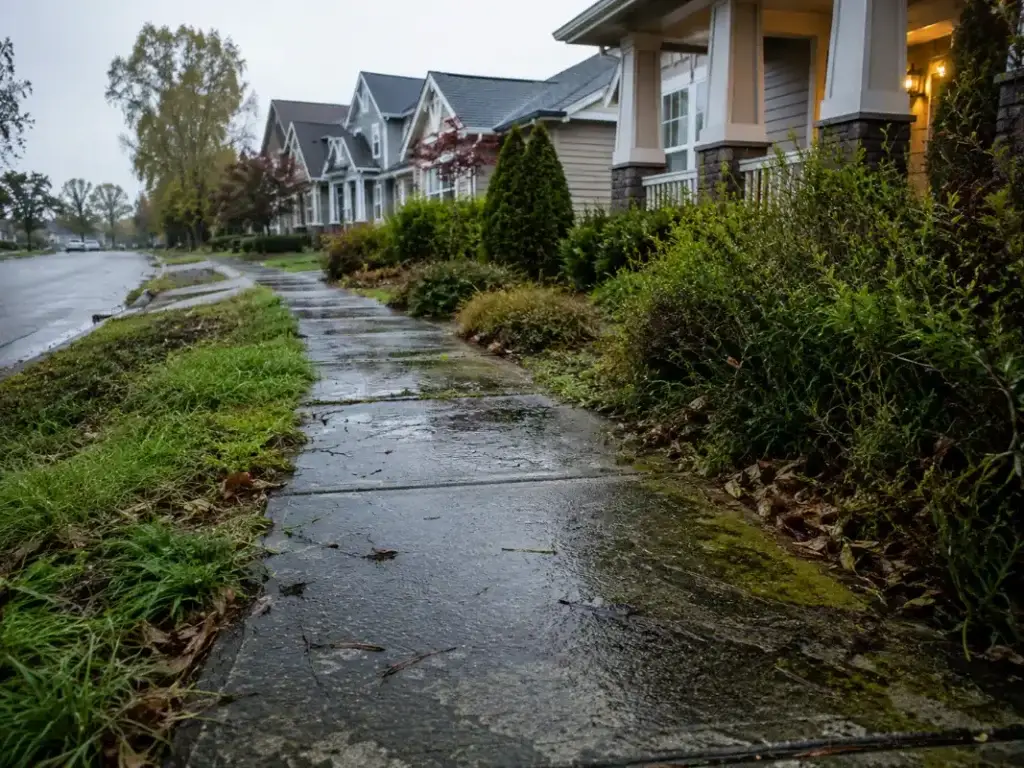
 Slippery Sidewalks and HOA Violations in Northern Virginia: How Algae Becomes a Legal Liability Problem
There are two ways to learn this lesson. The easy way: read this article, schedule a sidewalk cleaning appointment, and spend your…
 Exterior Cleaning
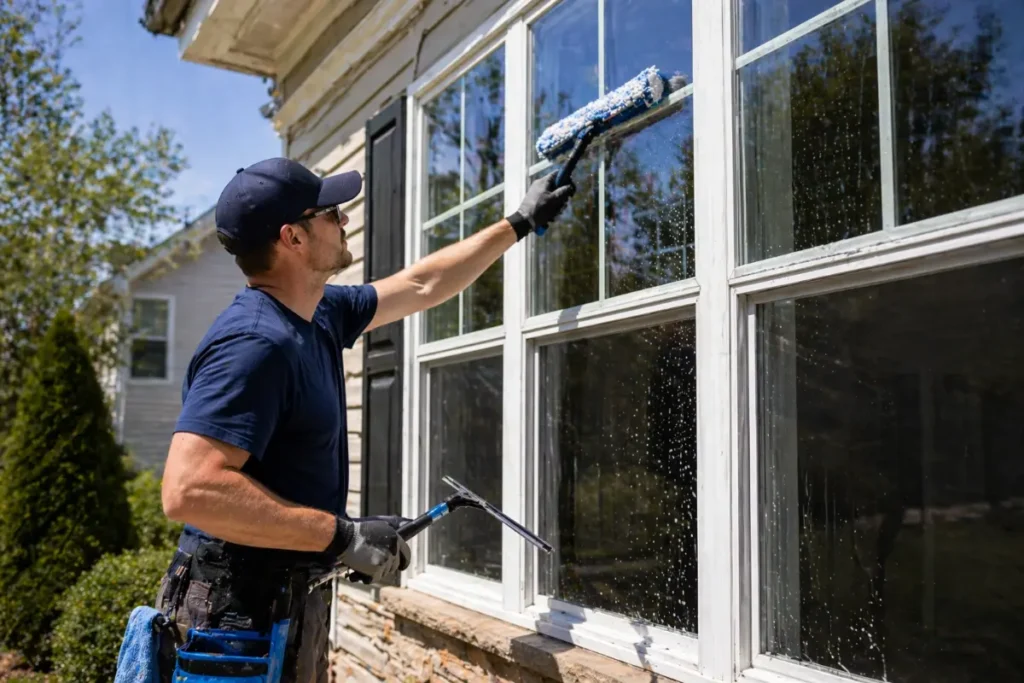
 How to Remove Hard Water Stains from Windows in Northern Virginia (And Why They Keep Coming Back)
You cleaned your windows last spring. Spent a Saturday afternoon with Windex and elbow grease. Maybe even hired someone. They looked great…
 Exterior Cleaning
 Spring House Washing in Northern Virginia: Why Pollen Season Makes It Urgent
You wake up one Saturday morning in April, walk outside with your coffee, glance up at your house and stop dead in…
Want this handled by the crew that wrote the guide?
Veteran-owned. Licensed & insured. Free walkthroughs across Northern Virginia — quotes in 24–48 hours.
Get Your Free Estimate