
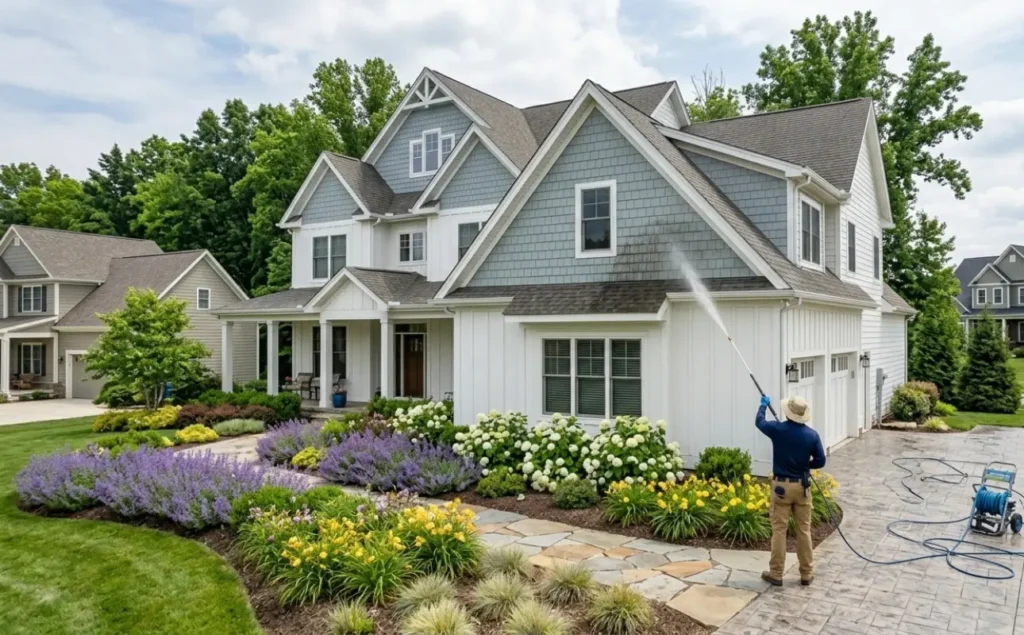
You wake up one Saturday morning in April, walk outside with your coffee, glance up at your house and stop dead in your tracks. Your navy blue siding is now a chalky, yellowish-green. Your white trim looks like it needs a trip to the laundry. Your driveway has a fuzzy film on it that wasn’t there two weeks ago.
Congratulations. Pollen season has officially arrived in Northern Virginia and your house caught it.
This happens every single spring across Aldie, Ashburn, Brambleton, Loudoun County, Fairfax, Arlington, Chantilly, Herndon, Sterling, Stone Ridge, and Falls Church. And while most homeowners wipe it off their cars and call it a day, what’s landing on your home’s exterior is doing something a lot more serious than making it look dirty.
At Lawn Theory, Northern Virginia’s veteran-owned house washing and exterior cleaning company, we watch this happen every year and we watch homeowners wait too long. This guide is your definitive, no-fluff breakdown of why spring house washing in Northern Virginia isn’t optional, why pollen season is the trigger that makes it urgent, and exactly what happens if you skip it.
What Is Spring House Washing in Northern Virginia — and Why Does Pollen Make It Different?
Spring house washing is the professional soft-wash cleaning of your home’s exterior — siding, trim, soffits, gutters, porches, and surrounding surfaces — to remove the biological and organic buildup that accumulates over winter and peaks during spring pollen season.
Here’s the short answer to why it matters: Northern Virginia pollen doesn’t just sit on your house. It feeds what comes next.
Unlike simple dust or dirt, pollen is a nutrient-rich organic material. When it settles onto your siding — and in Loudoun County and Fairfax, it settles heavily — it creates a sticky biological layer that:
- Traps moisture against the siding surface
- Provides food for mold, algae, and mildew spores
- Stains concrete, brick, and painted surfaces when it oxidizes
- Clogs gutters and downspouts when it accumulates in wet layers
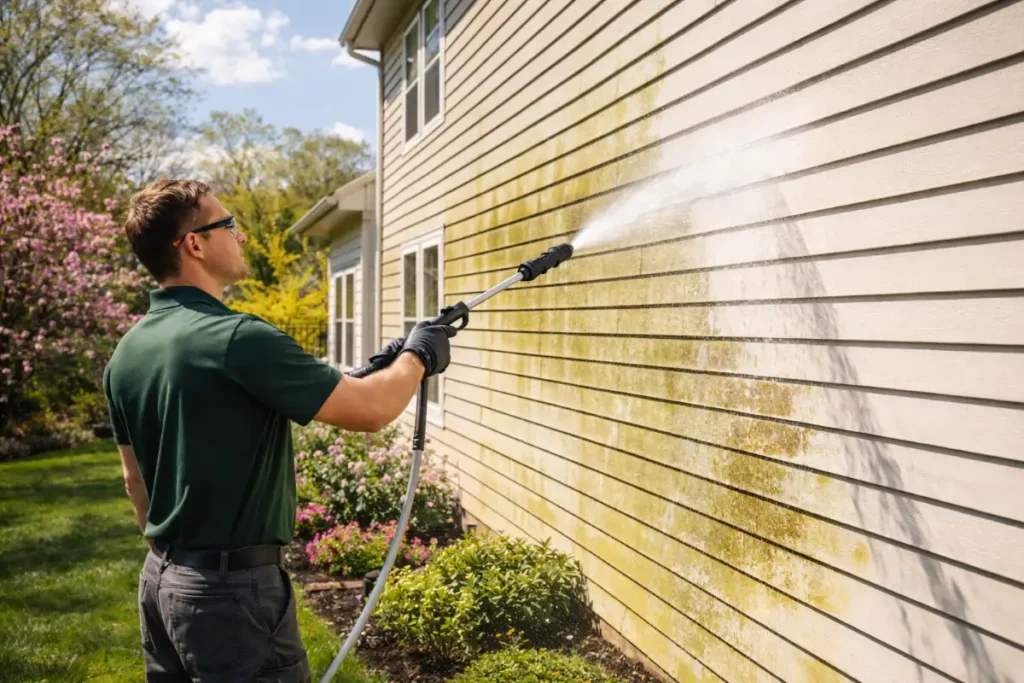
Rain doesn’t help. In fact, Northern Virginia’s April showers actively make the pollen problem worse — mixing with the pollen film and pressing it deeper into textured siding, weep holes in vinyl panels, and porous brick mortar joints. By the time you can visibly see green streaks forming on the shaded side of your house, the biological process has already been underway for weeks.
Northern Virginia Pollen Season: The Timeline Your House Is Fighting Against
Understanding the Northern Virginia pollen calendar is the first step to protecting your home’s exterior — because the window to act is shorter than most homeowners realize.
February–March: Tree pollen begins. Maple, cedar, and elm trees fire first. Pollen counts in Loudoun County and Fairfax begin climbing in late February — often before homeowners are even thinking about spring maintenance. This early pollen is fine-grained and airborne, coating north-facing siding and shaded surfaces with a thin but active layer.
April: Oak and birch peak — the worst weeks for your home. April is the month Northern Virginia earns its reputation. Oak pollen in Ashburn, Aldie, and Brambleton is intense. The volume is high, the particles are sticky, and the temperatures are warm enough that any trapped moisture begins to activate mold spore germination. This is the most dangerous month for your siding if pollen buildup hasn’t been addressed.
May: Grass pollen replaces tree pollen — but the damage compounds. By late May, tree pollen tapers, but the layer it left behind has had weeks to bake into your siding in the warming sun. Mold and algae that established themselves in April’s damp pollen film are now visibly spreading. This is when most homeowners first notice the green streaks on the north side of their house — by which point the problem is already two months in the making.
The window that matters: The ideal time for spring house washing in Northern Virginia is late March through mid-April — after the first major pollen deposit but before warm temperatures lock the biological buildup permanently into your siding. Miss this window and you’re playing catchup for the rest of the year.
What Pollen Actually Does to Your Home’s Exterior (It’s Not Just Cosmetic)
This is the section most homeowners skim — and the one that explains why our phones ring off the hook every June from people who waited.
Pollen Creates the Mold Pipeline
Here’s the biological chain reaction happening on your siding right now:
Step 1: Oak, cedar, and maple pollen lands on your siding and forms a sticky layer in the presence of morning dew and spring rain.
Step 2: That pollen layer traps moisture against the siding surface, preventing it from drying out between rain events — especially on north-facing and shaded walls throughout Aldie, Brambleton, and Ashburn neighborhoods with mature tree cover.
Step 3: Mold, mildew, and algae spores — which are always present in the air — land in that moist, nutrient-rich pollen layer and begin to germinate. They don’t need much. Warmth, moisture, and organic material is all they need to establish.
Step 4: Within 4–8 weeks of heavy pollen deposition, visible green or dark streaking appears on shaded siding surfaces. By this point, the organisms are established and actively feeding on your siding material.
Step 5: Without treatment, the colony expands. Algae spreads across the full facade. Mildew penetrates porous materials. Mold on wooden trim and around windows begins to compromise paint adhesion and ultimately the wood itself.
This is why spring house washing in Northern Virginia is a preventive maintenance investment, not a cosmetic luxury. A $300–$500 professional soft wash in April prevents a $2,000–$5,000 mold remediation or siding repair job later in the year.
Pollen Damages More Than Just Siding
Your siding catches most of the attention, but pollen does damage across your entire home’s exterior:
Concrete driveways and walkways: Pollen mixes with rainwater and oxidizes into a persistent yellow-brown stain on concrete and pavers. It also feeds the green algae growth on damp concrete that makes surfaces slippery and dangerous. Our professional driveway cleaning service removes this buildup before it stains permanently.
Gutters: A wet pollen layer in your gutters combines with leaf debris to create a thick, paste-like blockage that traps standing water at the roofline — the exact environment that accelerates fascia rot and soffit damage. Our gutter cleaning and brightening service is one of the most requested spring add-ons for good reason.
Decks, patios, and outdoor living spaces: All that pollen that landed on your siding? It landed on your deck, patio, pergola, and outdoor furniture too. And if you’ve invested in a beautiful outdoor living space — a patio, outdoor kitchen, or fire pit area — the last thing you want is a spring season where you can’t comfortably use it because every surface is coated in biological film.
Roof shingles: Pollen on your roof feeds the same Gloeocapsa magma algae responsible for those black streaks. Our professional roof cleaning service pairs naturally with spring house washing for complete exterior protection.
Why Northern Virginia Homes Are More Vulnerable Than Most
If you’ve lived in other parts of the country and moved to Loudoun County, Fairfax, or Arlington — you probably noticed the pollen here is different. More intense. More persistent. You’re right, and here’s why:
Tree canopy density: Neighborhoods throughout Aldie, Ashburn, Brambleton, Stone Ridge, and Sterling were built with mature tree preservation in mind. That’s beautiful — and it means your home is surrounded by oak, maple, and cedar trees producing maximum pollen volumes at close range.
Humidity that doesn’t quit: Northern Virginia’s spring humidity routinely sits in the 60–80% range during April and May. That’s the exact moisture range in which pollen-fueled mold growth thrives. Unlike drier Mid-Atlantic climates, our region doesn’t get the dry sunny stretches that would naturally break down pollen deposits before they activate biological growth.
Clay soil moisture retention: The same dense clay soil that challenges lawn care in Loudoun County keeps ground moisture high around your foundation. Siding at ground level and in foundation plantings stays damp far longer than in well-draining environments.
HOA appearance standards: If you live in a community like Ashburn Farm, Brambleton, One Loudoun, or similar HOA-managed neighborhoods — appearance standards are enforced. Visible mold streaking, green siding, or algae-stained driveways can trigger HOA notices and fines. A spring house wash isn’t just good maintenance; it’s HOA compliance insurance.
Soft Wash vs Pressure Wash for Spring House Washing in Northern Virginia
This is the question we get most often — and the answer matters for your home’s long-term health.
Soft washing uses low-pressure water (comparable to a garden hose) combined with a biodegradable cleaning solution — typically a sodium hypochlorite blend with a surfactant — to chemically kill and lift biological growth at the root level. It’s the method endorsed by the Asphalt Roofing Manufacturers Association (ARMA) and recommended by every major siding manufacturer for exterior surfaces.
Pressure washing uses high-pressure water (1,500–3,500+ PSI) to blast surface contaminants off by force. It’s effective on concrete driveways and hardscaping — but on vinyl siding, painted surfaces, and trim, it forces water behind panels, damages paint, and removes the pollen and surface growth without killing the underlying organisms. The streaks return within months.
For spring house washing on Northern Virginia homes, soft washing is the correct method for siding, trim, and rooflines. Pressure washing is appropriate for driveways, sidewalks, and hardscaped surfaces like patios and pool decks.
At Lawn Theory, every professional house washing service uses soft wash technique on siding and appropriate pressure on hard surfaces — protecting your home while delivering results that last.
What a Professional Spring House Wash Includes at Lawn Theory
When our crew arrives at your Ashburn, Aldie, Chantilly, or Herndon home for a spring exterior cleaning, here’s exactly what happens:
1. Full exterior inspection. We assess siding type (vinyl, fiber cement, brick, stucco), identify areas of heaviest pollen and biological buildup, check for any pre-existing siding damage that should be noted before cleaning begins, and plan the approach accordingly.
2. Landscape and surface pre-protection. Every planting bed, lawn area, and surface around your home is pre-wet before any cleaning solution is applied. Our biodegradable solutions are safe — but we take no chances with your landscaping.
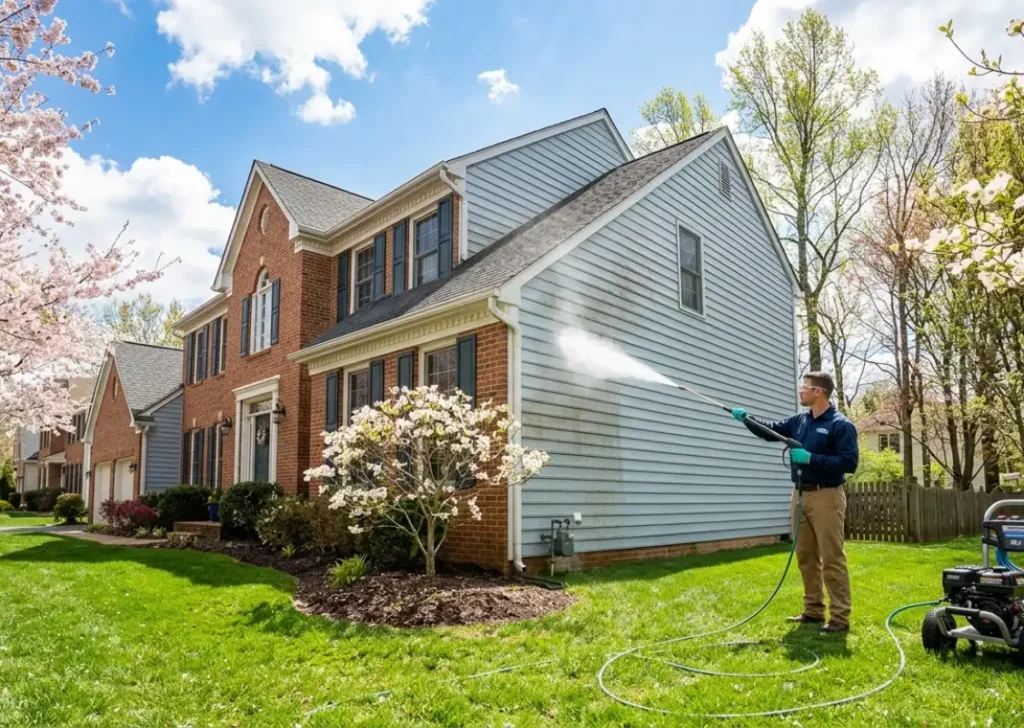
3. Soft wash solution application. We apply our professionally mixed soft wash solution at low pressure across all siding surfaces, soffits, fascia, and trim. The solution dwells and chemically breaks down pollen film, mold, mildew, and algae at the cellular level — not just at the surface.
4. Thorough rinse. We rinse completely, carrying all dissolved biological material off the surfaces and away from your home.
5. Hard surface cleaning (if included). Driveways, walkways, patios, and porch surfaces get appropriate pressure cleaning to remove pollen-stained concrete and algae growth from hardscaping.
6. Gutters (if included). Pollen-packed gutters are cleared, brightened, and flowing before we leave.
The full service typically takes 2–4 hours for an average Northern Virginia home. You don’t need to be present — just accessible water supply and clear access to your home’s exterior.
The Spring Pollen Window: When to Schedule for Best Results
Timing your spring house wash correctly in Northern Virginia makes a meaningful difference in how long the results last.
Best window: Late March – Mid-April. Schedule during peak pollen season, not after. Why? Because soft washing during active pollen deposit removes the biological film before it has time to permanently stain surfaces or allow mold to establish. Results from a late-March wash typically hold 12–18 months in average Northern Virginia conditions.
Second-best: Late April – May. If you’ve missed the peak window, a late April or May wash still prevents the pollen film from hardening further through summer heat. Some surfaces may require additional treatment for established mold, but the results are still excellent.
Avoid: June–August for first wash. By summer, pollen that wasn’t removed in spring has baked into siding surfaces under heat and UV exposure. It’s harder to remove, may require a second treatment pass, and any mold established in April has had months to entrench. You can still clean — but you’re working harder for the same result.
Pro tip from our team: Many Loudoun County homeowners with heavy oak tree cover schedule a light mid-season rinse in addition to the spring wash — once in April and once in July — to catch the summer algae surge before it establishes. Ask about our seasonal exterior maintenance plans when you call.
The Outdoor Living Connection: Don’t Forget What’s Beyond Your Siding
Here’s something most house washing articles never mention — and it’s a connection that matters deeply for Northern Virginia homeowners who’ve invested in their outdoor spaces.
If you’ve built a beautiful patio, pergola, outdoor kitchen, or fire pit area — or if you’re planning to this year — a spring house wash is the foundation that makes your outdoor living space actually livable in spring and summer.
Pollen-coated decks and patios are uncomfortable, uninviting, and frankly gross. A clean exterior that extends from your siding to your walkways and pathways, your patios and hardscapes, and your deck surfaces means your outdoor space is ready to use from the first warm weekend — not the second month of summer after you’ve finally gotten around to cleaning it.
And if you’re thinking about adding to your outdoor space this year, our outdoor living design and build team can help you plan everything from a new patio to a pergola or outdoor kitchen — on a freshly cleaned, ready-to-build canvas.
Frequently Asked Questions: Spring House Washing and Pollen Season in Northern Virginia
Q1: When is the best time for spring house washing in Northern Virginia?
The optimal window for spring house washing in Northern Virginia is late March through mid-April — during active pollen season rather than after. Cleaning during this window removes pollen film before it bakes onto siding surfaces in summer heat and before mold and algae have established themselves. Homes in tree-dense neighborhoods like Aldie, Ashburn, and Brambleton benefit most from this early timing.
Q2: Does pollen actually damage your home’s exterior, or is it just cosmetic?
Pollen starts as a cosmetic issue but quickly becomes structural if ignored. The mechanism: pollen deposits trap moisture against siding surfaces, and that moist pollen film provides the nutrients that mold, mildew, and algae need to establish. Within 4–8 weeks of heavy pollen deposition, visible biological growth begins — which, if left untreated, can cause permanent siding staining, paint damage, and in severe cases, wood rot around trim and window frames.
Q3: How often should Northern Virginia homes be washed in spring?
Most homes in Northern Virginia benefit from one professional house wash per year, ideally timed to spring pollen season. Homes with heavy tree canopy coverage — particularly oak, maple, and cedar — or those in shaded HOA communities may benefit from a second light cleaning in summer to address algae growth accelerated by summer humidity. Annual spring washing is the single highest-impact exterior maintenance routine for most NoVA homeowners.
Q4: Is soft washing safe for vinyl siding and painted surfaces?
Yes — soft washing is specifically designed for siding surfaces. It uses low-pressure water (equivalent to a garden hose) combined with a biodegradable cleaning solution, so there’s no risk of forcing water behind vinyl panels, damaging paint, or stripping surface coatings. Pressure washing above 1,500 PSI on siding is what causes damage and is not something Lawn Theory uses on siding surfaces.
Q5: How much does professional spring house washing cost in Northern Virginia?
Professional spring house washing in Northern Virginia typically runs $250–$550 for an average single-family home, depending on size, siding type, and buildup level. Homes with significant pollen-fed mold or two-story facades may run higher. Bundling with driveway cleaning, gutter cleaning, and window washing typically reduces the per-service cost compared to scheduling separately.
Q6: Will house washing damage my landscaping or lawn?
Professional soft washing at Lawn Theory uses biodegradable cleaning solutions and pre-wet all landscape beds, grass, and plantings before and after application. When applied correctly, the solution does not harm healthy plants. This is one of the reasons we do not recommend DIY bleach application — improper concentration or rinsing can damage landscaping that a professional process protects.
Q7: Does pollen cause HOA violations in Northern Virginia communities?
Yes — many HOA communities in Ashburn, Brambleton, Stone Ridge, Herndon, and Sterling enforce exterior appearance standards that include mold, algae, and biological growth on siding. A home with visible green streaking or pollen-stained siding can receive an HOA notice requiring remediation within a specific timeframe. Annual spring house washing keeps you well ahead of this issue.
Q8: Can I pressure wash my house myself to remove pollen?
DIY pressure washing is not recommended for siding surfaces. Rented pressure washers typically operate at 1,500–3,500 PSI — far above the safe threshold for vinyl siding, painted surfaces, or fiber cement board. Improper pressure washing forces water behind siding panels (causing hidden moisture damage and interior mold), strips paint, and can void siding manufacturer warranties. For concrete driveways and walkways, lower-pressure washing can work, but for your home’s siding, professional soft washing is the safe and effective choice.
Q9: Should I wash my house before or after spring lawn care treatments?
Ideally, schedule your house wash first, then follow with lawn fertilization, aeration, and any landscape work. House washing runoff — even with biodegradable solutions — can temporarily affect turf if it pools in lawn areas during application. Scheduling house washing before your lawn care and landscaping maintenance ensures your grass isn’t impacted, and gives your freshly cleaned exterior a clean-slate backdrop for any landscape upgrades.
Q10: How long does professional spring house washing take in Northern Virginia?
A professional spring house washing for an average Northern Virginia home typically takes 2–4 hours, depending on home size, number of stories, and the extent of biological buildup. Two-story homes or those with significant pollen/mold accumulation may run 3–5 hours. You don’t need to be home during service — we just need access to an exterior water spigot and clear exterior access.
Ready for a Pollen-Free, Freshly Washed Home This Spring?
Here’s the honest truth: pollen season in Northern Virginia doesn’t care how busy your schedule is. It’s happening right now, it’s coating your siding, and every week you wait is another week that film is feeding mold, staining surfaces, and doing what it does.
The fix is fast, affordable, and the results speak for themselves.
Lawn Theory is Northern Virginia’s veteran-owned exterior cleaning team serving Aldie, Ashburn, Brambleton, Loudoun County, Fairfax, Arlington, Chantilly, Herndon, Stone Ridge, Sterling, and Falls Church. We bring military-grade attention to detail to every job, biodegradable solutions that protect your landscaping, and the local expertise that knows exactly how Northern Virginia pollen behaves on every siding type. See us on Instagram & Linkedin.
Here’s how to get started:
→ Explore our professional house washing service → → See all our exterior cleaning services → → Add gutter cleaning to your spring package → → Request a free, no-pressure spring quote →
📞 Call us directly: (703) 650-5655 or Book a Quote.
Spring books fast. Your house — and your HOA — will thank you.
Lawn Theory — Veteran-Owned Exterior Cleaning & Outdoor Living | Serving Aldie, Ashburn, Loudoun County, Fairfax, Arlington, Chantilly, Herndon, Brambleton, Stone Ridge, Sterling, and Falls Church, Virginia | (703) 650-5655