How to design a functional outdoor living space in Northern Virginia starts with one honest question: How do you really live at home? Not how Pinterest thinks you live. Not how your neighbor’s backyard looks during one party in June. I mean your real life… weekday dinners, kids running in and out, the dog tracking mud, friends showing up last-minute, and that one spot where water always puddles like it pays rent.
At Lawn Theory, we design and build outdoor spaces across Northern Virginia that feel natural to use, not “nice to look at but nobody touches.” If you’re in Fairfax, Loudoun, Arlington, Alexandria, Falls Church, McLean, Reston, Burke, Centerville, Oakton, Great Falls, Gainesville, Haymarket, Leesburg, Fairfax Station, Fredericksburg, Woodbridge (and nearby), this guide is written for your climate, your soil, your seasons, and your typical freeze-thaw chaos.
Call us (703) 650-5655 or request a design consultation today.
Start With a “Real Life” Plan, Not a Pretty Sketch
A functional outdoor living space works when it has zones and flow. Before you choose pavers or pergola colors, map out how people will move.
Think in three zones:
- Arrival zone: where you step outside (door, steps, landing, main path)
- Living zone: where you sit, eat, cook, and hang out
- Utility zone: where the “unsexy” stuff lives (trash bins, hose bib, storage, grill fuel, AC clearance, drainage paths)
A quick layout rule that saves headaches:
Make the “walking lines” obvious and wide enough. For a comfortable path, 36 inches is a common standard, and 48 inches feels better for two people walking side-by-side.
Avoid the classic mistake: putting the grill or fire feature right in the traffic lane. That’s how you end up with a “functional outdoor living space” that functions like an obstacle course.
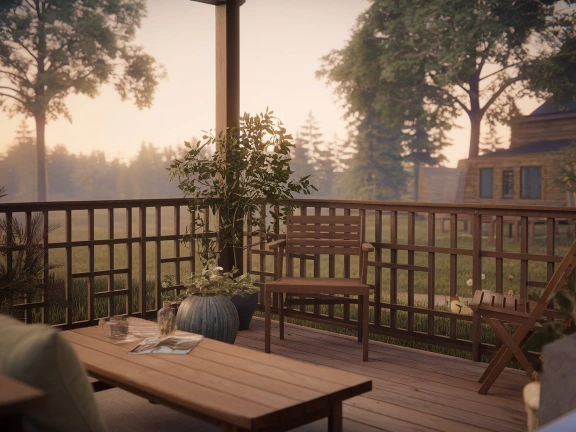
Design for Northern Virginia Weather (Freeze-Thaw Is the Boss)
Northern Virginia outdoor spaces take a beating:
- Freeze-thaw cycles that shift soil and base layers
- Heavy spring rains that expose weak grading
- Humid summers that test drainage and slip resistance
- Leaves, shade, and algae that make surfaces slick
What this means in plain English:
If the base, grading, and drainage are wrong, the prettiest patio in the world turns into a wobbly paver piano.
Pro note for structural planning: footings and posts need to account for local frost depth. Many Northern Virginia jurisdictions use a frost depth around 18 inches as a benchmark for frost protection.
That matters for things like:
- Pergola and pavilion posts
- Steps and landings
- Retaining walls and seating walls
- Outdoor kitchens and heavier built-ins
Choose Materials That Match How You’ll Use the Space
This is where most homeowners get stuck. Here’s the shortcut: pick materials based on function first, then style.
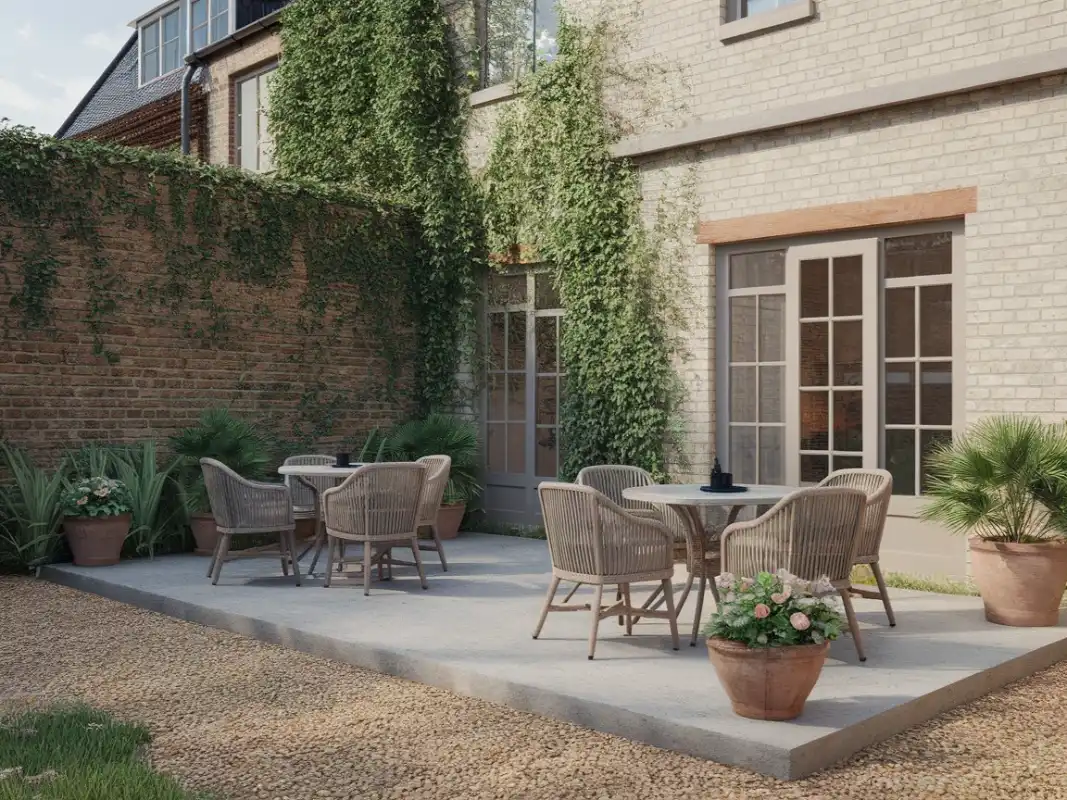
Patios & Hardscapes
If your outdoor living space is the “main room,” your patio surface is the floor. It needs to be:
- stable under foot traffic
- slip-resistant when damp
- repairable without ripping up everything
Great functional options:
- Concrete pavers: strong, modular, repair-friendly
- Natural stone: high-end look, needs the right base and sealing plan
- Poured concrete: clean, but cracking risk goes up if the site prep is weak
Walkways & Pathways
Pathways should feel like they were meant to be there. Keep them:
- direct (no awkward zigzags unless it’s intentional)
- wide enough to pass comfortably (again: 36–48 inches is a great target)
- graded so water doesn’t run onto your patio
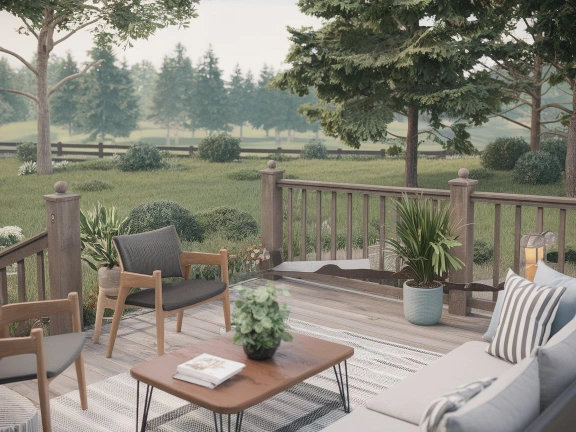
Decks & Porches
If you love barefoot mornings outside, this is your move. A deck makes sense when:
- your yard slopes
- you want elevation and views
- you want a softer feel than stone
Retaining Walls & Seating Walls
These do double duty:
- manage slopes and drainage
- add built-in seating (which means fewer chairs cluttering your patio)
Bonus: seating walls are the most underrated “function upgrade” in Northern Virginia. You gain space without enlarging the patio footprint.
Build the Space Around Your “Anchor Feature”
Every great outdoor living space has one main feature that sets the tone. Choose one anchor, then support it.
Common anchors we build at Lawn Theory:
- Outdoor Kitchens
- Fire Pits & Fireplaces
- Pergolas & Pavilions
- Water Features & Fountains
- Pool Patios & Surrounds
Outdoor Kitchens
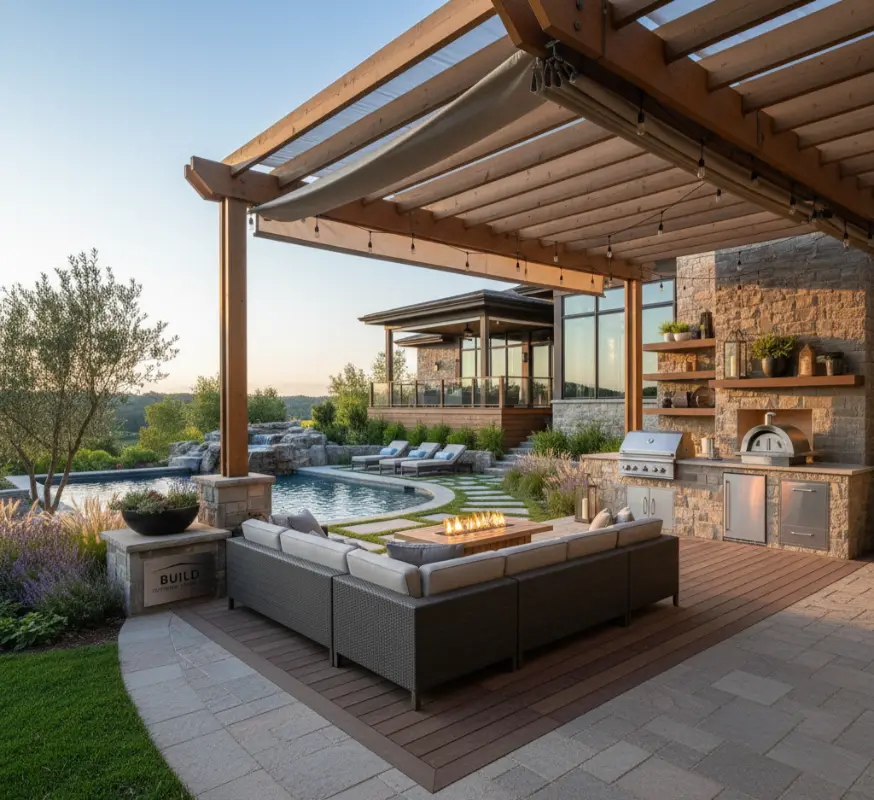
If you cook even a little outside, you already know: running back and forth to the indoor kitchen gets old fast.
Functional kitchen layout basics:
- keep it near the door (so you’re not carrying trays across the yard)
- give yourself landing space (counter space beats “balancing everything on a chair”)
- plan power, gas, and water early (don’t “figure it out later”)
Fire Pits & Fireplaces
Fire features extend the season into fall and mild winter nights. The key is placement:
- not directly under tree canopies
- not in the wind tunnel between the house and fence
- far enough from walkways to avoid crowding
Pergolas & Pavilions
Shade changes everything. It makes the space usable at noon in July, and cozy when the air gets crisp.
Functional tip: decide if you want shade or cover.
- Pergola = filtered shade, airy feel
- Pavilion = real roof, weather protection, longer season
Lighting Is Not a “Nice Extra” in Northern Virginia
If you want the space to feel functional, lighting is non-negotiable. Otherwise your patio becomes unusable the moment the sun dips.
A strong outdoor lighting plan includes:
- path lighting (so nobody faceplants)
- step lighting (especially around grade changes)
- accent lighting (trees, walls, water features)
- task lighting (grill and outdoor kitchen)
At Lawn Theory, Outdoor Lighting Installation is one of the biggest “wow” upgrades because it makes the space feel finished and usable, not like a dark patio floating in a black void.
Don’t Ignore Drainage (That’s Where Outdoor Spaces Go to Die)
Drainage problems show up as:
- shifting pavers
- joint washout
- standing water
- muddy lawn edges
- algae slick spots
- erosion around steps and walls
If you’ve ever said, “It only puddles there when it rains,” that’s your sign.
A functional design in Northern Virginia often needs:
- proper grading away from the house
- strategic downspout routing
- drainage swales or underground drainage solutions
- base prep that handles water movement
If drainage is an issue now, building over it without fixing it is like putting a new TV in a house with bad wiring. Looks great… until it doesn’t.
Blend Hardscape and Landscape So It Doesn’t Feel “All Stone”

The top-ranking competitor articles talk about blending structure and greenery, but they usually stay generic. Here’s how to make it work locally:
Use landscaping to soften edges and improve comfort
- foundation plantings that don’t trap moisture against walls
- layered beds that block views of utility areas
- plant choices that match your sun/shade reality (not fantasy)
Use hardscaping to reduce maintenance and improve usability
- define lawn boundaries (less string trimming)
- create clean transitions (less mud tracked inside)
- build usable spaces instead of “decorative dead zones”
This is where Lawn Theory’s approach helps: we’re not just “build” or “plants.” We connect lawn care & landscaping with build & outdoor living so your outdoor space looks good and stays healthy.
Quick “Function Test” Before You Finalize Your Design
Walk through these questions:
- Can two people pass each other comfortably on the main path? (36–48 inches is a great target.)
- Can you carry food from the kitchen door to the seating area without weaving around furniture?
- Does water run away from the house and away from the patio surface?
- Is there shade where you’ll sit in summer?
- Will you use the space after dark (lighting)?
- Are the “utility” needs hidden but accessible?
- Are permanent features placed so you can still maintain the yard?
If you can answer “yes” across the board, your outdoor space will get used constantly.
FAQs
How much space do I need for a functional outdoor living area?
Enough for a clear path, a main seating zone, and breathing room. A smaller space can still feel big if the layout is clean and furniture is scaled right.
What materials hold up best in Northern Virginia?
Materials that handle moisture and freeze-thaw well, with proper base prep and drainage. Concrete pavers are a common choice because they’re durable and repairable.
How wide should outdoor walkways be?
A common standard is 36 inches, and 48 inches is more comfortable for two people side-by-side.
Do I need a permit for a patio, pergola, or outdoor kitchen?
Sometimes, depending on structure type, size, utilities, and your local jurisdiction. It’s smart to check before finalizing the plan.
What’s the biggest mistake people make designing outdoor spaces?
Ignoring drainage and traffic flow. The space might look great, but it won’t feel good to use.
How do I make the space usable in more seasons?
Add cover (pavilion), heat (fireplace), lighting, wind protection, and materials that stay stable through weather swings.
Ready to Design It Right (and Not Redo It Later)?
If you want a functional outdoor living space in Northern Virginia that fits your routine, holds up through the seasons, and actually gets used, Lawn Theory can help you design and build it end-to-end. See us on Instagram & YouTube.
Tell us what you want the space to do (relax, cook, entertain, all of it), and we’ll map out a layout with the right materials, drainage plan, and features so it works beautifully now… and still works years from now.