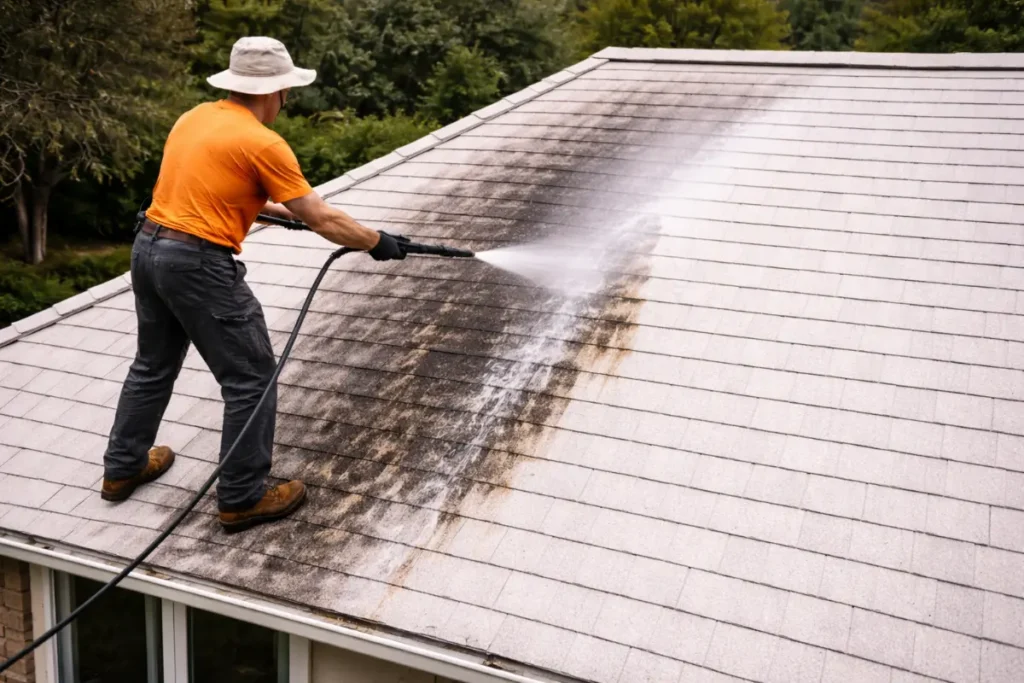
You pull into your driveway, glance up, and there they are: dark, ugly stripes running down your roof like someone dragged a giant dirty finger across your shingles. Your first instinct? Must be dirt. Or mold. Or maybe it’s time for a new roof.
Here’s the good news: it’s almost certainly none of those things. The bad news? Ignoring it is slowly costing you money and a trip up a ladder with a pressure washer will make it significantly worse.
At Lawn Theory, Northern Virginia’s veteran-owned exterior cleaning and lawn care company serving Aldie, Ashburn, Loudoun County, Fairfax, Arlington, Chantilly, Herndon, Brambleton, Stone Ridge, Sterling, and Falls Church, we clean roofs across the region every season. We’ve seen every variety of streaked, stained, and algae-covered shingle imaginable and we’re here to give you the full story, no fluff.
Let’s start with the culprit.
What Are Those Black Streaks on Your Roof? (The Real Answer)
Those dark streaks are not dirt. They’re not mold. They’re not water damage. They are a living, feeding, spreading organism called Gloeocapsa magma — a cyanobacteria (commonly called roof algae) that is literally eating the limestone filler inside your asphalt shingles.
Yes. Your roof has a hungry tenant, and it’s been there longer than you think.
Here’s the sneaky part: by the time those black streaks are visible to you from the driveway, the algae colony has likely been established for six months to a year or more. What you’re actually seeing is the algae’s dark UV-protective pigment a kind of biological sunscreen it produces to survive. The organism itself is microscopic. The streaks are millions of them, packed together.
Gloeocapsa magma thrives specifically in warm, humid conditions which makes Northern Virginia one of its favorite addresses in the entire country. Our humid summers, shaded lots throughout Loudoun County, and the dense tree canopies in neighborhoods like Aldie and Brambleton create almost perfect breeding conditions for this algae to establish and spread.
It doesn’t stay put, either. Spores travel via wind, birds, and squirrels which is why once you see black streaks on one roof on your street, it’s a reliable indicator your roof is next (or already infected).
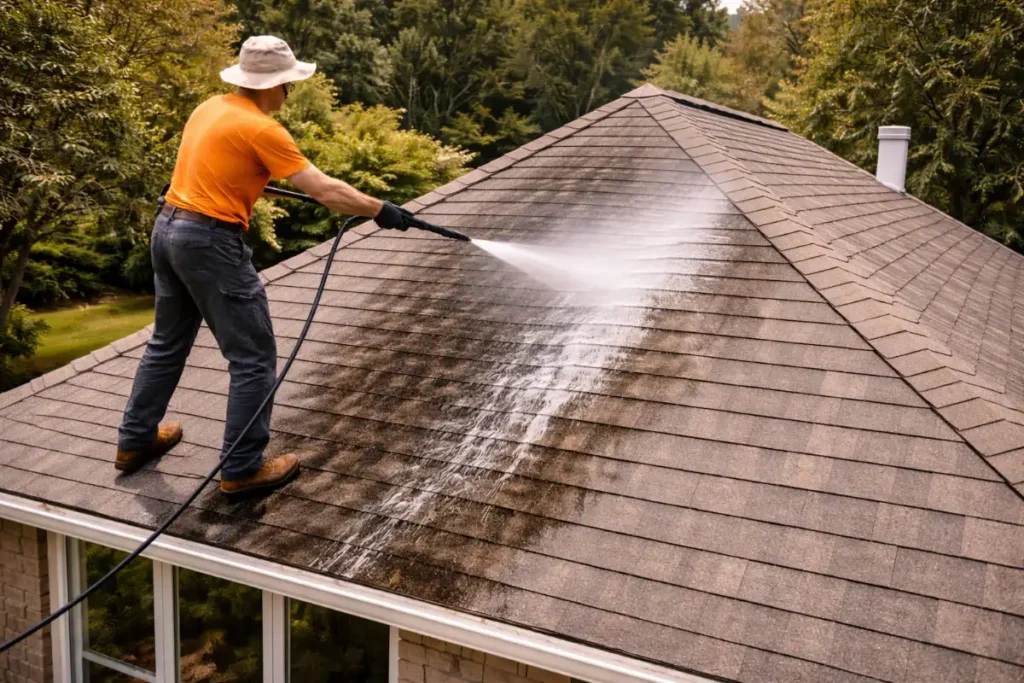
Why Northern Virginia Roofs Are Especially Vulnerable
Most generic blog posts about black streaks on roofs are written for a national audience. But Northern Virginia has specific conditions that make this problem more aggressive and faster-spreading here than in most parts of the country.
Here’s what’s working against your roof in our region:
1. Humidity that doesn’t quit. Northern Virginia summers routinely sit at 70–90% relative humidity from June through September. Gloeocapsa magma doesn’t just tolerate humidity it needs it. Our climate is essentially a welcome mat for the algae.
2. Clay-heavy soil = poor drainage = lingering moisture. The same dense clay soil that challenges our lawns (sound familiar?) also means water sits around the foundation and on the roof surface longer than in better-draining regions. Moisture that lingers is moisture that feeds algae.
3. Tree canopy coverage. Neighborhoods across Loudoun County Aldie, Stone Ridge, Brambleton, Ashburn — tend to have mature trees and significant shade coverage. Shaded roof sections stay damp longer after rain, and areas that never get direct afternoon sun are especially vulnerable. North-facing slopes are almost always the first to show streaking.
4. Our temperature swings accelerate spread. Virginia’s freeze-thaw cycles in late fall and early spring don’t kill the algae — they stress the shingles themselves, creating micro-cracks that give the organisms even more surface area to colonize.
The result? A roof in Northern Virginia that might develop visible streaking in 5–7 years on a shaded lot — compared to 10–15 years in a drier, sunnier climate. Speed matters here.
Is It Just Ugly — or Is It Actually Damaging Your Roof?
This is where most homeowners get confused, so let’s be precise.
The short answer: it starts cosmetic and becomes structural if you let it.
Here’s the progression, and why timing matters:
Stage 1 — Early algae (cosmetic): Small dark spots appear, usually on north-facing slopes or shaded sections. At this stage, the algae is primarily an aesthetic issue. Your roof’s performance isn’t yet compromised. This is the cheapest and easiest stage to treat.
Stage 2 — Established algae colony (early structural concern): The streaks are now visible across multiple roof planes. The algae is actively feeding on the limestone granules embedded in your asphalt shingles. Those granules exist for a reason — they protect shingles from UV degradation and regulate temperature. As the algae consumes the limestone, granule adhesion weakens. You may notice granules in your gutters or downspouts at this stage.
Stage 3 — Algae + moss/lichen (serious structural damage): Left untreated algae creates a persistently damp environment on the roof surface — perfect conditions for moss and lichen to establish. Unlike algae, which sits on the shingle surface, moss and lichen put down actual roots that penetrate between shingles. They wedge shingles apart, allowing water infiltration, and the resulting trapped moisture accelerates rot, mold, and eventually interior water damage.
Lichen — that crusty, barnacle-like growth — is the worst offender. It adheres so strongly to shingles that aggressive removal can pull granules off with it. This is a situation where you genuinely want a professional involved.
One more thing no one tells you: Many homeowners insurance policies and roofing manufacturer warranties have clauses requiring roofs to be maintained in “good condition.” Extensive, untreated algae and moss growth — documented in a home inspection report — can be used to deny warranty claims and complicate insurance renewals. Getting ahead of this protects far more than just your curb appeal.
The DIY Trap: Why a Pressure Washer Will Make Everything Worse
This is the part of the blog we really need you to read.
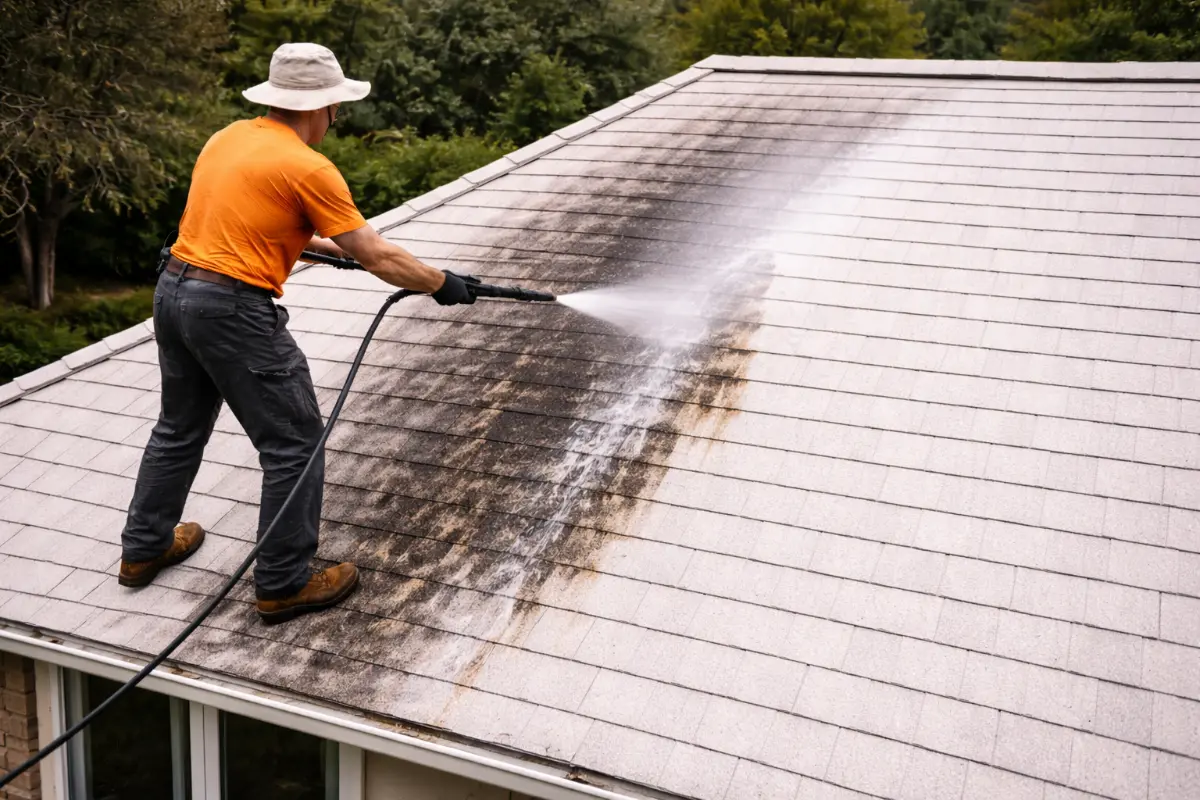
You see the streaks. You rent a pressure washer. You point it at the roof and blast the algae off. Problem solved, right?
Wrong. Very, very wrong.
Here’s what actually happens when you pressure wash an asphalt shingle roof:
- You strip protective granules. Those granules on your shingles aren’t decoration — they’re what protects the underlying asphalt mat from UV radiation and weathering. High-pressure water blasts them off. Once they’re gone, they don’t grow back. Your shingles are now aging at an accelerated rate.
- You void your manufacturer’s warranty. Every major shingle manufacturer — GAF, Owens Corning, CertainTeed — specifically prohibits pressure washing in their warranty terms. One pressure wash can void a 25-year warranty on a 6-year-old roof. That’s a very expensive moment of DIY enthusiasm.
- You don’t kill the algae. Pressure washing removes the visible dark pigment — temporarily. But it doesn’t kill the organism. The colony that’s embedded in your shingle granules survives, and within one to two seasons, the streaks are back. You’ve paid for a haircut, not a treatment.
- You’re working on a wet, sloped surface. We shouldn’t have to say this, but: ladders + wet roof + pressure equipment is genuinely dangerous. Falls from roofs are one of the leading causes of home-improvement-related injuries and fatalities.
What about the bleach-and-water method you’ve seen online?
A diluted bleach solution (sodium hypochlorite) is actually the active ingredient in professional soft washing — so the chemistry isn’t wrong. The issue is concentration, application method, and protecting everything around your home. Undiluted or improperly mixed bleach can discolor or damage your siding, kill landscaping, and harm your lawn if runoff isn’t managed carefully. The professional soft wash process controls all of this systematically.
The Right Fix: Professional Soft Wash Roof Cleaning
Soft washing is the only cleaning method endorsed by the Asphalt Roofing Manufacturers Association (ARMA) and approved by every major shingle manufacturer. It’s the reason professional roof cleaning companies — including Lawn Theory’s exterior cleaning team — don’t touch a pressure washer when it comes to roofs.
Here’s how the process works:
1. Pre-treatment inspection. A professional assesses the extent of algae, moss, or lichen coverage, identifies any damaged shingles that need attention before cleaning, and plans the approach.
2. Landscape and surface protection. All surrounding plants, garden beds, and lawn areas are pre-wet and protected before any cleaning solution is applied. (This is where DIY bleach attempts frequently go wrong — your landscaping gets sacrificed.)
3. Low-pressure application of soft wash solution. A biodegradable cleaning solution — typically sodium hypochlorite (bleach) at a precise dilution, combined with a surfactant — is applied at garden-hose-equivalent pressure. It coats the entire roof surface and dwells for a set period, chemically killing the algae at the cellular level.
4. Rinse and post-treatment. The solution is gently rinsed, carrying dead algae and organic material off the roof. In many cases, some residual treatment is left to continue working — rain will naturally rinse the dead material away over the following weeks.
5. Results. Black streaks disappear. Moss turns white and falls off over 2–3 weeks. Your roof looks years younger, and the treatment actively inhibits regrowth — professional soft wash results typically last 2–4 years in Northern Virginia’s climate.
What does it cost? Professional soft wash roof cleaning in Northern Virginia typically runs $300–$600 for an average residential roof — a small fraction of the $8,000–$15,000 cost of premature roof replacement. Most homeowners describe it as the best exterior maintenance investment they’ve made.
How to Tell If Your Northern Virginia Roof Needs Cleaning Right Now
Not sure if your roof has crossed the threshold from “fine” to “needs attention”? Here’s a quick checklist:
Clean up now if you see:
- Dark streaks running vertically down any roof plane (especially north-facing slopes)
- Streaks that have expanded noticeably from one season to the next
- Any green or dark-gray fuzzy growth (moss beginning to establish)
- Crusty, barnacle-like patches (lichen — treat immediately)
- Granules accumulating in your gutters or at downspout outlets
- Your neighbor’s roof has visible streaking (yours is next)
Monitor but not urgent yet if:
- You have one or two small spots on an otherwise clean roof
- Streaks are limited to one heavily shaded section and haven’t spread in two years
Consider a professional inspection regardless if:
- Your roof is more than 10 years old and has never been cleaned
- You’re planning to sell your home — streaked roofs fail home inspections and tank buyer confidence instantly
- Your HOA has issued a notice (Loudoun County and Fairfax HOAs are particularly active on exterior appearance standards)
Black Streaks on Your Roof vs. Other Roof Stains: How to Tell the Difference
Not every roof stain is Gloeocapsa magma. Here’s a quick guide to what you might actually be seeing:
| What it looks like | Most likely cause | Urgency |
|---|---|---|
| Dark gray/black vertical streaks | Gloeocapsa magma algae | Moderate — treat within 1 season |
| Green fuzzy patches (damp areas) | Moss | High — moss roots damage shingles |
| Crusty gray/green patches | Lichen | Very high — difficult to remove without damage |
| Orange or rust-colored streaks | Metal oxidation (flashing, gutters) | Low — cosmetic |
| Dark stains near vents/pipes | Mold or mildew (possible) | High — may indicate moisture intrusion |
| Brown streaks from edge | Tannin from overhanging trees | Low — cosmetic |
If you’re genuinely unsure what you’re looking at, the safest move is a professional assessment. At Lawn Theory, we’ll tell you honestly what’s on your roof and what — if anything — needs to happen next.
Prevention: How to Keep Black Streaks Off Your Roof Longer
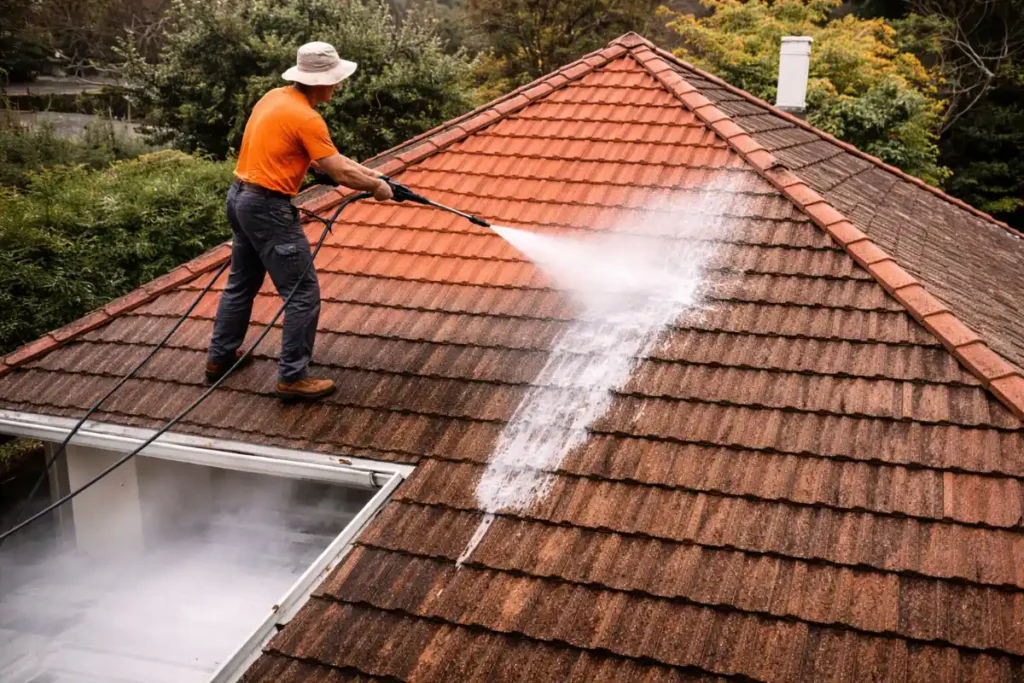
Once your roof is professionally cleaned, you want those results to last. Here are the most effective prevention strategies for Northern Virginia homes:
1. Trim overhanging branches. Tree limbs over your roof create perpetual shade and deposit organic debris that feeds algae. Keeping branches trimmed back is one of the highest-impact preventive steps. Our tree and shrub care service can handle this as part of a seasonal maintenance plan.
2. Keep gutters clean. Clogged gutters cause water to back up and pool on roof surfaces — exactly the moisture environment algae loves. Our gutter cleaning and brightening service is a natural complement to roof maintenance and should be scheduled at least twice a year in Northern Virginia.
3. Schedule routine roof cleaning every 2–3 years. In our climate, waiting until the streaks are dramatic means you’re treating a larger, more entrenched colony. A lighter cleaning every 2–3 years keeps the algae in check and extends the intervals between intensive treatments.
4. Consider algae-resistant shingles at next replacement. When your roof does reach end of life, ask your roofing contractor about algae-resistant shingles containing copper or zinc granules. These are standard offerings from most major manufacturers and carry warranties against algae formation.
5. Zinc or copper ridge strips. Zinc strips installed along the roof ridge act as a passive algae deterrent — rainwater washes trace amounts of zinc down the roof planes, inhibiting algae establishment. These work best as a preventive measure after a professional clean, not as a treatment on an existing colony.
The Full Picture: Roof Cleaning Is Part of a Whole-Home Exterior Strategy
Here’s something your roof is trying to tell you: if your shingles are covered in algae, the rest of your home’s exterior has almost certainly accumulated years of buildup too — siding, walkways, driveways, decks.
At Lawn Theory, we’re not just a roof cleaning company. We’re Northern Virginia’s full-service outdoor living and exterior care team. While we’re on-site treating your roof, many homeowners add:
- Professional house washing — removes mold, mildew, pollen, and oxidation from siding and trim
- Driveway and concrete cleaning — blast away oil stains, tire marks, and organic growth from concrete and pavers
- Deck and fence cleaning — restore weathered wood and composite surfaces before they need expensive replacement
- Patio and pool deck cleaning — keep outdoor entertaining spaces safe, clean, and photo-ready
- Sidewalk and walkway cleaning — remove slippery algae and mold from high-traffic surfaces
And when you’re ready to take your outdoor space to the next level — patios, outdoor kitchens, pergolas — our Build & Outdoor Living team is standing by.
A clean roof. A clean exterior. A beautiful outdoor space. That’s the Lawn Theory standard.
Frequently Asked Questions: Black Streaks on Roofs in Northern Virginia
Q1: What are the black streaks on my roof in Northern Virginia? The black streaks on your roof are almost certainly caused by Gloeocapsa magma — a type of cyanobacteria (commonly called roof algae) that feeds on the limestone filler in asphalt shingles. The dark color comes from a UV-protective pigment the algae produces to survive. It’s not dirt, mold, or structural damage — but it will become a structural issue if left untreated. Northern Virginia’s high summer humidity and tree canopy coverage make our region especially prone to this algae.
Q2: Are black streaks on my roof dangerous, or just ugly? At first, black streaks are primarily cosmetic. However, if left untreated, the algae consumes limestone granules from your shingles, weakening their UV resistance and accelerating aging. Algae also creates persistently damp conditions that invite moss and lichen — both of which cause genuine structural damage by penetrating between shingles and trapping moisture against the roof deck. In Northern Virginia’s humid climate, visible streaks typically mean the algae has been established for 6–12 months already, so early treatment is always the smart call.
Q3: Can I pressure wash black streaks off my roof myself? No — and this is one of the most expensive DIY mistakes homeowners make. Pressure washing strips protective granules from asphalt shingles, voids manufacturer warranties (GAF, Owens Corning, CertainTeed all explicitly prohibit pressure washing), and doesn’t kill the algae at the root — so the streaks return within a year or two. The only manufacturer-approved cleaning method is soft washing, which uses a low-pressure application of a sodium hypochlorite solution to chemically kill the algae without damaging shingles.
Q4: What is soft wash roof cleaning, and how is it different from pressure washing? Soft washing uses a biodegradable cleaning solution — primarily diluted sodium hypochlorite (bleach) combined with a surfactant — applied at garden-hose-equivalent pressure (under 100 PSI). It kills algae, moss, mildew, and lichen at the cellular level without physically abrading the shingles. Pressure washing, by contrast, uses 1,500–3,000+ PSI to blast contaminants away — which removes granules, can lift shingle tabs, and doesn’t actually kill the algae, just displaces it temporarily. Soft washing is endorsed by ARMA (Asphalt Roofing Manufacturers Association) and preserves your shingle warranty.
Q5: How much does professional roof cleaning cost in Northern Virginia? Professional soft wash roof cleaning in Northern Virginia typically costs $300–$600 for an average single-family home, depending on roof size, pitch, and the extent of algae or moss coverage. Two-story homes or roofs with significant lichen growth may run higher. Compare that to $8,000–$15,000+ for premature roof replacement — routine cleaning is one of the highest-ROI home maintenance investments available.
Q6: How often should I have my roof cleaned in Northern Virginia? In Northern Virginia’s climate, professional roof cleaning every 2–3 years is the standard recommendation. Homes with heavy tree canopy coverage, north-facing roof slopes, or a history of rapid algae growth may benefit from annual cleaning or a post-treatment zinc strip installation to extend the intervals. After the first professional clean, monitor your roof each spring — early intervention is always cheaper than waiting for visible streaking to return.
Q7: Will roof cleaning void my shingle warranty? Proper soft wash roof cleaning done according to ARMA guidelines will not void your shingle warranty — in fact, neglecting algae and moss buildup can be grounds for warranty denial if it causes premature shingle failure. What voids warranties is pressure washing, which every major manufacturer specifically prohibits. Always confirm that your cleaning company uses soft wash methods and does not use pressure washers on shingle surfaces.
Q8: Why does my Northern Virginia roof get black streaks faster than my parents’ house in another state? Northern Virginia sits in a climate transition zone with hot, humid summers (routinely 80–90% humidity in July and August) that create near-ideal conditions for Gloeocapsa magma algae. Add our significant tree canopy coverage, clay soils that retain moisture, and north-facing roof slopes that never fully dry out — and you have an accelerated algae environment compared to drier parts of the country. Homes in Aldie, Ashburn, and Brambleton with mature tree cover can develop visible streaking in as little as 4–6 years on shaded slopes.
Q9: Do black streaks spread from one roof to another in a neighborhood? Yes — Gloeocapsa magma spreads via airborne spores, carried by wind, birds, and small animals. If one home in your neighborhood has visible algae streaking, nearby roofs are almost certainly already colonized at a microscopic level. This is why Northern Virginia HOA communities in Ashburn, Stone Ridge, and Brambleton tend to see synchronized algae problems across multiple homes — and why proactive cleaning actually benefits your entire street.
Q10: Can moss or lichen on my roof cause leaks? Yes. Unlike algae, which primarily sits on the shingle surface, moss and lichen develop root structures that physically penetrate between shingles and into the shingle mat itself. Moss holds water against the roof surface for days after rain, accelerating material breakdown. Lichen adheres so aggressively that improper removal tears granules off with it. Both organisms — if allowed to establish following untreated algae — can eventually compromise the waterproof barrier your roof provides, leading to interior water intrusion and rot. This is why treating algae early (before moss and lichen arrive) is always the cheapest path forward.
Ready to Get Rid of Those Black Streaks for Good?
You’ve got the full picture now. Those dark stripes on your roof aren’t cosmetic decoration — they’re a living organism slowly working against your shingles, your warranty, and your curb appeal. And a pressure washer isn’t the answer.
The answer is a professional soft wash from a team that knows Northern Virginia roofs, Northern Virginia soil, and Northern Virginia homeowners.
Lawn Theory is a veteran-owned exterior cleaning and outdoor living company serving: Aldie · Ashburn · Brambleton · Loudoun County · Fairfax · Arlington · Chantilly · Herndon · Stone Ridge · Sterling · Falls Church — and all of Northern Virginia.
We bring military precision and zero-compromise results to every job. When our crew leaves your property, your roof won’t just look cleaner — it’ll be protected. See us on Instagram & YouTube.
Here’s how to get started:
→ Explore our professional roof cleaning service → See all our exterior cleaning services → Request a free quote — no pressure, no runaround
📞 Call us directly: (703) 650-5655 or Request a Free Roof Inspection Today!
Your roof is one of your home’s most valuable assets. Treat it like one.